play icon for videos
← Academy
SOPACT ACADEMY · IMPACT MEASUREMENT · DEFINE

How Do You Turn Reporting Requirements Into Evidence You Can Collect?

Translate funder requirements, standards, and methods into approved measures, traceable evidence sources, visible gaps, and collection-ready decisions.

SOPACT ACADEMY · IMPACT MEASUREMENT · DEFINE

To turn reporting requirements into evidence you can collect, begin with the report—not a framework catalog. Extract each required claim, measure, breakdown, narrative, and method from the funder’s documents and the authoritative standards it names. Connect each requirement to an approved organization measure, then identify the quantitative, qualitative, documentary, and longitudinal evidence that can support it. Record gaps and human decisions. The result is a Reporting-to-Evidence Map that guides collection and generates different reports from the same governed evidence.

This lesson is for nonprofit, foundation, program, MEL, grant, and impact leads who encounter terms such as SDG, IRIS+, GRI, Five Dimensions of Impact, SROI, schema, and data dictionary—but need a practical way to use them without first becoming standards specialists.

What you will produce

  • One list of reporting requirements, each linked to its source.
  • One approved organization measure or question for each requirement.
  • An inventory of usable evidence—numbers, interviews, open text, emails, PDFs, and longitudinal records.
  • A visible list of gaps, contradictions, and decisions requiring human review.

How do you turn reporting requirements into evidence?

  1. Start with the report. Identify the decision, audience, reporting period, required output, and authoritative documents.
  2. Extract the requirements. Separate required claims, measures, disaggregations, narratives, calculations, and supporting documents.
  3. Connect each requirement to a measure. Reuse the approved Metric Definition Sheets from the previous chapter; never match by label alone.
  4. Connect each measure to evidence. Identify the source, owner, collection moment, timestamp, consent/access rule, and what is missing.
  5. Test the output. Confirm that the evidence can produce the required report with citations, visible limitations, and no unsupported claims.

What problem does the shared evidence map solve?

In short: Reporting requirements arrive in different languages and formats, while the evidence lives across different people and systems. A shared evidence map translates both sides: what each audience asks for and which governed evidence can support the answer.

What arrives
Grant agreement Funder email SDG / IRIS+ / GRI Custom indicators SROI request
Shared evidence map
Requirement → Approved measure → Evidence source → Gap → Owner
One translation layer connects external language to the organization’s evidence.
What you can produce
Proposal response Grant report Board brief Portfolio view Program decision

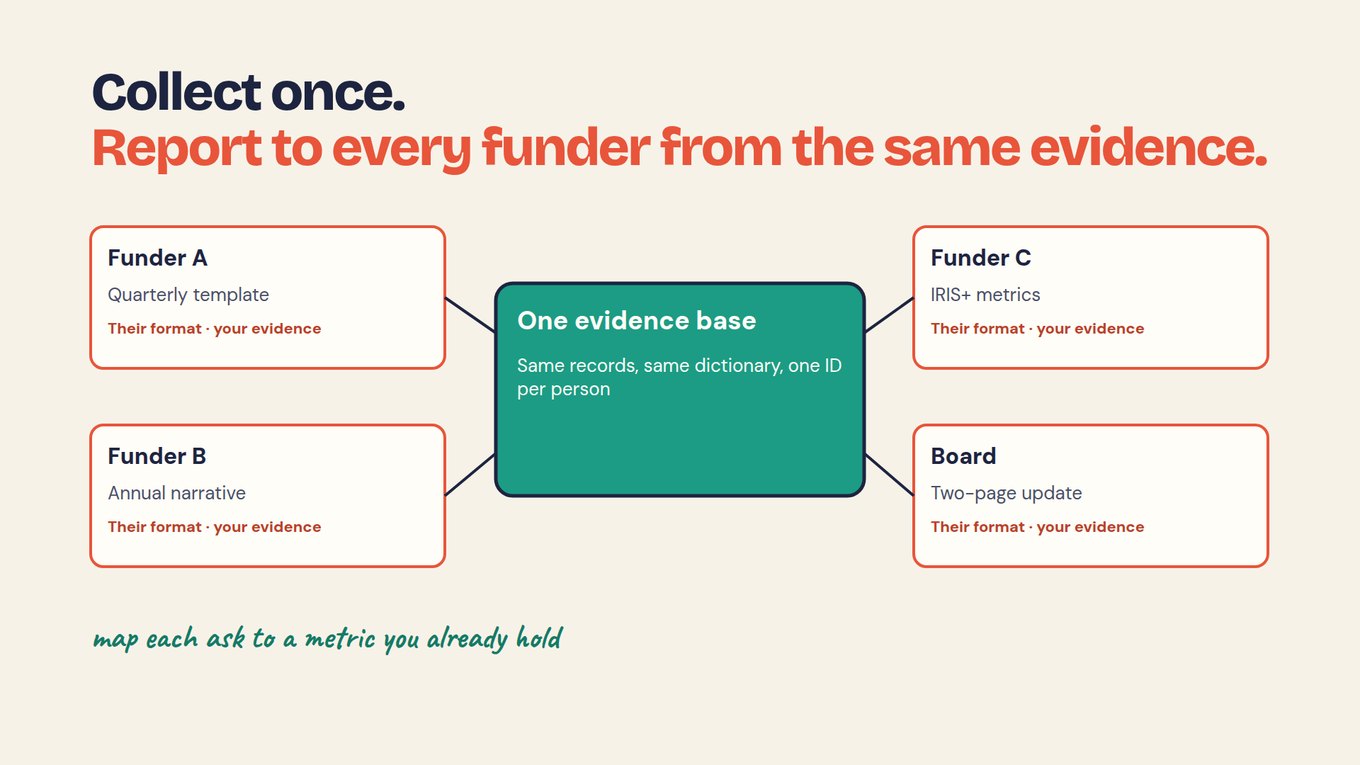
The goal is not one universal report. It is one governed evidence base that can produce audience-specific outputs without redefining the evidence each time.

What is a data dictionary in plain language?

In short: A data dictionary is the governed version of your shared evidence language. It records what each item means, how it is measured, where it comes from, who owns it, and which reporting requirements it can support.

You do not need to begin with field IDs or database types. Begin with the confusion the dictionary prevents. “Participant,” “completed,” “employed,” “person with a disability,” and “retained at 90 days” must mean the same thing when they appear in a program form, partner PDF, board dashboard, and funder report. Chapter 5 approved those meanings. This chapter connects them to reporting requirements and evidence sources.

The technical implementation—stable IDs, allowed values, validation, missing-data rules, access classification, and version history—still matters. It belongs in the supporting guide, How to Build a Data Dictionary for Program and Impact Data, after the team understands the practical job.

Are data dictionaries, schemas, standards, methods, and AI skills the same?

In short: No. They are connected layers with different jobs. Treating them as synonyms makes the system harder to govern and easier to misapply.

Audience requirements
What this funder, donor, investor, regulator, or board needs. Formal artifact: Funder Context Profile.
Organizing logic
The questions or dimensions used to think about change. Formal term: framework.
External reporting vocabulary
Published indicators, disclosures, definitions, or rules for a reporting purpose. Formal term: standard or indicator catalog.
Shared evidence language
What the organization means by every approved measure and evidence item. Formal term: data dictionary.
Evidence structure
How participants, activities, outcomes, sources, and time points connect. Formal term: schema or data model.
Calculation or evaluation procedure
How a result or claim is calculated and substantiated. Formal term: methodology.
Repeatable AI workflow
How approved sources, instructions, evidence rules, and outputs are applied repeatedly. Formal term: AI skill.

What do SDG, IRIS+, GRI, the Five Dimensions, and SROI actually do?

In short: They are not peer metric lists and they are not interchangeable. Each contributes a different kind of reporting or measurement guidance. Use only what applies to the decision and document the source and version.

Source Plain-language job What not to assume
SDG indicatorsOfficial global indicators and metadata used to follow progress on the 2030 AgendaSelecting an SDG icon does not create a program measure or prove contribution
IRIS+Impact-investing guidance, Core Metrics Sets, taxonomy, and qualitative and quantitative metric catalogA similar metric name is not an exact mapping
GRIA modular sustainability-reporting system with Universal, Sector, and Topic StandardsGRI is not merely a list of impact-program metrics
Five Dimensions of ImpactOrganizing norms for considering What, Who, How Much, Contribution, and RiskA framework does not supply every field, instrument, or reporting rule
SROIA social-value methodology involving stakeholders, outcomes, materiality, valuation, transparency, verification, and avoiding overclaimingSROI is not simply assigning money to an output and calculating a ratio
Custom measuresOrganization-, service-, community-, or theme-specific evidence external sources do not captureCustom does not mean ungoverned or less credible

The official UN SDG metadata repository, IRIS+ overview, GRI Standards, Impact Frontiers norms, and Social Value International guidance describe these purposes in detail. Standards and methods evolve; record the version and revalidate before relying on a mapping or formal claim.

Why is evidence bigger than a spreadsheet?

In short: Many reporting claims require numbers and context together. Useful evidence can be structured, qualitative, documentary, and longitudinal. The shared structure must preserve the source, date, person or entity, program stage, access rule, and citation—not force everything into a numeric column.

Quantitative
Enrollment · attendance · completion · placement · retention · score
Qualitative
Interview · open-text response · case note · participant story
Documentary
Email · grant agreement · 100-page partner PDF · meeting note
Longitudinal
Intake → first session → completion → placement → 90-day follow-up
Every evidence record keeps
Source · person or entity · date · program stage · approved definition · consent/access · citation · review status

Worked example: disability-inclusive workforce reporting

In short: Translate each reporting requirement into an approved measure or question, then identify the source and gap. Do not begin by adding every available disability, employment, or SDG indicator to a survey.

Illustrative scenario: A workforce program must report how participants with disabilities enroll, complete training, enter employment, and retain employment at 90 days. The funder also wants evidence about barriers and the program’s response, plus references to selected SDG and IRIS+ measures.

Reporting requirement Approved measure or question Evidence source Mapping status Gap or next action
Participants with disabilities enrolledConfirmed enrollment, disaggregated using the approved disability measureConsent + intake + enrollment recordCandidateApprove instrument, language, consent, threshold, and access
Training completedCompletion under Chapter 5’s approved event and denominatorAttendance + assessment + completion recordOrganization-approvedConfirm partner sites use the same rule
Entered employmentEmployment started within the approved windowParticipant record + employer verification emailIRIS+ candidateCompare population, window, numerator, denominator, and version
Retained at 90 daysEmployed on the 90-day follow-up date under the approved ruleFollow-up record + employer or participant confirmationOrganization-approvedSeparate unreachable from not retained
Barriers participants experienced“What made it difficult to participate or remain employed?”Open text + interview + case noteCustom qualitativePreserve exact words; human-review themes
How the program respondedBarrier → action → owner → date → resultCase action, meeting note, referral, partner emailCustom narrativeLink each response to evidence and timestamp

If the reporting purpose requires comparable disability disaggregation, use a suitable approved instrument rather than asking staff or AI to infer disability from narrative evidence. The Washington Group Short Set on Functioning was developed for censuses and surveys to produce comparable functioning data; WHO’s WHODAS 2.0 is a standardized assessment of functioning and disability. Neither is a universal substitute for deciding the reporting purpose, population, consent, administration mode, language, safeguarding, and local applicability.

How should AI help with standards and long documents?

In short: AI can reduce the first-pass reading burden by extracting candidate requirements, comparing definitions, inventorying evidence, and flagging gaps. It cannot decide which standard applies, establish compliance, validate causality, or approve a sensitive measure.

AI can
  • Extract requirements with page or source citations
  • Compare candidate definitions and mappings
  • Find relevant evidence across PDFs, emails, interviews, and tables
  • Flag missing, contradictory, or outdated information
  • Draft audience-specific outputs from approved evidence
People decide
  • Which source and version are authoritative
  • Whether the framework applies
  • Whether a mapping is valid
  • What evidence supports the claim
  • How privacy, consent, and access are governed
  • What the organization will report and sign

Prompt: build a draft Reporting-to-Evidence Map

You are preparing a DRAFT Reporting-to-Evidence Map for human approval. INPUTS 1. Reporting request, grant agreement, or funder instructions 2. Official excerpts for every named standard/framework, including version 3. Approved Metric Definition Sheets 4. Existing forms, datasets, interviews, emails, case notes, and reports FOR EACH REPORTING REQUIREMENT RETURN - Exact requirement and source citation - Requirement type: measure / disaggregation / narrative / method / document - Candidate approved organization measure or question - Mapping: Exact / Related / Organization-specific / Unresolved - Definition differences: population, period, unit, boundary, calculation - Evidence source, owner, timestamp/stage, and access rule - Evidence status: available / incomplete / contradictory / missing - Human decision or collection action required RULES - Never invent a framework code, reporting requirement, evidence source, or value. - Do not classify a mapping Exact when either definition is incomplete. - Keep participant statements, human-coded themes, and AI interpretations separate. - Do not infer disability, health, identity, or another sensitive attribute. - Do not turn qualitative evidence into a quantitative value unless an approved method permits it. - Cite every extracted requirement and evidence claim. - Mark all uncertain items NEEDS HUMAN REVIEW. OUTPUT 1. Reporting-to-Evidence Map 2. Missing evidence plan 3. Contradictions requiring resolution 4. Definitions or mappings requiring approval

Where does Sopact Sense help?

A team can build this map manually in a spreadsheet and shared folder. Friction grows when each funder has different documents, evidence is spread across staff and partner systems, the same requirement recurs under different wording, and a report must be regenerated after new evidence arrives.

Sopact Sense can hold the grant documents, official reference extracts, approved organization definitions, forms, PDFs, interviews, emails, and report evidence in one governed workspace. It can extract candidate requirements with citations, apply approved mappings, flag missing or contradictory sources, and generate different audience views from the same evidence. People validate the standards mapping, approve definitions, review sensitive interpretations, and retain final authority for the report.

For high-stakes reporting, test extraction and qualitative coding across languages, document overrides, restrict access to sensitive participant data, establish retention rules, and keep the source text and citation available for review. AI should make the work more traceable—not make unsupported claims sound more polished.

Frequently asked questions

How do you turn reporting requirements into collectable evidence?

Identify the report and authoritative sources, extract each measure, breakdown, narrative, method, and document requirement, connect each to an approved organization definition, identify the evidence source and collection moment, and record gaps and human decisions. Test whether the resulting evidence can support the required output with citations and visible limitations.

What is a data dictionary for a nontechnical team?

It is the organization’s shared evidence language written down and governed. It says what every approved measure or evidence item means, how it is calculated or interpreted, where it comes from, who owns it, and where it can be used. Technical fields implement that agreement; they are not the starting explanation.

Do we need to choose one framework for the whole organization?

Not necessarily. Different reports may legitimately use different standards, frameworks, and methods. Govern the organization’s definitions once, then document how each external requirement relates to them. Do not force unrelated requirements into one framework or claim equivalence when populations, boundaries, periods, or calculations differ.

Can AI select the right SDG, IRIS+, or GRI metric?

AI can propose candidates and show definition differences, but it should not make the final selection. A responsible owner must confirm the reporting purpose, applicable source and version, population, unit, period, boundary, calculation, and disclosure requirements against the official material.

Are custom metrics less credible than standard metrics?

No. A custom metric may be essential when an external standard does not capture the service, community, or decision. Credibility comes from a clear definition, appropriate collection, stakeholder relevance, documented calculation, traceable evidence, consistent use, and honest limits—not from attaching a familiar label.

Can an email, interview, or PDF count as evidence?

Yes, when its role and limitations are clear. Preserve the source, author or speaker, date, context, access rule, and citation. A document can support a claim, reveal a requirement, or provide narrative context, but it is not automatically accurate or sufficient merely because it exists.

Should qualitative responses be converted into metrics?

Not automatically. Preserve the participant’s exact words. An approved coding method may group responses into themes, counts, or ordered categories, but the code and source text should remain linked and interpretations should be human-reviewed. Never infer a quantitative value or sensitive attribute that the respondent did not provide.

Is SROI just another reporting standard?

No. SROI is a methodology for analyzing social value. It requires stakeholder involvement, evidence of outcomes, judgments about materiality and value, attention to contribution and overclaiming, transparency, and verification. The evidence map can preserve inputs for a later SROI analysis, but it should not manufacture a monetary value before the method is properly applied.

What happens after the Reporting-to-Evidence Map is approved?

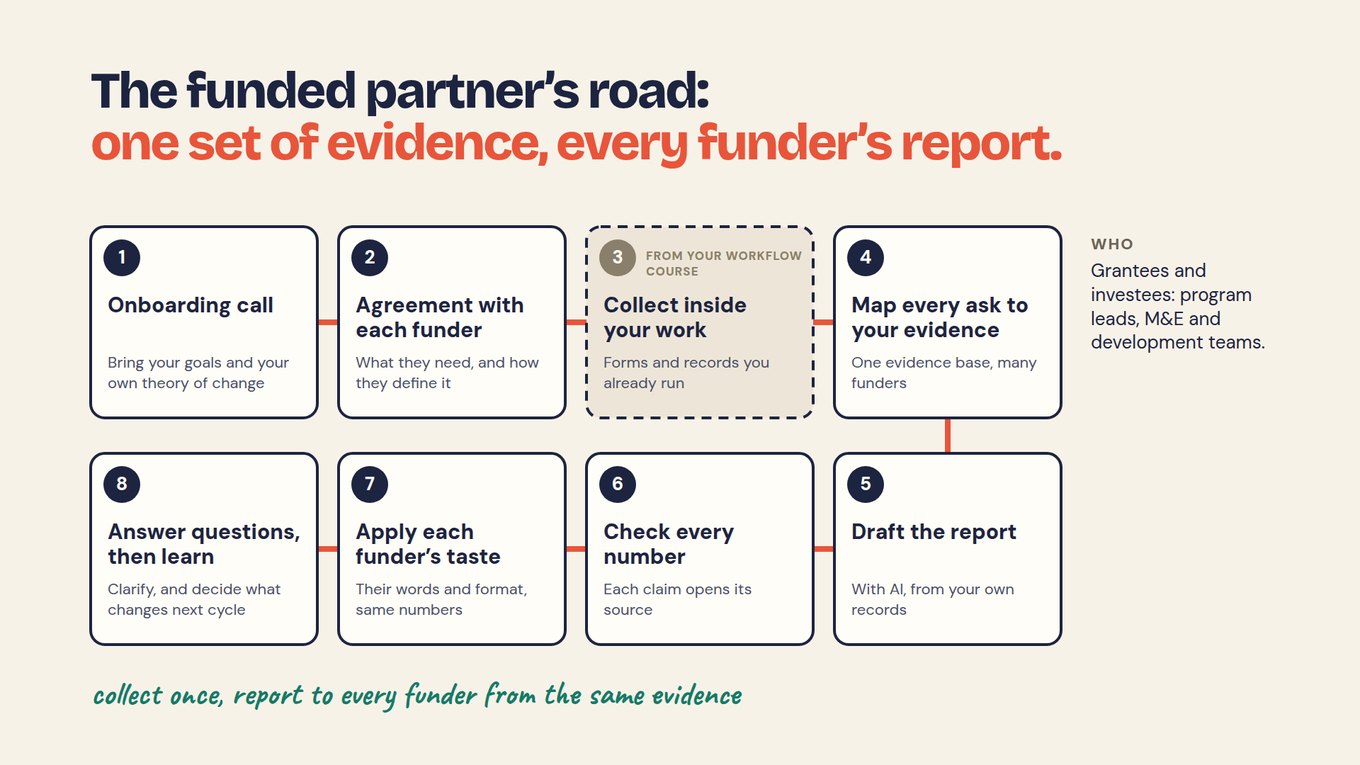
Turn each evidence requirement into a collection moment inside the real workflow: enrollment, attendance, service delivery, follow-up, interview, case note, partner report, or document review. Define who collects it, what validation occurs, how identity and time are linked, and when the evidence becomes available for analysis.

Sources and versions

Author: Sopact (Unmesh Sheth). Drafted August 2026. Standards and methodologies change; verify the authoritative version and applicability before formal reporting, assurance, regulatory filing, or SROI analysis.

Next: You now know what every report requires, which approved measure answers it, where the evidence lives, and what is missing. Put that plan inside enrollment, service delivery, follow-up, interviews, and partner workflows in How Do You Collect Clean Evidence Inside the Workflow? →

Ready to try it for yourself?

ChatGPT, Claude, and Gemini are fine for a quick test — but not for an answer you'll put in front of a funder or board. When it has to hold up, run it in Sopact Sense.

Build your evidence map →
The Loop
The Loop — the method in one read
the-loop
Loop
The method
0
One continuous method for reliable, traceable AI reporting across case, application, grant, and program workflows: collect clean, analyze on arrival, and improve in time.
Teams running cases, applications, grants, or programs that need AI-assisted reporting they can reproduce, trace to source evidence, and act on before the cycle ends.
What Is Case Intelligence?
what-is-case-intelligence
Case
Foundation
1
Treating everything a stakeholder touches — applications, surveys, notes, follow-ups — as one connected record, analyzed the moment it arrives, so you can prove whether their situation improved.
Workforce & training · Youth & mentoring · Case management · Scholarships · Accelerators · Education · Nonprofit programs
What Is Grant Intelligence?
what-is-grant-intelligence
Grant
Foundation
1
Scoring every submission on arrival and reading every grantee report the moment it lands — across qual, quant, financial, and social — so risk surfaces mid-grant and compliance is a by-product.
Foundations & grantmakers · Accelerators · Scholarships & fellowships · Nonprofit programs
What Is Portfolio Intelligence?
what-is-portfolio-intelligence
Portfolio
Strategy
1
Rolling impact up live from every investee's own record — comparable, blended, and honest about thin data — so an aggregate portfolio figure is defensible on any given day.
Impact funds & investors · Foundations · DFIs & blended-finance vehicles
What Is Connected Data Intelligence?
connected-data-intelligence
Feedback
Map
1
Connect evidence across forms, spreadsheets, CRMs, documents, notes, sites, languages, and reporting periods so quant, qual, and longitudinal data can be used together.
Multi-site programs, membership and chapter networks, nonprofits, funders, and impact teams with evidence scattered across systems
What Is Embedded Impact Measurement?
embedded-impact-measurement
Reporting
Align
1
Build impact measurement into Case, Grant, Portfolio, and Connected Data workflows—aligning organization outcomes, funder context, definitions, evidence, and decisions.
Program, impact, grant, MEL, and portfolio teams that need measurement to support learning and funding decisions
The Loop Methodology
Methodology — continuous, not annual
loop-methodology
Loop
The method
1
The continuous collect–analyze–improve cycle, adopted as an experiment: start with the step that already pays and add one data-collection step at a time.
Teams tired of rebuilding spreadsheets and forms who want a measurement system that compounds instead of resetting.
How to Build a Theory of Change with AI: Prompts, Workflow & Examples
Build a Theory of Change That Survives Funder Questions
how-to-build-a-theory-of-change
Case
Foundation
2
How Do You Onboard a Portfolio and Track Results?
Onboard a Portfolio & Lock the Impact Agreement
onboard-portfolio-lock-impact-agreement-track-results
Portfolio
Data Dictionary
2
The Loop: Reliability
Reliability — the same answer twice
loop-reliability
Loop
The method
2
Determinism as a feature: the same question over the same data returns the same answer every run — the opposite of a generic AI chat that drifts.
Anyone who has watched a general AI tool give two different numbers for the same question and needs results they can stand behind.
How Do You Collect Feedback Offline and in the Field?
Collect Feedback Offline & in the Field
collect-feedback-offline
Feedback
Connect
2
Capturing stakeholder feedback where there's no connectivity and syncing each answer to one clean, identified record — so field and multi-site programs keep a single identity from intake to endline.
Field & multi-site programs · Low-connectivity contexts · Nonprofits collecting in person
How to Design a Fair Application and Selection Process
Design an Application Process
how-to-design-an-application-process
Grant
Foundation
2
How Do You Build an Organization Evidence Model?
Build the Organization Evidence Model
build-organization-evidence-model
Reporting
Align
2
How to Clean Open-Ended Survey Responses
Clean Open-Ended Responses at the Source
clean-open-ended-survey-responses
Feedback
Clean
3
How Do You Onboard a Grant or RFP Program?
Onboard a Grant or RFP Program
how-to-onboard-a-grant-rfp-program
Grant
Foundation
3
Theory of Change to Data Collection: A Four-Step Workflow
Turn a Theory of Change into a Data-Collection Workflow
theory-of-change-to-data-collection-workflow
Case
Foundation
3
How Do You Map Portfolio Data to IRIS+, GRI, and ESRS?
One Data Dictionary & Standards Mapping (IRIS+ / GRI / ESRS / CSRD)
portfolio-data-dictionary-standards-mapping
Portfolio
Chapters
3
The Loop: Traceability & Transparency
Traceability & Transparency
loop-traceability
Loop
The method
3
Every figure links back to the exact response, note, or document it came from — a full audit trail from headline result to raw evidence.
Teams whose numbers get scrutinized — by funders, boards, auditors, or standards — and who need to answer where did this come from on the spot.
How Do You Build a Funder Context Profile?
Build a Sourced Funder Context Profile
build-funder-context-profile
Reporting
Align
3
How Do You Design a Grant Rubric and Eligibility Rules?
Design Your Rubric & Eligibility Rules
grant-rubric-eligibility-rules
Grant
Foundation
4
How Do You Frame Portfolio Outcomes Over Outputs?
Frame Outcomes Over Outputs at Portfolio Level
frame-outcomes-portfolio-level
Portfolio
Chapters
4
The Loop: Flexibility
Flexibility — one method, four workflows
loop-flexibility
Loop
The method
4
The same collect–analyze–improve cycle, shaped to four kinds of impact work — case, grant, portfolio, and feedback — each shown end to end.
Anyone deciding where the Loop fits their work, who wants to see the full path from messy input to a report they can defend.
How Do You Analyze Multilingual Feedback?
Analyze Multilingual Feedback
analyze-multilingual-feedback
Feedback
Clean
4
Cleaning and theming multilingual open-ended feedback across languages on one record — every theme cited to the person's own words, with no manual translate-then-code step.
Multi-country programs · Multilingual survey data · Global networks & chapters
How Do You Define Measures the Organization and Funder Can Both Use?
Define Measures the Organization and Funder Can Both Use
define-impact-metrics-funders-want
Reporting
Align
4
How Do You Handle Attrition in Longitudinal Studies?
Survey Attrition — Who Dropped Off
survey-attrition-longitudinal-studies
Feedback
Read
5
How Do You Design an Intake Form for a Baseline?
Design an Intake Form That Captures a Usable Baseline
intake-form-usable-baseline
Case
Nonprofit Track
5
What's the Difference Between Outcomes and Outputs?
Outcomes vs Outputs
frame-outcomes-over-outputs
Grant
Foundation
5
How Do You Do Pre-Investment Due Diligence?
Pre-Investment Due Diligence & Screening
pre-investment-due-diligence-screening
Portfolio
Chapters
5
How Do You Define an Impact Metric So Everyone Counts It the Same Way?
Give Every Number One Definition
one-definition-for-every-number
Reporting
Define
5
The Loop Guarantee
The Guarantee — first workflow in 2 months
loop-guarantee
Loop
The method
5
How to Analyze Pre and Post Survey Data
Analyze Pre / Mid / Post Data
analyze-pre-mid-post-survey-data
Feedback
Read
6
How Do You Spot At-Risk Participants Mid-Program?
Spot At-Risk Participants Mid-Program
spot-at-risk-participants-mid-program
Case
Nonprofit Track
6
How to Write a Nonprofit Grant Application: Template and Example
Grant Application for Nonprofits
grant-application-for-nonprofit-organizations
Grant
Foundation
6
How Do You Collect Investee Reporting Without Burden?
Collect Standardized Reporting from Every Investee, Without Burden
collect-investee-reporting-without-burden
Portfolio
Chapters
6
How Do You Turn Reporting Requirements Into Evidence You Can Collect?
Turn Requirements Into Collectable Evidence
turn-reporting-requirements-into-evidence
Reporting
Define
6
How Do You Connect Quantitative and Qualitative Data?
Connect Quantitative & Qualitative Data
connect-quantitative-qualitative-survey-data
Feedback
Read
7
How Do You Measure Change at Exit?
Measure Change at Exit (Not Just Completion)
measure-change-at-exit
Case
Nonprofit Track
7
How Do You Collect Applications Clean at the Source?
Collect Applications Clean at the Source
collect-applications-clean-at-source
Grant
Collect
7
How Do You Chase Missing Investee Data?
Chase Missing Investee Data — Automatically
chase-missing-investee-data
Portfolio
Chapters
7
How Do You Collect Clean Evidence Inside the Workflow?
Collect Clean Evidence Inside the Workflow
collect-clean-data-at-the-source
Reporting
Embed
7
How Do You Analyze Longitudinal Survey Data?
Track One Person’s Change Across Years
analyze-longitudinal-survey-data
Feedback
Read
8
How to Catch At-Risk Participants Early with Mentor Notes
Catch At-Risk Participants Early with Mentor Notes
mentor-notes-early-warning
Case
Nonprofit Track
8
How Do You Reduce Applicant Burden?
Reduce Applicant Burden
reduce-applicant-burden-auto-clarification
Grant
Collect
8
How Do You Analyze Investee Reports?
Read Investee Reports Across Qual + Quant + Financial + Social
read-investee-reports-multi-signal
Portfolio
Chapters
8
How Do You Get Stable Results From Governed Data?
Get Stable Results From Governed Data
same-numbers-every-time
Reporting
Read
8
How Long Do Program Outcomes Last?
Measure Drop-Off & Duration
measure-outcome-duration-drop-off
Feedback
Read
9
How Do You Calculate SROI Live?
Calculate SROI — Live, Sourced, and Honest
calculate-sroi-live
Case
Nonprofit Track
9
How Do You Collect Grantee Reports Without Burden?
Collect Grantee Reports Without Burden
collect-grantee-reporting-without-burden
Grant
Collect
9
How Do You Track Investees Against the Impact Agreement?
Track Investees Against the Impact Agreement (Variance)
track-investees-impact-agreement-variance
Portfolio
Chapters
9
How Do You Trace Every Result Back to Its Evidence?
Trace Every Result Back to Its Evidence
where-every-number-came-from
Reporting
Read
9
How Do You Write an Impact Narrative for a Funder?
Write a Cited Impact Narrative
impact-narrative-funder-report-cited
Feedback
Prove
10
How to Report a Job-Training Program to Grant Funders
Turn a Cohort into a Funder Impact Report
job-training-grant-impact-report
Case
Nonprofit Track
10
How Do You Chase Missing Grantee Data?
Chase Missing Grantee Data
chase-missing-grantee-data
Grant
Collect
10
How Do You Monitor Portfolio Risk in Real Time?
Portfolio Risk Monitoring & Early-Warning Alerts
portfolio-risk-monitoring-alerts
Portfolio
Chapters
10
How Do You Write a Donor Report?
Design a Report for a Real Funding Decision
donor-report-funders-trust
Reporting
Decide
10
A practical, step-by-step track for building a donor or grant report funders trust — from the funder's decision back through metrics, clean data, and traceable numbers.
Program & grant managers who report to funders
How Do You Turn a Job Description Into a Checklist?
Turn a Job Description into a Requirements Checklist
job-description-requirements-checklist
Case
Social Enterprise Track
11
How Do You Review Applications Without Reviewer Bias?
Review Without Reviewer Bias
review-applications-without-reviewer-bias
Grant
Analyze
11
Ask Your Whole Portfolio Anything (Claude + MCP)
ask-your-portfolio-anything
Portfolio
Chapters
11
How Do You Get AI to Write a Funder Report?
Generate the Audience-Specific Report From Evidence
assistant-writes-the-funder-report
Reporting
Decide
11
How Do You Analyze a Batch of Grant Applications?
Analyze a Whole Round
how-to-analyze-a-batch-of-grant-applications
Grant
Analyze
12
How Do You Score Candidate-Role Matches Without Bias?
Score Candidate–Role Matches Without Bias
score-candidate-role-matches-without-bias
Case
Social Enterprise Track
12
How Do You Put a Dollar Value on Impact?
Add a Credible Dollar Value With SROI
credible-dollar-value-on-impact
Reporting
Optional method
12
How Do You Roll Up a Grant Portfolio?
Aggregate Outcomes Across the Portfolio
how-to-roll-up-a-grant-portfolio
Portfolio
Communicate
13
How to Report Job Placements to Impact Investors
Turn a Cohort into a Social-Enterprise Investor Report
job-placement-investor-impact-report
Case
Social Enterprise Track
13
How Do You Track Reviewer Conflicts of Interest?
Track Reviewer Conflicts of Interest
track-conflicts-of-interest-audit
Grant
Analyze
13
How Do You Read a Grantee Report?
Read a Grantee Report
read-grantee-report-multi-signal
Grant
Analyze
14
How Do You Monetize Impact with SROI?
Monetize Impact with SROI Across Levels
monetize-impact-sroi-across-levels
Portfolio
Chapters
14
How Do You Compute Grantee Variance?
Compute Grantee Variance
how-to-compute-grantee-variance
Grant
Analyze
15
How Do You Track Budget and Actual Spend?
Track Budget vs Actual Spend
how-to-track-budget-invoices-actual-spend
Grant
Analyze
16
How Do You Analyze Grantee Reporting Longitudinally?
Analyze Grantee Reporting Over Time
analyze-grantee-reporting-longitudinal
Grant
Analyze
17
How Do You Compare and Benchmark Investees?
Compare & Benchmark Investees
compare-benchmark-investees
Portfolio
Chapters
17
How Do You Read a 990 for Compliance?
Read a 990 for Compliance
how-to-read-a-990-for-compliance
Grant
Analyze
18
How Do You Build Dashboards and Compliance Reports?
Portfolio Dashboards & Geographic Mapping
dashboards-sroi-compliance-reports
Portfolio
Communicate
18
Ask Your Whole Grant Round Anything (Assistant + MCP)
Ask Your Whole Grant Round Anything
ask-your-grant-round-anything
Grant
Analyze
19
How Do You Produce an LP and Board Impact Report?
Produce the LP / Board Impact Report — Live, Not Annual
portfolio-lp-board-impact-report
Portfolio
Chapters
19
How Do You Build a Grant Audit Trail?
Build a Grant Audit Trail
grant-audit-compliance-trail
Grant
Communicate
20
How Do You Connect Your Stack Without Lock-In?
Connect Your Stack Without Lock-In (Microsoft Dynamics, Power BI, Affinity, MCP)
portfolio-connect-your-stack
Portfolio
Chapters
20
How Do You Produce Grant Compliance Reports?
Produce Compliance Reports
grant-compliance-regulatory-reports
Grant
Communicate
21
How Do You Roll Grantees Into a Board Report?
Roll Grantees Into a Board Report
roll-grantees-funder-board-report
Grant
Communicate
22
How Do You Build Grant Dashboards and Maps?
Grant Dashboards & Maps
grant-dashboards-geographic-mapping
Grant
Communicate
23