play icon for videos
← Academy
Sopact Academy · Measurement & reporting · Chapter 8

Capture each funder's taste, and your own

Two funders can read the same accurate report and come away with opposite impressions. The difference is rarely the numbers; it is whether the report was written the way that funder reads.

Academy / Measurement & reporting

Chapter 8 of 13 · Funded partner road · About 15 minutes

Capture each funder's taste, and your own

Two funders can read the same accurate report and come away with opposite impressions. The difference is rarely the numbers; it is whether the report was written the way that funder reads.

You will learn: how to write a short taste file for each funder and one for your own organization, keep them beside the agreement in an AI project, and check every draft by reading it as the funder first.

Who this is for: the funded partner writing reports for several funders, most often the development lead or program lead who drafts with AI. You bring your agreements, your past reports and whatever the funders said about them. Funders can use the same method for their own board or donors.

On this page: What taste is · Funder taste file · Your taste file · Where it lives · Read it as the funder · Never the numbers · Try it · Questions

What is funder taste in reporting?

In short: funder taste is how a specific funder reads: what they look at first, the words they use, the proof they trust and what makes them doubt. Your own taste is how your organization speaks. Both are judgment, not decoration.

The idea comes from marketing. In Loop, HubSpot's Kipp Bodnar and Kieran Flanagan describe a Taste Profile with two halves, customer taste and brand taste, that tells AI how to reach people. This chapter adapts that idea to reporting. The customer is the funder who reads your report. The brand is your organization's own voice and judgment.

It matters more now that AI writes most first drafts. Without context, every draft comes out in the same generic voice and reads right to nobody. A taste file tells the AI which number goes first, how to name a miss and which word will make this program officer wince.

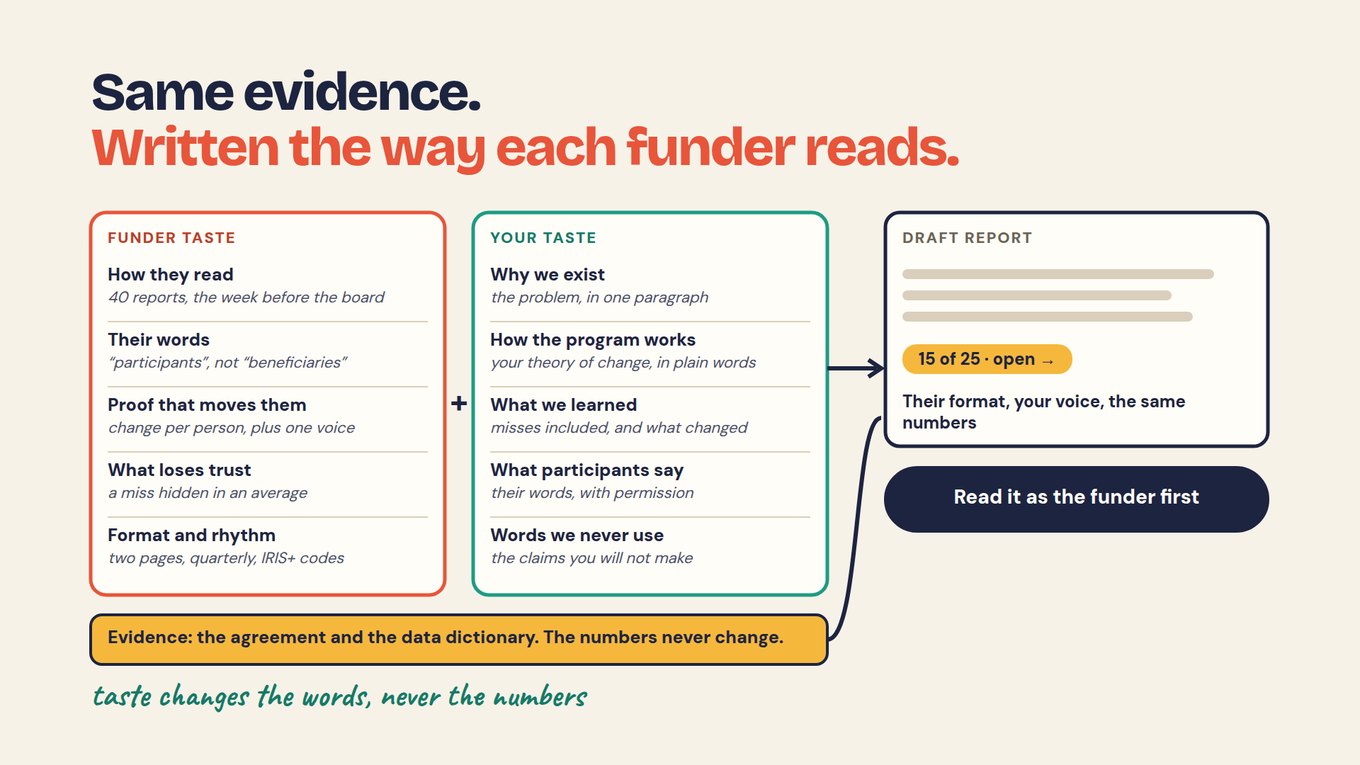
Slide titled Same evidence. Written the way each funder reads. A Funder taste box lists: how they read, 40 reports the week before the board; their words, participants not beneficiaries; proof that moves them, change per person plus one voice; what loses trust, a miss hidden in an average; format and rhythm, two pages, quarterly, IRIS+ codes. A Your taste box lists: why we exist, how the program works, what we learned with misses included, what participants say with permission, words we never use. Both feed a draft report marked their format, your voice, the same numbers, followed by a button reading Read it as the funder first. A bottom bar says the evidence is the agreement and the data dictionary, and the numbers never change. Handwritten line: taste changes the words, never the numbers.
Funder taste plus your taste shape the draft; the agreement and the dictionary fix the numbers.

Keep one distinction clear. The requirements map holds what a funder requires. The taste file holds how they prefer to read it. When the two disagree, the agreement wins.

What goes in a funder taste file?

In short: five parts, a few lines each, and every line written from something the funder actually said or published, not from a guess.

PartWhat to captureWhere to find it
How they readWhen they read, how many reports, what they look at firstOnboarding call transcript; the program officer's emails
Their wordsTerms they use, terms they avoidPublished strategy and grantee guidance
Proof that moves themThe evidence they trust and ask forTheir questions on past reports; the onboarding call
What loses trustWhat made them doubt or follow upTheir questions on past reports
Format and rhythmLength, schedule, template, codesThe agreement; grantee guidance

The richest source is the questions a funder sent back on your last reports. Each one marks a place where the report did not read the way they needed. Copy them in word for word, with the date.

FUNDER TASTE FILE · FICTIONAL EXAMPLE

FunderFunder C, one of Partner C's funders; reports use IRIS+ metrics
How they readThe program officer reads about 40 reports the week before the board meets. First page and the table; the rest only if something looks off.
Their words"Participants", not "beneficiaries". "Placed in a job" and "retained", as in the agreement.
Proof that moves themChange per person: where a trainee started and where they are now. Plus one participant voice, with permission.
What loses trustA miss hidden in an average. A definition that changed without a note.
Format and rhythmTwo pages, quarterly, IRIS+ codes beside each metric, table before narrative.
SourcesOnboarding call transcript; questions on the last two reports; grantee guidance. Updated after each report.

What goes in your own taste file?

In short: five parts that keep every report sounding like your organization: why you exist, how the program works, what you learned, what participants say and the words you never use.

Write it once and reuse it in every funder's project, so your reports do not sound like four different organizations. Draw on your theory of change, team debriefs, surveys and the claims your leadership has decided not to make.

YOUR TASTE FILE · FICTIONAL EXAMPLE · PARTNER C

Why we existAdults in our county who are ready to work often lack the certification local employers ask for. We close that gap.
How the program worksTraining and mentoring lead to certification, placement in a job within 90 days of exit and a job still held at 12 months, aiming at living-wage work.
What we learnedLast cycle we sent a six-month placement count where a funder had agreed 90 days. We now map every ask before drafting.
What participants sayQuotes from exit and follow-up surveys, only with permission for this audience, each linked to its record.
Words we never use"Beneficiaries", "life-changing", "lifted out of poverty". No "because of our program" without a comparison that supports it.

The "what we learned" part is the one teams skip, and the one funders value most. A report that names a miss and what changed reads as a partner who is paying attention.

Where should the taste files live?

In short: in one AI project per funder, such as a Claude Project or a ChatGPT Project, beside the agreement, the data dictionary and past reports with the funder's feedback.

01 · AGREEMENT

What you committed to report, and how each metric is defined.

02 · DICTIONARY

Your metrics, dimensions and any standard codes.

03 · TWO TASTE FILES

This funder's taste, and your own.

04 · PAST REPORTS

With the funder's questions and reactions attached.

One project per funder. Every draft for that funder starts here.

Sopact's founder works this way. He keeps a Claude project for each prospect, holding call transcripts, their published material and a short note on how they think, and uses it whenever he writes back to them or builds an article for them.

Keep participant records out of the project. The taste file describes a funder and a voice; the numbers come from your records at drafting time, through a source you have chosen.

Prompt · paste into Claude, ChatGPT or your AI tool

Build a funder taste file for [FUNDER NAME] from the material attached:
- the onboarding call transcript: [ATTACH]
- the questions and comments they sent on our past reports: [ATTACH]
- their published strategy and grantee reporting guidance: [ATTACH OR LINK]
- recent emails from their program officer: [PASTE]

Write five short sections:
1. How they read (when, how many reports, what they look at first)
2. Their words (terms they use, terms they avoid)
3. Proof that moves them (evidence they trust or ask for)
4. What loses trust (what made them doubt, question or follow up)
5. Format and rhythm (length, schedule, template, codes)

Rules: every line must cite the document and quote the words it comes from. If a section has no evidence, write "not known yet" and suggest one question we could ask. Do not guess from what funders in general prefer. Keep the whole file under one page.

How do you read a draft as the funder first?

In short: before you send, ask the AI to read the draft as that funder's program officer and say bluntly what lands, what is missing, which sentence loses them and what they would ask back.

This is a rehearsal, not a verdict. It catches the report that opens with a story when this reader wants the table. It will not catch a wrong number; that check comes in the next chapter.

Prompt · paste into Claude, ChatGPT or your AI tool

You are the program officer at [FUNDER NAME]. Use the funder taste file in this project to read the attached draft report the way you would: [DESCRIBE, e.g. one of 40 reports the week before the board].

Be blunt. Tell me:
1. What lands: the parts you would repeat to your board.
2. What is missing that you expected to see.
3. The one sentence where you stopped trusting or stopped reading, and why.
4. Every word or claim that does not sound like us, using our taste file.
5. The questions you would send back after reading it.

Do not rewrite or change any number. If a number looks wrong, undefined or unsupported, list it as a question instead.

Then close the loop. When the real questions and reactions arrive, add them to the funder's taste file with the date. After two or three cycles, the rehearsal gets close to the real thing.

Can taste change the numbers?

In short: never. Taste changes words, emphasis and format. The counts, definitions and periods come from the agreement and the dictionary, and they are the same in every report.

For Funder C

IRIS+ PI4060, Client Individuals: Total: 80 unique trainees in the period. Table first, code beside the number.

For the board

We enrolled 80 people this period. One sentence on who they are, one on what comes next.

If a funder's taste seems to ask for a different number, such as a longer placement window, that is not taste. It belongs in the requirements map, reported in their definition with a note on how it differs.

The method also works upward. A portfolio manager can keep a taste file for their own board or donors before writing the portfolio report. And a funder can share a short "how we read reports" note with partners at onboarding, which saves everyone a year of guessing.

Sopact has helped teams such as Open Play Foundation capture this kind of funder and organization context. A context layer in Sopact that applies definitions and taste as the AI Assistant writes is coming soon.

ASK ANY TOOL, INCLUDING OURS

Ask: "Using Funder C's taste file, which three numbers should lead our next report, and what should we say about 12-month retention, which is not yet available?" Any AI project holding the taste file can answer the first half. The numbers should come from a tool that reads your records, such as the AI Assistant in Sopact Sense, where each line links to a record you can open.

An honest limit: a taste file is a set of notes about people, and people change. A new program officer may read differently, so treat the file as a draft to confirm, not a rule. And the AI's reading as the funder is an approximation; one real question from the funder outweighs it.

Try it on your own reporting

  1. Pick the funder whose reports cause the most back-and-forth.
  2. Collect the onboarding notes or transcript, their questions on your last two reports and their grantee guidance.
  3. Run the first prompt and cut the result to one page. Mark every "not known yet".
  4. Write your own taste file, starting with "what we learned" and "words we never use".
  5. Take your last report to that funder and run the second prompt on it. Compare its questions with the ones the funder actually sent.
Check your reasoning

Suppose Partner C's draft for Funder C opens with a participant story and gives one average starting wage. Read against the taste file, it fails twice before the numbers are checked: this officer wants the table first, and one average is exactly the "miss hidden in an average" that loses their trust. The fix keeps every number and changes the order and the split: table first with IRIS+ codes, starting wage by track, then one voice with permission.

Questions teams ask

Is this writing what the funder wants to hear?

No, and the hard rule keeps it that way. Taste decides order, words and format; it never decides which results appear. A good taste file makes misses easier to report, because it tells you how this funder wants to hear bad news: in the table, with a reason and a plan.

How long should a taste file be?

One page for each funder and one page for your own organization. Longer files get ignored by people and diluted for the AI. When a part grows, keep the funder's own words and the latest reactions, and drop the rest. The file should be something a new colleague can read in five minutes.

What if we have no transcript or past feedback yet?

Start from their published strategy and grantee guidance, and mark the rest "not known yet". Then ask the program officer a short question, such as "What do you read first in a partner report?" After the first report, their questions fill most of the file.

Put this guide into practice.

Bring one funder’s past feedback and your last report. Build a taste file and read your draft as that funder.

Discuss your use case →
Prepare Data Governance Before Using AI
Prepare your data governance
nonprofit-data-governance-before-ai
Feedback
Foundation
Prepare an evidence register and a tested governance baseline before applying AI to program data.
How to Turn Findings into Action and Check What Changes
The Loop — the method in one read
the-loop
Loop
The method
0
One continuous method for reliable, traceable AI reporting across case, application, grant, and program workflows: collect clean, analyze on arrival, and improve in time.
For growing data collection, connected analysis and recurring reporting
What Is Case Intelligence?
what-is-case-intelligence
Case
Foundation
1
One current, traceable record for each person—connecting intake, services, notes, surveys, documents, outcomes, decisions, and follow-up.
Workforce and training · Youth and mentoring · Case management · Scholarships · Accelerators · Education · Nonprofit programs
What is grant intelligence?
What Is Grant Intelligence?
what-is-grant-intelligence
Grant
Foundation
1
One connected evidence record from application and committee review through the awarded grant, grantee reporting, renewal, and board accountability.
Foundations and grantmakers · Public grant programs · Scholarships and fellowships · Accelerators
What Is Portfolio Intelligence?
what-is-portfolio-intelligence
Portfolio
Strategy
1
A source-linked portfolio view that connects each investee or grantee's agreed plan, reporting cadence, evidence, risks, and results.
Impact funds and investors · Foundations with grant portfolios · Family offices · Blended-finance vehicles
What Is Connected Data Intelligence? Start Here Before You Add AI
What Is Connected Data Intelligence?
connected-data-intelligence
Feedback
Foundation
1
Keep evidence from surveys, files, notes, documents, systems, sites, and reporting periods connected to one continuing record.
For growing data collection, connected analysis and recurring reporting
Measurement and reporting: from agreement to report
embedded-impact-measurement
Reporting
Start here
1
Turn the onboarding call into a reporting agreement, share one data dictionary, and write reports funders can compare and check.
For funders and the organizations they fund
Build a repeatable collect, review and improve cycle
Methodology — continuous, not annual
loop-methodology
Loop
The method
1
The continuous collect–analyze–improve cycle, adopted as an experiment: start with the step that already pays and add one data-collection step at a time.
Teams tired of rebuilding spreadsheets and forms who want a measurement system that compounds instead of resetting.
How Do You Onboard a Portfolio and Track Results?
Agree the Portfolio Reporting Plan
onboard-portfolio-lock-impact-agreement-track-results
Portfolio
Data Dictionary
2
Test whether an AI-assisted result is repeatable and correct
Reliability — the same answer twice
loop-reliability
Loop
The method
2
Determinism as a feature: the same question over the same data returns the same answer every run — the opposite of a generic AI chat that drifts.
Anyone who has watched a general AI tool give two different numbers for the same question and needs results they can stand behind.
Design an application process around the decision, not the form
Design an Application Process
how-to-design-an-application-process
Grant
Foundation
2
How to Structure Stakeholder Data: Four Common Patterns
Choose your record structure
which-shape-is-your-data
Feedback
Foundation
2
Map the people, observations and relationships your workflow needs before collecting data.
Turn the onboarding call into a reporting agreement
onboarding-call-to-reporting-agreement
Reporting
Agree together
2
How to build a theory of change, then show it as a logic model, logframe or results framework
how-to-build-a-theory-of-change
Reporting
Agree together
3
How do you onboard a grant or RFP program?
Onboard a Grant or RFP Program
how-to-onboard-a-grant-rfp-program
Grant
Foundation
3
Turn your theory of change into a data-collection plan
Turn a Theory of Change into a Data-Collection Workflow
theory-of-change-to-data-collection-workflow
Case
Foundation
3
Build a portfolio data dictionary without forcing false comparisons
Map Portfolio Data to Reporting Standards
portfolio-data-dictionary-standards-mapping
Portfolio
Chapters
3
Keep a clear trail from a finding to its evidence
Traceability & Transparency
loop-traceability
Loop
The method
3
Every figure links back to the exact response, note, or document it came from — a full audit trail from headline result to raw evidence.
Teams whose numbers get scrutinized — by funders, boards, auditors, or standards — and who need to answer where did this come from on the spot.
Build Context: The Organization Evidence Model
Build the Organization Evidence Model
build-organization-evidence-model
Feedback
Foundation
3
How to Change Survey Questions Without Losing Comparability
Change questions with a clear history
change-questions-without-breaking-the-record
Feedback
Control
3
Create a question-change log and decide how old and new versions should appear in reports.
Programme & MEL leads · Teams whose questionnaire has ossified · Anyone evaluating a platform where configuration is a purchased service
How do you design a grant rubric and eligibility rules?
Design Your Rubric & Eligibility Rules
grant-rubric-eligibility-rules
Grant
Foundation
4
How to Measure Outcomes Across an Investment or Grant Portfolio
Frame Outcomes Over Outputs at Portfolio Level
frame-outcomes-portfolio-level
Portfolio
Chapters
4
Adapt the learning cycle to your workflow
Flexibility — one method, four workflows
loop-flexibility
Loop
The method
4
The same collect–analyze–improve cycle, shaped to four kinds of impact work — case, grant, portfolio, and feedback — each shown end to end.
Anyone deciding where the Loop fits their work, who wants to see the full path from messy input to a report they can defend.
How to Collect Feedback Offline and Keep Records Connected
Collect offline and reconcile the batch
collect-feedback-offline
Feedback
Connect
4
Build a field protocol and reconcile a test batch across devices, visits and delayed uploads.
Field & multi-site programs · Low-connectivity contexts · Nonprofits collecting in person
How Do You Design an Intake Form for a Baseline?
Design an Intake Form That Captures a Usable Baseline
intake-form-usable-baseline
Case
Nonprofit Track
5
Turn a proposed outcome into a reporting definition
Outcomes vs Outputs
frame-outcomes-over-outputs
Grant
Foundation
5
Impact Due Diligence: Review Evidence Before Investment
Pre-Investment Due Diligence & Screening
pre-investment-due-diligence-screening
Portfolio
Chapters
5
Plan and review your first workflow pilot
The Guarantee — first workflow in 2 months
loop-guarantee
Loop
The method
5
How to Analyze Documents as Evidence: Sources, Context and Review
Read documents as traceable evidence
read-documents-as-evidence
Feedback
Connect
5
Create a document register and reviewed findings with source locations, context and explicit exceptions.
Check each partner report against the agreement
check-partner-reports-against-agreement
Reporting
Funder road
5
How to Clean Open-Ended Survey Responses Without Losing Meaning
Clean responses and define the denominator
clean-open-ended-survey-responses
Feedback
Clean
6
Create a cleaning log, response-status table and reproducible report statement.
How to Review Participant Support Needs Mid-Program
Spot At-Risk Participants Mid-Program
spot-at-risk-participants-mid-program
Case
Nonprofit Track
6
How to Write a Nonprofit Grant Application: Template and Example
Grant Application for Nonprofits
grant-application-for-nonprofit-organizations
Grant
Foundation
6
Design quarterly portfolio reporting that investees can complete
Collect Investee Reporting Without Repeated Rework
collect-investee-reporting-without-burden
Portfolio
Chapters
6
Roll up and benchmark portfolio results
roll-up-and-benchmark-portfolio-results
Reporting
Funder road
6
How Do You Measure Change at Exit?
Measure Change at Exit (Not Just Completion)
measure-change-at-exit
Case
Nonprofit Track
7
How do you collect applications clean at the source?
Collect Applications Clean at the Source
collect-applications-clean-at-source
Grant
Collect
7
How to Follow Up on Missing Investee Data
chase-missing-investee-data
Portfolio
Chapters
7
How to Analyze Multilingual Feedback and Evaluate Software
Analyze and review multilingual feedback
analyze-multilingual-feedback
Feedback
Clean
7
Build a language review sheet and test software on original responses, translations, codes and reporting bases.
Multi-country programs · Multilingual survey data · Global networks & chapters
Write the portfolio report for your board or donors
write-the-portfolio-report
Reporting
Funder road
7
Survey Attrition in Longitudinal Studies: Track Missing Waves
Track missing waves and matched outcomes
survey-attrition-longitudinal-studies
Feedback
Read
8
Build a wave-status register, compare response groups and report paired change with coverage and limitations.
How to Use Mentor Notes to Review Participant Support
Use mentor notes for support review
mentor-notes-early-warning
Case
Nonprofit Track
8
How do you reduce applicant burden?
Reduce Applicant Burden
reduce-applicant-burden-auto-clarification
Grant
Collect
8
Find inconsistencies in portfolio returns before reporting
Analyze Investee Reports Across Sources
read-investee-reports-multi-signal
Portfolio
Chapters
8
Map every funder's ask to one evidence base
turn-reporting-requirements-into-evidence
Reporting
Funded partner road
8
How to Connect Quantitative and Qualitative Survey Data
Connect scores and comments
connect-quantitative-qualitative-survey-data
Feedback
Read
9
Build a linked analysis view and joint display, with clear groups, reporting bases and evidence limits.
How to Calculate SROI as New Evidence Arrives
Calculate SROI — Live, Sourced, and Honest
calculate-sroi-live
Case
Nonprofit Track
9
How to Collect Grantee Reports with Less Burden
Collect Grantee Reports Without Burden
collect-grantee-reporting-without-burden
Grant
Collect
9
Keep company, investment and reporting history connected
Track Results Against the Impact Agreement
track-investees-impact-agreement-variance
Portfolio
Chapters
9
Capture each funder's taste, and your own
capture-funder-taste
Reporting
Funded partner road
9
How to Analyze Pre, Mid and Post Survey Data
Analyze pre, mid and post surveys
analyze-pre-mid-post-survey-data
Feedback
Read
10
Build a matched pre/mid/post analysis, interpret score movement and retain clear rules for missing waves.
How to Report a Job-Training Program to Grant Funders
Turn a Cohort into a Funder Impact Report
job-training-grant-impact-report
Case
Nonprofit Track
10
How to Follow Up on Missing Grantee Data
Chase Missing Grantee Data
chase-missing-grantee-data
Grant
Collect
10
How to Build Useful Portfolio Impact Monitoring Alerts
Build Useful Portfolio Impact Alerts
portfolio-risk-monitoring-alerts
Portfolio
Chapters
10
Write each funder's report with AI, then check it
assistant-writes-the-funder-report
Reporting
Funded partner road
10
Draft from approved sources, check the claims, and save an accountable report version. Bring the brief from the previous lesson.
Program managers, grant leads and reporting teams
How to Analyze Longitudinal Survey Data
Analyze longitudinal survey data
analyze-longitudinal-survey-data
Feedback
Read
11
Build a continuing analysis record with clear time scales, observed trajectories and limits.
How to Turn a Job Description into a Requirements Checklist
Clarify employer requirements
job-description-requirements-checklist
Case
Social Enterprise Track
11
Review applications without reviewer bias: one rubric, read on arrival, people decide
Review Without Reviewer Bias
review-applications-without-reviewer-bias
Grant
Analyze
11
How to Ask AI Questions About Your Portfolio Data
Ask AI Questions About Portfolio Data
ask-your-portfolio-anything
Portfolio
Chapters
11
Compare your results with outside data: live queries and public datasets
compare-with-outside-data
Reporting
Toolkit
11
How do you analyze a batch of grant applications?
Analyze a Whole Round
how-to-analyze-a-batch-of-grant-applications
Grant
Analyze
12
How to Measure Outcome Duration and Drop-Off
Measure outcome duration and drop-off
measure-outcome-duration-drop-off
Feedback
Read
12
Build a dated outcome claim, distinguish missingness from outcome loss and test forecast assumptions.
How to Score Candidate–Role Matches with a Clear Rubric
Review candidate–role evidence
score-candidate-role-matches-without-bias
Case
Social Enterprise Track
12
Make every number in your report match its source
where-every-number-came-from
Reporting
Toolkit
12
How Do You Roll Up a Grant Portfolio?
Aggregate Outcomes Across a Grant Portfolio
how-to-roll-up-a-grant-portfolio
Portfolio
Chapters
13
How to Report Job Placements to Impact Investors
Turn a Cohort into a Social-Enterprise Investor Report
job-placement-investor-impact-report
Case
Social Enterprise Track
13
How do you track reviewer conflicts of interest?
Track Reviewer Conflicts of Interest
track-conflicts-of-interest-audit
Grant
Analyze
13
How to put a credible dollar value on your results
credible-dollar-value-on-impact
Reporting
Toolkit
13
Prepare a valuation brief. Decide what the evidence supports, what needs more work, and when an outcome account is enough.
Program, evaluation and investment teams considering social-value estimates
AI Data Access Controls: What Your Assistant May See
Control what the assistant can access
what-the-assistant-may-see
Feedback
Prove
13
Define task-specific access, test synthetic records and verify report-sharing boundaries.
How to calculate the SROI ratio, step by step: value map, financial proxies and adjustments
how-to-calculate-the-sroi-ratio
Reporting
Toolkit
14
Build a reproducible SROI calculation, test its assumptions and explain the result in a reviewed report.
Evaluation and reporting teams reviewing an SROI calculation
How to Write an Evidence-Based Impact Narrative for a Funder Report
Write a cited impact narrative
impact-narrative-funder-report-cited
Feedback
Prove
14
Build and check a report paragraph using a claim-and-source table, appropriate quotations and clear limitations.
How Do You Read a Grantee Report?
Read a Grantee Report
read-grantee-report-multi-signal
Grant
Analyze
14
How to Use SROI Across a Portfolio Without Double Counting
Use SROI Across a Portfolio
monetize-impact-sroi-across-levels
Portfolio
Chapters
14
How Do You Compute Grantee Variance?
Compute Grantee Variance
how-to-compute-grantee-variance
Grant
Analyze
15
Keep a person’s history connected across programs and staff changes
Follow one person over time
one-person-followed-for-years
Feedback
Shapes
15
Build a participant record that preserves episodes, dates, versions and missingness across repeated collection.
How do you track budget, invoices and actual spend for a grant?
Track Budget vs Actual Spend
how-to-track-budget-invoices-actual-spend
Grant
Analyze
16
Multi-Rater Feedback: Connect Perspectives and Protect Context
Connect several perspectives on one person
several-people-describing-one-person
Feedback
Shapes
16
Design subject-rater relationships, reporting rules and a tested multi-perspective feedback record.
How Do You Analyze Grantee Reporting Longitudinally?
Analyze Grantee Reporting Over Time
analyze-grantee-reporting-longitudinal
Grant
Analyze
17
How Do You Compare Investees When Each One Defines Its Metrics Differently?
Compare & Benchmark Investees
compare-benchmark-investees
Portfolio
Chapters
17
Cross-Program Reporting: Combine Results Without Losing Meaning
Combine evidence across programs
many-programs-one-picture
Feedback
Shapes
17
Build a defensible cross-program result with comparable measures, correct denominators and documented exclusions.
How to read Form 990 for a grant review
Read a 990 for Compliance
how-to-read-a-990-for-compliance
Grant
Analyze
18
How Do You Build Dashboards and Compliance Reports?
Build Dashboards and Reviewed Reports
dashboards-sroi-compliance-reports
Portfolio
Chapters
18
Pick One Question. Keep Every System You Have.
Run a member-network survey
member-network-survey
Feedback
Shapes
18
Design and test a member reporting cycle with continuing records, coverage checks and authorized results.
Ask your whole grant round anything (Assistant + MCP)
Ask Your Whole Grant Round Anything
ask-your-grant-round-anything
Grant
Analyze
19
Produce portfolio reports that trace back to approved evidence
Produce the LP and Board Impact Report
portfolio-lp-board-impact-report
Portfolio
Chapters
19
How do you build a grant audit trail?
Build a Grant Audit Trail
grant-audit-compliance-trail
Grant
Communicate
20
How Do You Connect Your Stack Without Lock-In?
Connect Systems and Test Data Portability
portfolio-connect-your-stack
Portfolio
Chapters
20
How do you produce grant compliance and regulatory reports?
Produce Compliance Reports
grant-compliance-regulatory-reports
Grant
Communicate
21
How Do You Roll Grantees Into a Board Report?
Roll Grantees Into a Board Report
roll-grantees-funder-board-report
Grant
Communicate
22
How Do You Build Grant Dashboards and Maps?
Grant Dashboards & Maps
grant-dashboards-geographic-mapping
Grant
Communicate
23