


Academy / Measurement & reporting
Course progress and additional readings
Measurement & reporting
You will learn: how to structure a portfolio report, draft it with AI from the checked roll-up and your partners' own words, check every number against its source, and feed what you learned into next year's agreement.
Who this is for: the funder, at the end of the funder road, with a board meeting or donor update coming. You bring the checked roll-up, the gap log with its held numbers, and your partners' reports in their own words.
What does a portfolio report for a board or donors need?
In short: Five things: the question it answers, the roll-up with its denominators, what is held or missing, a few partner stories used with permission, and what you will change. The rest is optional.
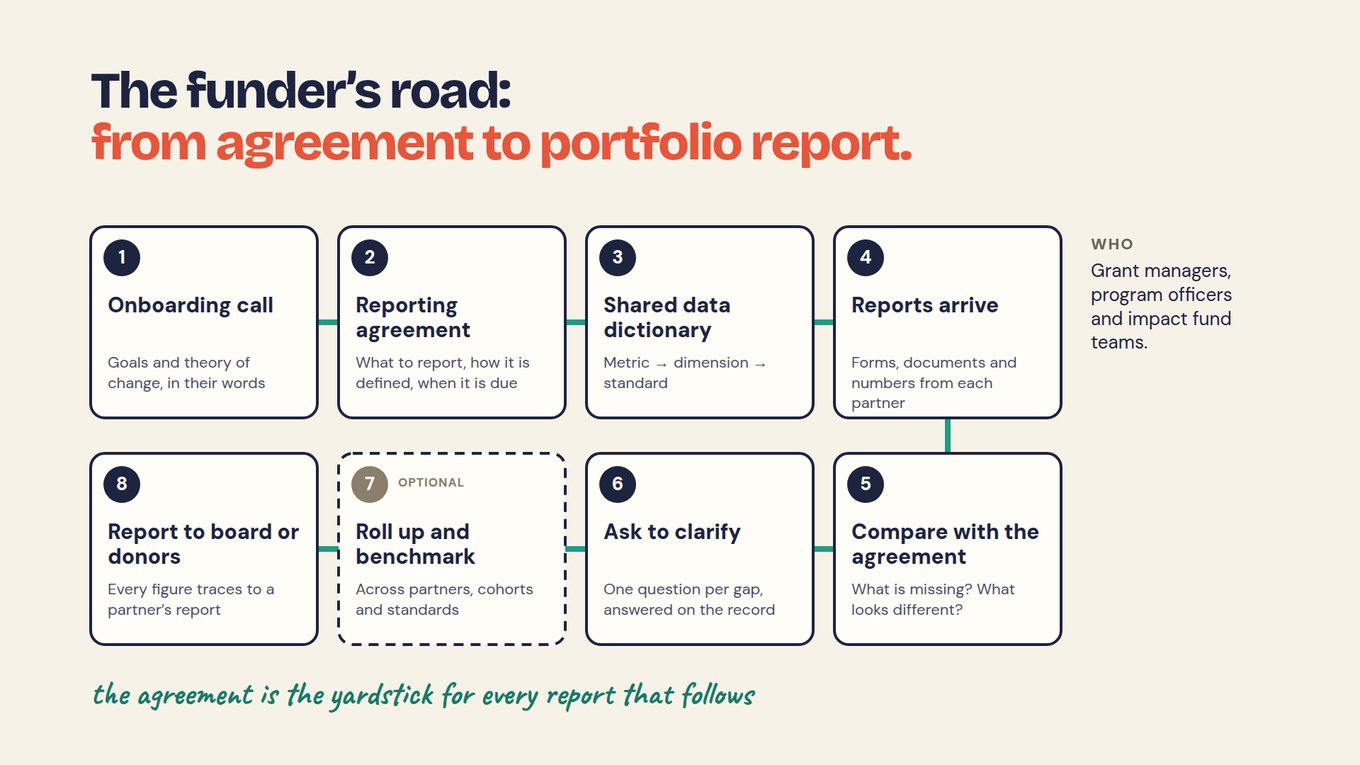
The portfolio report is the last stop on the funder's road. Every step before it, from the onboarding call to the roll-up, was built so that each figure here traces to a partner's report.
| Part | What it answers | Workforce fund (fictional) |
|---|---|---|
| The question | What did we set out to change? | Do trainees get jobs within 90 days and keep them? |
| Roll-up with denominators | How many, out of how many? | 100 placed within 90 days at A, B and D, beside the number who completed training there |
| Held or missing | What is not in the total, and why? | C's 55 (six-month count) held; C's 12-month retention not yet available |
| Partner stories | What does it look like for one person? | A trainee's words from a partner report, used with permission |
| What we will change | What will the fund do differently? | Ask every partner for wage by track from intake onward |
The question comes first because it tells the reader which numbers matter. Stories explain a number; they never replace one, so use a partner's own words, with the permission the partner collected for that audience, and never invent or tidy a quote to make it land.
How does your own board read?
In short: Capture your board's taste the way a funded partner captures a funder's: how they read, their words, the proof that moves them, what loses their trust, and the format they expect. Taste changes the words and format, never the numbers.
On the partner road, each partner keeps a short taste file for each funder. The method in Capture each funder's taste, and your own applies upward too: your board and donors are your funders. The idea is adapted from the Taste Profile in HubSpot's book Loop, by Kipp Bodnar and Kieran Flanagan.
BOARD TASTE · FICTIONAL EXAMPLE
Keep this file next to the agreement and dictionary in the AI project you draft in. After each meeting, add the questions the board asked; they are the best guide to what the next report should answer first.
What outline should a portfolio report follow?
In short: Six short sections in a fixed order, each with a named source. Use the same outline every period so readers learn where to look.
| Section | What goes in | Source |
|---|---|---|
| 1. The question | One or two sentences from the theory of change | Agreement, onboarding call |
| 2. Headline results | Roll-up with denominators, split by who where categories match | Checked roll-up |
| 3. Held and missing | Each held number, its reason, what you asked | Gap log |
| 4. Partner stories | Two or three, in partners' own words, with permission | Partner reports |
| 5. Benchmarks (optional) | Only outside numbers with the same definition | Named outside source |
| 6. What we will change | Changes to the agreement, dictionary or partner support | Gap log, board questions |
Portfolio report outline. Two pages suit most boards; partner tables go in an appendix.
How do you draft the report with AI and still trust every number?
In short: Give the AI only the checked roll-up, the gap log and the partners' own words, forbid it to calculate, then check every number against its source before anyone reads the draft.
What makes the draft trustworthy is what you feed it: an AI tool given raw partner spreadsheets will add up anything, including Partner C's 55.
Prompt · paste into Claude, ChatGPT or your AI tool
You are drafting a two-page portfolio report for [BOARD OR DONOR GROUP].

Use only these inputs:
- Checked roll-up, with denominators: [PASTE ROLL-UP TABLE]
- Gap log, with held and missing numbers and reasons: [PASTE GAP LOG]
- Partner quotes cleared for this audience: [PASTE QUOTES WITH PARTNER NAME]
- Our board's taste file: [PASTE TASTE FILE]

Follow this outline: the question; headline results; held and missing; partner stories; what we will change.

Rules:
- Do not calculate, round or combine any number. Use each number exactly as given, with its denominator.
- Put every held or missing number under "held and missing" with its reason. Never add a held number to a total.
- Use quotes word for word, and only those provided.
- After each number, name its source in brackets, such as [roll-up, row 2] or [gap log, Partner C].
- Where an input is missing, write [MISSING: what is needed] instead of filling the gap.
Then check. Put the draft beside its sources and tick every figure: the number, its denominator, its period and the partner it came from. The method is in Make every number in your report match its source; in a portfolio report, each check should end at a partner report you can open.
ASK ANY TOOL, INCLUDING OURS
Ask: "Draft the headline results for the board from placements within 90 days, show the denominator, list any partner held out and why, and cite the partner record behind every number." In Sopact Sense, the AI Assistant stays locked until you pick which surveys it may use, answers in plain language with sources, and an Intelligence Row gives a per-partner summary you can quote from. Claude or ChatGPT can query the same data through MCP; a shared place for definitions, the dictionary and taste that the Assistant applies is coming soon.
How does this year's report improve next year's agreement?
In short: Read the gap log and the board's questions back into the agreement before the next onboarding call. Every recurring gap is a definition, a form or a date to fix.
01 · GAP LOG
Which rows came up for more than one partner?
02 · BOARD QUESTIONS
Which could the report not answer?
03 · AGREEMENT
Tighten definitions, add breakdowns, set due dates.
04 · PARTNERS
Tell every partner before the new period starts.
Workforce fund example · fictional
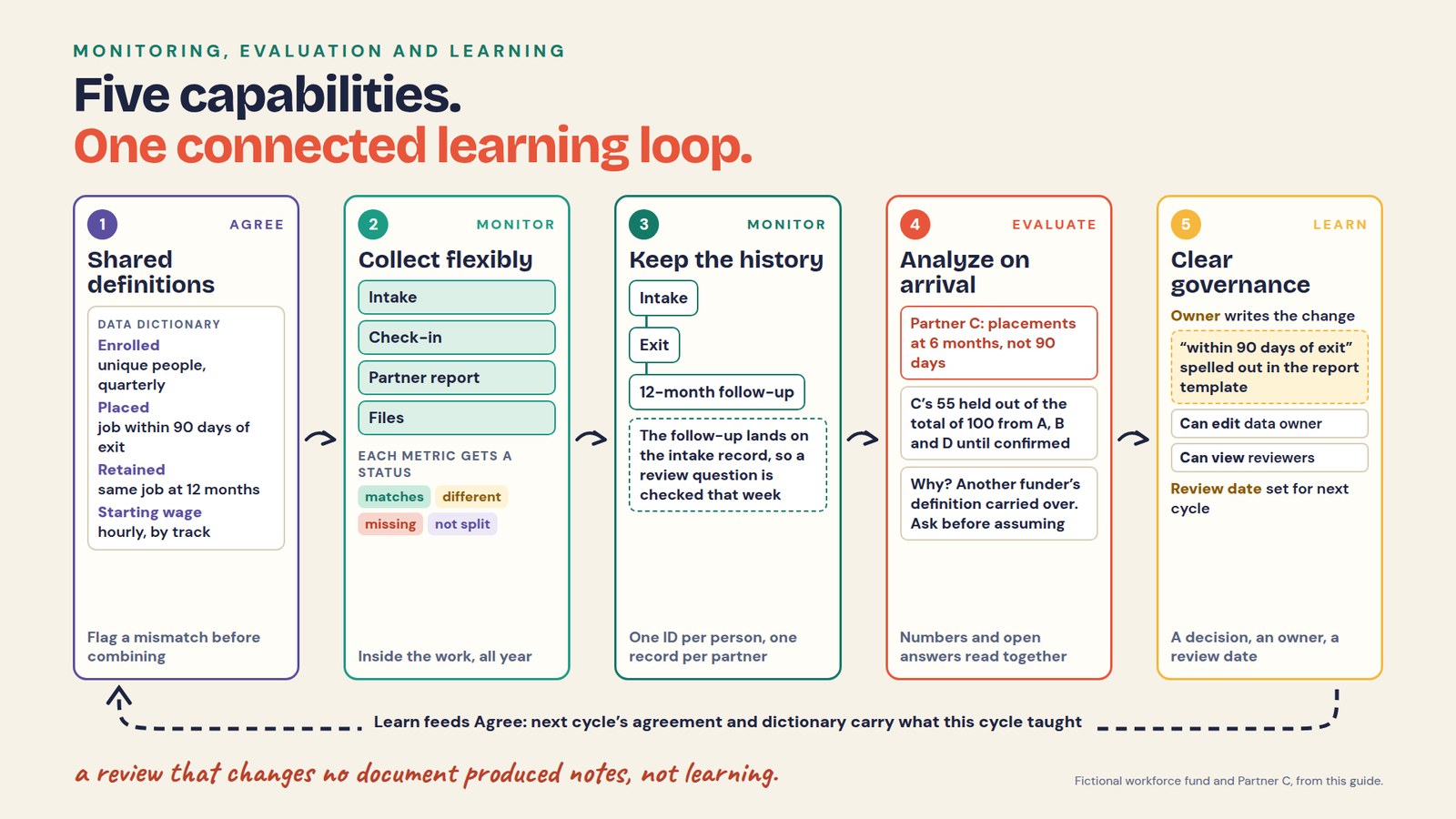
Partner C's six-month window suggests the 90-day rule belongs in the reporting template itself, not only in the agreement. Its single wage average suggests adding track to the intake form, so wage can be split from the first record. And 12-month retention belongs on the annual calendar with a due date, so no one reads its absence as a miss.
That is the loop: agreement, reports, check, roll-up, report, and back to the agreement. Start the next cycle at Turn the onboarding call into a reporting agreement with this year's gap log open, and as a team practice keep a change log of what changed and who approved it.
What should a portfolio report not claim?
In short: It reports what partners observed and what the portfolio can add up; it does not prove the fund caused the change.
Four partners serving different people is not a controlled study. "100 people placed within 90 days" is a count, not evidence that the fund's money produced those jobs, so where a board asks about cause, say what further evidence would be needed. If you plan to put a dollar value on results, the optional chapter How to put a credible dollar value on your results covers when that holds up.
Try it on your own portfolio
- Write the question your next board or donor report answers, in one sentence.
- Fill the outline table with your own sources, and mark any empty cell rather than guessing.
- Write five lines of board taste from the questions asked at your last two meetings.
- Draft with the prompt, then check every number against its source.
- List three changes for next year's agreement from your gap log.
Check your reasoning
For the workforce fund, the question is whether trainees get jobs within 90 days and keep them. The headline is 100 placed within 90 days from A, B and D, with the completer count beside it. Held: C's 55 on a six-month definition, and C's retention not yet available. The changes: state the 90-day rule in the template, add track at intake, put retention on the annual calendar. If the draft says 155 anywhere, unchecked numbers got into the inputs.
Questions teams ask
How long should a portfolio report be?
Long enough to answer the board's question and no longer. Many boards read page one closely and skim the rest, so put the question, the headline results and anything held on the first page, and move partner tables to an appendix. Your board taste file is a better guide than any rule.
Can we name partners and participants in a donor report?
Only with their agreement, and only in the way they are comfortable with. Some partners welcome recognition; others work with people for whom visibility carries risk. Use participant stories only with the permission the partner collected for that audience, and when in doubt, describe a partner by its role and leave participants unnamed.
What if the board wants one number?
Give them one number with its denominator and its note. "One hundred people placed within 90 days, out of those who completed training at three of our four partners; the fourth is being confirmed" is still one line. A number without the held note is shorter, but it loses trust the moment a board member asks how it was counted.
Should partners see the portfolio report?
Yes, if you can. Partners see how their numbers were used, can spot an error before it spreads, and learn why a held number mattered. The gap log questions then feel less like an audit and more like part of a shared result. Remove anything confidential to other partners first.
How is a portfolio report different from a partner's report to us?
A partner's report describes one program against one agreement. A portfolio report describes several partners against the same agreement, so its main work is honest aggregation: only shared definitions add up, and anything held is shown. The funded partner road, starting at Map every funder's ask to one evidence base, covers the other side of the same exchange.