


Academy / Measurement & reporting
Course progress and additional readings
Measurement & reporting
You will learn: how to run and record the onboarding call, turn its transcript into a draft theory of change and a reporting agreement table, and get both sides to sign off.
Who this is for: both sides of a new grant or investment. The funder usually leads the onboarding call and brings the core metrics it tracks across the portfolio. The funded partner (the grantee or investee) brings its own goals, its theory of change if it has one, and what it already collects.
Why do most reporting problems start before the first report?
In short: because the two sides never wrote down what gets reported and what each number means. Each side fills the gap with its own reading, and the first report shows the difference months later.
A funder asks for "job placements". The program team counts anyone who found work within six months. The funder meant a job that started within 90 days of leaving training. Both numbers are honest, and they cannot be compared.
The mistake happened in the first conversation, when "placement" was said and never defined. By the time anyone notices, the quarter is closed.
Goals are discussed on a call, the grant letter lists outcome areas, and each report arrives in its own shape. The funder spends the review asking what each number means.
One page lists each metric, its plain definition, when it is due and where it comes from. Both sides signed it. Every report is checked against that page.
What should you cover in a funder onboarding call?
In short: six things: the partner's goals, who the program serves, the change it expects, what it already collects, the reporting rhythm, and how the funder reads reports. Each topic becomes a line in the theory of change or the agreement.
| Topic | Question to ask | What it becomes |
|---|---|---|
| Goals | What would success look like in three years? | The long-term change |
| Who you serve | Who enrolls, and who do you turn away? | Who is counted, and the splits |
| Expected change | What changes for a person, and by when? | Outcome steps and time windows |
| What you collect | Which forms and surveys do you already run? | The source of each metric |
| Reporting rhythm | What can you report quarterly, and what only yearly? | When each metric is due |
| How the funder reads | Who reads our report, and for what decision? | A short note on format and words |
Ask the question that could change a number. When someone says "placed" or "completed", ask how they would count one person. The answer is the definition you will write down.
Let the partner talk most, and start from what it already collects. Measurement is designed inside its own workflow, as the Foundations course describes, so reuse those forms before asking for new ones.
How do you record and transcribe the call with consent?
In short: ask permission at the start, say on the recording who will see the transcript and what it is for, and keep it with the partner's record. Most meeting tools can record and transcribe.
A recording protects both sides: when a definition is questioned a year later, you can go back to the exact words.
Keep the purpose narrow: the transcript is for drafting, and only the people who work on this grant should see it. If participants' names come up, leave them out of what you send to an AI tool; the Foundations chapter on what the assistant may see covers that choice.
How do you turn a call transcript into a theory of change and an agreement?
In short: give the transcript to an AI tool with a prompt that asks for two drafts, a theory of change and an agreement table, and tells it to use only what was said. Then read both drafts against the transcript.
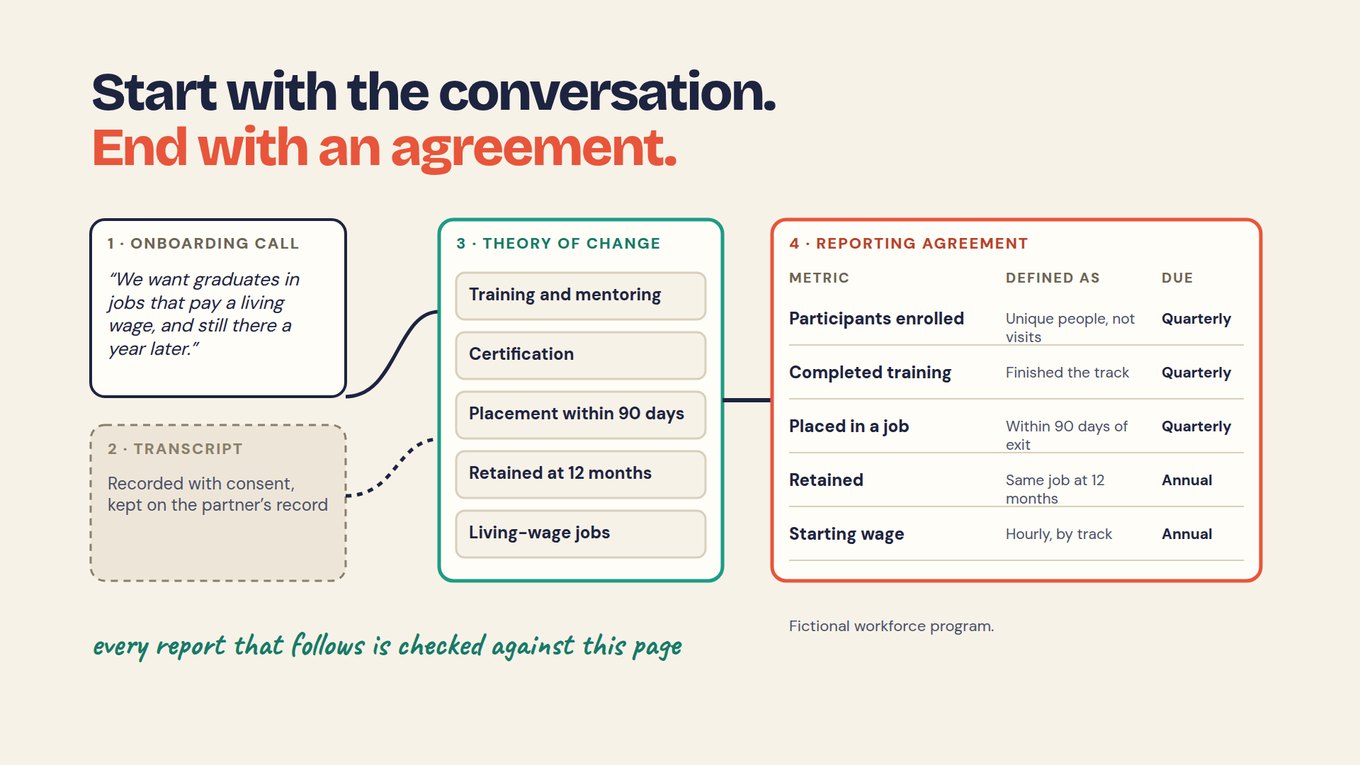
In the course's fictional example, a regional workforce fund holds this call with each of its four job-training partners. One partner says it wants graduates in jobs that pay a living wage, and still there a year later. That sentence becomes a chain of steps and five metrics.
The prompt below asks the tool to label every row by how sure it is. That separation keeps a guess from looking like a requirement.
Prompt · paste into Claude, ChatGPT or your AI tool
You are helping a funder and a funded partner turn an onboarding call into two drafts. Use only the transcript below. Do not add goals, metrics or numbers that nobody said.

Part A. Draft theory of change
1. Write the long-term change the partner wants, in the partner's words.
2. List the steps from activities to that change, in order: activities, outputs, outcomes, long-term change.
3. Under each arrow, write the assumption that must hold for the next step to follow.

Part B. Draft reporting agreement
Make a table with four columns: Metric | Plain definition | When it is due | Source.
- Write each definition so a new staff member could count it the same way (for example, "unique people, not visits").
- Source is the form, survey or record the number will come from. If nobody named one, write "not discussed".

Label every row of both drafts:
Required = the funder asked for it
Preferred = mentioned as nice to have
Inferred = your reading, not said directly
Unresolved = unclear or conflicting
Quote the transcript line behind each row.

End with the questions both sides must answer before sign-off.

Transcript:
[PASTE TRANSCRIPT]

Partner's existing theory of change or logic model, if any:
[PASTE, OR WRITE "NONE"]
Read the Unresolved rows first. They are the questions you send back, and they are cheaper to settle now than after a year of collection.
What goes in a reporting agreement?
In short: a short table of the metrics to report, each with a plain definition, a due date and a source, plus who signed off. It can be an annex to the grant agreement or a page of its own.
Copy the table and replace the rows with yours. If a definition needs a paragraph, it probably hides two metrics.
| Metric | Plain definition | Due | Source |
|---|---|---|---|
| Participants enrolled | Unique people, not visits | Quarterly | Enrollment form |
| Completed training | Finished the track | Quarterly | Completion record |
| Placed in a job | Job within 90 days of exit | Quarterly | Placement survey |
| Retained | Same job at 12 months | Annual | 12-month follow-up |
| Starting wage | Hourly, by track | Annual | Placement survey |
Workforce fund example, fictional. The sources are illustrative; use the forms your partner already runs.
AGREEMENT HEADER · FICTIONAL EXAMPLE
A real funder drafts both during the call.
AHA Ventures, the investment arm of the American Heart Association, is growing its portfolio from 19 to more than 40 companies. Its head of impact drafts each company's logic model and data dictionary during the onboarding call, from the call itself, with Sopact Sense. The company leaves the call with a draft to review instead of a template to fill in.
Who reviews and signs off the draft?
In short: both sides. The funder checks that the core metrics match what it tracks across the portfolio; the partner checks that every definition can be counted from records it keeps.
Send both drafts within a few days, open questions at the top. Whoever runs the partner's data should read them: a definition they cannot count is a promise the report will break.
When a definition changes later, add a line to the change log instead of overwriting it, so last year's report can still be read by last year's rule.
ASK ANY TOOL, INCLUDING OURS
Give any AI tool the transcript and the draft agreement and ask: "Which metric in this agreement could two people count differently? Quote the words that allow it." In Sopact Sense, the transcript can sit on the partner's record, and an Intelligence Cell can read each uploaded transcript on arrival with a prompt you configure, such as the one above.
What this cannot do. A transcript records what was said, not what was agreed. The AI draft can make a passing remark look like a commitment, and it cannot tell whether the partner's forms can produce a number. Only the people who sign off can settle that.
What if a partner reports to several funders?
In short: make one agreement per funder, using the same table. Later you map every funder's rows to one evidence base, so the same records answer all of them.
A job-training program might send a quarterly template to one funder, an annual narrative to another and IRIS+ metrics to a third. Where two funders say "placement" differently, their agreements show it on day one.
The mapping happens on the funded partner road, in map every funder's ask to one evidence base. How each funder reads reports can be noted too, in capture each funder's taste, and your own.
Next, shape the draft theory of change into the format the funder expects in one change model, four formats, then give each metric a full entry in a shared data dictionary.
Try it on your own reporting
- Pick one current grant or investment and find the words it uses for its main outcome.
- Write the definition you think both sides hold, in under ten words.
- Add when it is due and which form or survey the number comes from.
- Send the row to the other side and ask: "Is this how you would count it?"
- Record the answer, who gave it and the date.
Check your reasoning
In the workforce example, "placed in a job" became "a job within 90 days of exit", due quarterly, from the placement survey. If one partner later counts placements within six months instead, the agreement shows that the report changed the rule, not the funder. The fund can ask one clear question: "Can you count placements within 90 days, as agreed?"
Questions teams ask
Who should be on the onboarding call?
From the funder, the person who will read the reports, usually the portfolio or grant manager. From the funded partner, the program lead and whoever runs its data, because that person knows what can be counted. Add a grants lead if they write the reports. Keep it small enough that everyone speaks.
Is the reporting agreement the same as the grant agreement?
Not always. The grant agreement covers money, terms and legal duties. The reporting agreement covers the metrics to report, what each one means, when it is due and where it comes from. It can be an annex or a separate page; what matters is that it is written, dated and signed off by someone on each side.
What if we cannot count a metric the way the funder wants?
Say so before sign-off, and propose what you can count. If you cannot reach people at 12 months yet, say when you will, and write the gap and the plan into the agreement. A funder would rather read an honest gap on day one than find a different definition in the third quarterly report.
Can the partner bring its own theory of change?
Yes, and it should. Many partners already have a theory of change or logic model from their own planning. Paste it into the prompt with the transcript so the draft builds on it rather than replacing it. The funder's core metrics then sit inside the partner's model, so the agreement fits the way the program already works.