


Additional course links
You leave with: An evidence map that traces one funded promise from application to first report, and a checklist for testing the grant system you already run.
Where this fits: Lesson 1 asks you to design the R-2 intake from the decision it supports. Before you write step one, this deep dive follows one applicant, A-31, from application to its first quarterly report, so you can see which later answers depend on what intake collects. Bring back a short list of what the award and the first report will need from the form, and any gaps you find in the system you run today.
Watch · 6:30–8:14 · think end to end, then start small
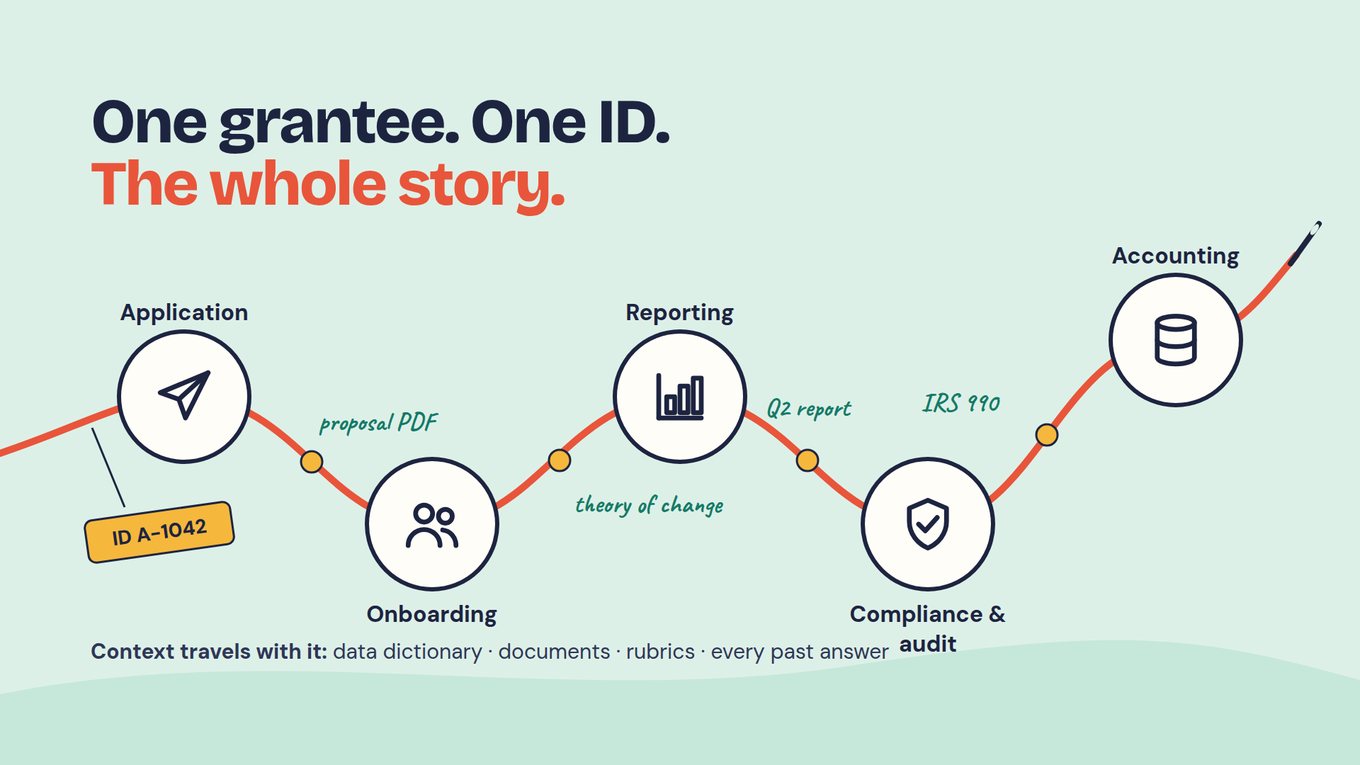
Unmesh lays out the whole cycle — applications, onboarding, grantee reporting, compliance, accounting — and then argues for starting with the application step, and with fellowships or scholarships before large grants that need heavy due diligence. Note his point that a human still reviews the scores. Watch on YouTube ↗
Jump to: 7:40 — don't boil the ocean · 8:14 — the onboarding call becomes the plan
Grant intelligence is the practice of keeping an application, its review evidence, the award decision and every later report on one connected record, and reading that evidence as it arrives instead of only storing it. It lets a team explain why an applicant was funded, what it agreed to deliver, whether it is on track, and where each answer came from. It works alongside a grant management system; payments, approvals and financial controls stay where they are.
See the whole cycle before you design step one
On a Monday, Horizon's board chair asks: "What did R-2 fund, and is it working?" The same week the auditor asks for proof behind the A-31 decision, and finance wants spend against budget for each grantee. None of those answers is created at the end of the cycle. Each depends on something intake did or did not collect.
In most configured systems the pieces live apart: the application in the portal, the rationale in minutes, the reporting template in another form, the answers in an export to Excel. Traditional grant systems are good at workflow, forms, approvals and payment records. Their limit is that they store evidence rather than read it, so every question means reassembling the story by hand.
Trace A-31 from application to first report
Here is one fictional grant, Eastgate Youth Works, followed through R-2. The right-hand column is what each step hands to the next.
| Step | What happens to A-31 | What it leaves for the next step |
|---|---|---|
| 1. Define the decision | R-2 will fund about 10 one-year grants of up to $25,000 for youth employment programs serving 16–24-year-olds in Lake County | Four eligibility gates and a four-criterion, 100-point rubric |
| 2. Collect once | Eastgate requests $24,000 for a 12-week job-readiness and placement program, with narrative answers, a budget and an employer letter | One record with a persistent ID: answers, uploads and dates |
| 3. Read on arrival | Draft scores of 4, 3, 4 and 3 give 70 of 100; the employer letter is flagged as an expression of interest, not a confirmed placement role | Draft scores with the sentence behind each |
| 4. People decide | Reviewers split on feasibility, 4 and 2; calibration settles the anchor at 3. Approved with a condition: confirm the employer placement role before the second payment | Rationale, calibration note and the condition |
| 5. Award becomes the plan | A 60–90 minute onboarding call agrees goals, responsibilities, a theory of change and quarterly measures: unique youth enrolled (target 200 over the year), attendance at 3 of the first 4 sessions, job placements at 90 days, budget against actual | Measure definitions on the same record as the award |
| 6. Report read on arrival | Eastgate uploads its own program report and budget workbook. Q1: 180 registrations; 108 of 150 eligible participants attended at least 3 of the first 4 sessions; $2,000 moved from materials to transport stipends, approved with a reason | Flags: 30 registrations need a status; registrations are not enrollments |
| 7. Questions answered | The board chair, auditor and finance ask their questions of the record | Answers with sources, not an export |
Notice the dependencies. The award condition exists only because intake asked which employer commitments were confirmed. The Q1 check works only because onboarding defined "enrolled" and "attended" first. The auditor's question is answerable only because review kept the sentence behind each score. Each is a choice made months earlier.
Reviewer disagreement is evidence
When one reviewer scores A-31's feasibility 4 and another 2, averaging gives 3. Calibration also landed on 3, but for a reason the committee can use: the letter is an expression of interest, and that is what became the award condition. An average would have hidden the one fact that mattered.
Keep individual scores, notes and the rationale together rather than a mean. The Hult Prize selection process is a published example of the same separation: judges score individually, deliberate, and reach a shared decision. It is a competition, but the practice carries over.
What to check in the grant system you already run
Take one completed grant and answer each question from the system alone, without email or a spreadsheet. Some platforms handle several of these well, and "grant intelligence" is this course's approach, not a software category. Treat the table as a test on your own data, not a verdict.
| Question | Open this for one past grant | A gap looks like |
|---|---|---|
| Why was this applicant selected? | Rubric version, each reviewer's scores and notes, the committee rationale | A score or status with no reasoning behind it |
| Can a reviewer see the sentence behind a score? | One criterion score and the application it came from | Reviewers search attachments to find the evidence |
| Does the system read narratives and PDFs, or only store them? | A proposal PDF and a long narrative answer | Files open as files; nothing is extracted, compared or flagged |
| What did the award commit to? | The agreement, its conditions and any later change | Conditions tracked in email; reports measured against a superseded promise |
| What does a reported number mean? | The indicator's definition, period, denominator and source | Registrations compared with enrollments as if they were the same |
| What changed since the last report? | Dated updates, corrections and follow-up notes | An overwritten figure with no history |
| Can you answer a new question without an export? | The board's last unexpected question | An answer rebuilt in Excel over a weekend |
| What does the next program cost to set up? | The configuration work behind last round | Months of setup, vendor tickets, one admin nobody can replace |
Each gap you recognize is a place to start, and the first four usually trace back to intake. Keep payments and financial controls in the system of record either way. For a buyer's view of the same questions, see grant management software for foundations.
Where grant intelligence fits, and where it does not
| Strong fit | Not the main fit |
|---|---|
| Foundation and public grant programs with reporting after award | One-time donations with no application or reporting relationship |
| Scholarships and fellowships | Procurement and vendor bidding |
| Accelerators with an application-to-program journey | Internal budgeting and financial planning |
| Reviews where narratives and documents carry the evidence | A purely transactional payment process |
| A small first pilot, such as R-2, that needs proof within one cycle | Automated awards with no accountable human decision |
The limit worth stating once: AI can locate evidence, check completeness, apply a published rubric, compare reviewers and draft questions, but eligibility, award, compliance and renewal decisions stay with accountable people. Every AI output should open to its source. The NIST AI Risk Management Framework is voluntary guidance for testing that kind of workflow in its own context; it is not a certification.
In Sopact Sense, a persistent unique ID holds the thread: A-31's answers, scores, rationale, onboarding transcript and Q1 upload sit on one record. Intelligence Cells read each answer and document as it arrives, an Intelligence Row summarizes the grantee, and the AI Assistant answers questions like the board chair's with sources. Claude or ChatGPT can query the same record through MCP.
Put it into practice
Build an evidence map for one funded promise
- Use A-31 from
horizon-r2-applications.csvandeastgate-q1-update.csv, or one grant of your own. Pick one reporting period. - Fill a four-column map: the commitment, its approved definition, the result and its source, and the next action. The first rows are started below.
- Beside each row, name the intake field or decision record the row depends on. Carry that list into your field-role table in step 1 of the workbook.
- Run the system checklist above on the same grant and mark each question answered, partly answered or not answered.
| Commitment | Approved definition | Q1 result and source | Next action |
|---|---|---|---|
| Enroll 200 unique youth over the year | Unique eligible participants, duplicates removed | 180 registrations; 150 eligible (program report) | Give the other 30 a status: not yet eligible, not started, withdrawn or unknown |
| Consistent attendance | Eligible participants attending at least 3 of the first 4 sessions | 108 of 150 = 72% (attendance log) | Ask what kept the others away |
| Budget against actual | Spend by approved budget line | $2,000 moved from materials to transport stipends (budget workbook) | Keep the Q1 approval and its reason on the record |
Download the workbook (PDF)
Practice data: horizon-r2-applications.csv · horizon-rubric.csv · calibration-scores.csv · eastgate-q1-update.csv
Check your reasoning before moving on
The attendance rate is 108 ÷ 150 = 72%. Dividing by all 180 registrations gives 60%, which answers a different question, so the denominator belongs in the definition. Registrations are not enrollments; the 30 without a status stay unknown rather than becoming zero or "enrolled". Add a fourth row for the award condition: confirm the employer placement role before the second payment. It depends on the intake question about confirmed commitments: carry that dependency back to Lesson 1.
Questions grant teams ask
What is grant intelligence?
Grant intelligence keeps an application, its review evidence, the award decision and every later report on one connected record, and reads that evidence as it arrives. A team can then explain why an applicant was funded, what it agreed to deliver, whether it is on track and where each answer came from, without rebuilding the story from exports each time someone asks.
How is grant intelligence different from grant management software?
Grant management software is good at workflow, forms, approvals, permissions and payment records. It usually stores evidence rather than reading it. Grant intelligence reads and connects the evidence across those records: narratives, documents, scores, decisions and reports. It can sit beside an existing system, which is why this course starts with one small program instead of a migration.
Does AI decide which applicants receive funding?
No. AI can read applications, apply a published rubric, draft scores with the sentence behind each, and flag missing or ambiguous evidence. Reviewers check that evidence against the source, and accountable people make and record eligibility, award and renewal decisions, including any override of a draft score.
How does grant intelligence reduce grantee reporting burden?
It reuses what grantees already produce. Instead of re-keying metrics into a new template, a grantee uploads its own program report or budget workbook, which is read against the definitions agreed at award. When something is missing or unclear, the team sends one focused question tied to the grantee's record instead of asking for the whole report again.
Can qualitative and quantitative evidence be reviewed together?
Yes, and they should be. A count, a budget line, a participant comment and a narrative explanation mean more side by side. For A-31, the attendance rate and the budget move toward transport stipends are easier to interpret together than apart.
What makes a grant audit trail defensible?
Each important score, decision, figure and claim keeps its definition, source, date, owner and any documented exception. For A-31 that means the draft and final scores, the sentence behind each, the calibration note, the award condition and the approval of the Q1 budget change, all on the same record and created during the work rather than reconstructed at the end.
Where should a grantmaker start?
Start with one past grant: trace one funded promise from the application to the latest report, and note every break in the path. Then pick your smallest program, such as a small grant round, fellowship or scholarship, and run one complete cycle with a connected record while the current system keeps running for everything else.