


Course progress and additional readings
Foundations · Lesson 6 of 6
You will make: A report brief where each claim links to its source, coverage and unknowns, a five-step review before sharing, and a pilot plan for one workflow.
It is Thursday. The partner employers want a spring-cohort summary by Monday, the board chair has asked what changed, and the delivery manager has to decide whether the practice session goes into the next course. From lesson 5 you have the finding: 15 of 25 respondents used the skill at work within 30 days, and 15 of the 40 completers are unknown. Now it becomes a report someone can check, and the course becomes a pilot for next cycle.
Why do reports stall on the usual paths?
In short: The report is where scattered data gets its last chance to be reconciled, and there is rarely time. A fluent paragraph with no path back to the records falls apart when someone asks “which learners?”
On the most common path, someone exports the follow-up survey to Excel, pastes it into ChatGPT and asks for a summary. The draft reads well, but nobody can see which rows produced “60%”, the same file pasted twice can give two answers, and learner names have travelled into a chat window. A CRM with AI bolted on counts registrations but never connected the survey comments and mentor notes. A warehouse shows the number, and “what stopped the other ten?” goes back to a spreadsheet. Either way the team spends the week reconciling instead of deciding.
A pasted export, a confident paragraph, no row behind any number. The reviewer trusts the draft or redoes the analysis.
Each response already carries the learner’s ID, wave and cohort. A draft cites the records it used, and a reviewer opens them before the report goes out.
What goes in a report brief?
In short: Six lines: audience, decision, period, evidence required, detail allowed, and coverage and unknowns. Write it before any narrative, and separate what the reader requires from what you guess they want.
REPORT BRIEF · TRAINING EXAMPLE (ILLUSTRATIVE)
“Provide a 30-day follow-up result” in a partner agreement is a requirement. “They probably want a success story” is a guess to check. Design changes how a report looks, never its denominator or who may see a quote.
How does every claim point to a record?
In short: Write the finding in four sentences (result, coverage and timing, limitation, action) and attach to each claim the record it came from, its coverage and what is unknown. If a reviewer can’t open the source in one step, the claim isn’t ready.
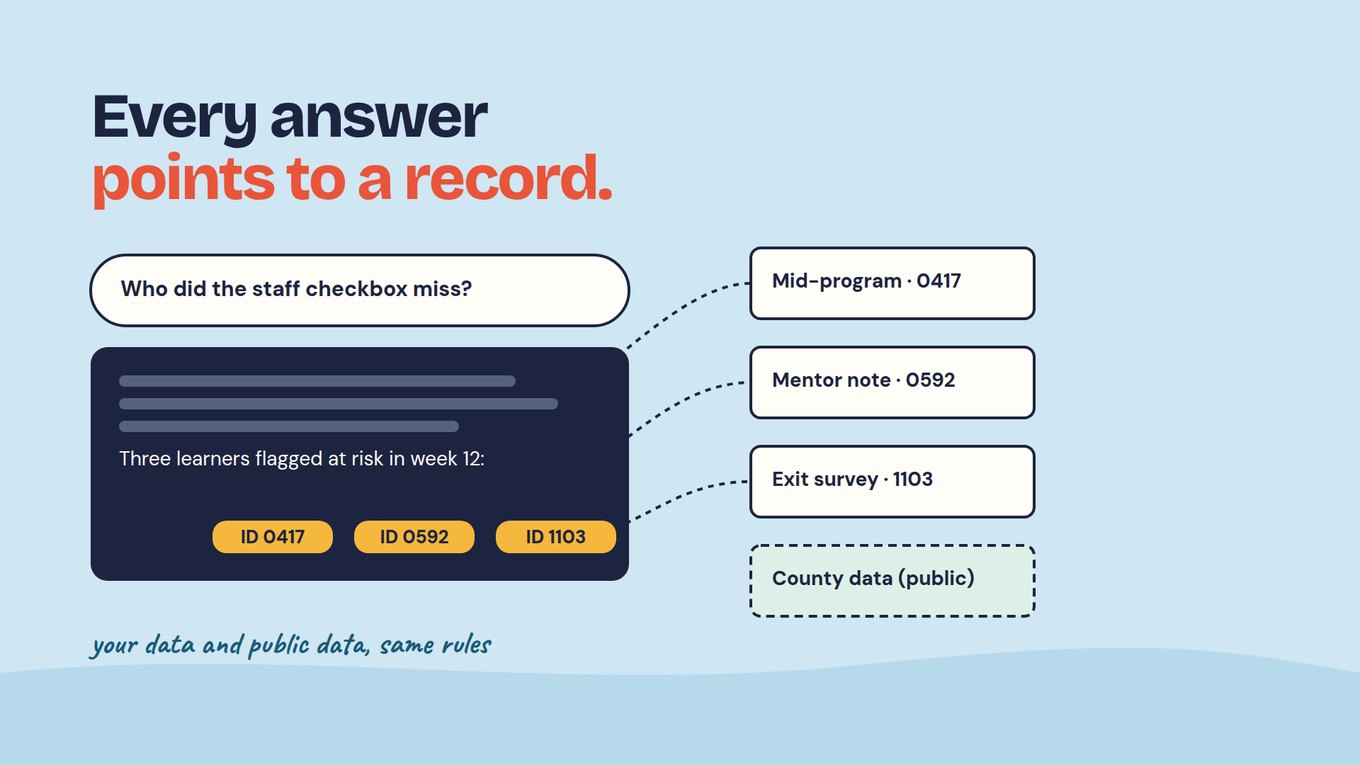
The talk sets the standard with one question: “Who did the staff checkbox miss?” The answer names three learners flagged at risk in week 12, and each ID links to its record: a mid-program survey, a mentor note, an exit survey. County data, loaded as a public survey, follows the same rules. A report should work the same way.
Training example · fictional
Finding for the delivery manager. Forty learners completed the spring course. At the 30-day follow-up, 25 responded and 15 said they used the skill at work: 60% of respondents, with 62.5% coverage. Outcomes are unknown for 15 completers, and these self-reports don’t show that the course caused the change. The course coordinator will test a 45-minute practice session with the next cohort and check the same measure in the same window.
Behind it sits a claim-and-source table, the part of the brief a reviewer reads first.
| Claim | Source record | Coverage | Unknowns |
|---|---|---|---|
| 40 learners completed | Spring completion list, dated | All completers | None for this count |
| 15 of 25 respondents used the skill (60%) | 30-day follow-up, “used skill” question, day 25–35 | 25 of 40 (62.5%) | 15 completers with no reply; they may differ from those who answered |
| 5 of the 8 non-users who described a barrier mentioned no time to practise | Reviewed open-ended answers, follow-up wave | 8 of the 10 who answered “no”; 1 declined, 1 left it blank | Says nothing about the 15 who didn’t reply |
| One learner’s path, used as illustration | Record 0417: intake, mentor note, exit, 30-day follow-up | One person | Shows how the change can look, not how common it is |
The last row is Maria: confidence 2 out of 5 at intake and 4 at exit, 10 of 12 sessions, a mentor who saw her lead a mock interview, and skill use on the job at 30 days. Because every piece carries ID 0417, checking it took minutes, not an afternoon of matching names across three tools. When the report is a longer narrative for a funder, with quotes to choose and permissions to confirm, use the deep dive on writing a cited funder narrative and bring back its claim-and-source table.
How do you review a report before you share it?
In short: Let AI draft from evidence you’ve already checked, then have someone who didn’t write the draft open every source, recompute every number and confirm every quote may be shared. A second AI pass can spot problems; it isn’t sign-off.
PROMPT · COPY INTO ANY AI TOOL
Using only the records and tables I have shared, draft a one-paragraph finding for [audience] about [decision].
Include the result with its numerator and denominator, response coverage, the time window, one limitation and the next action.
Rules: cite the record or table for every number. Do not claim the course caused the result. Report non-response as unknown. List anything the report needs that the evidence does not contain.
01 · OPEN
Open the record behind each claim, not a whole folder.
02 · RECOMPUTE
Redo 15 ÷ 25 and 25 ÷ 40 by hand; check the window.
03 · UNKNOWNS
The 15 non-respondents stay unknown in every version.
04 · PERMISSION
Quotes approved for this audience; no names or emails leave the team.
05 · SIGN
Record reviewer, date and changes in the team’s change log.
Five checks before a report leaves the team. The change log is a team practice, kept wherever your team keeps decisions.
Be honest about what review can’t settle. These are self-reports from 25 of 40 people, and the 15 who didn’t reply may differ. A 30-day checkpoint shows use at day 30, not lasting change, and showing the course caused it would need a comparison group. A link proves where a sentence came from, not that its interpretation is right. People decide what the finding means; AI helps find the records and draft the words.
What does one governed record look like in practice?
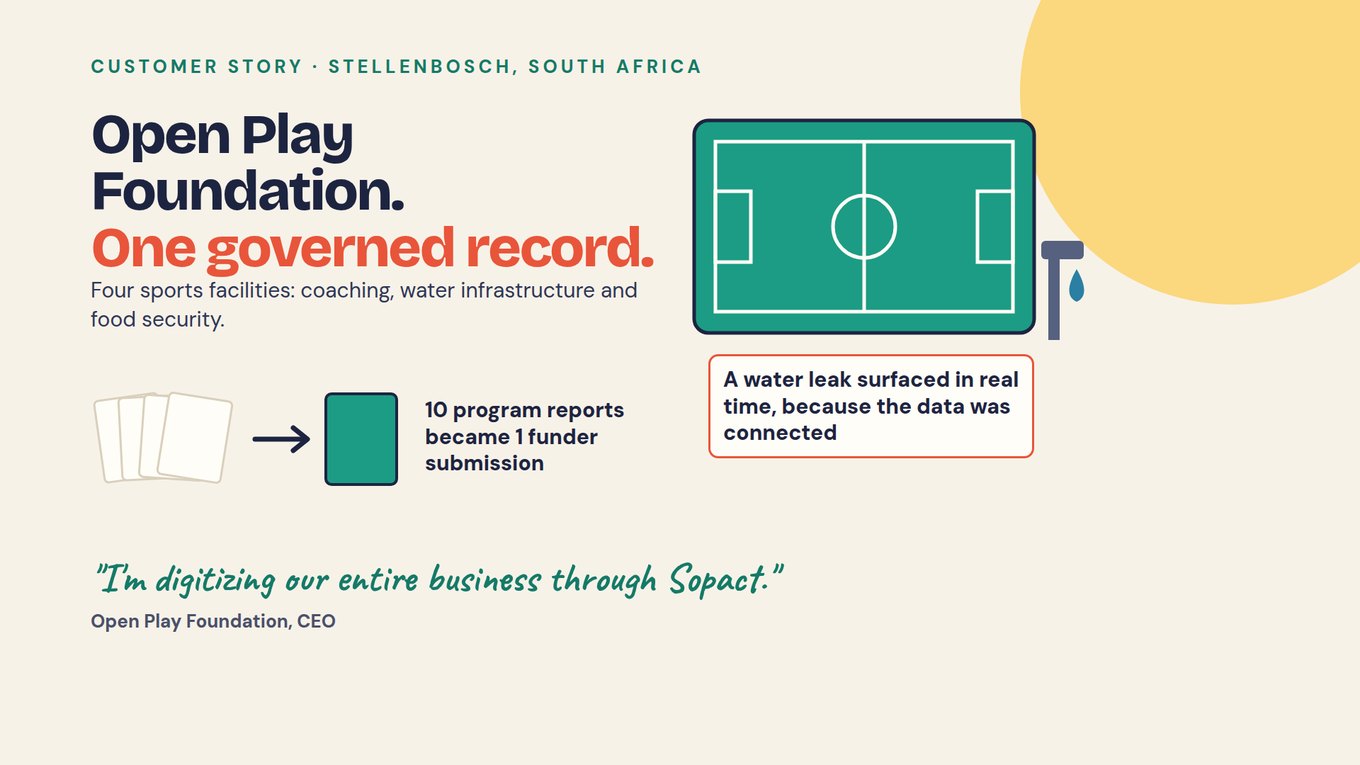
In short: Open Play Foundation runs four sports facilities in Stellenbosch, South Africa, covering coaching, water infrastructure and food security. On one governed record, ten program reports became one funder submission.
The second result matters as much as the first. A water leak surfaced in real time because the data was connected. When collection is governed from the first form, reporting stops being a scramble at the end of the year and becomes something the team notices during it. The organization’s CEO put it this way: “I’m digitizing our entire business through Sopact.”
How do you choose a workflow and run a pilot?
In short: Start with one form you already run, decide which fields AI may see, and add the next workflow when that one is working. A pilot is one question, one cohort, one owner and a review date.
The training team doesn’t rebuild everything. It starts with the registration form it already runs, so each learner gets an ID at the first form. Names, emails and phone numbers stay out of what AI sees; confidence scores, barrier answers and mentor notes go in. Once registration works, the exit survey and 30-day follow-up join the same ID. Nothing needs merging later, because the record was connected when it was collected.
PILOT PLAN · TRAINING EXAMPLE (ILLUSTRATIVE)
If the next cohort’s rate is higher, that is encouraging, not proof: the groups and response rates differ, and the report should say so.
Unmesh Sheth on why heavily configured systems still feel slow, and how to bring AI in one low-risk workflow at a time. The example is grant management; the pilot logic applies to a training program too. Watch on YouTube ↗
How do you test a tool before the pilot?
In short: Run the six checks from lesson 2 again with your report question, on any tool, ours included. A good answer names the records behind it, shows coverage, and gives the same result when you ask twice.
| Lesson 2 check | What to bring | What a good answer shows |
|---|---|---|
| 1. Collect flexibly | The follow-up form, an employer letter and the attendance spreadsheet | All three land on the right learner’s record, not in a folder beside it |
| 2. Keep every wave | A new form for people already on the record | Answers land on the same ID with no export, merge or IT ticket |
| 3. Analyze on arrival | Barrier answers, then the same question asked twice | The same counts both times, each theme opening the passage behind it |
| 4. Govern what AI sees | A form with name, email and phone; surveys from two teams or sites | You choose which fields reach the model, and the assistant uses only the surveys you picked |
| 5. Trace every answer | A wave where some people didn’t reply | Every line links to a record; the result carries its denominator, and no reply is never counted as “no” |
| 6. Owned by your team | The person who will run the pilot | They add a question to the report’s source form while you watch, with no IT ticket or consultant |
ASK ANY TOOL, INCLUDING OURS
Ask “Which completers used the skill after 30 days, and what stopped the others?” on your own follow-up data. A good answer gives the count with its denominator and coverage, lists the unknowns and links each reason to its response. Then ask for the four-sentence finding and a list of what the evidence doesn’t contain. If the tool fills a gap with a plausible number, you have your answer about it.
In Sopact Sense, each person gets a persistent ID at the first form and later workflows join that record. Each team works in its own folder, the AI Assistant stays locked until you pick its surveys, you choose which fields are sent to AI, and every line of an answer links to a record you can open. Claude or ChatGPT can query the same data through MCP. A shared place for definitions and frameworks is coming soon. Run the six checks on it as you would on anything else.
Which workflow course should you take next?
In short: Pick the course whose records and decisions look most like yours, and carry this plan into it rather than starting new documents.
Training, partners, portfolios and more have their own courses. See all workflow courses.
Add this to your plan
Open your working evidence plan ↗
- Write your report brief in six lines: audience, decision, period, evidence required, detail allowed, and coverage and unknowns.
- Write a four-sentence finding from your own data. For each claim, add a row: source record, coverage, unknowns.
- Name the reviewer and run the five checks: open, recompute, unknowns, permission, sign.
- Choose the one form you already run where the pilot starts. List the fields AI may see and the ones it may not.
- Set the owner, review date, success criteria and the next workflow to add to the same ID. Run lesson 2’s six checks on any tool you are considering.
Check your reasoning
A strong brief keeps 15 of 25, the 40 completers, the 62.5% coverage and the 30-day window together, and every claim has a record a reviewer can open. The 15 non-respondents stay unknown in every version. The finding makes no causal claim and ends with a test. The pilot starts on a form the team already runs, keeps names out of AI, has one owner and a review date, and succeeds only if a colleague can reproduce the result from the records without an export.
Questions teams ask
What makes a report useful to the people who read it?
It answers a decision they have to make, with checked numbers, stated coverage, clear limits and a next step. Start from the decision and the reader’s real requirements, not from all the data you have. A reader who can follow any claim back to its record will trust the rest of the report more.
Can AI write our report?
AI can draft it from records you’ve already checked and cite the source for each line. Your team still recomputes the numbers, confirms each quote is approved for the audience and removes any claim the evidence doesn’t support. A second AI review can catch problems, but the sign-off belongs to a person who didn’t write the draft.
How should the report change for different audiences?
Adjust detail, tone and format: learner IDs and approved notes for staff, aggregate results and approved quotes for partners and funders. Never change the numbers, the denominator, the coverage or the limitations between versions. If a shorter version would make “60% of respondents” read as “60% of everyone”, keep the denominator in the sentence.
How big should a pilot be?
Small enough to finish in one cycle: one question, one cohort, one form you already run and one owner. The aim is to test the whole process, from the first form to a reviewed report, including handover and corrections, before you add more workflows. Note any IT or vendor help you needed; a pilot that depends on it will struggle to grow.
What should we do after the pilot?
Review it against your success criteria on the review date. Fix whatever a colleague couldn’t reproduce, then add the next workflow to the same ID or start the workflow course that matches your records. Carry the same plan forward rather than starting new documents.
Deep dives for this lesson
Open one when the lesson raises that question, then come back. Each uses the same training-team example.