


Where the slowness starts
Maya runs grants at a foundation that gives about $25 million a year. She is a composite of the grant leads Unmesh Sheth, Sopact's founder, talks with: about 800 applications a cycle, 380 live grants, 12,000 grantee profiles, and the same heavily configured platform for over a decade. Nothing is broken, but everything is slow.
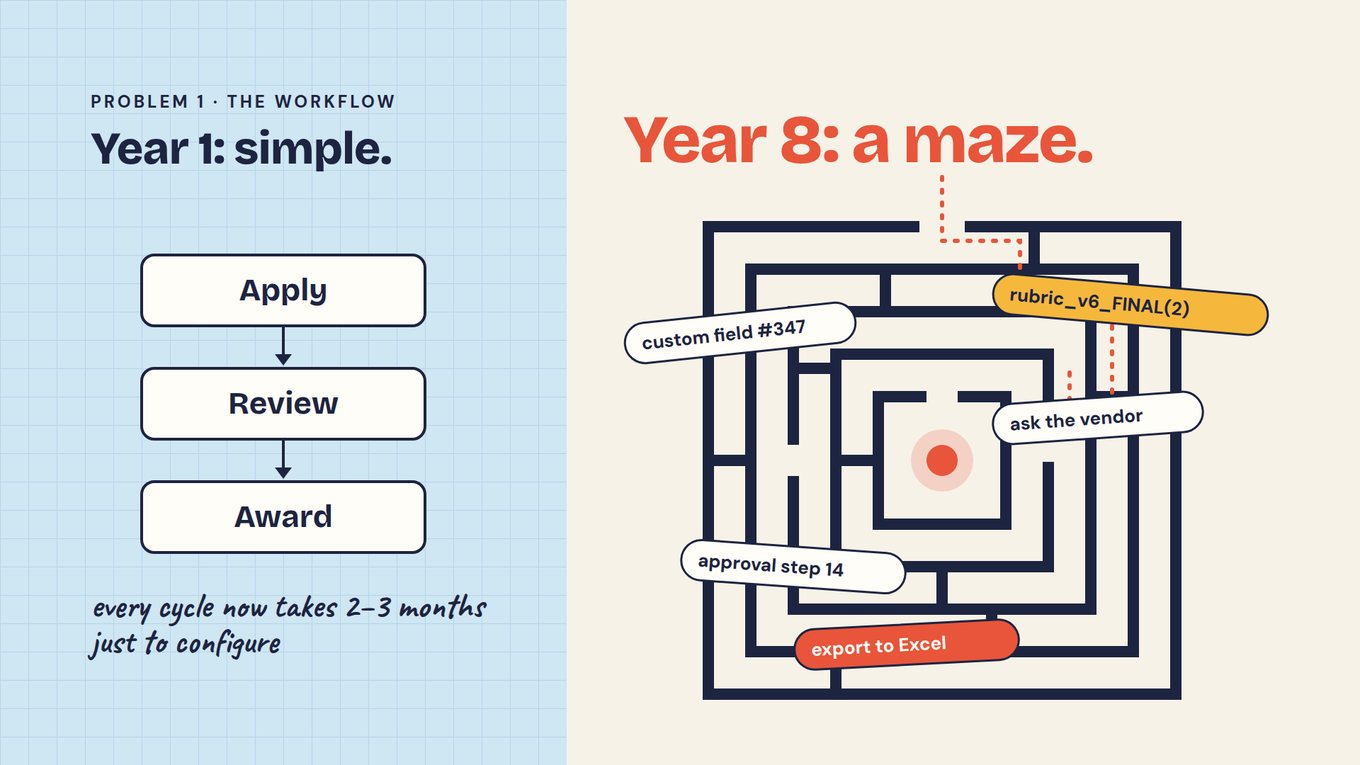
Ask Maya where the slow part is and she will point to the reading, the re-reading and the export to Excel. Trace it back and it begins at intake. Before a single application arrives, each cycle means configuring the form, reviewer preferences, rubric and approval steps again. In typical timelines from Sopact's work with application programs, traditional application software — non-AI-native tools such as Submittable or SurveyMonkey Apply — takes 2–3 months to set up the form, rubric and workflow, and another 2–3 months to read, re-read, score and select.
Now take your own seat. You are the grants manager at Horizon Foundation, a fictional regional funder. It has configured its grant system for eight years. In year one the process was apply, review, award. By year eight the form carries custom fields nobody can explain, a rubric copied and renamed for years, and 14 approval steps. The admin who built most of it has left, and nobody dares touch it.
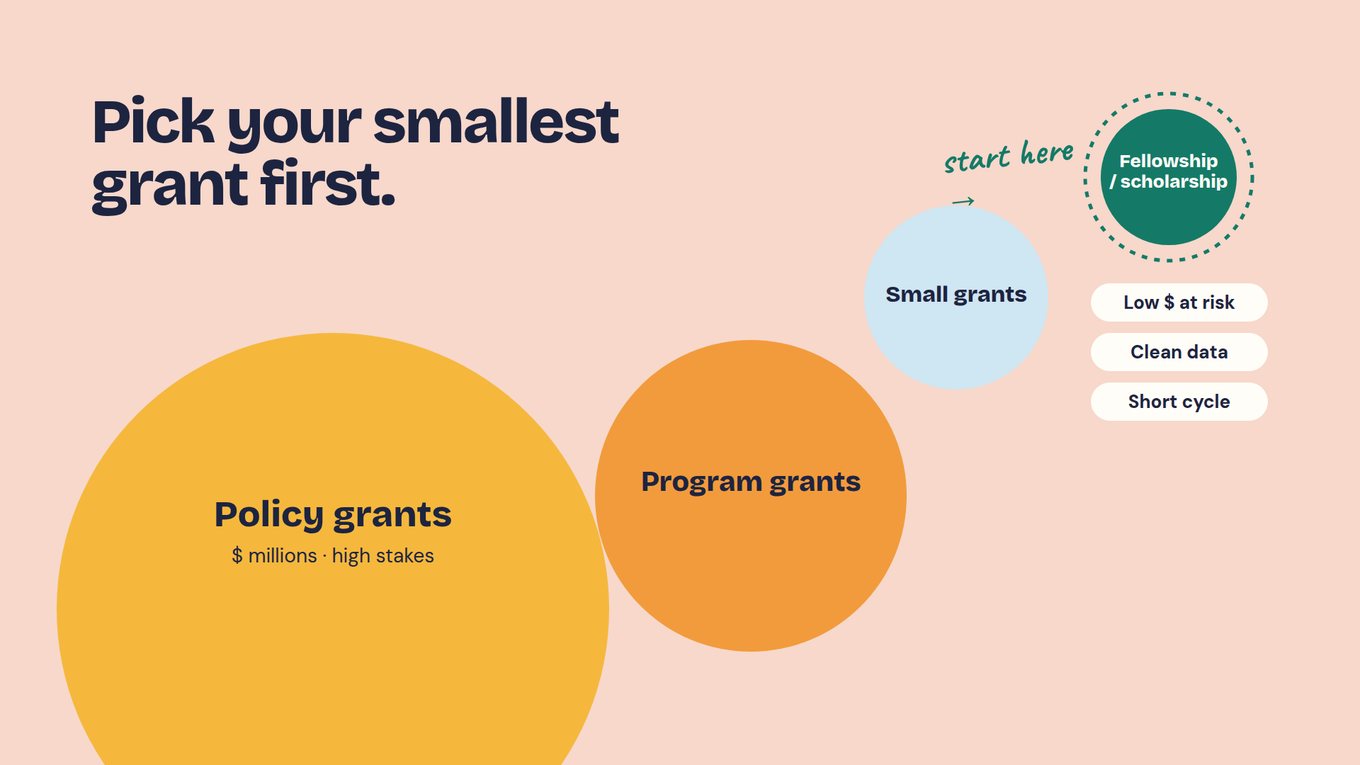
The instinct is to fix the whole maze at once, or buy a new one. This lesson asks for less. Keep Horizon's system running for its large grants. Pick one small program, design its intake from the decision it supports, and let AI read each application as it arrives while people keep the decision.
Watch · 1:14–2:13 · intake that listens
Unmesh shows an intake that looks like a survey but works as a data-collection design: a few profile questions, then open questions applicants answer in their own words. Watch for his point that "where do you live" is useful but builds no context. That is the shift you will make in the R-2 form. Watch on YouTube ↗
Jump to: 0:00 — collect from any source · 0:28 — barriers in applicants' own words · 0:47 — a prompt for each field
To design an application process, start from the decision you must make and work backward to the form. Write down what you are funding and who decides, then sort every field into an eligibility gate, a scored criterion or tracking metadata, and ask narrative questions that give reviewers the evidence each criterion needs. Publish the criteria, set the stages and applicant messages, and decide where AI reads and where people decide before the round opens.
Start with your smallest program
Horizon runs several programs. The one you will redesign is the smallest: the Youth Pathways Fund, round R-2. It makes one-year grants of up to $25,000 to organizations running youth employment programs for 16–24-year-olds in Lake County, which is also fictional. The round expects 64 applications, six reviewers (four staff and two community volunteers) and about 10 awards.
It is the right first choice: few dollars at risk, a short cycle, cleaner data than the large programs, and a rubric the team already argues about, so a better one is a problem people want solved.
Before you design step one, see the whole path an application travels, from review to award to the first quarterly report. What you ask at intake decides what you can answer at the end. If you have not traced a grant end to end, read what grant intelligence is, which follows one R-2 applicant from application to first report, then come back.
Write the decision before the form
Most intake redesigns start by editing the old form. Start instead with a one-page decision brief that answers five questions: what you fund, who is eligible, who decides, what each decision must be able to show later, and what an award will report.
Horizon example · fictional
Decision brief, Youth Pathways Fund R-2. We will fund about 10 one-year grants of up to $25,000 to organizations that help 16–24-year-olds in Lake County into work.
Eligible applicants serve Lake County, are a 501(c)(3) or apply through a fiscal sponsor, request $25,000 or less, and serve ages 16–24. Six reviewers score against a published 100-point rubric; the award committee decides and records any override.
For every award we must show the evidence behind each score and any condition attached. Funded programs report quarterly on young people enrolled, attendance, job placements and budget against actual.
Every field on the form now has to serve one of those sentences, or it goes. Notice the last sentence: the reporting plan already shapes intake, because an applicant who cannot say how they will count placements will struggle to report them.
Give every field one job: gate, criterion or metadata
Sort each field by what it does in the decision. Eligibility gates are pass/fail, checked before scoring. Scored criteria supply the evidence reviewers rate. Metadata identifies the applicant and lets you filter and report on the pool. A field can carry two documented jobs if you write both down.
Keeping these apart prevents two errors. An ineligible applicant is not scored low; it never enters the ranked pool. And a field collected for monitoring never quietly becomes a criterion.
| Field or upload | Role | How it is used | In the score? |
|---|---|---|---|
| Serves Lake County | Eligibility gate | Checked first, pass/fail | No |
| 501(c)(3) status, or a fiscal-sponsor letter | Eligibility gate | Checked first; the letter must be on file | No |
| Serves ages 16–24 | Eligibility gate | Checked first, pass/fail | No |
| Amount requested | Eligibility gate and scored evidence | $25,000 or less; compared with the budget | Only through budget justification |
| Budget and employer or partner letter attached | Completeness | Required items present and readable | No |
| The need and who you serve; the program and its pathway to employment | Scored criterion | Outcome pathway, 30 points | Yes |
| Delivery plan and partners; employer or partner letter | Scored criterion | Delivery feasibility, 30 points | Yes |
| Budget upload | Scored criterion | Budget justification, 20 points | Yes |
| How you will know it worked | Scored criterion | Learning and reporting plan, 20 points | Yes |
| Most recent Form 990, if the organization files one | Due-diligence evidence | Read before award | No |
| Organization name, contact, applicant ID | Metadata | Identity, duplicates, messages | No |
| Neighborhood served, primary language | Metadata | Filters and reporting on the pool | No |
Three rows deserve a second look. The requested amount carries two documented uses. The Form 990 is not scored; Horizon reads it before award, which Lesson 3 covers. Completeness sits apart from eligibility: a missing letter is a gap to clarify, not a failed rule.
The table says what each field is for, not how it is collected so the evidence survives: definitions and units, structured answers versus documents, unreadable files, corrections kept beside the original. If your old form has fields whose meaning drifted over the years, work through collecting applications clean at the source before you finalize it.
Publish the weights and show the arithmetic
Horizon's rubric has four criteria worth 100 points: outcome pathway 30, delivery feasibility 30, budget justification 20, and learning and reporting plan 20. Each criterion is scored on a five-point scale with written anchors, and its contribution is the weight times the score, divided by five. Gates and metadata sit outside the 100.
Horizon example · fictional
A-31, Eastgate Youth Works requests $24,000 for a 12-week job-readiness and placement program. It passes all four gates, so it enters the ranked pool.
| Criterion | Weight | Score | Contribution |
|---|---|---|---|
| Outcome pathway | 30 | 4 of 5 | 30 × 4 ÷ 5 = 24 |
| Delivery feasibility | 30 | 3 of 5 | 30 × 3 ÷ 5 = 18 |
| Budget justification | 20 | 4 of 5 | 20 × 4 ÷ 5 = 16 |
| Learning and reporting plan | 20 | 3 of 5 | 20 × 3 ÷ 5 = 12 |
| Total | 100 | 70 of 100 |
Feasibility is where reviewers split: one gave 4, reading Eastgate's employer letter as a commitment; another gave 2. The letter is an expression of interest, not a confirmed placement role. Lesson 2 shows how calibration settled it at 3.
Publish the criteria and weights with the call for applications, so applicants know what evidence matters and reviewers share one reference. Publishing the full anchors is a judgment call, covered in the questions below. Whatever you decide, do not change the scoring rules after you have seen the applications. If writing anchors is the hard part, work through the rubric and eligibility rules deep dive in Lesson 2 before you open the round.
Ask questions that listen
An application form looks like a survey, but it is a data-collection design. Location and primary language help you filter the pool; they do not tell a reviewer why this program will work for these young people. Specific narrative questions do, and each should feed one criterion.
| Instead of | Ask | Feeds |
|---|---|---|
| Who do you serve? | Describe the young people you serve and what stands between them and work: transportation, childcare, no clear goal, or something else. Where do they most often drop out? | Outcome pathway |
| List your partners. | Which employers or partners have committed to what, in writing? Say which commitments are confirmed and which are still interest. | Delivery feasibility |
| Attach your budget. | Attach the budget you already use, and explain the largest cost line in two or three sentences. | Budget justification |
| What are your outcomes? | How will you know it worked? Name what you will count, over what period, and how you will collect it. | Learning and reporting plan |
Questions like these also give AI something to read. As each answer arrives, a prompt configured for that field — in Sopact Sense, an Intelligence Cell — can pull out the barriers applicants name, point to the sentence behind a draft score, and flag a letter that expresses interest rather than commitment.
Read the delivery plan and the uploaded employer or partner letter for this application. Score Delivery feasibility from 1 to 5 using the attached anchors. Quote the sentence that supports the score. For each employer named, state whether the letter confirms a placement role or expresses interest. If the letter is missing or unreadable, say so and do not score.
Keep the applicant's work small and the door open
Every question costs applicants time, and the cost is not neutral. Long forms turn away small and newer organizations first, often the ones a youth employment fund most wants. If the decision brief does not need a field, cut it.
Then design for access: a form that works on a phone, saves and resumes, and comes in the languages your applicants use. Publish a realistic completion time, offer a way to request an accommodation, and accept documents organizations already keep, such as their own budget workbook, instead of asking them to re-key the same facts.
Decide now what happens when something is missing. In R-2, A-44 arrives without its fiscal-sponsor letter. It is not ineligible and not scored low: it is held, sent one request naming the letter, and scored once the letter arrives within the window. How to write that request, and tell a clarification from a second chance to improve, is in reducing applicant burden with focused clarification.
Set the stages and what applicants hear
Lock the shape of the round before you open it, because stages change both the form and the timeline. R-2 keeps a single application stage; an interview round would add weeks for a small grant.
| Stage | What happens | What applicants hear |
|---|---|---|
| Open | Applications arrive; each is read on arrival | A confirmation on submission, with what happens next |
| Completeness and eligibility | Gates checked; complete, eligible applications get a draft score; missing items held, not rejected | One clarification request that names the gap, if needed |
| Review | Six reviewers check evidence and score; conflicts declared first (R3 sits on A-17's board); scores calibrated on A-31 before the live batch | Nothing, unless a clarification is open |
| Decision | The committee decides and records overrides and conditions | An award with any condition, or a prompt, respectful decline |
| Award | A 60–90 minute onboarding call agrees the reporting plan | The reporting plan and its dates |
In typical timelines from Sopact's work with application programs, AI-native review takes about 2 weeks to set up intake, rubric and prompts, 1 day for AI to read and score every application, and 1–2 weeks for human judgment and follow-up: about 3–4 weeks, against 4–6 months with traditional application software.
The message teams skip is the decline. With 64 applicants and about 10 awards, most will be told no. Send it promptly, say what was assessed, and ask separately for consent to keep an application for future rounds.
Protect applicant data from the first field
Decide before collection who can see which fields. Community volunteer reviewers may need the narratives and the rubric, not contact details or the Form 990. Set how long you keep submissions, document those rules with the staff responsible for privacy, and apply them to AI too: decide where data is processed and who can query it. The AI workspace is another reader with an access level, not an exception.
Where AI sits: it reads and scores on arrival; people decide
The design above is what lets AI help: each answer has a job, each criterion has anchors, each prompt knows what to look for. What changes is where the reading happens.
The form stores answers and uploads. After the deadline, reviewers read every essay and letter and score by hand; staff reconcile scores in a spreadsheet for the committee.
Each answer and document is read on arrival, given a draft score with the sentence behind it, and flagged when evidence is missing. Reviewers check the evidence and score; the committee decides and records any override.
Put it in writing for the committee and applicants: AI prepares evidence and draft scores, reviewers check them against the source, people select. The Hult Prize has judges score individually, then deliberate to a shared decision; keep that line between a score and a decision.
One honest limit. A pilot round of 64 applications does not show that AI-assisted scoring is fair. Compare draft scores with independent reviewer scores across kinds of applicants, languages and formats, look into material differences, and record what you changed. The NIST AI Risk Management Framework is voluntary guidance for that review, not a certification.
In Sopact Sense, answers, uploads and draft scores sit on one record with a persistent unique ID, so A-31 stays the same record from application to reporting. Intelligence Cells read each field on arrival, an Intelligence Row summarizes each applicant, and the AI Assistant answers questions across the round with sources; Claude or ChatGPT can query the same data through MCP. See grant application review for the setup. Whatever tool you choose, the design comes first.
Put it into practice
Write the decision brief and intake specification for one pilot
- Use step 1 of the workbook. For R-2 or your own smallest program, write the decision brief: what you fund, who is eligible, who decides, what each decision must show later, and what an award will report.
- Give every field and upload on the current form a role: eligibility gate, completeness, scored criterion, due-diligence evidence or metadata. Cut any field with no role.
- For each criterion in
horizon-rubric.csv, name the questions and uploads that supply its evidence. Rewrite one profile-style question so it listens, and write the prompt that reads it. - In
horizon-r2-applications.csv, say where A-31 and A-44 land after intake, and recompute A-31's weighted total. - Write the confirmation, clarification, award and decline messages in one line each, and mark where AI drafts and where a named person decides.
Download the workbook (PDF)
Practice data: horizon-r2-applications.csv · horizon-rubric.csv · calibration-scores.csv · eastgate-q1-update.csv
Check your reasoning before moving on
A usable brief names a decision and who makes it. Your table should have four eligibility gates, one completeness check, four scored criteria that add to 100, the Form 990 as unscored due-diligence evidence, and metadata that never touches the score. A-31 passes every gate and scores 24 + 18 + 16 + 12 = 70. A-44 is held for completeness, not rejected and not scored low, until its fiscal-sponsor letter arrives. The workbook's answer notes hold the full R-2 table.
Ask any vendor, including us
Build the R-2 intake in the demo from this field-role table and rubric, and time it. Submit a test application without a fiscal-sponsor letter: it should land as held for completeness, not ineligible and not scored low. Submit A-31's employer letter: the draft feasibility score should quote the letter and say it expresses interest rather than confirming a role. Then ask for the sentence behind every score; a good answer opens the source, not a summary.
Questions grant teams ask
What are the steps in designing an application process?
Start with the decision: what you fund, who is eligible and who decides. Sort every field into eligibility gates, scored criteria or metadata, and write narrative questions that supply evidence for each criterion. Build the rubric with written anchors and publish criteria and weights. Cut unneeded fields and design for access. Set the stages and applicant messages, decide data access, decide where AI reads and people decide, and pilot on a small program first.
What is the difference between eligibility criteria and selection criteria?
Eligibility criteria are pass/fail requirements, such as geography, tax status, ages served or request size, checked before anything is scored. Selection criteria are the weighted evidence used to rank applicants who clear eligibility. Keep them separate: an ineligible applicant is not scored low, it never enters the ranked pool. A missing document is different again, a completeness gap to clarify under your published rules.
Which application fields should be scored, and which are metadata?
Score criteria, not fields. Each criterion draws evidence from one or more narrative answers or uploads. Name, contact details, applicant ID, location and language are metadata: they identify the record, catch duplicates, and let you filter and report on the pool. They add no merit points unless a justified, published criterion uses them, and a field collected for monitoring should never become a criterion by accident.
How long should an application be?
Only as long as the decision requires. Check every field against your decision brief and cut any that no gate, criterion or report will use. Long forms and heavy document lists turn away small and newer organizations first. Publish a realistic completion time, accept documents applicants already keep, and prefer a few specific narrative questions over many generic ones. Length is a cost to applicants, not a sign of rigor.
Should you publish your scoring criteria?
Publish the criteria and their weights, so applicants understand what evidence matters and reviewers share one reference. Publishing the detailed anchors is a judgment call. It adds transparency, which suits public or high-accountability programs, and it also lets applicants write to the anchor without supplying stronger evidence. Decide, record why, and do not change the scoring rules after you have seen the applications.
How can AI be used fairly in application review?
Let AI read each application against a fixed, published rubric, draft scores and show the sentence behind each one. Reviewers check that evidence; people make and record the decision, including any override. Before relying on it, compare AI-assisted scores with independent reviewer scores across applicant groups, languages and formats, and investigate differences. A small pilot tests the workflow; that comparison is how you look at fairness.
Deep dives for this lesson
Open one when the exercise raises that question, then come back. Each uses the same Horizon example.
- What is grant intelligence?Trace one grant from application to first report, then test your current system against that path.
- How do you collect applications clean at the source?Keep answers and documents usable, tell missing from ineligible, and correct without losing history.
- How do you reduce applicant burden?Cut work before automating it, then send one request that names the gap instead of asking for a resubmission.