How do you review a grant application?
You review a grant application by screening it against the published eligibility rules, scoring its merit against a rubric with observable anchors, reconciling reviewer disagreement on the evidence, and recording an authorized decision with its reasoning. Each step answers a different question, and most slow or contested rounds come from running them together.
Most of the time in a review round is spent before anyone makes a decision. With traditional application software, non-AI-native tools such as Submittable or SurveyMonkey Apply, teams typically spend two to three months setting up the form, rubric and workflow, then another two to three months reading, re-reading, scoring and selecting. That review stretch goes into re-reading narratives against a rubric that never says what a 3 looks like, chasing an attachment the form never asked for, and settling score gaps in a meeting because nobody wrote down why they differ.
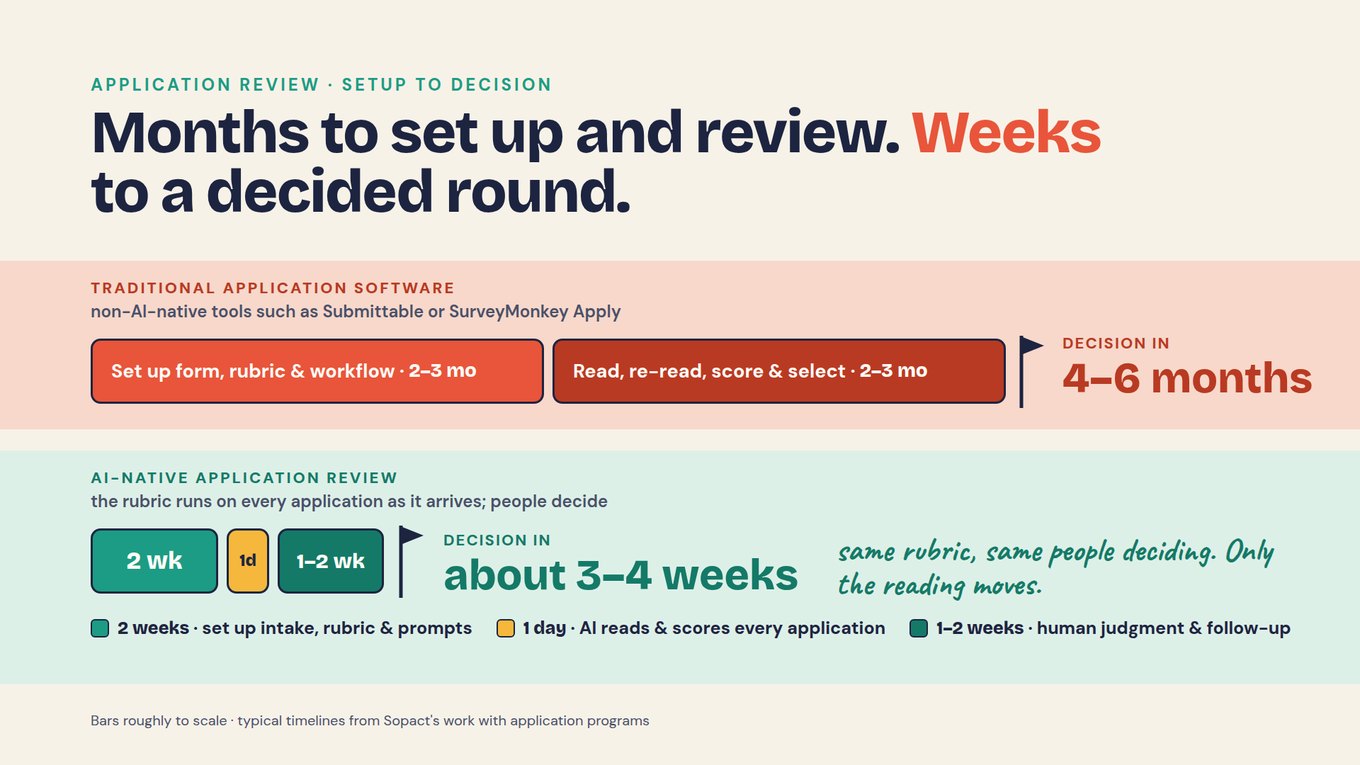
In Sopact’s work with application programs, an AI-native round usually looks like this: about two weeks to set up the intake, rubric and prompts; one day for AI to read and score every application against that rubric; then one to two weeks for the work that should stay human, which is panel discussion, conflicts, borderline calls and follow-up with applicants whose files need clarification. From setup to a decided round is about three to four weeks rather than four to six months.
This guide fixes the method first, from the process set before the round opens to blind review. It then shows where AI fits, using the workflow Unmesh Sheth, Sopact’s founder, demonstrates in his application-review walkthrough: intake designed to listen, each answer read as it arrives, and a panel that starts from a consistent analysis rather than a blank scoresheet.
Set the review process before applications arrive
Agree the funding purpose, eligibility rules, assessment criteria, decision authority and timetable before the round opens. Applicants should know what they are being asked to demonstrate. Reviewers should know which evidence counts and what to do when it is missing.
- ScreenCheck eligibility and completeness; clarify exceptions.
- AssessApply the rubric independently with evidence and reasoning.
- DiscussResolve material disagreements, conflicts and conditions.
- DecideRecord the authorized decision, rationale and next steps.
Keep the application version, rubric version and reviewer record together. The score supports the decision; it is not the complete decision.
Assign owners for screening, moderation and final approval, and decide in advance how recusals, clarification requests, late information and appeals will be handled. An exception invented in the panel meeting and never written down is the one that gets challenged later.
Then treat the application form as the evidence source for the rubric. As Unmesh puts it in his walkthrough, an intake form looks like a survey but is a data-collection design: where an applicant lives or their primary language is useful, but only open-ended questions and a narrative tell a reviewer about fit or feasibility. Map every criterion to the question or document that will evidence it, ask for narratives and documents once, up front, and test the form with a sample submission. If reviewers need something the form never asked for, the scoring problem started at intake.
Separate eligibility screening from merit scoring
Eligibility asks whether an application meets the published requirements. Merit asks how well it addresses the funding objectives. Folding both into one total lets a strong narrative carry an application past a mandatory requirement, or lets a missing document quietly lower a delivery score.
A screening record should name the rule, the evidence checked and the outcome: eligible, ineligible or clarification needed. A missing registration document triggers whatever follow-up the program rules allow. It does not become a low score for delivery capability.
Some checks are mechanical, such as a submission date or a required field. Others need interpretation, such as whether a proposed activity fits an ambiguous geographic or beneficiary rule. Route the second kind to a program officer, and record the reason for any exception and who authorized it. Keep incomplete evidence distinct from weak evidence, and apply the clarification policy the same way to every applicant.
Build a scoring rubric with observable anchors
A rubric translates the funding objectives into criteria and score descriptions. It should tell an evaluator what evidence supports each score, not offer a row of numbers labeled poor to excellent.
Use criteria that assess different things. Scoring “organizational strength,” “capacity” and “ability to deliver” separately can reward the same evidence three times. Polished writing and a large budget are not substitutes for what the program funds. The table is an illustrative rubric; adapt the criteria, weights and descriptions before using it.
On a narrow screen, scroll the table horizontally to read all columns.
| Criterion / weight | 1: weak evidence | 3: adequate evidence | 5: strong evidence |
|---|---|---|---|
| Fit and need / 40% | Need asserted; connection to funding aim unclear. | Relevant need and intended group described with supporting evidence. | Clear fit, credible evidence of need and a well-supported explanation of who benefits. |
| Delivery plan / 30% | Activities, timing or responsibilities unclear. | Feasible activities, timetable and responsibilities specified. | Coherent plan with credible capacity, dependencies and responses to material risks. |
| Learning and outcomes / 20% | Activity counts offered without intended changes. | Outcomes, measures and feasible follow-up described. | Measures, assumptions, limitations and a practical plan for using findings explained. |
| Budget rationale / 10% | Costs not explained or inconsistent with the plan. | Costs broadly explained and aligned with activities. | Clear cost assumptions and a credible explanation of resources and material uncertainties. |
Define the intervening scores of 2 and 4, and a 0 if the scale permits it. “Not assessed” and “clarification pending” need their own status rather than becoming an unexplained zero.
Anchors written this way do double duty: they make human scores comparable, and they are the clearest prompt you can give a system that reads each application against the rubric. Check, too, that no criterion penalizes information irrelevant to the funding purpose; scoring an unfair criterion consistently does not make it fair.
Calculate weighted scores without hiding missing evidence
Illustrative calculation. Using a 0–5 scale and the weights above, an application scores 4 for fit, 3 for delivery, 5 for learning and 2 for budget rationale. Each contribution is the criterion score divided by 5, multiplied by its percentage weight.
The weighted total is 74 out of 100
Fit: 4 ÷ 5 × 40 = 32. Delivery: 3 ÷ 5 × 30 = 18. Learning: 5 ÷ 5 × 20 = 20. Budget: 2 ÷ 5 × 10 = 4. Total: 32 + 18 + 20 + 4 = 74.
The unweighted average is 3.5 out of 5, or 70 out of 100, so a software demonstration should show which total it uses. If budget evidence is pending, do not renormalize the other criteria or score the missing one zero unless that is the approved policy; show the assessment as incomplete. And a 74 is not a 74% probability of success.
Adapt the grant review worksheet to your published criteria, evidence requirements and reviewer instructions. The completed scoring examples show the 74-point assessment and a separate incomplete one, where missing budget evidence stays unresolved rather than becoming zero or a renormalized total.
Give evaluators instructions they can actually use
Send reviewers the rubric, application requirements, conflict policy, deadlines and a contact for questions. Then make the instructions operational. This checklist can be adapted for a reviewer briefing:
- Declare conflicts before reviewing. Follow the program’s process for reassignment or recusal rather than scoring first and disclosing later.
- Use the assigned application version. Report any missing attachment or unreadable file through the agreed channel.
- Assess each criterion separately. Use its descriptors rather than a general impression of the applicant.
- Record evidence and reasoning. Point to the relevant response or document, and explain why it supports the chosen score.
- Mark uncertainty. Distinguish missing information, contradictory evidence and a substantive weakness.
- Submit independently before discussion where required. This preserves a record of initial judgments.
- Keep changes traceable. If a score changes after clarification or moderation, retain the earlier score and explain the change.
“Delivery plan: 3” is not reasoning. A useful note reads: “The timetable assigns responsibility for the main activities, supporting the adequate anchor; the staffing contingency is unresolved, so the strongest anchor is not yet supported.” That wording is illustrative, and it is the standard to hold both reviewers and any AI draft to.
Submittable’s review-process guide recommends practicing on a sample application to build a shared understanding of the rubric. Use that exercise to find unclear descriptors before the live round, not to push reviewers toward identical opinions.
Use calibration and moderation to understand disagreement
Calibration is a practice exercise before or early in the round. Moderation deals with differences in live assessments. Both work when the discussion is about criteria and evidence, not about whose total sits closest to the group average.
Suppose two reviewers give delivery scores of 2 and 4. Open the passages behind them. One may have missed an attachment; the other may be treating an unconfirmed partnership as secured capacity. Or they may hold a legitimate disagreement about feasibility, which is exactly what the panel is for.
Record whether the difference was resolved and why any score changed, keeping the initial assessment alongside the moderated one. A large gap is a reason to investigate, not proof of bias, and repeated variation on one criterion usually points to an ambiguous descriptor. If the rubric must change mid-round, change it through an authorized process and apply it to every affected application.
Calibration gets harder when reviewers work in different languages or countries. The Institute of the Americas is designing its planned CaliBaja North American Leadership Academy around that problem: one application pathway in English and Spanish, one set of selection criteria and one rubric shared by reviewers in Mexico and the United States, and an application file that keeps each source passage beside the evaluation. The Academy is not yet open for applications, so this is a design rather than a result, but it is a sound starting point for any program where fairness depends on reviewers reading the same evidence the same way. Read the Institute of the Americas story →
Treat blind review and conflicts as different controls
Blind review withholds specified identifying information from evaluators. Conflict management decides whether someone should take part in an assessment at all. Masking an applicant’s name does not resolve a reviewer’s conflict, and a recusal record does not make a review anonymous.
Define what reviewers should not see and at which stage. Names turn up in attachments, filenames, logos, references, document properties and narrative details, so test the complete reviewer view rather than hiding one form field and assuming the application is blind.
Some criteria depend on organizational history, which makes full anonymity impractical. A staged process can assess one part with identifying details withheld and another with authorized context, where the program permits it.
After a recusal, test the permissions, not only the status, and retain the record of who reviewed, who withdrew and who decided. Blind review reduces exposure to some identity cues, but proxies remain in the text, so the criteria need the same scrutiny as the masking.
Where AI fits in grant application review
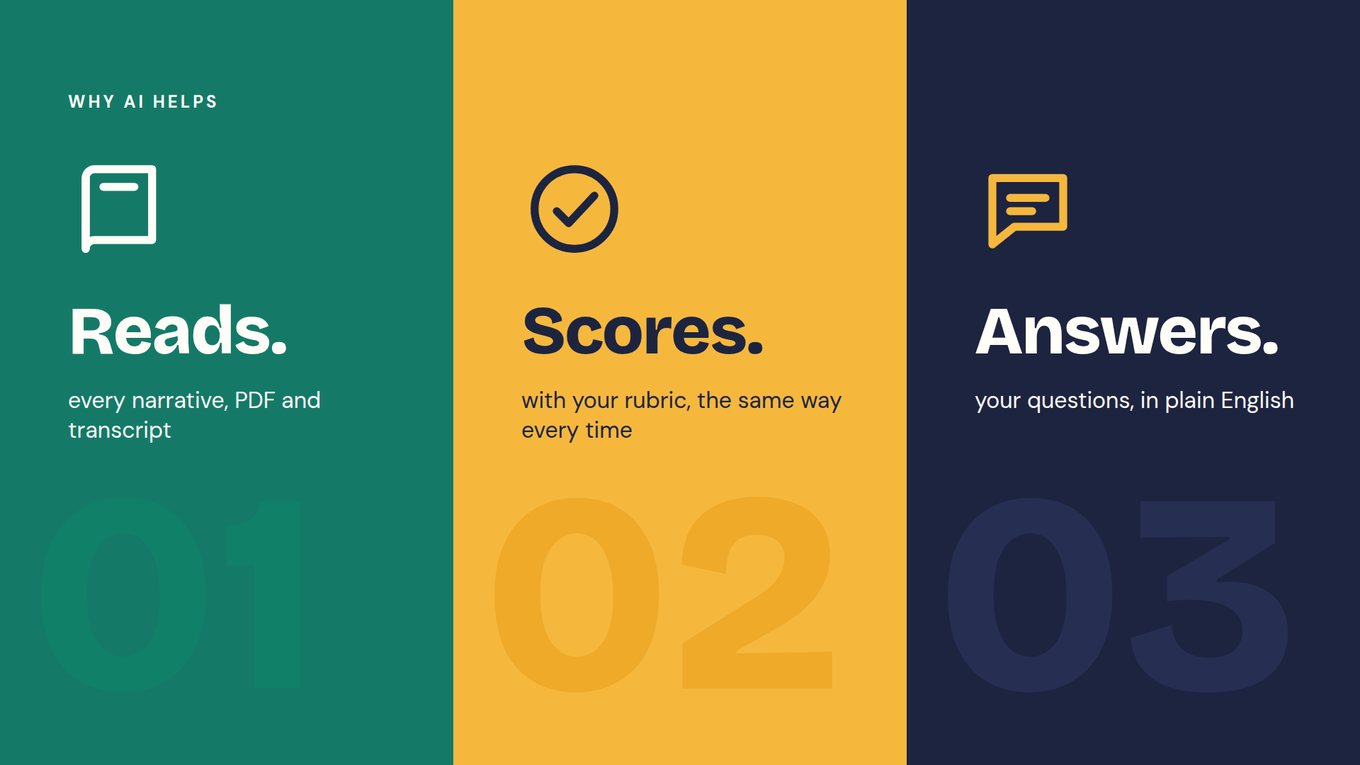
Once the method is set, most of the review stretch is reading and re-reading. AI helps there and not upstream: it cannot write your rubric or set your eligibility policy, but it can read every application against the rubric you wrote, the same way for the first submission and the last.
Unmesh’s walkthrough breaks the workflow into three moves. First, collect from any source: form answers, proposals, PDFs, interview notes, past records. Second, configure each field with a prompt so it is analyzed as it arrives; in Sopact this is the Intelligence Cell. In his example, 80 applications come in and each gets a first read as it lands, with a baseline, an initial confidence and a suggested next step. Third, ask questions of the whole pool through an AI assistant, including Claude or ChatGPT connected through MCP: what barriers this applicant faces, who needs extra support, which ten are strongest. That last request returns a report the team can share before the panel meets.
Set against the method above, the division of labor is plain. The rubric anchors become the prompt the Intelligence Cell applies to each narrative, so every proposed criterion score arrives with the passage behind it. Eligibility rules stay rules: a check flags a missing field, a formula totals the score, and neither needs a language model. Reviewers still score independently, starting from a consistent reading instead of a cold first pass, and moderation goes to applications where the evidence is genuinely contested. The ten-strongest report is a shortlist for discussion, not a ranking to ratify.
What stays with people, and what to check. First confirm the rules for the particular review. NIH prohibits generative AI for analyzing and formulating scientific peer-review critiques, and other funders set their own limits. Where it is permitted, treat every AI assessment as a draft and verify quoted passages in context, because a correct quotation can still support a wrong conclusion. Test scanned documents, contradictory attachments and an application containing instructions addressed to the AI; applicant content is evidence, never authority to change the rubric. The authorized decision-maker stays responsible for the outcome. And because only funded applicants produce follow-up data, claiming that high scores predict success needs an evaluation design, not a correlation.
The walkthrough below runs this workflow end to end in under five minutes. Watch the intake design first, because every later answer depends on the open-ended questions asked there, then see how the ten-strongest request draws on analysis already stored for each applicant rather than re-reading every file.
Jump to: 1:14 — Designing intake that listens · 2:13 — 80 applications, read on arrival · 2:42 — Asking questions of the pool · 3:25 — The top-ten report
Unmesh closes by noting that customers describe what used to take months now happening as daily business: for a panel, the reading is done when the round closes. Sopact’s Applications & Grants workflow connects the submissions, criteria, documents and reviewer reasoning.
Test review software on a complete application round
Existing products already offer scoring and review automation. Submittable’s automated-review product page, for example, describes assessing applicant data against a scoring rubric. The useful buying question is which configuration handles your evidence, controls and workload well.
Build a representative test batch: an eligible proposal, a borderline case, a missing attachment, a reviewer conflict and a material disagreement. Use your actual rubric and reporting requirements, and check each area below during the demonstration.
| Area | What to see in the demonstration |
|---|---|
| Rubric configuration | Separate criteria, score anchors, weights and missing-evidence handling that match your policy. |
| Reading on arrival | A submission added mid-demo is analyzed against your rubric, with its status and any failure visible. |
| Evaluator view | Application evidence and the scorecard readable side by side, with the source behind each proposed score. |
| Review controls | Independent scoring, deadlines, assignment, masking and recusal behave as the rules say. |
| Volume | A realistic batch size, your attachment formats, processing failures and the reviewer workload that remains. |
| Changes | Rubric revisions, overrides and moderation keep their history. |
| Export | The decision can be reconstructed outside a dashboard screenshot. |
Ask staff to make a routine configuration change during the demonstration, such as rewording a criterion, and count implementation, training and ongoing administration in the cost.
For the wider buying decision, see grant management software. For the basic lifecycle and system boundaries, use the grant management system guide.
Record the decision and carry the context into the award
Keep the final decision distinct from individual scores and AI drafts. Record who had authority, the rationale, any conditions and the approved amount or scope. If a high-scoring proposal is not funded because of a published portfolio constraint or budget limit, record that explanation rather than adjusting its score to fit the result.
Give applicants feedback consistent with the program’s policy and confidentiality rules, without disclosing another applicant’s information or a protected reviewer discussion.
For funded proposals, keep the decision on the same record as the application and scores. In Sopact that is a persistent unique ID per applicant, carried from application to award to reporting, so later reports are checked against the approved targets rather than the original request; the grant outcome tracking guide shows how to keep that distinction.
Where application review sits in the grant lifecycle
Application review is the first workflow in a grant’s life, and Unmesh recommends starting AI there because the payoff shows within one cycle. A small program makes a contained first round: one foundation we spoke with runs three fellowship programs outside its main platform, any of which could be reviewed this way without touching the legacy system.
What you build in review carries forward: the applicant ID, rubric evidence and award reasoning become the starting record for onboarding, grantee reporting and compliance. The short video below follows Maya, a composite of the grant leads we talk to, through that lifecycle; watch for the point where review becomes cycle one of a longer change, with each later step added on the same grantee record (watch on YouTube).
Promotora Social México’s customer story describes bringing application documents, identifiers, rubric evidence and decisions together; its integration and reporting work is described as still being tested.
To start, reconstruct one decision from a completed round: application version, criteria, assessments, discussion and authorization. Note every place a reviewer relied on memory, then test whether the proposed workflow keeps that information. Continue with the Grant Intelligence course, then grant reporting and board reporting; for communicating results use the impact report writing guide and report examples and dashboards.
Frequently asked questions
What is grant application review?
Grant application review is the process of checking each application against published eligibility rules, assessing its merit against agreed criteria, discussing the evidence where reviewers disagree, and recording an authorized funding decision with its rationale. An eligible proposal is not automatically a strong one, and a high score does not replace a documented decision. Keeping the application, rubric version and reviewer notes together lets a program explain every outcome later.
What should a grant scoring rubric include?
Distinct criteria that do not reward the same evidence twice, observable descriptions for each score level, weights that add to 100%, the evidence each criterion relies on, and rules for missing or conflicting information. “Not assessed” and “clarification pending” should be separate statuses, not zeros. Anchors written so a reviewer can point to a supporting passage also work as the prompt if AI drafts criterion assessments.
How do weighted rubric scores work?
Divide each criterion score by the top of the scale, multiply by the criterion’s weight and add the contributions. On a 0–5 scale weighted 40, 30, 20 and 10, scores of 4, 3, 5 and 2 give 32 + 18 + 20 + 4 = 74 out of 100, while the unweighted average is 70. Confirm which total the software reports and how incomplete assessments are handled.
Does blind review eliminate bias?
No. Blind review withholds specified identifying information, but names and identity cues often remain in attachments, filenames, logos, references and the narrative itself. It also does nothing about a reviewer’s conflict of interest, which needs its own declaration and recusal process. Test the complete reviewer view, state which stages are masked, and review the criteria themselves, because proxies for identity can sit inside them.
Can AI score grant applications?
Where the program permits it, AI can read each application as it arrives and draft criterion scores against your rubric, each with the passage that supports it. Reviewers verify those drafts, score independently and make the decision. Some programs prohibit this use; NIH, for example, bars generative AI from scientific peer-review critiques. Test rule checks, score totals and AI interpretation separately before a live round.
How should reviewer disagreement be handled?
Compare the evidence behind each score before discussing totals. A gap may come from a missed attachment, an unconfirmed partnership treated as capacity, or a genuine difference of judgment about feasibility. Resolve omissions through the agreed moderation process, keep both the initial and moderated scores with the reason for any change, and treat repeated disagreement on one criterion as a sign its descriptor needs rewriting.