


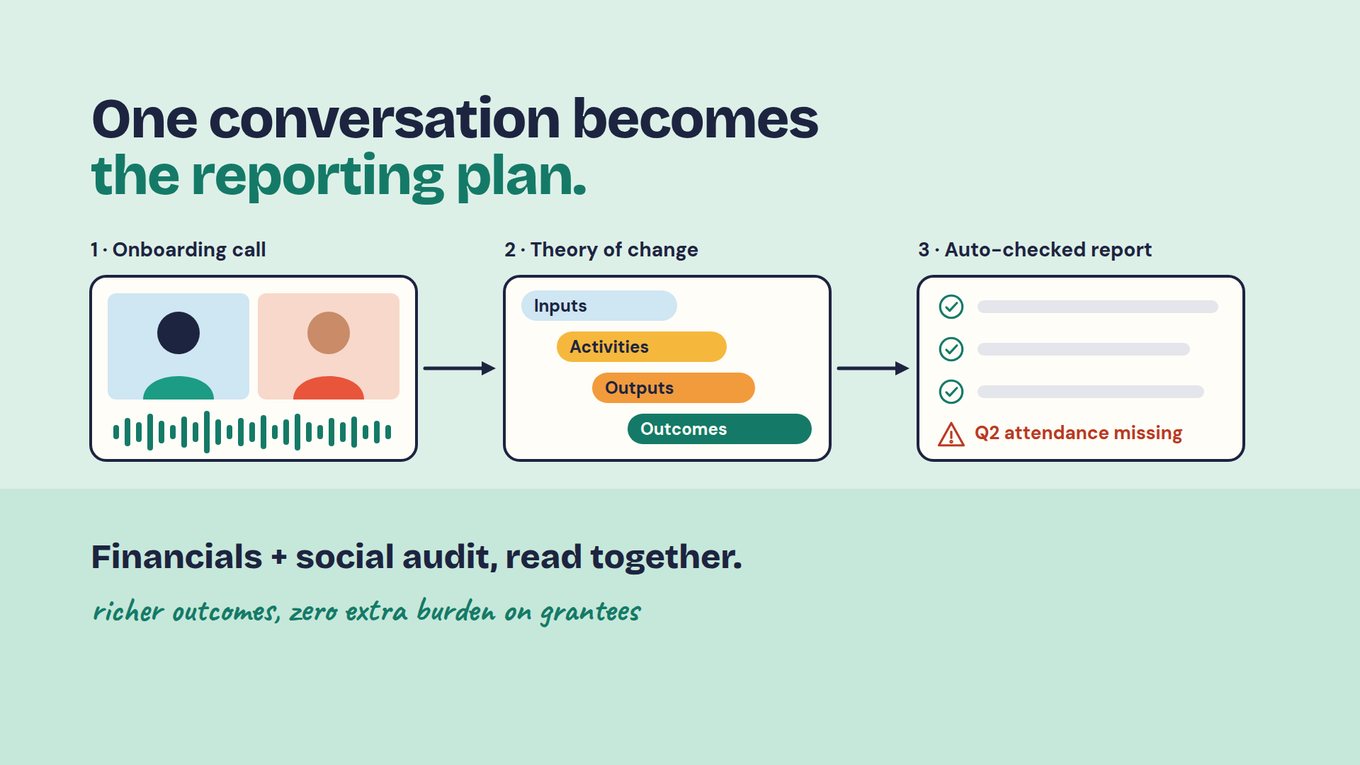
Watch · 8:14–9:30 · from onboarding call to reporting plan
Unmesh describes the step after review: upload the onboarding call transcript, let it draft a theory of change, and let that become the grant agreement and the plan for what the grantee reports. Watch the order. The conversation comes first and the reporting form comes last, which is the order this lesson follows for Eastgate. Watch on YouTube ↗
Jump to: 8:49 — collecting grantee data each quarter or year · 11:08 — the 60–90 minute onboarding call · 12:43 — portfolio context and red flags
The award is where the evidence usually breaks
R-2 is decided. Your six reviewers have scored 64 applications, the committee has approved about ten, and one of them is A-31: Eastgate Youth Works, $24,000 for a 12-week job-readiness and placement program, 70 out of 100, approved with a condition. This week the award letters go out. Next quarter someone will ask how Eastgate is doing.
In many configured systems, this is the moment the evidence breaks. The approved proposal is saved as a PDF in the grant's folder. The reporting form is the generic quarterly template every grantee receives, whatever it promised. The condition lives in the committee minutes. When the program officer picks up the grant, she rebuilds the context from email: what did Eastgate say it would do, what worried the reviewers, what did we agree to measure?
Each step works on its own. What does not travel is the reasoning behind the award: the scores, the feasibility disagreement, the employer letter that was an expression of interest rather than a confirmed role. The plan is written from scratch, and the first report is read without it.
The award is approved in the workflow. The proposal is filed as a PDF, reporting uses the standard template, the condition is tracked in minutes or a spreadsheet, and the program officer reconstructs the context from email and the review export.
The award is added to the A-31 record that already holds the assessed application and its scores. The condition is an entry with an owner and a due point, the onboarding call transcript drafts the reporting plan, and every later report arrives on the same record and is read against that plan.
Separate the organization, the submission, the award and the reporting period
One record is not one row. A-31 is a submission from an organization in round R-2. If Eastgate applies again next round, that is a new submission from the same organization. If Horizon funds it twice, the two awards need their own dates, terms and reporting schedules. Keep four kinds of record, linked by one ID, and every later question has a place to land.
| Record | For Eastgate | Connects to | Keep distinct |
|---|---|---|---|
| Organization | Eastgate Youth Works | Contacts, every submission, every award | The organization versus the people who speak for it |
| Submission | A-31 in R-2, as assessed | Round, uploads, scores, clarifications | The version reviewers scored versus anything added later |
| Award | $24,000, one year, one condition | Decision, approved terms, reporting plan | Separate awards to the same organization |
| Reporting period | Q1 update, then Q2 to Q4 | Award, measures, uploaded reports | Submitted versus accepted; a correction versus a new quarter |
Link people by role. If Eastgate's program lead changes in the spring, that is a role change on the organization, not a new organization, and access moves only after someone reviews it.
Keep the assessed version exactly as reviewers saw it. A-31's record should still show the four scores (4 / 3 / 4 / 3), the feasibility disagreement between a 4 and a 2, and the calibration note that settled the anchor. Clarifications, such as A-44's fiscal-sponsor letter, sit beside the original with a date. A budget revised after award sits next to the assessed budget, with its reason.
A correction and a new period are different events. Correcting a Q1 figure keeps both values and who changed them; Q2 never overwrites Q1.
Finish due diligence before the award
Due diligence belongs before the award letter, while an open question can still become a condition. For a grant of Eastgate's size it should be proportionate: confirm the organization is who it says it is, that it meets the eligibility gates, and that its filings raise nothing the committee has not seen.
Eastgate uploaded its most recent Form 990 with its application. Read it for identity, tax year, completeness and the few parts that matter here, recording each finding with its page. A grant this size does not need an audit-level review. It does need someone to confirm the facts match the applicant and to note what the filing cannot tell you. Anything left open becomes a question answered before award or a condition written into it. If reading a 990 for a grant review is new to your team, work through the Form 990 deep dive, then come back with Eastgate's evidence sheet.
Write the condition into the award record
A-31's condition came out of review. One essential employer commitment in the application is an expression of interest, not a confirmed placement role. The committee approved the grant and asked Eastgate to confirm the employer placement role before the second payment.
A condition written only in the minutes is a condition someone has to remember. Put it on the award as its own entry, with what must be shown, who owns it on each side, when it is due and what evidence satisfies it.
A-31 · Award condition 1 · fictional
Condition: Confirm the employer placement role named in the application.
Why: Reviewers found the employer letter to be an expression of interest; delivery feasibility scored 3 of 5 after calibration.
Evidence that satisfies it: A letter or agreement from the employer confirming the placement role.
Due: Before the second payment is released.
Owners: Eastgate program lead provides it; Horizon program officer checks it and records the decision.
Status: Open.
Finance can see why the second payment is held without asking, and when the auditor asks for proof of the A-31 decision, the reason, condition and resolution are in one place.
Use the onboarding call to draft the plan
Unmesh describes the step after award as relationship-building rather than paperwork (Video A, 11:08). Soon after approval, funder and grantee spend 60 to 90 minutes settling the goals, who is responsible for what, which measures will be reported and the theory of change that connects them. With consent the call is recorded, and its transcript becomes the first draft of the plan. In the configured version the reporting form exists before anyone has talked to the grantee; here it comes last.
Horizon example · fictional
Onboarding call agenda: A-31, Eastgate Youth Works (75 minutes)
| Minutes | Topic | What the transcript should capture |
|---|---|---|
| 0–10 | Introductions and roles | Who is responsible for what on each side |
| 10–20 | What the committee saw | The scores, the feasibility concern and the condition, read back to Eastgate |
| 20–40 | Goals and theory of change | Who is served, what the 12 weeks should change, what has to be true for it to work |
| 40–55 | Measures and definitions | Enrollment, attendance, placement at 90 days, budget versus actual, and what counts for each |
| 55–70 | Schedule and sources | Quarterly updates; which documents Eastgate already keeps and will upload |
| 70–75 | Confirm next steps | Who drafts the plan, who checks it, when Eastgate sees it |
Reading the committee's concerns back is the part teams skip. Ten minutes separate a condition Eastgate understands from one it discovers when a payment is held.
Ask which documents Eastgate already keeps. Unmesh's point at 11:08 is that grantees should not re-key metrics they already maintain in their own reports. Eastgate agrees to upload its program report and its budget workbook each quarter, and Horizon reads them.
If turning "our young people will get jobs" into a measure both sides can count is the hard part of the call, work through the outcomes deep dive before you draft the plan. It builds the data dictionary entry for placement at 90 days, then sends you back here.
Draft the reporting plan from the transcript
The transcript drafts and people agree. An Intelligence Cell configured with a prompt reads the transcript and proposes the plan in four parts, each item quoting the passage it came from. Your program officer checks every line against the conversation, corrects what the draft got wrong and sends it to Eastgate to confirm. Only the confirmed version goes on the award.
Read this onboarding call transcript for award A-31. Draft a reporting plan with four parts: goals, responsibilities (by role, on each side), measures and schedule. For each measure give the definition agreed on the call, the source document, the reporting frequency and any target that was stated. Quote the passage each item comes from. If the call did not settle something, list it as open rather than filling it in.
Horizon example · fictional
Draft reporting plan: A-31, Eastgate Youth Works
Goal: Young people aged 16–24 in Lake County complete a 12-week job-readiness program and move into paid work.
| Measure | Definition agreed | Source | When |
|---|---|---|---|
| Unique youth enrolled | Distinct eligible participants enrolled; target 200 over the year | Eastgate program report | Quarterly |
| Attendance | Eligible participants attending at least 3 of the first 4 sessions | Eastgate program report | Quarterly |
| Job placement at 90 days | Participants in paid work 90 days after the program; what counts as paid work still open | Eastgate follow-up records | Quarterly, once the first cohort reaches 90 days |
| Budget versus actual | Spend by line against the approved $24,000 budget; any change approved with a reason | Eastgate budget workbook | Quarterly |
Responsibilities: Eastgate's program lead uploads the program report and budget workbook each quarter and provides the employer confirmation. Horizon's program officer reads each update against this plan and records the condition's status.
Open item: the paid-work definition for placement (minimum hours, temporary roles).
The plan has four measures rather than a generic list of twenty, each with a definition, a source Eastgate already keeps and a schedule. Registrations are not on the list; unique youth enrolled is. That difference will matter when the first update arrives, and Lesson 4 picks it up there.
Keep one ID from the application to the last report
A-31 is the ID Eastgate's submission received at intake. Keep it. The award, the condition, the plan, each quarterly upload, each correction and each question Horizon sends Eastgate attach to the same record. When a quarterly update is missing a figure, the program officer asks for that one figure against A-31, and Eastgate's answer lands where the next reader will look for it.
This is what lets a report be read on arrival: the upload lands on the record that holds the plan, and the check is whether each measure is present and matches its definition. That is the "Q2 attendance missing" flag on the slide above.
Connection is not access. Eastgate sees its own plan, condition and uploads, not reviewers' notes or other applicants' scores. Decide who sees what by role and write it into the handoff.
Hand the grant from the selection team to the program owner
The people who reviewed R-2 are not the people who will manage Eastgate for a year, and the handoff is where configured systems lean hardest on memory. Test it directly. Give A-31 to a program officer who did not sit on the committee and ask three questions. What did we approve, and on what terms? What is still open? What is due next, and from whom?
If she can answer all three from the record in a few minutes, without searching email, the handoff works. If not, fix the record rather than briefing the person.
In Sopact Sense, the persistent unique ID created at intake carries the record forward. The Intelligence Row for A-31 summarizes the application, scores, condition and agreed plan in one view. An Intelligence Cell reads the transcript and each upload as it arrives; the AI Assistant, or Claude or ChatGPT through MCP, answers "what is still open on Eastgate?" with sources. Your current system keeps handling payments while you test this on R-2 (see the applications and grants solution).
A plan drafted from a transcript is still a draft. The transcript can miss a nuance or keep a number someone corrected later in the call, so the program officer checks each item against the conversation and Eastgate confirms the result. The same holds for the condition: AI can flag that the employer letter has arrived, and a person decides whether it satisfies the condition.
Put it into practice
Map A-31 and draft its reporting plan
- Open step 3 of the workbook and the Eastgate award terms in it. Draw A-31's record map from applicant to first report: organization, submission as assessed, clarifications, award, condition and reporting periods. Mark where the ID is created and where each later item attaches.
- Add two events to the map: Eastgate's program lead changes in the spring, and a budget line is revised after award. Show where each one lands and what stays unchanged.
- Write a 60–90 minute onboarding call agenda for Eastgate, including the minutes that read the committee's concerns and the condition back to the grantee.
- Draft the reporting plan: goal, responsibilities, four measures with definitions and sources, and a quarterly schedule. List anything the call still has to settle as an open item.
- Run the handoff test. Give your map and plan to a colleague who has not seen R-2 and ask the three questions from this lesson.
Download the workbook (PDF)
Practice data: horizon-r2-applications.csv · horizon-rubric.csv · calibration-scores.csv · eastgate-q1-update.csv
Check your reasoning before moving on
A strong map keeps the submission exactly as assessed, with the 4 / 3 / 4 / 3 scores and the calibration note, and puts the clarification, award, condition and each quarter on separate entries linked by one ID. The contact change is a role change; the budget revision sits beside the assessed budget with its reason. The plan names four measures, not twenty, each drawn from Eastgate's own program report or budget workbook, with the paid-work definition open until both sides agree it. The condition has evidence, owners and a due point before the second payment. If your colleague had to ask you anything to answer the handoff questions, that answer belongs on the record.
Ask any vendor, including us
Using one of your own awarded applications, ask to see the award on the same record as the assessed application, with the scores and reviewer notes still attached and nothing re-keyed. Upload a real onboarding call transcript and ask for a draft reporting plan in which every measure quotes the line it came from and unsettled items are marked open. Enter a correction to a reported figure and ask to see both values, who changed it and when. A good answer shows one ID from intake to report and a person approving each draft.
Questions grant teams ask
What should a grant onboarding call cover?
Plan 60 to 90 minutes: roles on both sides, what the committee saw (scores, concerns, any condition), goals and theory of change, each measure with a definition both sides can apply, the schedule, and which documents the grantee already keeps. Record it with consent. The transcript becomes the first draft of the reporting plan, which the program officer checks and the grantee confirms.
Should a selected application be overwritten with current information?
No. Keep the submission exactly as reviewers assessed it, with its scores and notes. Store clarifications, approved budget revisions and later reports as separate, dated entries linked to it. That way anyone can see what was proposed, what was approved and what was reported, and an auditor can trace the decision without guessing which version the committee read.
Can AI write the reporting plan or grant agreement from the call?
AI can draft it. An Intelligence Cell reads the transcript and proposes goals, responsibilities, measures and schedule, quoting the passage behind each item and marking anything the call left unsettled. A program officer checks every line against the conversation, and the grantee confirms the result before it goes on the award. The draft saves hours of writing; the agreement is still made by people.
What is a persistent grantee ID, and why does it matter after the award?
It is the identifier a submission receives at intake and keeps for the life of the grant. The award, conditions, plan, every upload, correction and follow-up question attach to it. When a report is missing a figure, you ask for it against the same ID, and the answer lands where the next reader will look. Without it, context is rebuilt from email each quarter.
Does connecting the records mean every team sees every record?
No. Connection and access are separate choices. A grantee sees its own plan, conditions and uploads, not reviewers' notes or other applicants' scores. Finance may see payment holds and budget lines without reading narratives. Set access by role and record it in the handoff.
Deep dives for this lesson
Open one when the exercise raises that question, then come back. Each uses the same Horizon example.