play icon for videos
← Academy
Grant review course · Lesson 5 of 5

Run the pilot with clear ownership, then decide what to move next

Monday, 9:04. Horizon's board chair, finance and the auditor each want an answer about R-2 today. Run the pilot so each answer comes from the record, with every role seeing only its part, then decide what to move next from proof rather than a demo.

Academy / Applications, awards & grants / Lesson 5

Lesson 5 of 5 · About 35 minutes with practice, plus a two-minute video

Run the pilot with clear ownership, then decide what to move next

Monday, 9:04. Horizon's board chair, finance and the auditor each want an answer about R-2 today. Run the pilot so each answer comes from the record, with every role seeing only its part, then decide what to move next from proof rather than a demo.

You will make: A pilot test log for R-2 and a one-page requirements brief that doubles as a vendor test script you can run on your own data.

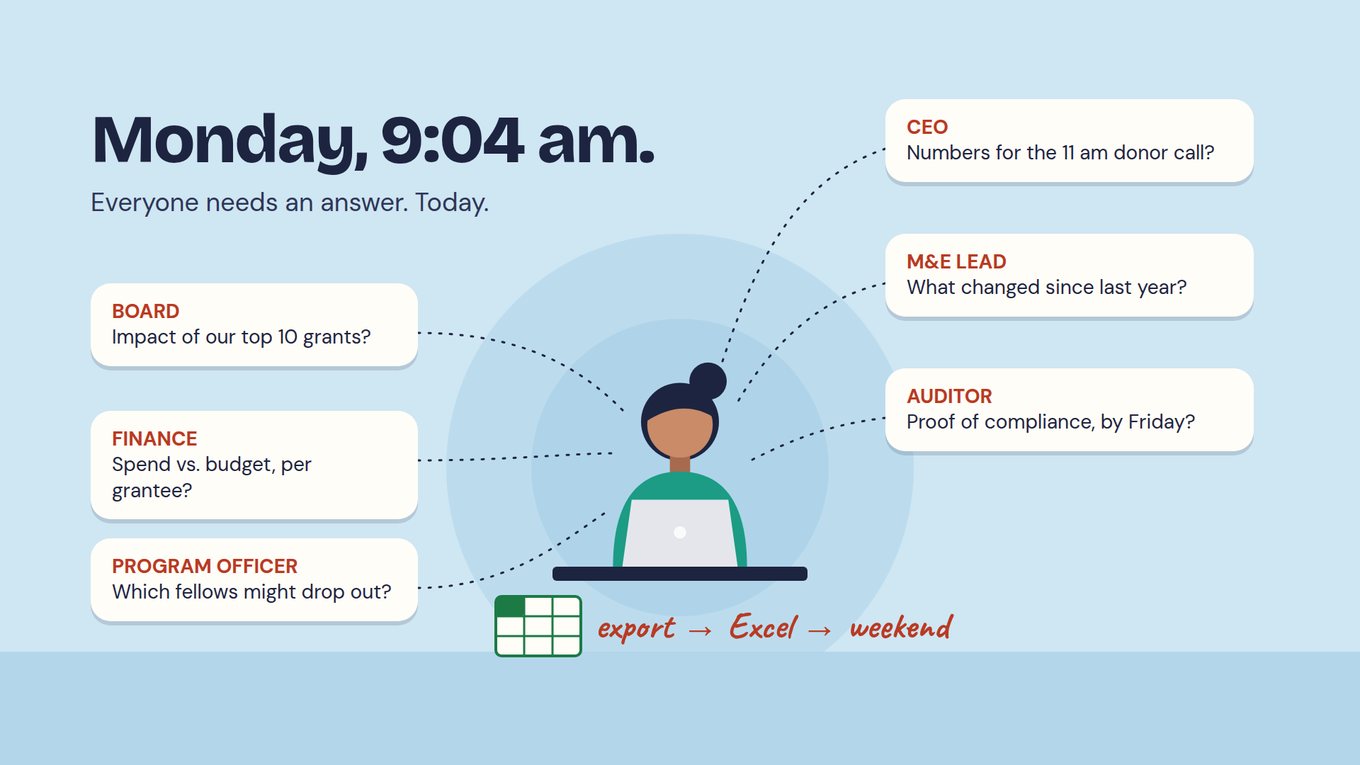
Slide titled Monday, 9:04 am. Everyone needs an answer. Today. A grant manager at a laptop is surrounded by six questions: the board asks for the impact of the top 10 grants, the CEO wants numbers for the 11 am donor call, finance wants spend versus budget per grantee, the M&E lead asks what changed since last year, a program officer asks which fellows might drop out, and the auditor wants proof of compliance by Friday. A spreadsheet icon reads export, Excel, weekend.
Three of these six questions land on Horizon's grants manager after R-2. The pilot is ready when all three can be answered from the record the same morning. From the video Rethinking Grant Management with AI.

Watch · 9:30–11:08 · one workflow at a time

Unmesh finishes the end-to-end sequence: connect accounting through MCP servers and APIs, move one low-risk workflow at a time, and keep the current system running meanwhile. At 9:57 he sets that against the 6 to 9 months a traditional implementation takes, the contrast this lesson ends on. Watch on YouTube ↗

Jump to: 4:03 — the Monday questions · 9:57 — 6 to 9 months to implement · 13:19 — the compliance questions a board needs

Monday, 9:04: three answers due today

R-2 is decided and the first quarterly updates are in. Your inbox has three messages. The board chair asks, "What did R-2 fund, and is it working?" Finance wants spend against budget for each grantee. The auditor wants proof of how the A-31 award to Eastgate Youth Works was decided.

The questions are ordinary. The hard part is where the answers live: in Horizon's configured system, award amounts sit in one module, reviewer comments in another, the budget workbook in an attachment and the reason for the A-31 condition in a committee member's email.

So the answer becomes a project: export, Excel, weekend. By Tuesday the numbers exist, but nobody can say which budget version they reflect.

In a configured system

Roles are set once and rarely tested. Answers leave by export and are rebuilt by hand. The decision rationale lives wherever the reviewer wrote it. Changing anything means asking the admin, or the vendor.

AI-native, one cycle

Each role sees its part of one record per applicant. Questions are asked of the record and answered with sources. Suggested scores, reviewer scores and the committee decision sit side by side, each with its author.

Give each role a defined job and a defined view

Write down who does what before you test anything. One person may hold several roles, but each responsibility needs a name. The last column is the test that should fail: a denied action tells you more about access than an allowed one.

RoleResponsible forMay seeTest that should fail
Applicant (for example, Eastgate)Submitting, answering clarification requests, uploading reportsIts own application, requests, award terms and reporting planOpening another application or a reviewer's note
Reviewer (4 staff, 2 community volunteers)Scoring assigned applications, declaring conflicts, recording disagreementAssigned applications, the rubric and anchors, suggested scores with their sourcesR3 opening A-17's files or export after reassignment
CommitteeDeciding awards, setting conditions, recording overridesAll eligible applications, reviewer scores, calibration notesRecording a decision without a rationale
Program ownerOnboarding, the reporting plan and follow-upApproved terms, conditions, reporting plan and reportsReading committee deliberation
FinancePayments against conditions, spend against budgetAward amounts, payment conditions, approved budget versionsReleasing Eastgate's second payment before the condition is met
AI Assistant or MCP client (Claude, ChatGPT)Reading, summarizing and answering with sourcesOnly what the person asking may seeReturning a restricted note to someone not permitted to see it; changing a record

The last row is the one teams forget. A question to the AI Assistant, or to Claude through MCP, carries the asker's permissions. If a volunteer reviewer cannot open committee notes, a question cannot open them either.

R3 sits on A-17's board, declared it, and A-17 was reassigned before scoring. Test that the reassignment removed R3's access everywhere: screen, source files, export and assistant.

Give clarifications one owner. A-44's missing fiscal-sponsor letter should produce one request, on the record, visible to its assigned reviewers, not a private email from one reviewer.

Record who decided, and what each audience receives

The committee decides. Suggested scores from the Intelligence Cell are inputs, in the same way a reviewer's first read is an input. A ranked list can prepare a meeting; it cannot replace one. The decision record should say who had authority, what they considered and what conditions they set.

A-31 decision record · fictional

Eastgate Youth Works · requests $24,000 for a 12-week job-readiness and placement program.

Assessment: 70/100. Outcome pathway 4 (24) · Delivery feasibility 3 (18) · Budget justification 4 (16) · Learning and reporting plan 3 (12).

Disagreement: feasibility scored 4 and 2 by two reviewers. Calibration applied the anchor: an expression of interest is not a confirmed placement role. Agreed score 3, both originals kept.

Decision: approved with a condition. Confirm the employer placement role before the second payment.

Sources: application sections, employer letter, calibration note, committee minute with members present and date.

Each audience receives a different part of this record. Eastgate gets the decision, the condition and its reporting plan. Finance gets the amount, the payment schedule and the condition holding the second payment. The board gets a summary of what was funded and why. A public announcement follows approved release. Deliberation stays with the committee.

Approve what each audience receives, then check the links as well as the text. A board summary that hides reviewer names on screen but links to the full scoring sheet has not hidden them.

Rehearse the whole round with three records

Before the pilot counts as run, walk three records through every step they touch. Each tests a different part of the round.

Horizon example · fictional

RecordWhat you testA pass looks like
A-44Missing fiscal-sponsor letterHeld, not failed. One clarification request, answered within the window, attached to the record, then scored.
A-17Reviewer conflictR3's conflict declared and A-17 reassigned before scoring. R3's access removed from files, exports and the assistant.
A-31Corrected assessmentBoth feasibility scores kept, the calibration note attached, the agreed 3 traceable to the anchor, total 70.
A-31Committee decisionApproval, condition and decider recorded. The AI's suggested scores shown separately from the people's scores.
A-31First reporting requestThe quarterly update asks for what the onboarding call agreed: unique youth enrolled (target 200 over the year), attendance at 3 of the first 4 sessions, placements at 90 days, budget against actual.

Run each test as the role that would do it. An admin account sees everything, so it proves nothing about access. Log in as a reviewer, the program owner and Eastgate.

When a test fails, fix it and rerun that step. A failed rehearsal costs an afternoon; the same failure found by an applicant costs more.

Answer the Monday questions from the record

Now return to the three messages. Each answer should come from the record with its sources, say how much of the round it covers and name what is not yet known. The ask-the-round deep dive shows how to phrase the question, set its boundaries and check the answer. Work through it if your first answer comes back as a confident paragraph with no sources, then come back.

Board chair · "Is it working?" · Eastgate, fictional

Funded: A-31, Eastgate Youth Works, a 12-week job-readiness and placement program. Approved with a condition on the employer placement role. Source: A-31 decision record.

Q1 so far: 180 registrations. 108 of 150 eligible participants attended at least 3 of the first 4 sessions (72%). Source: Eastgate's Q1 program report, as uploaded.

Not yet known: 30 registrations have no status (not yet eligible, not started, withdrawn or unknown), so enrollment against the target of 200 is not yet a clean count. Job placements at 90 days are not due yet.

At the end of Q1 that is a useful answer: attendance is on the record, the enrollment gap has an owner, and placements are honestly unknown.

Finance's question works the same way, grantee by grantee. Eastgate's answer includes the $2,000 moved from materials to transport stipends, approved in Q1 with a reason, and reads spend against that approved budget version.

The auditor's question needs more than an answer. It needs a trail a stranger can follow: the application as submitted, both feasibility scores, the calibration note, the decision, the condition and whether it has been met. The audit trail deep dive reconstructs A-31 and Eastgate's budget change step by step. Use it to build the packet before Friday.

Run the pilot as a real cycle, with a test log

A pilot is a real round with real applicants and real money, run so every step leaves evidence. R-2 qualifies: grants of up to $25,000, 64 applications, 6 reviewers and about 10 awards. Small enough to watch closely, real enough to mean something.

Keep a test log from the first day. For each step, write what should happen, what did happen, the evidence and who owns the fix. Record the staff time each step took, too; that is the number your keep-or-extend decision will lean on.

Step testedExpectedEvidence to keepOwner
Incomplete application (A-44)Held with one clarification requestRequest, answer, timestampGrants manager
Conflict (A-17)Reassigned before scoring; access removedDeclaration, reassignment, denied-access screenshotReviewer lead
Suggested scoresEach criterion shows the passage it rests onThree sampled applications checked against sourceReviewer lead
Override (A-31)Both scores and the reason keptCalibration noteCommittee chair
Condition to financeSecond payment held until the placement role is confirmedPayment record showing the holdFinance lead
Report on arrival (Eastgate Q1)30 unresolved registrations flagged, not counted as enrolledCheck result and request sent to EastgateProgram owner
Assistant accessA restricted committee note is not returned to the program ownerQuestion asked and the refusalGrants manager
CorrectionEarlier version kept when a value changesVersion history for the changed fieldGrants manager

An honest limit belongs in the log as well. One pilot shows that the workflow ran and where it broke. It does not show that the scoring is fair across every program you run, and Eastgate's attendance figures do not show that the program caused later placements. People make the decisions, every AI reading is checked against its source, and questions of cause need an evaluation design.

Decide: keep, extend or replace

At the end of R-2 you have what a demo cannot give you: proof on your own data. Use it to decide on each workflow you tested.

Keep a step that passed and that your team can repeat without the vendor in the room. Extend by adding the next workflow in the next cycle. Replace the matching piece of the configured system only after the new step has held up over more than one cycle. Anything that failed gets fixed and retested before it enters that conversation.
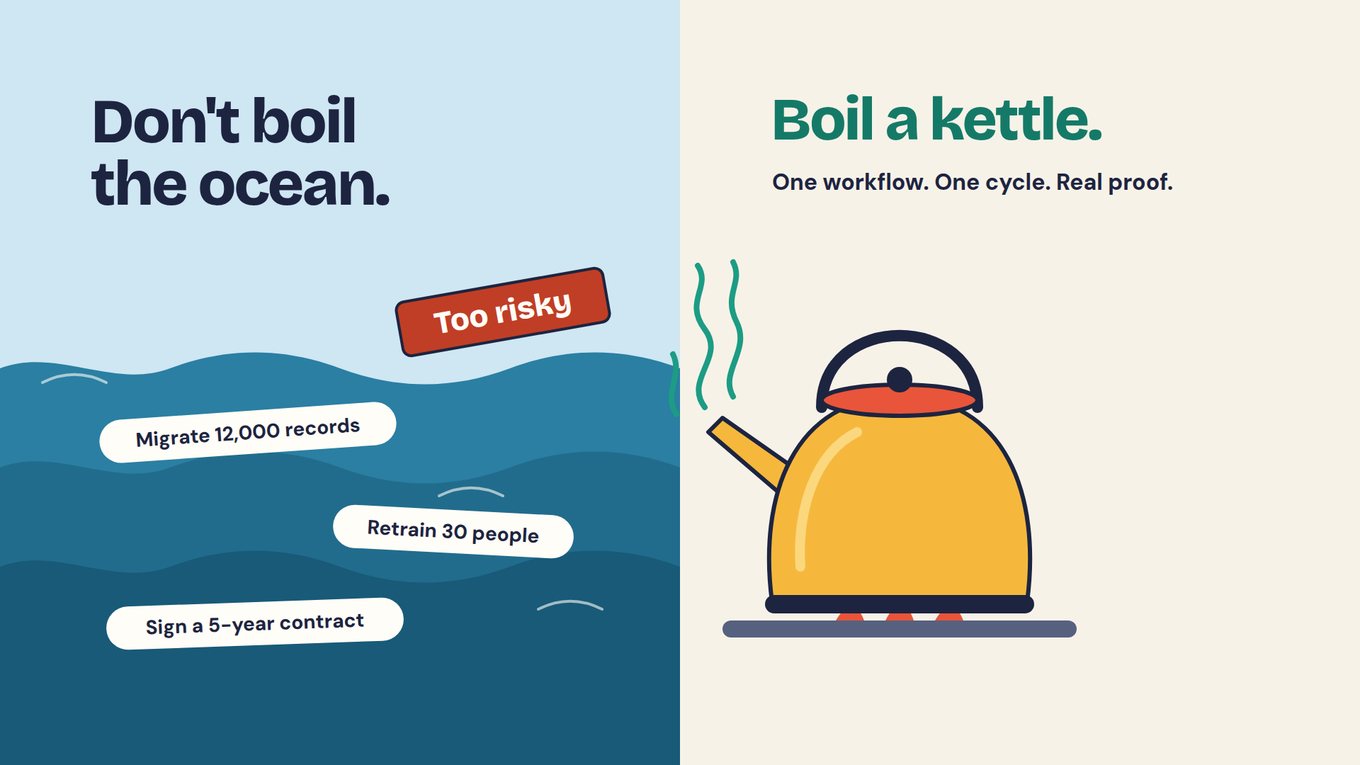
Split slide. Left, titled Don't boil the ocean, shows waves carrying three labels: migrate 12,000 records, retrain 30 people, sign a 5-year contract, with a red tag reading Too risky. Right, titled Boil a kettle, shows a steaming kettle with the line One workflow. One cycle. Real proof.
Horizon's version of the ocean is eight years of configuration and 14 approval steps. The kettle is R-2. From the video Rethinking Grant Management with AI.

Traditional grant-system implementations take 6 to 9 months. For a team whose current system works, that is the wrong first bet: months of migration and retraining before one application is read differently, and a long contract signed on the strength of a demo.

One workflow per cycle is the better bet. Horizon keeps its configured system for its large grants and adds one step at a time: application review first, then onboarding, then grantee reporting, then compliance and audit, then a connection to accounting through MCP or APIs. Each step builds on the same record, so the fifth step inherits everything the first four learned.

For Horizon, the likely decision after R-2 is keep application review, extend to onboarding for the next round, and replace nothing yet. If the next move is a new program rather than a new workflow, the launch deep dive shows how to put it on the tested workflow without copying eight years of configuration along with it.

Turn your five artifacts into a vendor test script

The course has produced five artifacts: the intake specification (Lesson 1), the anchored rubric and calibration record (Lesson 2), the reporting plan for Eastgate (Lesson 3), the report-completeness rubric (Lesson 4) and this test log. Together they are a requirements brief, and a test script any vendor should pass on your data, Sopact included.

TestWhat to bringWhat a passing answer shows
Intake that listensYour form and three permitted past applications, one incompleteThe gap raised as a clarification on the same record, not scored as zero
Rubric scoring with sourcesYour anchored rubric and five applications your team has already scoredA suggested score per criterion with the passage behind it; differences from your team explained
Override and calibrationOne application your reviewers disagreed onBoth scores kept, the anchor decision recorded, the change traceable
Award to reporting planOnboarding call notes or transcript and the award termsMeasures, targets and due dates on the same record as the application
Report checked on arrivalA real grantee report and budget workbookMissing or inconsistent items flagged with a request back to the grantee
Ask the roundThree questions your board, finance and auditor asked last quarterSources, coverage and what is unknown, repeatable next week
Access and auditYour role table and one past decisionA denied request that stays denied through export and MCP; the decision reconstructed with versions

Run the same script with every vendor, on the same data, with the same people watching. The comparison is then about your team's work, not the more polished demo.

In Sopact Sense, each applicant keeps one persistent unique ID from application to award to reporting. The Intelligence Cell reads each answer and document as it arrives, the Intelligence Row summarizes each applicant or grantee, and the AI Assistant answers questions with sources. Claude or ChatGPT can query the same governed data through MCP. Ask us to run this script on your own records, and hold us to the passing column.

Put it into practice

Run R-2 as a pilot and write your test script

  1. Open step 5 of the workbook and horizon-r2-applications.csv. Fill in the role table for your team: who holds each role, what each may see and one test that should fail.
  2. Rehearse A-44, A-17 and A-31 through clarification, reassignment, corrected assessment (use calibration-scores.csv), committee decision and first reporting request. Log the expected result, actual result, evidence and owner for each.
  3. Answer the board chair's question from eastgate-q1-update.csv with sources, coverage and what is still unknown.
  4. Run one denied-access test through the assistant and one through an export.
  5. Mark each workflow keep, extend or replace, and name the one workflow you will add next cycle.
  6. Use the vendor test script template in the workbook to turn your five artifacts into a one-page requirements brief.

Download the workbook (PDF)
Practice data: horizon-r2-applications.csv · horizon-rubric.csv · calibration-scores.csv · eastgate-q1-update.csv

Check your reasoning before moving on

A-44 is held, not rejected, and scored only after its letter arrives. A-17 is reassigned before scoring, and R3 cannot reach its files through an export or a question to the assistant. A-31's 70 is traceable to four criterion scores, with both feasibility scores and the calibration note kept. Finance can see the condition, and the second payment stays held until the placement role is confirmed.

The board answer gives 72% attendance (108 of 150), flags the 30 registrations without a status and says placements are not yet known. After one cycle, Horizon keeps application review, extends to onboarding and replaces nothing yet. The test script is ready when every row names what to bring and what a pass looks like.

Ask any vendor, including us

Log in as a volunteer reviewer and try to open a reassigned application, then ask their AI assistant for it; both should refuse. Ask them to reconstruct one past decision from your records, with both reviewers' scores and the approval. Ask last quarter's board question on your data and look for sources, coverage and unknowns. Then ask what adding onboarding next cycle would take without touching the tested review step.

Questions grant teams ask

Do we have to replace our grant management system?

No. Keep it running for the programs it handles well. Pilot one complete cycle on your smallest program, alongside it, and decide from the results. Horizon keeps its configured system for large grants while R-2 runs AI-native. Replacement comes later, one workflow at a time, and only after a step has held up for more than one cycle on your own data.

Can automated ranking replace the committee?

No. Suggested scores and ranked lists prepare the meeting; the committee makes the decision and records its reasons. In R-2, two reviewers disagreed on A-31's feasibility, and calibration, not the AI, settled the anchor. What AI changes is the reading: every application read the same way, with the passage behind each score, so people spend their time on judgment.

What should we pilot first?

Your smallest, lowest-risk program: a small grant round, a fellowship or a scholarship. Look for low dollars at risk, a short cycle, clean data and a rubric the team already argues about. Run application review end to end first. Onboarding, grantee reporting, compliance and audit, and the accounting connection follow in later cycles.

How do we compare vendors fairly?

Give every vendor the same test script, the same permitted data and the same people watching. Bring your rubric, applications your team has already scored, one disputed decision, a real grantee report and three questions your board asked. Judge the answers by sources, coverage and what they admit is unknown, and by how much your staff must rebuild next cycle.

Deep dives for this lesson

Open one when the exercise raises that question, then come back. Each uses the same Horizon example.

Put this guide into practice.

Prepare Data Governance Before Using AI
Prepare your data governance
nonprofit-data-governance-before-ai
Feedback
Foundation
Prepare an evidence register and a tested governance baseline before applying AI to program data.
How to Turn Findings into Action and Check What Changes
The Loop — the method in one read
the-loop
Loop
The method
0
One continuous method for reliable, traceable AI reporting across case, application, grant, and program workflows: collect clean, analyze on arrival, and improve in time.
For growing data collection, connected analysis and recurring reporting
What Is Case Intelligence?
what-is-case-intelligence
Case
Foundation
1
One current, traceable record for each person—connecting intake, services, notes, surveys, documents, outcomes, decisions, and follow-up.
Workforce and training · Youth and mentoring · Case management · Scholarships · Accelerators · Education · Nonprofit programs
What is grant intelligence?
What Is Grant Intelligence?
what-is-grant-intelligence
Grant
Foundation
1
One connected evidence record from application and committee review through the awarded grant, grantee reporting, renewal, and board accountability.
Foundations and grantmakers · Public grant programs · Scholarships and fellowships · Accelerators
Connected Data Intelligence
Understand the approach
connected-data-intelligence
Feedback
Foundation
1
Connect recurring collection, relevant history, AI analysis, and governance in a workflow your team can maintain.
Growing organizations managing recurring data collection without a dedicated data team.
Measurement and Reporting: From Agreement to Evidence-Based Report
Measurement and reporting: from agreement to report
embedded-impact-measurement
Reporting
Start here
1
Turn the onboarding call into a reporting agreement, share one data dictionary, and write reports funders can compare and check.
For funders and the organizations they fund
Connect company context before collecting another return
Connect context
track-investees-impact-agreement-variance
Portfolio
Portfolio intelligence tools
1
Build a repeatable collect, review and improve cycle
Methodology — continuous, not annual
loop-methodology
Loop
The method
1
The continuous collect–analyze–improve cycle, adopted as an experiment: start with the step that already pays and add one data-collection step at a time.
Teams tired of rebuilding spreadsheets and forms who want a measurement system that compounds instead of resetting.
Agree the theory of change and core metrics on the onboarding call
Agree measures
onboard-portfolio-lock-impact-agreement-track-results
Portfolio
Portfolio intelligence tools
2
Test whether an AI-assisted result is repeatable and correct
Reliability — test repeatability and accuracy
loop-reliability
Loop
The method
2
Test repeatability and accuracy using versioned data, defined calculations, known-answer checks and human review of qualitative interpretation.
Teams that need to check recurring AI-assisted analysis before using it in decisions or reports.
Design an application process around the decision, not the form
Design an Application Process
how-to-design-an-application-process
Grant
Foundation
2
How to Structure Stakeholder Data: Four Common Patterns
Choose your record structure
which-shape-is-your-data
Feedback
Foundation
2
Map the people, observations and relationships your workflow needs before collecting data.
Turn the onboarding call into a reporting agreement
onboarding-call-to-reporting-agreement
Reporting
Agree together
2
How to build a theory of change, then show it as a logic model, logframe or results framework
how-to-build-a-theory-of-change
Reporting
Agree together
3
How to Build a Logic Model: Steps, Example and AI Prompt
Build a Logic Model You Can Use
how-to-build-a-logic-model
Reporting
Align
3
How do you onboard a grant or RFP program?
Onboard a Grant or RFP Program
how-to-onboard-a-grant-rfp-program
Grant
Foundation
3
Turn your theory of change into a data-collection plan
Turn a Theory of Change into a Data-Collection Workflow
theory-of-change-to-data-collection-workflow
Case
Foundation
3
Run quarterly collection around each company's dictionary
Collect quarterly
collect-investee-reporting-without-burden
Portfolio
Portfolio intelligence tools
3
Keep a clear trail from a finding to its evidence
Traceability & Transparency
loop-traceability
Loop
The method
3
Every figure links back to the exact response, note, or document it came from — a full audit trail from headline result to raw evidence.
Teams whose numbers get scrutinized — by funders, boards, auditors, or standards — and who need to answer where did this come from on the spot.
Build Context: What Your AI Needs to Know
Build context
build-organization-evidence-model
Feedback
Foundation
3
How to Change Survey Questions Without Losing Comparability
Change questions with a clear history
change-questions-without-breaking-the-record
Feedback
Control
3
Create a question-change log and decide how old and new versions should appear in reports.
Programme & MEL leads · Teams whose questionnaire has ossified · Anyone evaluating a platform where configuration is a purchased service
Five Dimensions of Impact: How to Review Your Evidence
Use the Five Dimensions to Test the Evidence
five-dimensions-of-impact
Reporting
Align
4
How do you design a grant rubric and eligibility rules?
Design Your Rubric & Eligibility Rules
grant-rubric-eligibility-rules
Grant
Foundation
4
Review impact and financial evidence before it reaches the dashboard
Review and approve
read-investee-reports-multi-signal
Portfolio
Portfolio intelligence tools
4
Adapt the learning cycle to your workflow
Flexibility — one method, four workflows
loop-flexibility
Loop
The method
4
The same collect–analyze–improve cycle, shaped to four kinds of impact work — case, grant, portfolio, and feedback — each shown end to end.
Anyone deciding where the Loop fits their work, who wants to see the full path from messy input to a report they can defend.
How to Collect Feedback Offline and Track the Same People Over Time
Collect offline and reconcile the batch
collect-feedback-offline
Feedback
Connect
4
Build a field protocol and reconcile a test batch across devices, visits and delayed uploads.
Field & multi-site programs · Low-connectivity contexts · Teams collecting in person
How Do You Design an Intake Form for a Baseline?
Design an Intake Form That Captures a Usable Baseline
intake-form-usable-baseline
Case
Nonprofit Track
5
Turn a proposed outcome into a reporting definition
Outcomes vs Outputs
frame-outcomes-over-outputs
Grant
Foundation
5
Plan and review your first workflow pilot
loop-guarantee
Loop
The method
5
How to Analyze Documents as Evidence: Sources, Context and Review
Read documents as traceable evidence
read-documents-as-evidence
Feedback
Connect
5
Create a document register and reviewed findings with source locations, context and explicit exceptions.
Check each partner report against the agreement
check-partner-reports-against-agreement
Reporting
Funder road
5
Combine compatible metrics and explain every portfolio total
Build rollups
portfolio-impact-rollups
Portfolio
Portfolio intelligence tools
5
How to Clean Open-Ended Survey Responses Without Losing Meaning
Clean responses and define the denominator
clean-open-ended-survey-responses
Feedback
Clean
6
Create a cleaning log, response-status table and reproducible report statement.
How to Review Participant Support Needs Mid-Program
Spot At-Risk Participants Mid-Program
spot-at-risk-participants-mid-program
Case
Nonprofit Track
6
How to Write a Nonprofit Grant Application: Template and Example
Grant Application for Nonprofits
grant-application-for-nonprofit-organizations
Grant
Foundation
6
Personalize quarterly donor and annual LP reports
Report with evidence
portfolio-lp-board-impact-report
Portfolio
Portfolio intelligence tools
6
How to Build a Funder Context Profile: Research to Reporting
Build a Sourced Funder Context Profile
build-funder-context-profile
Reporting
Align
6
Roll up and benchmark portfolio results
roll-up-and-benchmark-portfolio-results
Reporting
Funder road
6
How Do You Measure Change at Exit?
Measure Change at Exit (Not Just Completion)
measure-change-at-exit
Case
Nonprofit Track
7
How do you collect applications clean at the source?
Collect Applications Clean at the Source
collect-applications-clean-at-source
Grant
Collect
7
Turn portfolio findings into action and test the next cycle
Act and improve
portfolio-risk-monitoring-alerts
Portfolio
Portfolio intelligence tools
7
How to Analyze Multilingual Feedback Without Losing Meaning
Analyze and review multilingual feedback
analyze-multilingual-feedback
Feedback
Clean
7
Build a language review sheet and test software on original responses, translations, codes and reporting bases.
Multi-country programs · Multilingual survey data · Global networks & chapters
How to Define Impact Metrics Your Team and Funder Can Use
Define Measures the Organization and Funder Can Both Use
define-impact-metrics-funders-want
Reporting
Align
7
Write the portfolio report for your board or donors
write-the-portfolio-report
Reporting
Funder road
7
Survey Attrition: How to Track Missing Waves in Longitudinal Studies
Track missing waves and matched outcomes
survey-attrition-longitudinal-studies
Feedback
Read
8
Build a wave-status register, compare response groups and report paired change with coverage and limitations.
How to Use Mentor Notes to Review Participant Support
Use mentor notes for support review
mentor-notes-early-warning
Case
Nonprofit Track
8
How do you reduce applicant burden?
Reduce Applicant Burden
reduce-applicant-burden-auto-clarification
Grant
Collect
8
Impact Metric Definitions: A Practical Worksheet and Example
Give Every Number One Definition
one-definition-for-every-number
Reporting
Define
8
Map every funder's ask to one evidence base
turn-reporting-requirements-into-evidence
Reporting
Funded partner road
8
How to Connect Quantitative and Qualitative Survey Data
Connect scores and comments
connect-quantitative-qualitative-survey-data
Feedback
Read
9
Build a linked analysis view and joint display, with clear groups, reporting bases and evidence limits.
How to Calculate SROI as New Evidence Arrives
Calculate SROI — Live, Sourced, and Honest
calculate-sroi-live
Case
Nonprofit Track
9
How to Collect Grantee Reports with Less Burden
Collect Grantee Reports Without Burden
collect-grantee-reporting-without-burden
Grant
Collect
9
Capture each funder's taste, and your own
capture-funder-taste
Reporting
Funded partner road
9
How to Analyze Pre, Mid and Post Survey Data
Analyze pre, mid and post surveys
analyze-pre-mid-post-survey-data
Feedback
Read
10
Build a matched pre/mid/post analysis, interpret score movement and retain clear rules for missing waves.
How to Report a Job-Training Program to Grant Funders
Turn a Cohort into a Funder Impact Report
job-training-grant-impact-report
Case
Nonprofit Track
10
How to Follow Up on Missing Grantee Data
Chase Missing Grantee Data
chase-missing-grantee-data
Grant
Collect
10
How to Collect Clean Data Inside Your Workflow
Collect Clean Evidence Inside the Workflow
collect-clean-data-at-the-source
Reporting
Embed
10
Write each funder's report with AI, then check it
assistant-writes-the-funder-report
Reporting
Funded partner road
10
Draft from approved sources, check the claims, and save an accountable report version. Bring the brief from the previous lesson.
Program managers, grant leads and reporting teams
How to Analyze Longitudinal Survey Data
Analyze longitudinal survey data
analyze-longitudinal-survey-data
Feedback
Read
11
Build a continuing analysis record with clear time scales, observed trajectories and limits.
How to Turn a Job Description into a Requirements Checklist
Clarify employer requirements
job-description-requirements-checklist
Case
Social Enterprise Track
11
Review applications without reviewer bias: one rubric, read on arrival, people decide
Review Without Reviewer Bias
review-applications-without-reviewer-bias
Grant
Analyze
11
How to Keep Impact Reporting Numbers Consistent
Get Stable Results From Governed Data
same-numbers-every-time
Reporting
Read
11
Compare your results with outside data: live queries and public datasets
compare-with-outside-data
Reporting
Toolkit
11
How do you analyze a batch of grant applications?
Analyze a Whole Round
how-to-analyze-a-batch-of-grant-applications
Grant
Analyze
12
How to Measure Outcome Duration and Drop-Off
Measure outcome duration and drop-off
measure-outcome-duration-drop-off
Feedback
Read
12
Build a dated outcome claim, distinguish missingness from outcome loss and test forecast assumptions.
How to Score Candidate–Role Matches with a Clear Rubric
Review candidate–role evidence
score-candidate-role-matches-without-bias
Case
Social Enterprise Track
12
Make every number in your report match its source
where-every-number-came-from
Reporting
Toolkit
12
How to Report Job Placements to Impact Investors
Turn a Cohort into a Social-Enterprise Investor Report
job-placement-investor-impact-report
Case
Social Enterprise Track
13
How do you track reviewer conflicts of interest?
Track Reviewer Conflicts of Interest
track-conflicts-of-interest-audit
Grant
Analyze
13
How to Write a Donor Report: Format, Evidence and Example
Design a Report for a Real Funding Decision
donor-report-funders-trust
Reporting
Decide
13
Build a report brief and claim-and-evidence table before drafting. Explain delivery, outcomes, spending, limitations and next actions.
Program managers, grant leads and reporting teams
How to put a credible dollar value on your results
credible-dollar-value-on-impact
Reporting
Toolkit
13
Prepare a valuation brief. Decide what the evidence supports, what needs more work, and when an outcome account is enough.
Program, evaluation and investment teams considering social-value estimates
AI Data Access Controls: What Your Assistant May See
Control what the assistant can access
what-the-assistant-may-see
Feedback
Prove
13
Define task-specific access, test synthetic records and verify report-sharing boundaries.
How to calculate the SROI ratio, step by step: value map, financial proxies and adjustments
how-to-calculate-the-sroi-ratio
Reporting
Toolkit
14
Build a reproducible SROI calculation, test its assumptions and explain the result in a reviewed report.
Evaluation and reporting teams reviewing an SROI calculation
How to Write an Evidence-Based Impact Narrative for a Funder Report
Write a cited impact narrative
impact-narrative-funder-report-cited
Feedback
Prove
14
Build and check a report paragraph using a claim-and-source table, appropriate quotations and clear limitations.
How Do You Read a Grantee Report?
Read a Grantee Report
read-grantee-report-multi-signal
Grant
Analyze
14
How Do You Compute Grantee Variance?
Compute Grantee Variance
how-to-compute-grantee-variance
Grant
Analyze
15
Keep a person’s history connected across programs and staff changes
Follow one person over time
one-person-followed-for-years
Feedback
Shapes
15
Build a participant record that preserves episodes, dates, versions and missingness across repeated collection.
How Do You Build an SROI Value Map?
Build an SROI Value Map
how-to-build-an-sroi-value-map
Reporting
Optional method
16
Build a first value map, keep missing evidence visible, and give each unresolved outcome a next action.
Evaluation, program and investment teams preparing an SROI analysis
How do you track budget, invoices and actual spend for a grant?
Track Budget vs Actual Spend
how-to-track-budget-invoices-actual-spend
Grant
Analyze
16
Multi-Rater Feedback: Connect Perspectives and Protect Context
Connect several perspectives on one person
several-people-describing-one-person
Feedback
Shapes
16
Design subject-rater relationships, reporting rules and a tested multi-perspective feedback record.
How Do You Pick a Financial Proxy for SROI?
Pick a Defensible Financial Proxy
how-to-pick-a-financial-proxy-for-sroi
Reporting
Optional method
17
Compare candidate valuation sources and document why one fits your outcome, stakeholder and reporting period.
Evaluation and reporting teams selecting financial proxies
How Do You Analyze Grantee Reporting Longitudinally?
Analyze Grantee Reporting Over Time
analyze-grantee-reporting-longitudinal
Grant
Analyze
17
Cross-Program Reporting: Combine Results Without Losing Meaning
Combine evidence across programs
many-programs-one-picture
Feedback
Shapes
17
Build a defensible cross-program result with comparable measures, correct denominators and documented exclusions.
How to read Form 990 for a grant review
Read a 990 for Compliance
how-to-read-a-990-for-compliance
Grant
Analyze
18
Pick One Question. Keep Every System You Have.
Run a member-network survey
member-network-survey
Feedback
Shapes
18
Design and test a member reporting cycle with continuing records, coverage checks and authorized results.
Ask your whole grant round anything (Assistant + MCP)
Ask Your Whole Grant Round Anything
ask-your-grant-round-anything
Grant
Analyze
19
How do you build a grant audit trail?
Build a Grant Audit Trail
grant-audit-compliance-trail
Grant
Communicate
20
How do you produce grant compliance and regulatory reports?
Produce Compliance Reports
grant-compliance-regulatory-reports
Grant
Communicate
21
How Do You Roll Grantees Into a Board Report?
Roll Grantees Into a Board Report
roll-grantees-funder-board-report
Grant
Communicate
22
How Do You Build Grant Dashboards and Maps?
Grant Dashboards & Maps
grant-dashboards-geographic-mapping
Grant
Communicate
23