play icon for videos

Survey Software: What Changed and How to Choose in 2026

Survey software guide for 2026 — what survey platforms, tools, apps, and builders do now, why form builders fall short, and how to choose for your program.

Updated
June 10, 2026
360 feedback training evaluation
Use Case
Survey Software · 2026 Guide

Survey software was built to collect answers. The job is now to produce decisions.

Every survey platform can build a form and chart the multiple-choice answers. Almost none can tell you why your numbers moved, which respondent needs attention today, or what to report when the funder, the board, or the executive team asks for evidence. This guide covers what survey software is, what changed underneath the category, and how to choose.

~12 survey requests the typical person now receives per month
30%18% response-rate drop many organizations reported within six months
~70% of respondents abandon surveys they find exhausting
80%+ of open-ended responses are typically never analyzed at all

Survey software is an application for designing questionnaires, distributing them through links, email, QR codes, or embedded forms, and collecting and analyzing the responses. Core features include a question builder with branching logic, multi-channel distribution, response storage, and reporting dashboards. Modern survey software also analyzes open-ended answers and tracks the same respondents across multiple collection rounds.

The category split in two. Most buying guides haven't noticed.

For twenty years, survey software competed on the form: more question types, prettier themes, smarter skip logic. That race is over — every serious tool builds a good form now. What separates platforms in 2026 is everything that happens after the response arrives. One generation of software stops at collection and hands you a CSV. The other treats each response as the start of analysis: open text is themed and scored on arrival, the respondent's history attaches automatically, and the report updates itself.

Form-builder generation

Collects answers

  • Builds and sends the questionnaire
  • Charts the closed-ended answers
  • Exports open text for someone to read later
  • Each survey is a separate, anonymous event
  • Reporting means screenshots into slides
Continuous-learning generation

Produces context

  • Builds the questionnaire — and the analysis plan with it
  • Themes and scores open text the moment it arrives
  • Matches every response to a persistent respondent record
  • Accepts interviews and documents alongside surveys
  • Reporting is live, shareable, and traceable to source

The market data explains why the split matters. Response rates are falling across nearly every channel as people drown in requests — Pew Research tracked public survey participation falling from 36 percent to single digits over two decades, and recent industry benchmarks show organizations losing a third of their response rate within months. The instinct of the form-builder generation is to send more and longer surveys. The continuous-learning generation asks fewer questions, because one open-ended answer, properly analyzed, replaces ten rating scales.

Platform, tool, app, builder — what each term actually means

The category travels under half a dozen names. They are not interchangeable, and knowing which one you actually need shortcuts the evaluation.

Online survey software

The full application: builder, distribution, response database, and reporting, delivered in the browser. When people say "survey software" today, they almost always mean this — desktop survey programs are effectively gone. The evaluation question is not whether it works online but what it does with responses once they land.

Survey platform

A system of record for many surveys, respondents, and teams — not one questionnaire. A platform carries respondent identity across collection rounds, manages permissions, and feeds organization-wide reporting. If you run recurring programs rather than one-off polls, you are shopping for a platform even if you searched for a tool.

Online survey tool

The lightweight end of the spectrum: design one form, send one link, read one set of results. Tools are the right choice for a quick pulse check or an event RSVP. They become the wrong choice the second survey you send to the same audience — because the tool has no idea those two surveys are related.

Survey app

Survey software framed around mobile collection — field teams on tablets, kiosk feedback, offline data capture that syncs later. For respondents, any modern survey link already opens as a mobile-responsive form; a dedicated app matters mainly when your collectors work where connectivity does not.

Survey builder

The design surface inside the software: question types, branching and skip logic, piping, translations, themes. Builders are where vendors look most alike. The differentiating question is whether the builder connects each field to downstream analysis — a question designed without an analysis plan produces data nobody uses.

Where the category is heading

Surveys are becoming one input among several. Interviews, open-ended responses, uploaded documents, and administrative records carry most of the explanatory weight in any serious feedback program. Software that treats the survey as the whole system caps how much you can learn; software that treats it as the front door does not.

Two adjacent categories have their own dedicated guides: enterprise survey software for organization-wide deployments with compliance and SSO requirements, and survey analysis software for teams whose collection already works but whose analysis does not.

The core problem

A survey alone gives you about 5 percent of the picture

Run the thought experiment on your own last survey. The closed-ended answers told you what happened — satisfaction dipped, confidence rose, 64 percent completed the program. They told you nothing about why, for whom, or what to do next. The why lives in open-ended responses nobody had time to read, in the interview a program officer ran last month, in the report a grantee uploaded as a PDF. That is the 5 percent problem: the survey captures a thin structured layer, and the context that would make it actionable — the other 95 percent — sits unanalyzed in text, transcripts, and documents.

The category's response to thin data has been more data. It is not working.

71%
growth in survey requests since 2020 — the typical person now fields around a dozen per month, and every additional request erodes the response rate of the next one.
30→18
response rates collapsing within six months for many organizations, even with survey design and distribution unchanged. Email surveys in some industries now land under 5 percent.
~70%
of respondents abandon surveys they experience as exhausting — and questionnaires got long precisely because thin analysis demanded more questions to compensate.
80%+
of open-ended and document data is never analyzed, by most analyst estimates. The richest material your respondents give you is the material most platforms throw away.

The way out is not a better form. It is a shorter ask and a deeper read. When open text is themed and scored on arrival, a five-question survey with one well-designed open prompt outperforms a forty-question matrix — respondents finish it, and the answers carry explanation instead of just measurement. When the same respondent's answers connect across rounds, you stop re-asking what you already know. Reach goes up because the burden goes down; context goes up because nothing gets discarded. Collection quality starts at the source — see survey data collection for the design patterns.

How to choose

Six questions that separate survey software in about ten minutes

Feature checklists make every platform look the same — they all have logic, themes, and dashboards. These six questions do not. Ask them in a demo and the field sorts itself quickly.

01 · Identity

Does it recognize the same person twice?

Send a baseline survey in January and a follow-up in June. Can the platform match the two responses to the same participant without a spreadsheet VLOOKUP project? If every survey is an anonymous event, you can never measure change — only take repeated snapshots of strangers.

02 · Open text

What happens to an open-ended answer?

The honest answer from most vendors: it goes in an export. Ask to see a thousand open responses become a theme distribution with quotes attached, in minutes, with no manual coding pass. Then ask whether each theme links back to the responses behind it.

03 · Consistency

Does the same input score the same twice?

If the platform uses automated scoring, run one response through it three times. Generic models return three different answers — unusable for an award, an admit, or any decision someone must defend. Look for locked rubrics that return one answer with the evidence cited.

04 · Beyond the form

Can it take an interview or a PDF?

Most of your context does not arrive as a survey response. Transcripts, uploaded reports, and documents should land in the same respondent record and the same analysis as the form data — otherwise you are buying a second tool and a stitching project on day one.

05 · Traceability

Does every number click back to source?

When a board member asks where "confidence rose 38 percent" came from, the answer should be one click to the underlying responses — not "trust the dashboard." Traceability is what separates reporting you can defend from reporting you can only present.

06 · Time to first insight

How long until the data tells you something?

Form-builder tools deliver insight at export time, weeks after collection closes. Enterprise feedback suites deliver it after months of implementation and consulting. The benchmark to demand: a finding you can act on the same day responses start arriving.

Criteria one through three are where the form-builder generation fails structurally — not because the vendors are careless, but because the architecture stores surveys, not respondents. Criteria four through six are where the enterprise suites fail on cost and time. The enterprise survey software guide documents that second failure mode with implementation evidence; the sections below show what passing all six looks like in practice.

01 · Programs that measure change

Pre and post surveys that actually connect

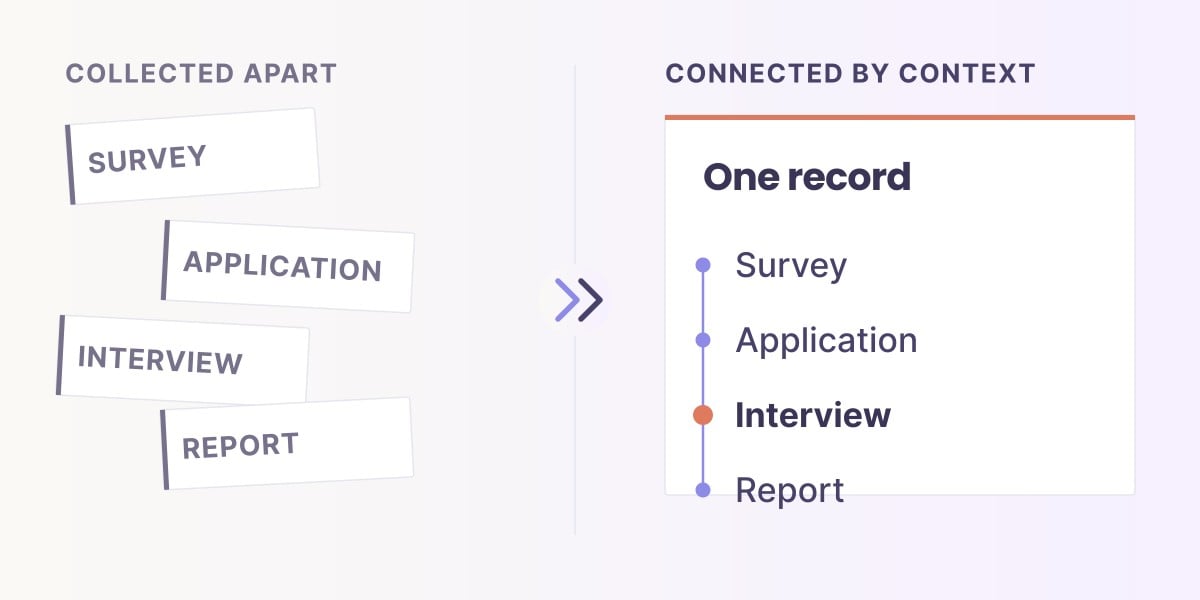
A workforce training nonprofit runs a 16-week cohort of 47 participants. Intake survey in week one, exit survey in week sixteen, a mid-point check-in, and a coach interview for anyone flagged at risk. In a form-builder tool, that is four disconnected datasets and a quarter-end matching project. In a continuous-learning platform, every response lands against the participant's persistent record the moment it is submitted.

Start with what happens to a single open-ended answer. The exit survey asks: "What feels different about your job search now compared to when you started?" One participant writes a few sentences. On arrival, the response runs against the program's scoring rules — defined once, applied identically to all 47.

Response on arrival

"Before this I would never email a hiring manager directly. Last week I negotiated my offer up by $4,000 because I finally knew what my certifications were worth."

Scoring rule

confidence_rubric v2
scale 1–5 · locked
evidence: required
themes: from codebook

Output, with evidence

Confidence: 5/5 — cites "negotiated my offer up" as evidence.

self-advocacy salary negotiation outcome: placed

Because the platform recognizes the participant across all four touchpoints, the scored answer does not float alone — it joins everything else known about that person. The intake score sits next to the exit score. The coach's interview notes sit next to the survey data. One record, assembled without anyone assembling it:

PARTICIPANT P-0341 Cohort 7 · Intake Jan 12 · Exit May 30 · 4 touchpoints
Job-search confidence · intake2/5
Job-search confidence · exit5/5
Technical skill self-rating · exit4/5

"Before this I would never email a hiring manager directly." — exit survey, May 30, linked to confidence score

The same pattern carries to any program measuring change in people: a youth services organization tracking students across school years, a scholarship program following recipients from application to graduation, a health program pairing intake assessments with case notes. The instrument design behind this lives in longitudinal surveys and pre and post surveys.

"The flexibility of an AI-native tool that allows an organisation to manage its own longitudinal data and reporting — without needing a highly technical background — is a fantastic approach. We can certainly see the potential for a tool like this to help us tell the story of the impact and change we are seeing with our kids."

Laura · I Have A Dream Foundation, New Zealand
02 · Decisions made from text at scale

When the answers are essays, consistency is everything

A scholarship program receives 500 applications, each with two essays. A company collects 2,300 open-ended customer feedback comments a quarter. An HR team runs exit interviews it never has time to synthesize. The data type is the same — unstructured text attached to a person — and so is the failure mode: either nobody reads it, or three reviewers read it three different ways.

This is also where automated scoring earns or loses its place. Run the same scholarship essay through a general-purpose model three times and you get three different scores. That is unusable for an award decision — the next run decides something different. A locked rubric returns one answer, every time, with the sentence it came from:

Generic model · same essay, three runs
Run 1 · mission alignment7/10
Run 2 · mission alignment8.5/10
Run 3 · mission alignment6/10

No evidence cited. No two runs agree. Whichever run happens last decides a scholarship.

Locked rubric · same essay, every run
Run 1 · mission alignment8/10
Run 2 · mission alignment8/10
Run 3 · mission alignment8/10

Cites "founded a coding club for 30 middle-schoolers" as evidence. The panel can audit the score; the board can defend the award.

Scored consistently, individual responses become a cohort-level picture. Across all 500 applications — or all 2,300 customer comments — one dimension distributes across the whole population, and the review effort goes where the signal is:

Mission alignment · 500 applications · scored on arrival
Strong (8–10)
117
Moderate (5–7)
261
Weak (1–4)
122

The panel reads 117 essays in depth instead of 500 in a blur. Every score still clicks back to its evidence, so nothing is decided by the machine — the machine just orders the queue.

The customer and employee versions are identical in shape. Quarterly feedback comments theme on arrival, so the product team sees that "onboarding confusion" doubled before the renewal cohort churns. Exit interview transcripts score against a retention rubric, so HR sees which departure drivers are fixable. The 60-question annual survey shrinks to five questions and one open prompt — and the response rate recovers, because the burden dropped while the analysis deepened.

03 · Portfolios, and acting in real time

From single responses to a view someone can run a meeting on

A foundation tracks 32 grantees, each submitting quarterly narrative reports as documents plus a short structured update. An accelerator follows 18 portfolio companies through financial uploads and founder check-ins. In both cases the question at review time is the same: who is on track, who needs attention, and what is the evidence. When every report and response has been analyzed on arrival, that view assembles itself — sortable, filterable, with every cell tracing back to the source document:

Sort: risk ▾ Filter: Q2 submitted 32 grantees
GranteeOutcome progressTop theme this quarterRisk signalEvidence
G-117On track · 86% of targetStaff capacity strainWatchQ2 report, p.3
G-204Behind · 41% of targetSite delays, permitsFlagQ2 report, p.1 · check-in 5/14
G-088Ahead · 112% of targetDemand exceeding planNoneQ2 report, p.2

No program officer read 32 PDFs to build that table. They read the three that mattered — the flags — with the relevant passages already surfaced. The same grid shape serves a CSR team reporting program outcomes to leadership, or a multi-site nonprofit comparing locations: the rows change, the architecture of every-number-traces-back does not.

When a response should trigger an action, not a chart

Some answers cannot wait for the quarterly review. A field report mentioning a safety issue, a check-in where a student signals crisis, a customer comment naming a contract-threatening defect — these need to move the day they arrive. Because responses are analyzed on arrival, they can be piped into whatever workflow the moment demands: a flag to the case manager, an alert in the team channel, a follow-up form triggered automatically for one cohort. Paired with automation tools — including agentic setups like Claude Code wired to your systems — the survey platform becomes the sensing layer of a loop that does not just measure the program but runs parts of it.

And when the reporting deadline does come, the primary data collected here is the half the document that secondary sources cannot supply. Compliance filings, funder reports, and board decks pull program records from many systems — what they consistently lack is current, attributable stakeholder evidence. A platform holding analyzed primary data with citation chains supplies exactly that: the quote with a date and an ID behind it, the outcome number with the responses underneath it.

See what these reports look like finished

Worked examples of survey reports built from analyzed responses — formats, sections, and the visuals that carry them.

View survey report examples
The landscape

The honest comparison — on the axes that decide outcomes

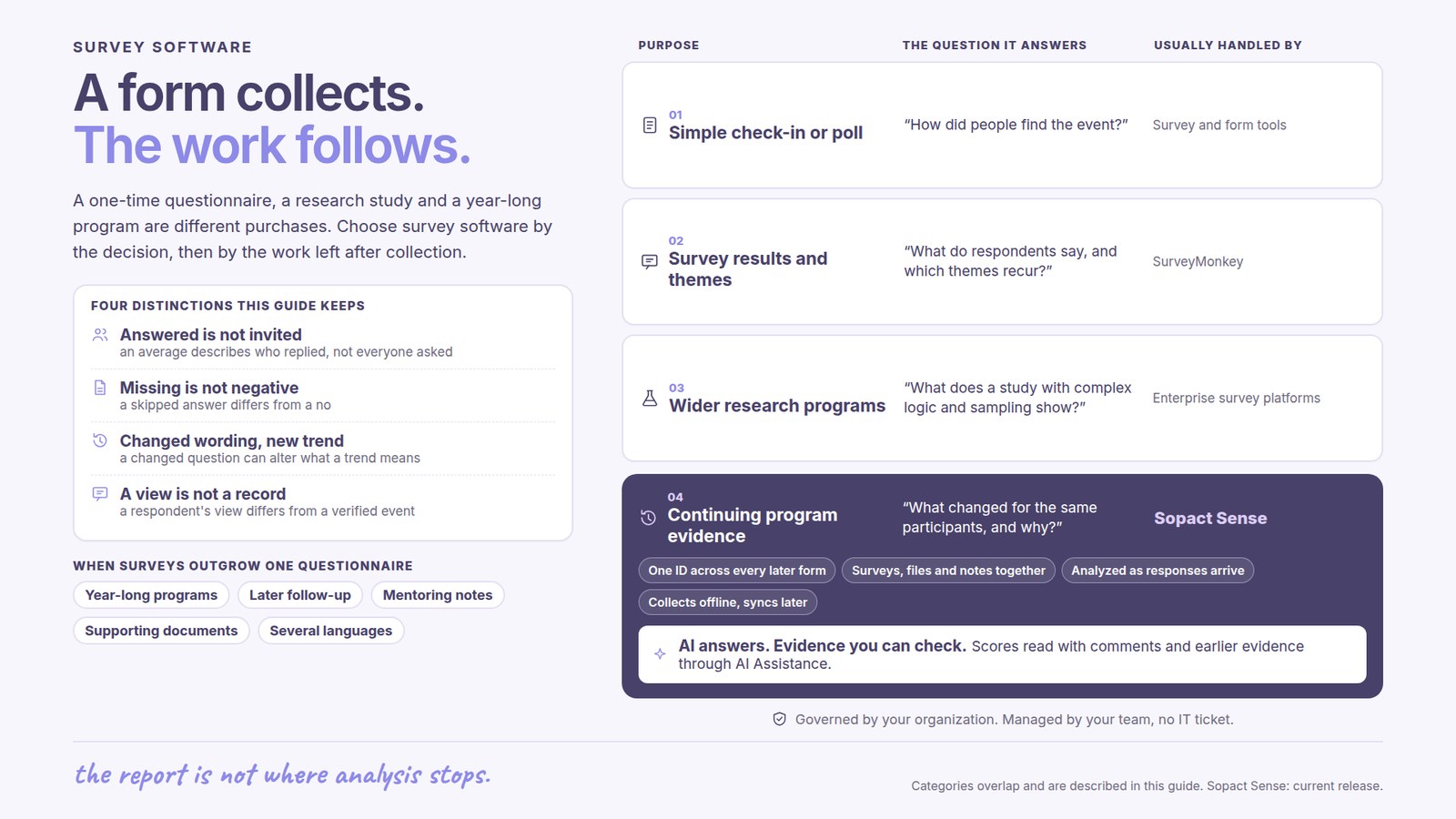
Every "best survey software" list compares the same ten tools on question types and pricing tiers. Those rows are real but rarely decisive — every platform below builds a competent form. The columns that actually separate them are what happens to open text, whether respondents have identity across rounds, and how long until the data produces a decision.

Platform Best for Open-ended responses Same respondent across rounds Time to first insight
Google Forms Free one-off questionnaires, internal quick polls Exported to Sheets for manual reading No — each form is independent At export, if someone does the analysis
SurveyMonkey Market research, general business surveys, large template library Word clouds and basic text tagging; deep analysis is manual or exported Limited — contact lists, not longitudinal participant records Closed-ended charts immediately; open text waits for a person
Typeform Conversational forms where completion experience drives response rate Collected well, analyzed elsewhere No — built around the single form At export
Qualtrics Enterprise experience management with research teams and budget Text analysis available on higher tiers; configuration is its own project Yes, with panel infrastructure and setup effort After implementation — commonly months, often with consultants
Sopact Sense Programs collecting from the same stakeholders over time — training, scholarships, grantees, customer and employee feedback Themed and rubric-scored on arrival, with evidence cited per score Yes — persistent record per participant, surveys plus interviews plus documents Same day responses arrive; live shareable reports

The fair summary: for a one-time poll, the free tools win and nothing else is worth paying for. For brand-tracker market research with a dedicated research team, the established platforms have depth this table cannot capture. For continuous learning from your own stakeholders — where the value is in the open text and the change over time — the form-builder architecture is the wrong shape regardless of vendor, and the enterprise suites solve it at a cost documented in the enterprise survey software guide.

Questions

Survey software, answered directly

What is survey software?

Survey software is an application for designing questionnaires, distributing them through links, email, or embedded forms, and collecting and analyzing the responses. Modern survey software adds analysis of open-ended answers, persistent respondent identity across multiple collection rounds, and reporting that updates as responses arrive.

What is the difference between a survey tool and a survey platform?

A survey tool typically refers to a lightweight application for building and sending a single questionnaire. A survey platform refers to a broader system that manages many surveys, respondents, and reporting workflows in one place — including respondent identity, analysis, and distribution across an organization. The terms overlap; the distinction is scope.

What is the best survey software?

It depends on the job. For one-off polls, free tools like Google Forms work. For market research panels, SurveyMonkey and Qualtrics lead. For programs that collect feedback from the same people over time and need open-ended responses analyzed — training programs, scholarships, grantee reporting, customer or employee feedback — choose software that keeps a persistent record per respondent and analyzes text on arrival.

Is there good free survey software?

Yes. Google Forms is free and handles short, one-time questionnaires well. Most commercial platforms offer free tiers with limits on responses, questions, or features. Free tiers usually exclude the capabilities that matter for ongoing programs: open-text analysis, respondent identity across rounds, and exportable reporting.

What is a survey builder?

A survey builder is the design interface inside survey software — the part where you create questions, set answer types, add logic that skips or branches based on previous answers, and control the look of the form. Every survey platform includes a builder; they differ in question types, logic depth, multilingual support, and whether the builder connects each question to downstream analysis.

What is a survey app?

A survey app is survey software delivered as a mobile or web application, usually emphasizing collection on phones and tablets — in the field, at events, or offline. For respondents, most modern survey links open as mobile-responsive web forms, so a separate app is mainly relevant for offline field data collection.

How do I choose survey software for a nonprofit or social program?

Start from the reporting you owe — to a funder, a board, or your own team — and work backward. Programs measuring change need pre and post responses matched to the same participant, open-ended answers analyzed rather than skimmed, and reports that trace each number back to its source response. Generic form builders handle collection but leave the matching and analysis to spreadsheets.

Why are survey response rates declining?

People receive far more survey requests than they once did — research puts the typical volume around a dozen requests per person per month — and most see no evidence their answers change anything. Long questionnaires built to compensate for thin analysis make it worse. The most reliable fix is asking fewer, better questions and visibly acting on what comes back.

Can survey software analyze open-ended responses?

Traditional survey software charts closed-ended answers and exports open text for someone to read manually, which is why most open-ended responses are never analyzed. Newer platforms apply automated theming and rubric scoring as each response arrives, so a thousand open answers become a theme distribution with quotes attached — without a manual coding project.

What is the difference between survey software and enterprise survey software?

Enterprise survey software adds organization-wide controls: single sign-on, role-based permissions, compliance certifications such as HIPAA or GDPR support, integrations, and dedicated support. The trade-off has historically been implementation cost and timeline — enterprise feedback platforms often take months and significant consulting to deploy. The enterprise survey software guide covers the category in depth.

Can survey software replace interviews and documents?

No, and it should not try to. Surveys capture structured signals at scale; interviews, open responses, and documents carry the explanation. The strongest feedback systems collect both against the same respondent record, so a score and the story behind it sit side by side in the same report. See qualitative data collection methods for the collection side.