


Related solution
Training & Programs
Connect starting assessments, participant feedback and later skill use across cohorts.
Explore the solution →


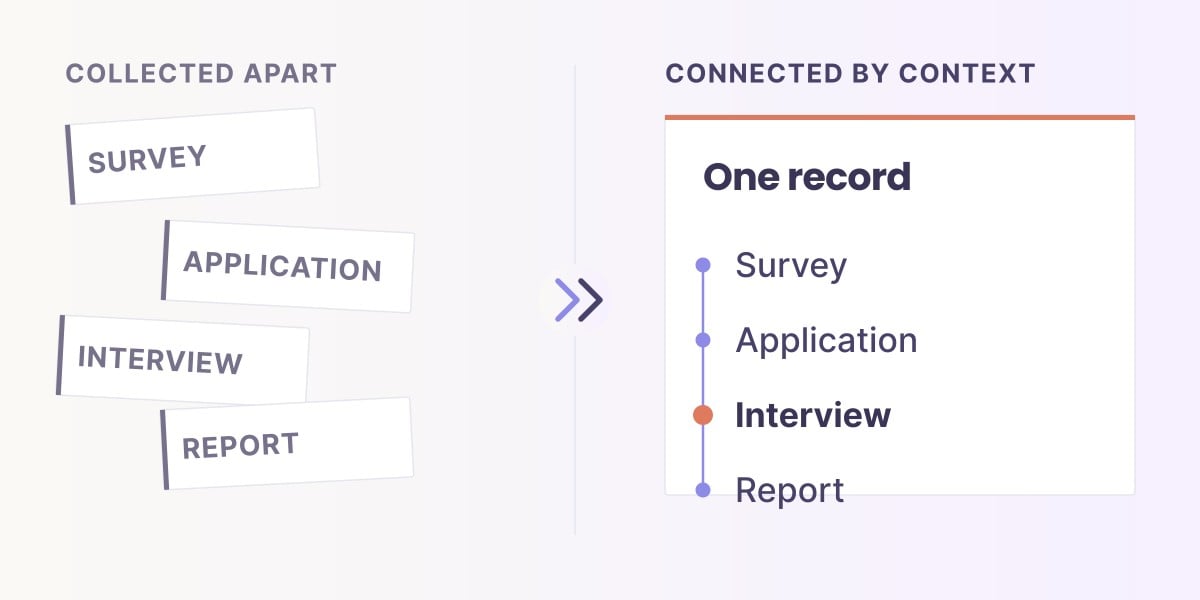
Live webinar: Wednesday, October 7, 2026 | 9:00 AM PT
Building context across your data. In 30 minutes, see how to connect data and definitions across teams, with the right permissions and governance, so scattered data points become intelligence your teams and AI can actually use.
Save your spot (free)Longitudinal data collection · Practical guide
Longitudinal data collection software links repeated surveys, assessments, notes and feedback to the same person or organization over time. Good software helps research and program teams maintain a reliable participant history, follow up with the right people, and understand both what changed and what participants experienced.
Keeping that history intact is the difficult part. Across a 9–18-month program, a mistyped unique ID can separate a follow-up from its baseline; a duplicate registration can make one person look like two. Staff changes, missed visits and inconsistent fields add reconciliation work. Written feedback and case notes create another burden: teams must read, code and compare them across rounds while preserving who said what and when.
AI can help interpret that qualitative material alongside repeated measurements. But an insightful summary is only useful if it belongs to the right participant and collection period. Buyers need to assess the whole process: identity and follow-up, data quality, qualitative analysis, and the effort required to keep results connected.
Sopact brings those needs together for programs and portfolios by connecting forms, files and feedback around continuing participant records. Its value is helping teams examine progress with the explanations behind it, instead of reconstructing the relationship for each report. Collection can be tailored to each program, with ongoing Sopact support as questions and reporting needs change.
The same person connected across enrollment and every follow-up.
Scores, qualitative feedback and notes connected over time.
Compare progress without rebuilding the record for each report.
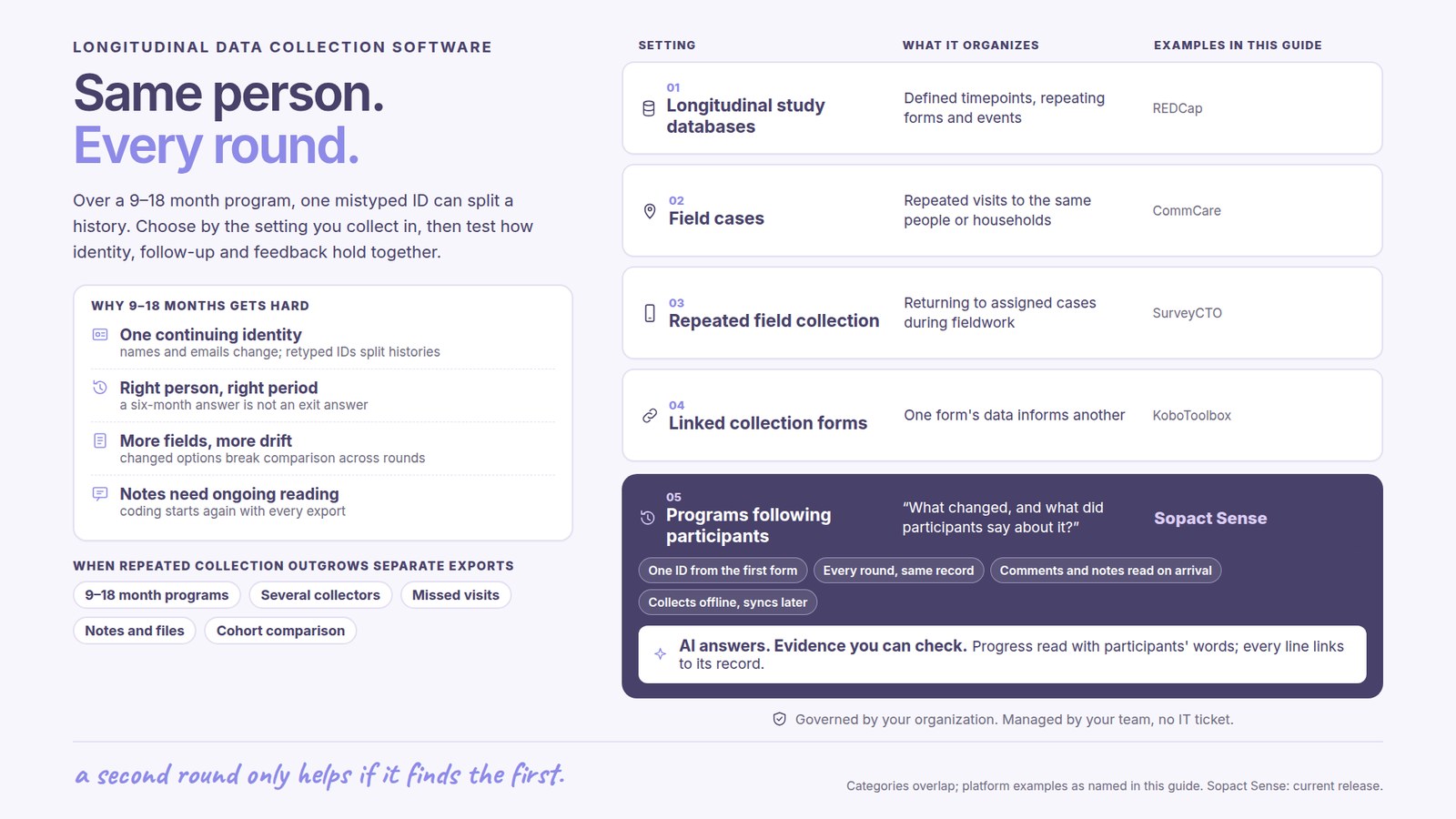
A program may begin with a clean enrollment list and still end with follow-up spreadsheets that take days to reconcile. The difficulty grows when different people collect information, participants return at different times, and surveys, staff notes and supporting files follow separate paths.
A name or email address alone is a fragile way to connect records: spelling varies, contact details change and people can share names. A stable unique ID provides the link, but the collection process must carry it forward correctly. When staff retype IDs or match separate exports by hand, an error can split a history or attach an answer to the wrong person. Good software reduces repeated entry and keeps uncertain matches visible for correction.
A six-month response is different from an exit assessment, even when both use the same questionnaire. Late responses, missed visits and changing staff assignments complicate the picture. Teams need to see which participants were expected, which responded and which remain missing before interpreting a trend. Otherwise, a change in the group answering can look like a change in individual outcomes.
Long forms and repeated entry increase the work for participants and field staff. Inconsistent dates, changed answer options and differently interpreted questions can undermine comparison across rounds. The buying requirement is a manageable collection process with useful validation and a clear way to resolve errors—not simply the ability to add more fields.
Scores may indicate progress while a participant’s comments describe a new barrier. Understanding that combination requires reading responses, checking interpretations and comparing themes across time. When notes are stored separately and coding begins again with each export, context is easy to lose and reporting becomes dependent on a central analyst. AI assistance is valuable when it reduces that repeated reading while preserving the original words, participant and date.
A clinical research study, a field team making repeated household visits and a workforce program following alumni all collect information over time. They differ in how people are reached, how observations are organized and who uses the results.
Research teams need a dependable structure for repeated assessments and a clear history of the data. Institutional requirements, study procedures and the analysis plan often shape the choice. The platform must fit the study rather than dictate which questions the researchers can ask.
Field teams may work with intermittent connectivity and return to the same households or cases. Their priority is collecting the right follow-up information in the setting where the work happens. Reliable field operation and access to earlier case context can matter more than an executive dashboard.
Program teams may collect an initial assessment, completion feedback and later updates. They need to understand change, the obstacles participants report and differences across cohorts. Sopact focuses on connecting those sources for program and portfolio decisions.
Carry the same participant identity into every collection round.
Keep the collection period and missing responses visible.
Read qualitative feedback and notes alongside repeated scores.
Use connected histories to compare cohorts and guide support.
Sopact publishes this guide. The shortlist groups platforms by purpose; it is not an independent ranking. Linked product documentation supports the descriptions. Features and services depend on the selected product and agreement.
| Platform | Main buying need | What matters in this choice |
|---|---|---|
| REDCap — longitudinal studies and databases | Longitudinal study databases | A direct option for longitudinal collection: defined timepoints, repeating forms and events, and scheduling. Particularly relevant when the organization needs a configurable study database within an established institutional research environment. |
| CommCare — continuing field cases | Field cases | Case management supports repeated interactions with the same people or households. Consider it when frontline teams need a practical field application and continuity between visits. |
| SurveyCTO — repeated field collection | Repeated field collection | Case-management capabilities support returning to assigned cases during data collection. Relevant when structured fieldwork and the data-collection operation are central to the study or program. |
| KoboToolbox — linked collection forms | Linked collection forms | Dynamic data attachments allow information collected in one form to inform another. This can support repeated collection, but the buyer should account for the work needed to organize follow-up and analysis around that capability. |
| Sopact — recurring program analysis | Program and portfolio analysis | Connects forms, files and participant feedback across stages and programs. Relevant when the main goal is understanding progress and its explanations for staff, leadership and funders. |
These platforms already support important parts of longitudinal work. A disconnected process is not inevitable, and manual ID matching is not a required step in every deployment. The practical difference is how the full workflow is configured and maintained, especially when collection must feed continuing qualitative and program analysis.
CommCare’s research platform supports participant tracking across visits, access to earlier data and offline collection. Dimagi also describes onboarding for complex protocols and connections to reporting and statistical tools. For a field-led program, assess how the case application and analytical tools will work together when questions change or notes need to be interpreted across visits.
SurveyCTO case management uses a case list with unique IDs, associated forms and assignments. When a form is opened through that case workflow, its case ID can be populated automatically. This reduces re-entry; it does not depend on manually matching every export. Buyers should account for maintaining the case list and form relationships, then establish how qualitative interpretation and reporting will continue across rounds.
KoboToolbox’s dynamic data attachments can bring earlier information into later forms. Its documentation describes setup for linked projects, handling duplicate index values, refreshing offline data and updating connections when fields change. These are concrete maintenance considerations for repeated collection.
KoboToolbox also supports AI-assisted qualitative analysis of audio responses, with review and verification. At the time of this review, that documented feature covers audio responses rather than text or other response types. Compare its scope with the evidence your program actually collects: typed feedback, staff notes, recordings and separate files may need different analytical paths.
For all three, evaluate the work from a returning participant’s response to a usable program finding. Strong collection tools can be the right choice. A team seeking connected program analysis should also compare how much interpretation, reconciliation and reporting it must maintain around them.
REDCap belongs in a longitudinal data collection shortlist. Its official training library covers longitudinal projects, scheduled events and repeating instruments. UCLA’s REDCap guidance also explains how forms or groups of forms can repeat when the number of follow-ups is not known in advance. Tracking the same people over time is a shared capability.
REDCap provides configurable surveys and databases, audit trails, reporting and statistical exports. A team with established study procedures and analytical support may already have a suitable environment. REDCap also supports customization and user control, so those capabilities alone do not separate Sopact.
A workforce program may need to understand an assessment score alongside a participant’s account of difficulty applying a skill. A portfolio leader may need to compare those patterns across several programs while preserving each program’s context. Sopact emphasizes that combined interpretation of forms, files and feedback, including AI-assisted analysis and answers that staff can review against their source material. The benefit to evaluate is how readily program staff can use the information for support and improvement.
In the standard consortium model, REDCap’s institutional partner operates the system and supports its users; the services available vary by institution. Sopact offers a vendor relationship around personalization, team ownership and continuing program support. Compare the help your team will actually receive as questions and reporting needs change. REDCap Cloud is a separate commercial offering and should be evaluated separately.
Both platforms support repeated data collection, offline work and multiple languages. The more useful distinction is how participant identity, collection rounds and analysis are brought together.
SurveyCTO can take information from one form, update a shared dataset and make that information available to another form. Its publishing rules determine which fields connect and whether incoming values update existing records or create new ones. This flexibility suits teams designing detailed field workflows. The responsibility is to maintain those connections as forms, collection rounds and reporting requirements change.
In Sopact’s documented collection model, enrollment establishes a participant identity that carries into related forms. Participant-specific links support follow-up and correction of existing responses. For program teams, the benefit is continuity from the first collection round, with less reliance on matching separate files later.
Sopact also documents AI analysis of written answers and PDF attachments that retains the participant relationship. The resulting analysis can stay alongside the collected response. This helps teams examine a change in scores with the participant’s explanation, rather than preparing a separate qualitative report and reconnecting it afterward.
SurveyCTO includes built-in data exploration and AI transcription and translation; Sopact’s distinction is not simply that it uses AI. For a program following people over many months, compare how each approach supports an evolving participant history, qualitative interpretation and usable findings across cohorts. Sopact combines this program focus with personalization and continuing team support. The value is the connected work the team can maintain throughout the program.
Sopact’s program approach connects repeated assessments, feedback and relevant files with a continuing participant record. A program manager can consider an exit score alongside earlier concerns and later follow-up, rather than treating each survey as a separate report. Stable identifiers and configured relationships underpin that continuity; missing or mismatched records still need attention.
The analytical benefit is bringing qualitative explanations into the same view of progress. A score may improve while a participant’s notes describe difficulty using the new skill at work. Connecting those sources helps staff decide what support to offer and helps leaders understand differences across cohorts. This is the basis for evaluating Sopact’s value: less repeated assembly of evidence, more usable context for program decisions.
For an organization running several programs, Sopact combines questions tailored to each program with reporting across the portfolio. Customer ownership and continuing Sopact support are part of that approach: the team needs to adapt follow-up as its programs change while preserving useful context from earlier periods.
Sopact supports offline collection and multiple languages, so those capabilities alone do not distinguish these options. The decision is how well the platform serves the program’s continuing work: collecting follow-up, understanding participants’ experiences and using the findings across programs. Research institutions should also weigh their study-specific and institutional requirements.
Start with the full duration of your program. Include enrollment, repeated follow-up, staff changes and the final reporting question. A platform that collects one round well may still leave substantial work between rounds.
Compare five requirements: preserving the same participant identity; handling missed and late responses; limiting repeated entry and correcting errors; analyzing written feedback, notes and files alongside scores; and maintaining the process when the program changes. Ask who owns each part and what continuing support is included.
Choose field case management when the core need is reliable frontline collection and visits. Choose a study database when research design and institutional requirements drive the work. Consider Sopact when program staff need connected participant histories and qualitative interpretation to remain useful across programs and reporting cycles.
It is longitudinal when observations are connected to the same subjects over time. Surveying a different group each year describes population snapshots rather than individual change.
AI-generated text does not replace an observation from a participant. Missing responses need to remain visible and be considered in interpretation.
Following change over time is valuable, but causation depends on the evaluation design and other influences. A platform can organize evidence without establishing that the program alone produced the result.
Continue with a purpose
Related solution
Connect starting assessments, participant feedback and later skill use across cohorts.
Explore the solution →Continue learning
Define a meaningful outcome, compare follow-ups and account for people you did not hear from.
Start learning →
Customer story
Building a shared data foundation across member organizations, languages and event cycles.
Read the story →Explore how your team could connect starting assessments, participant feedback and later updates across its programs.
See it with your workflow →