Sopact is a technology based social enterprise committed to helping organizations measure impact by directly involving their stakeholders.
Useful links
Copyright 2015-2025 © sopact. All rights reserved.

New webinar on 3rd March 2026 | 9:00 am PT
In this webinar, discover how Sopact Sense revolutionizes data collection and analysis.
SurveyCTO gets data from field to server. The Extraction Wall begins there. Honest comparison of KoboToolbox, ODK, and Sopact Sense — for organizations where program intelligence is the real bottleneck.
By Unmesh Sheth, Founder & CEO, Sopact
The field survey ran for six weeks across three districts. Enumerators collected 2,400 household interviews on Android tablets. SurveyCTO Collect worked exactly as it should: forms loaded offline before enumerators left the regional office, GPS coordinates logged each interview location, audio audits flagged three enumerators whose completion times suggested fabricated responses, validation rules rejected implausible values in real time. When connectivity was available, data synced automatically to the server. When it was not, SurveyCTO held it locally without losing a record.
The data arrived on the server clean, validated, encrypted, and structured. Then the M&E officer opened Stata.
The data cleaning script ran for two hours. The household roster pre-loaded into the form did not perfectly match the actual household registry — seventy-three households had changed composition between the roster generation date and the interview date, requiring manual reconciliation. The qualitative field notes enumerators had typed into open-text fields — observations about community dynamics, barriers to program access, participant responses that went beyond the survey instrument — had been exported as text strings and sat in 2,400 rows of a spreadsheet that nobody had time to read. The follow-up survey, scheduled for six months later, would produce another 2,400 rows that needed to be matched to the baseline on household ID. The program manager asked when the analysis would be ready for the quarterly report. The answer was three weeks.
This is the Extraction Wall — the structural boundary where SurveyCTO's job ends and the researcher's job begins. SurveyCTO was designed to get clean, validated data from the field to the server. It does that job extraordinarily well. The analysis, the qualitative synthesis, the longitudinal matching, the outcome narrative, the program intelligence — those were always the researcher's responsibility. The Extraction Wall is not a SurveyCTO failure. It is the designed boundary of field data collection infrastructure. The question this article addresses is whether that boundary is in the right place for your organization's actual bottleneck.
The evaluation must start with an honest distinction. SurveyCTO and Sopact Sense share two genuine capabilities — offline data collection and multi-language form support. Everything beyond that surface is architecturally different. Before evaluating alternatives, the bottleneck must be precisely located.
The credit belongs where it is earned — and SurveyCTO has earned a significant amount of it.
The offline capability is genuinely differentiated. The SurveyCTO Collect Android app is, by consistent G2 reviewer consensus, "the gold standard for offline and low-connectivity data collection." Forms with all their media, skip logic, and validation rules download to the device before a field team leaves for a remote location. Data is captured, validated against form constraints, and stored locally — with GPS coordinates, audio audit recordings, and signature captures intact — without any connectivity. When connectivity is available, sync is automatic. When it is not, records queue without loss. For organizations operating in rural sub-Saharan Africa, mountain communities in South Asia, or post-disaster humanitarian contexts where connectivity is genuinely absent, this is not a feature — it is the functional prerequisite for any data collection at all.
Field quality control is the second genuine differentiator. SurveyCTO's supervisor monitoring capabilities go beyond what any web-survey platform provides. Audio audit recordings capture the interview as it was conducted — enabling supervisors to verify that the enumerator actually read the question as written, not a paraphrased version that biases the response. GPS fencing confirms the interview happened in the right geographic area, not at the enumerator's home. Automated completion-time analysis flags interviews that were completed improbably fast — the statistical signature of fabricated responses. For M&E programs where enumerator fraud is a real operational risk, these are not optional features; they are the integrity layer that makes the data scientifically credible.
XLSForm compatibility with the ODK ecosystem means SurveyCTO forms can be designed in a standard spreadsheet format and deployed across the entire ODK toolkit — KoboToolbox, ODK Briefcase, Open Data Kit, and affiliated research infrastructure. For research institutions, academic M&E programs, and global health organizations that operate within the ODK ecosystem, this compatibility eliminates vendor lock-in and enables collaboration with external partners using compatible tools.
End-to-end encryption for sensitive data — public key encryption at the device level, data never stored unencrypted on the server — meets the requirements of IRB-approved clinical research, health surveys collecting sensitive identifying information, and humanitarian programs where participant safety depends on data security. For organizations where a data breach creates legal or physical harm for participants, SurveyCTO's encryption architecture is the appropriate standard.
Who SurveyCTO is for, stated precisely: Academic researchers and their field teams. Global health M&E programs conducting population-based surveys. Humanitarian organizations collecting data in crisis contexts. Clinical researchers requiring IRB-compliant data management. Monitoring and evaluation professionals who will analyze data in Stata, R, SPSS, or SPSS and have the technical capacity to design XLSForms and write cleaning scripts. Organizations where the bottleneck is field data collection quality and integrity, not what happens after the data reaches the server.
SurveyCTO's power is concentrated in the data transport layer: the distance from field enumerator's tablet to the project server. The platform does not attempt to be an analysis platform, and this is not a weakness — it is the correct scope for the problem it was designed to solve.
The Extraction Wall appears at the server boundary. Once data is on the server, SurveyCTO's primary contribution is complete. What exists on the other side of the wall:
Qualitative content analysis. Open-text fields in SurveyCTO forms collect enumerator observations, participant narratives, and field notes. These arrive at the server as text strings in a CSV export. Reading 2,400 text responses manually takes weeks. Extracting themes systematically requires NVivo, MAXQDA, or a manual coding framework that lives entirely outside SurveyCTO. The qualitative signal in the open-text fields — often the richest evidence about why program outcomes happened or didn't — sits behind the Extraction Wall.
Longitudinal participant matching. SurveyCTO's case management feature enables enumerator workflow management — tracking which households need follow-up visits, assigning new interviews, monitoring field team progress. It does not automatically connect the same participant's baseline survey responses to their six-month follow-up responses under a persistent participant identity. Longitudinal linkage requires pre-loading a participant ID into each wave and then matching on that ID in the analysis phase — a technically feasible but operationally fragile process. When pre-loaded IDs are missing, when participants were enrolled after the roster was generated, or when ID fields were not filled in, the longitudinal connection requires manual reconciliation behind the Extraction Wall.
Real-time program intelligence. SurveyCTO provides real-time monitoring of field data collection: how many forms are submitted, from which devices, with which GPS locations. This is operational intelligence about the data collection process. It is not program intelligence about whether the program is working: which participants are progressing, which are at risk, what qualitative themes are emerging across the cohort, what the data so far suggests about outcome achievement. That intelligence lives behind the Extraction Wall, available only after the export, the cleaning, and the analysis are complete.
Reporting latency. SurveyCTO data becomes program reporting after the Stata script runs, the analysis is complete, and the visualization is built — typically weeks after data collection closes. For programs that need to make mid-cycle decisions based on emerging data (which participants need additional support, which program components are underperforming, which sites are off-track), the reporting lag means the decisions are made retrospectively rather than in real time.
For nonprofit impact measurement and program evaluation buyers — particularly program managers and impact officers at social enterprises, foundations, and workforce programs — the Extraction Wall is the defining limitation. The field data collection is excellent. The intelligence that should follow from it requires a separate research infrastructure that most program teams do not have.
Sopact Sense begins where SurveyCTO ends. It is not a replacement for field data collection infrastructure in environments where SurveyCTO's offline capability and enumerator quality controls are required — it is the intelligence platform for program contexts where enumerator-mediated field surveys are not the primary data collection model.
How Sopact Sense handles offline and multi-language: Both capabilities are present. Sopact Sense forms work offline and support multilingual instruments — the surface similarity with SurveyCTO that Unmesh noted. The architecture beneath those features is different. Sopact Sense offline capability is designed for program participants filling in forms on their own devices (direct participant data collection), not for trained field enumerators conducting structured interviews on tablets. Multi-language support in Sopact Sense is participant-facing — participants select their language and receive the form in that language. In SurveyCTO, multi-language is primarily enumerator-facing, with the enumerator seeing question text in one language and the participant hearing it read aloud.
What Sopact Sense does that SurveyCTO does not:
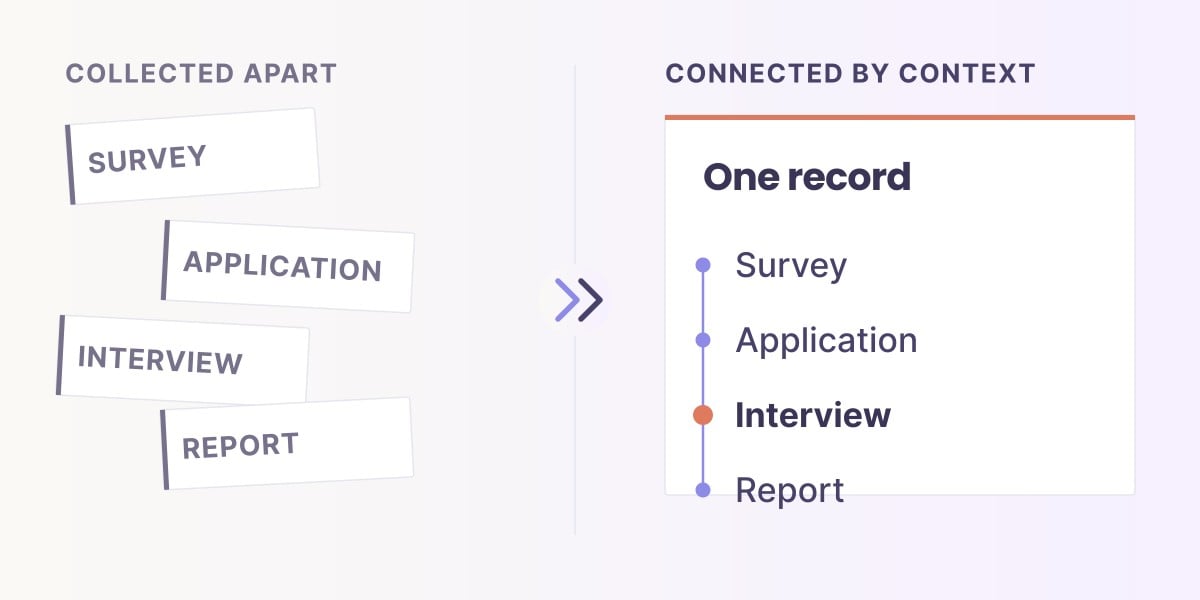
Persistent Contact IDs assigned at program intake connect every subsequent data collection event — surveys, check-ins, document uploads, interview records — to the same participant identity automatically. The longitudinal matching problem is solved at the architecture level, not the analysis phase. There is no export step between data collection and longitudinal analysis.
The Intelligent Suite analyzes open-ended responses across all data collection events simultaneously — extracting themes from 300 participant narratives in minutes, linking qualitative evidence to quantitative metrics under the same Contact ID. The qualitative content behind SurveyCTO's Extraction Wall is analyzed in real time in Sopact Sense.
Program intelligence — which participants are progressing, which are at risk, what themes are emerging in qualitative data, how outcomes compare to targets — is available as data arrives. The program manager does not wait for the Stata script.
Logic model alignment means data collection instruments are designed from the theory of change — each survey question maps to a program output or outcome milestone. The analysis structure exists in the data collection design, not in the post-export code.
For survey for nonprofits and nonprofit storytelling buyers whose program data collection happens with willing participants rather than field enumerators, and whose bottleneck is what comes after data collection rather than the collection itself, Sopact Sense closes the Extraction Wall.
The alternatives most frequently evaluated alongside SurveyCTO fall into two categories: ODK ecosystem tools that share the field-first, enumerator-mediated architecture; and program intelligence platforms that take a fundamentally different approach.
KoboToolbox. The most direct SurveyCTO alternative within the ODK ecosystem. Open-source, free for humanitarian organizations through the Humanitarian Response plan, XLSForm compatible. Weaker offline capability than SurveyCTO in genuinely extreme conditions, but adequate for most field contexts. Less sophisticated supervisor monitoring — no audio audit equivalent. KoboToolbox's humanitarian focus makes it the right choice when budget is the constraint and the SurveyCTO-level field quality controls are not required. The Extraction Wall is identical — KoboToolbox data exits to Stata, R, or external tools for analysis. For organizations evaluating cost rather than architecture, KoboToolbox is the honest first alternative.
ODK (Open Data Kit). The open-source foundation that both SurveyCTO and KoboToolbox build on. Self-hosted, free, maximum technical control. Requires a technical team to set up and maintain the server infrastructure. The right choice for large research institutions or governments that need maximum control over data sovereignty and are willing to invest in technical infrastructure. The Extraction Wall applies.
REDCap. The clinical research standard for longitudinal data management — covered in the Qualtrics alternatives page. REDCap has genuine persistent participant identity management and is the right choice when IRB compliance and clinical trial standards are required. Not designed for field enumerator workflows or offline-first data collection at SurveyCTO's level.
Sopact Sense. Not a replacement for SurveyCTO in enumerator-mediated field survey contexts. The right choice when: the primary bottleneck is program intelligence rather than field data collection, data collection is participant-direct (not enumerator-mediated), the team needs real-time qualitative and quantitative intelligence without statistical research expertise, and the Extraction Wall is the actual problem. For longitudinal survey software and impact measurement and management buyers working in program delivery contexts rather than academic research contexts, this is the defining fork.
The honest hybrid: Several organizations use SurveyCTO and Sopact Sense in complementary roles. SurveyCTO handles population-based field surveys requiring enumerator management and offline integrity. Sopact Sense handles participant-direct surveys, outcome tracking, qualitative synthesis, and program intelligence. The data from SurveyCTO's field surveys can be imported into Sopact Sense for longitudinal intelligence analysis — the Extraction Wall is crossed once, and subsequent program phases happen in Sopact Sense's identity-continuous architecture.
SurveyCTO is the right tool when:
Your data collection requires trained field enumerators conducting structured interviews — community health workers administering WASH assessments, M&E teams conducting population-based household surveys, humanitarian field staff collecting needs assessment data. The participant is not self-reporting; the enumerator is mediating the interview. Sopact Sense is not designed for this model.
Your context requires offline data collection in environments where connectivity is absent for days at a time — not "poor connectivity" but genuine offline conditions. Sub-Saharan Africa field surveys, mountain community assessments, post-disaster humanitarian contexts. Sopact Sense handles offline collection for participant-direct forms, but not at SurveyCTO's depth of offline reliability.
Your data security requirements demand end-to-end encryption at the device level — clinical research with sensitive health identifiers, humanitarian surveys in conflict contexts where participant identification creates physical safety risk. SurveyCTO's encryption architecture meets standards that web-based platforms do not.
Your team includes M&E researchers with statistical training who will analyze data in Stata, SPSS, or R, and the Extraction Wall is a manageable part of the research workflow rather than an organizational bottleneck.
The Extraction Wall is your bottleneck when: The analysis that should follow field data collection consistently arrives too late to inform program decisions, when qualitative open-text responses go unanalyzed because the manual coding capacity does not exist, when longitudinal matching between survey waves consumes weeks of researcher time every reporting cycle, or when the program manager needs real-time outcome intelligence that the research workflow cannot provide at the speed the program requires.
SurveyCTO pricing in 2026: The Basic plan includes 10,000 monthly submissions, unlimited forms, users, and storage, starting around $198/month ($198–250+ per independent pricing sources). Annual subscription provides a 10% discount. Additional submission credits available at quantity discounts of 20–50%. Free 15-day trial with full features, limited to 200 submissions. Free community subscription available for evaluation after trial. SurveyCTO is expensive relative to KoboToolbox (free) and ODK (free, self-hosted) — the premium funds the 24/7 professional support and managed hosting that research institutions require.
Sopact Sense pricing: Published flat tiers with full AI analysis, longitudinal tracking, and qualitative intelligence at every level. No per-submission billing. No export step billing. Live in one day, self-service.
When to choose KoboToolbox over SurveyCTO: Budget-constrained humanitarian organizations that need XLSForm-compatible offline field collection. The trade-offs: less sophisticated supervisor monitoring, slightly less robust offline reliability in extreme conditions, humanitarian-focused community rather than academic research community.
What to bring to a Sopact Sense demo: Your current program data collection sequence — which instruments you use, in what order, with what participant population. The analysis question that the Stata script or the manual coding project answers too slowly to be useful for program decisions. One example of a qualitative question in your current survey instrument whose responses go largely unread. The demo shows what persistent participant identity and real-time qualitative analysis look like on your specific program data.
What to bring to a SurveyCTO evaluation: The connectivity conditions your field team operates in (percentage of time with no internet, duration of field trips). Your enumerator supervision requirements (how many supervisors to how many enumerators, fraud risk assessment). Your data security standard (IRB requirements, encryption specifications). The statistical analysis tools your research team uses downstream.
Best SurveyCTO alternative depends precisely on why you are looking. For ODK-ecosystem field data collection at lower cost: KoboToolbox is free for humanitarian organizations and XLSForm-compatible. For self-hosted maximum control: ODK. For IRB-compliant longitudinal clinical research: REDCap. For program intelligence — real-time qualitative and quantitative analysis, persistent participant identity, logic-model-aligned outcome tracking without a statistical research team: Sopact Sense. SurveyCTO remains the best choice when field enumerator management, extreme-offline reliability, and enumerator fraud detection are the actual requirements.
The Extraction Wall is the structural boundary where SurveyCTO's job ends and the researcher's job begins. Field data has been collected, validated, encrypted, and synced to the server. The analyst now exports to Stata, writes the cleaning script, merges baseline and follow-up on household ID, and codes the qualitative open-text responses manually. The Extraction Wall is the designed boundary of field data collection infrastructure — it is not a SurveyCTO failure. It is the cost of a research workflow that separates data collection infrastructure from data analysis. Sopact Sense was built to eliminate the Extraction Wall for program intelligence use cases.
Both Sopact Sense and SurveyCTO support offline data collection and multi-language forms. The architecture is different. SurveyCTO's offline capability is designed for field enumerators conducting structured interviews on Android tablets in connectivity-absent environments — GPS logging, audio audit, sync queue, supervisor monitoring. Sopact Sense's offline capability is designed for program participants directly completing surveys on their own devices. For enumerator-mediated field surveys in genuinely remote contexts, SurveyCTO's offline depth is more robust. For participant-direct program data collection with occasional connectivity gaps, Sopact Sense's offline capability is adequate.
KoboToolbox and SurveyCTO share the XLSForm standard and ODK ecosystem compatibility. KoboToolbox is free for humanitarian organizations (paid plans for others), making it the primary budget alternative to SurveyCTO. SurveyCTO's advantages over KoboToolbox: more sophisticated supervisor monitoring including audio audit, stronger offline reliability in extreme low-connectivity conditions, 24/7 professional support, and managed hosting that meets research institution procurement standards. Both share the Extraction Wall — data exits to Stata, R, or external tools for analysis. For organizations that need SurveyCTO-level field quality controls but have budget constraints, KoboToolbox is the honest step-down.
SurveyCTO pricing starts around $198/month for the Basic plan, which includes 10,000 monthly submissions, unlimited forms, users, and storage. Annual subscription gives a 10% discount. Additional submission credits available at 20–50% quantity discounts. A 15-day free trial includes all features limited to 200 submissions, followed by an ongoing free community subscription for evaluation. SurveyCTO pricing is higher than KoboToolbox (free for humanitarians) and ODK (free, self-hosted) — the premium funds 24/7 professional support, managed cloud hosting, and the infrastructure that research institutions require for IRB-grade data management.
SurveyCTO collects open-text fields and stores them as text data. Analysis of that text — theme extraction, sentiment analysis, manual coding — happens in external tools after the data is exported. SurveyCTO does not offer built-in qualitative analysis of open-text content. For programs where open-text field responses are a primary source of program intelligence — participant narratives, enumerator observations, community context notes — those responses sit behind the Extraction Wall until a researcher manually codes them in NVivo or a similar tool. Sopact Sense's Intelligent Suite analyzes open-ended responses automatically across all data collection events, extracting themes and linking qualitative evidence to quantitative metrics under the same participant Contact ID.
SurveyCTO supports longitudinal research through its case management feature, which tracks which participants or households need follow-up interviews and manages enumerator workflow across multiple survey waves. Longitudinal linkage — connecting the same participant's baseline and follow-up responses for analysis — requires a participant identifier pre-loaded into the forms and matched during the analysis phase. This is technically feasible but requires careful data management. SurveyCTO does not automatically link participant records across survey waves; that linkage happens in Stata or R after export. For academic longitudinal research with M&E researcher capacity: SurveyCTO's case management is the right tool. For program tracking where longitudinal connection needs to be automatic and real-time: Sopact Sense's persistent Contact ID architecture eliminates the export-and-match step.
SurveyCTO and REDCap both serve research data collection but in fundamentally different contexts. SurveyCTO is optimized for field survey data collection — enumerator-mediated, mobile-first, offline-capable, GPS and media capture. REDCap is optimized for clinical and academic longitudinal research — structured quantitative data capture, IRB compliance, genuine persistent participant identity management, self-hosted data sovereignty. For population-based field surveys in low-resource settings: SurveyCTO. For clinical trials and IRB-compliant longitudinal research with connected participants: REDCap. Both share a version of the Extraction Wall — data exits to statistical analysis software for most advanced analyses.
Four limitations define SurveyCTO's ceiling for non-researcher program management use cases: the Extraction Wall (analysis in Stata/R/SPSS requires statistical expertise most program teams don't have); qualitative isolation (open-text responses go to CSV export, not to real-time theme analysis); reporting latency (program intelligence available weeks after data collection, not in real time); and technical complexity (XLSForm design requires familiarity with spreadsheet form coding that non-technical program staff find prohibitive). These limitations are design consequences, not failures — SurveyCTO was built for researchers, not program managers. Sopact Sense was built for program managers, not researchers.
SurveyCTO is used by 15,000+ organizations across 165 countries, primarily academic research institutions (Stanford, Georgetown), global health M&E programs, humanitarian response organizations, clinical researchers, and professional monitoring and evaluation teams. Typical use cases include population-based household surveys, public health surveillance, market research in low-connectivity environments, clinical data collection, and humanitarian needs assessments. The common thread is professional field data collection requiring enumerator management, offline reliability, and data integrity controls that casual survey tools cannot provide.
Yes, and it is the honest answer for organizations that need both capabilities. SurveyCTO handles population-based field surveys requiring enumerator management, offline integrity, and GPS/audio quality controls. Sopact Sense handles participant-direct program surveys, longitudinal outcome tracking, qualitative synthesis, and real-time program intelligence. SurveyCTO field data can be imported into Sopact Sense for longitudinal analysis and program intelligence after the field survey completes. This hybrid approach uses each platform for the job it was designed for, rather than forcing either into a role it was not designed to fill.