play icon for videos

Best Grant Management Software: Top 10 Compared · Built for the AI Era · Sopact

The best grant management software, ranked: 10 top grant management software platforms reviewed and compared — Sopact, Submittable, Fluxx, Foundant, SmartSimple and more.

Updated
June 5, 2026
360 feedback training evaluation
Use Case
Best Grant Management Software: Top 10 Compared · Built for the AI Era · Sopact
Best grant management software · 2026

Beyond grant management. Grant intelligence has begun.

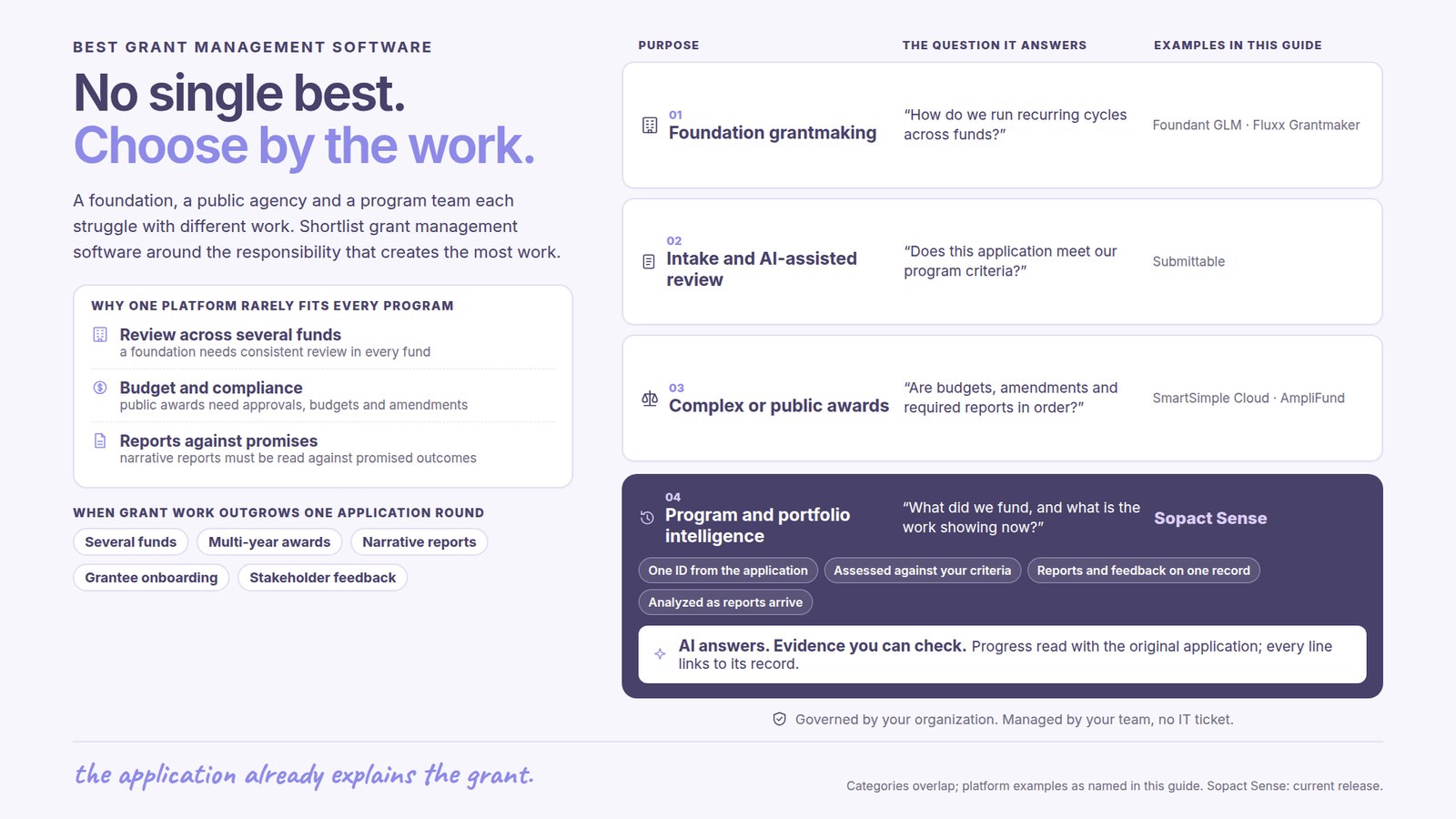
Every platform on this list can take an application and schedule a payment. Collection is solved. The new bottleneck is the workflow that reads every application on arrival — and proves what the grant changed after the money goes out. That is how we ranked them.

Most “best grant management software” roundups rank admin features: form builders, approval routing, payment tracking. Those are table stakes — every serious platform has them. What separates the top grant management software now is what happens to the narrative: the essays, budgets, and grantee reports that arrive as documents and, in most systems, sit unread until a program officer finds a weekend.

So this comparison weighs five things the category historically ignored: how fast a funder gets a first cycle live; whether AI reads each application on arrival with a citation trail, not just a chat summary; whether one applicant carries one ID from intake to the year-three outcome; whether a board-ready report is one query or four weeks; and whether a small grants team can run it without an integrator.

The grant is the unit of work, and the grant record has to be intelligent. AI without a workflow is a clever intern with no desk — it summarizes one PDF and forgets the program. The rankings below reward platforms that put the AI on the record: one applicant, one ID, one story.

Direct answer

What is the best grant management software?

The best grant management software depends on your bottleneck. Sopact leads for funders measured on outcomes — its AI reads every application and grantee report on arrival, scores against your rubric with a citation trail, and follows each grantee on one ID. Submittable and Foundant GLM lead for fast, opinionated intake; Fluxx and SmartSimple for complex enterprise workflows; AmpliFund for government compliance. The full grant management software comparison below ranks ten platforms.

This page is the roundup — the top grant management software ranked, with grant management software reviews distilled into one honest verdict per platform: who it is really best for, what configuration costs in time, and where it falls short. If you want the full definition of the category and how an AI-era grants platform works end to end, start with our grant management software pillar.

Evaluated for: private and family foundations · community foundations · corporate giving / CSR programs · re-granting intermediaries · government grant offices · grantseeking nonprofits (one tool, labeled).

Grant management software comparison

The top 10 at a glance

Ten platforms, one honest table. “AI on arrival” means the system reads every application or grantee report the moment it lands — rubric scores with a citation trail — not a chatbot you paste documents into. “Outcome reporting” means following one grantee on one ID long enough to show what the funding changed.

# Platform Best for Side Time to first cycle AI on arrival Outcome reporting Small-team friendly
1 Sopact Outcome-focused funders & AI-native review Funder Days Yes · native Yes · one ID, years Yes
2 Submittable High-volume intake & collaborative review Funder Weeks Partial · AI assists Limited Yes
3 Fluxx Large foundations, complex workflows Funder Months Limited Partial Heavy lift
4 Foundant GLM Community foundations, small–mid funders Funder Weeks–months Limited Limited Yes
5 SmartSimple Enterprise & global grantmaking Funder 3–6 months Partial · configurable Partial No
6 Blackbaud Grantmaking Funders on the Blackbaud ecosystem Funder Months Limited Partial · via suite No
7 Bonterra Corporate giving & CSR programs Funder Weeks–months Limited Partial Partial
8 Instrumentl Grantseekers finding & tracking funding Seeker Days Partial · AI drafting Limited Yes
9 Good Grants Small grantmakers on a budget Funder Weeks Limited Limited Yes
10 AmpliFund Government grants & compliance Both Months No Compliance-focused No

Honest note: the legacy platforms win on depth — payment rails, complex approval chains, decades of compliance edge cases. Sopact wins on the case-intelligence layer and on configuration measured in days, not quarters. Time-to-first-cycle reflects typical vendor-published or widely reported implementation ranges.

The ranking · 1 of 10

1. Sopact — best overall for the AI era

Best for: funders measured on outcomes, not throughput

Sopact is the only platform on this list built as a grant intelligence layer rather than a system of record. The moment an application, essay, budget, or grantee report arrives, the AI reads it — scores it against your rubric, cites the exact sentences behind every score, and attaches the result to one persistent applicant ID. Two years later, the year-three grantee report lands on that same record, so “what did this grant change?” is one query, not a four-week reporting scramble.

  • AI on arrival, with receipts. Rubric scoring with a citation trail — e.g. flagging 38 of 120 exit assessments, down to client #2841: “I finally have a lease in my name.” Reviewers verify in seconds instead of reading cold.
  • One grantee, one ID, one story. Intake, review, award, mid-grant check-in, and final outcome live on a single record — across programs and across years.
  • Configured in natural language. Describe the program, the rubric, and the report; the first cycle is live in days. No integrator, no six-month implementation.
  • Board-ready outcome reports as one query. Quantitative counts and the narrative evidence behind them, in the same report.
“Those statistics that we’re now running on Sopact immediately showed me there’s something significantly wrong … things like that, we would never have been able to do in the past.”— Marco Botha, CEO, Open Play Foundation

Where we’re honest: Sopact is not a payment-processing engine and does not try to replace deep grants accounting — it layers intelligence on top of, or alongside, your system of record. Funders whose hardest problem is multi-currency payment rails should pair it with one of the platforms below.

Side: funder · Time to first cycle: days · Pricing: by program complexity, not seats or tiers · Full grant management software deep-dive →
Daysto a live first grant cycle, configured in natural language
3–9 motypical legacy-platform configuration time beaten
4–6 wkof per-cycle reporting overhead removed
2–3×integrator cost that is never charged
The ranking · 2–4 of 10

The intake and workflow leaders

2

Submittable

Best for: high-volume application intake and collaborative review

Submittable made its name as a submission manager and it remains the smoothest front door in the category: clean branded forms, fast applicant experience, and review tools — assignment, scoring, side-by-side comparison — that committees actually enjoy using. Corporate social impact teams and foundations running thousands of applications per cycle pick it for exactly that.

  • Excellent applicant experience and form builder; weeks, not months, to launch.
  • Strong collaborative review: assignments, scoring sheets, blind review options.
  • AI assists summarize and tag submissions to speed triage.

Where it falls short: the intelligence stops at triage. AI summaries are not rubric scores with a citation trail, and once the award is made, the longitudinal story — what the grantee achieved over years — lives somewhere else.

Side: funder · Time to first cycle: weeks · Pricing: annual subscription, quote-based
3

Fluxx

Best for: large foundations with complex, multi-board workflows

Fluxx Grantmaker is the workflow heavyweight: configurable dashboards, multi-stage approval chains, payment scheduling, and a grantee portal, trusted by some of the largest private foundations. If your grantmaking involves four committees, two boards, and a bespoke approval matrix, Fluxx can model it.

  • Deeply configurable workflows, dashboards, and document generation.
  • Mature payments, budgeting, and compliance tracking.
  • Serious ecosystem of implementation partners.

Where it falls short: that configurability is the cost — implementations run months and usually involve consultants, and the platform stores narrative documents rather than reading them. Small teams routinely report it is more system than they can drive.

Side: funder · Time to first cycle: months · Pricing: five-figure annual licenses plus implementation
4

Foundant GLM

Best for: community foundations and small-to-mid funders

Foundant Grant Lifecycle Manager is the dependable mid-market choice: opinionated where Fluxx is open-ended, which is why thousands of community foundations and family foundations run on it. Since the 2024 merger with SmartSimple, Foundant covers the small-to-mid tier of a combined product family while SmartSimple serves the enterprise end — one company, two altitudes.

  • Purpose-built for community and family foundation workflows; scholarship sibling (SLM) available.
  • Approachable pricing and a well-liked support team.
  • CommunitySuite ties grants to fund accounting for community foundations.

Where it falls short: reading and synthesis stay manual — reviewers still read every application cold, and outcome reporting means exporting to spreadsheets. AI capabilities are early relative to this list’s top tier.

Side: funder · Time to first cycle: weeks–months · Pricing: reported five-figure annual range for most funders

The enterprise platforms

5

SmartSimple Cloud

Best for: enterprise and global grantmaking operations

SmartSimple Cloud is the most configurable platform on this list — a build-anything environment used by global corporates, governments, and research funders to run grants, research funding, and CSR in one system. Multi-language, multi-currency, regional hosting: if your grantmaking spans continents, SmartSimple was built for you.

  • Handles the most complex lifecycles in the category, including research funding.
  • Enterprise security: SSO, regional data residency, granular RBAC.
  • Now merged with Foundant — a clear enterprise-to-mid-market product family.

Where it falls short: implementations run 3–6 months with specialist configuration, published entry pricing starts around $6,000/yr and climbs quickly, and the AI story is configurable add-ons rather than reading every document natively on arrival.

Side: funder · Time to first cycle: 3–6 months · Pricing: from ~$6,000/yr published, scales with modules
6

Blackbaud Grantmaking

Best for: funders already on the Blackbaud ecosystem

Blackbaud Grantmaking is the grants module of the biggest software suite in the nonprofit world. Its argument is integration: if your foundation already runs Blackbaud financials, CRM, or fundraising, grants slot into the same data spine, the same vendor relationship, the same support contract.

  • Deep integration with Blackbaud Financial Edge and the wider suite.
  • Decades of grantmaking edge cases encoded in the product.
  • Strong fit for staffed foundations with established Blackbaud operations.

Where it falls short: outside the Blackbaud ecosystem the case weakens — the interface shows its age, implementations are consultant-led, and narrative intelligence is not the product’s ambition.

Side: funder · Time to first cycle: months · Pricing: quote-based, suite-dependent
7

Bonterra

Best for: corporate giving and employee engagement programs

Bonterra’s grants offering (the CyberGrants heritage) anchors the corporate side of the category: employee giving, volunteering, matching gifts, and corporate grantmaking on one platform. For a Fortune 500 CSR team that needs grants plus engagement plus compliance screening at scale, it is the incumbent answer.

  • Corporate-grade vetting, compliance screening, and disbursement at volume.
  • Employee giving and volunteering in the same platform as grants.
  • Large-enterprise track record with global programs.

Where it falls short: it is built around moving money and engagement metrics, not reading narratives — outcome measurement typically means counting dollars and participation, and mid-market funders find the platform heavier than their program.

Side: funder (corporate) · Time to first cycle: weeks–months · Pricing: enterprise, quote-based
The ranking · 8–10 of 10

The specialists

8

Instrumentl

Best for: grantseekers finding and tracking funding (the other side of the table)

One honest label most roundups skip: Instrumentl is grantseeker software. It sits on the nonprofit’s side of the table — matching organizations to funding opportunities, tracking deadlines, drafting proposals with AI, and managing awards. If you searched “best grant management software” because your nonprofit applies for grants rather than makes them, this is your entry on the list.

  • Strong grant discovery: matched opportunities, funder insights, deadline pipelines.
  • AI-assisted proposal drafting and a clean tracker the whole team can use.
  • Self-serve setup in days; published pricing from roughly $162/month.

Where it falls short: it does not run a funder’s intake, review, or award workflow at all — and on its own side, post-award outcome measurement is a tracker, not an intelligence layer.

Side: grantseeker · Time to first value: days · Pricing: published, from ~$162/mo
9

Good Grants

Best for: small grantmakers on a budget

Good Grants is the value pick: an internationally minded, no-drama grants platform with transparent published pricing (from about $3,200/yr) that covers intake, review, and award for small grantmaking programs. For a giving circle, a small family foundation, or a corporate program disbursing a few dozen grants a year, it does the job without an implementation project.

  • Transparent pricing and genuinely fast self-serve setup.
  • Clean applicant and reviewer experience; multi-currency and multi-language support.
  • Enough workflow for most small programs — without enterprise overhead.

Where it falls short: it is intentionally simple — complex multi-program funds outgrow it, and applications are stored and routed, not read; scoring, synthesis, and outcome reporting stay manual.

Side: funder · Time to first cycle: weeks · Pricing: published, from ~$3,200/yr
10

AmpliFund

Best for: government grants and compliance-heavy post-award

AmpliFund is the compliance specialist: built for state and local governments, agencies, and organizations managing federal pass-through funding, where the hard problem is not reading essays but satisfying auditors. Budget-to-actual tracking, performance reporting against award terms, and audit trails are the product’s core, on both the funder and recipient side.

  • Purpose-built for government funding rules and sub-recipient monitoring.
  • Strong budget, expenditure, and performance compliance tracking.
  • Spans grantor and grantee workflows for public-sector funding.

Where it falls short: it is a compliance system, not an intelligence one — implementations run months, the experience is built for auditors more than applicants, and narrative outcomes are out of scope. For the post-award discipline itself, see our post-award grant management guide.

Side: both (public sector) · Time to first cycle: months · Pricing: quote-based
How to choose

Match the platform to your bottleneck, not the feature list

Every platform above can store a grant. The differences that matter show up in three questions: what do you measure, how long do you follow people, and what arrives as narrative? Answer those and the shortlist picks itself.

Choose Sopact when…

You’re measured on outcomes

Your board or donors ask what the funding changed, not how many grants went out. You need rubric-scored review on the way in and evidence-backed outcome reports on the way out.

You follow people over years

Grantees report at month 6, year 1, year 3. You need one ID per grantee so the longitudinal story assembles itself instead of living in five spreadsheets.

Your evidence is narrative

Applications, essays, budgets, reflections, PDFs. The work is reading — and AI that reads on arrival with a citation trail turns four reviewer-weeks into a day.

Choose something else when…

Your hard problem is money movement

Multi-currency disbursement, complex payment scheduling, fund accounting, government compliance audits — that is Fluxx, SmartSimple, Blackbaud, or AmpliFund territory. Sopact layers on top of a system of record; it doesn’t replace one.

You only need a front door

If the whole job is collecting and routing a few dozen simple applications — no narrative review, no outcome reporting — Good Grants or Submittable will do it happily, and cheaper than an intelligence layer you won’t use.

On pricing: most vendors here quote annual subscriptions scaled by users and modules, plus implementation. Sopact prices on program complexity — programs, document volume, languages, reporting depth — never on seats or packaged tiers. Configuration is the headline feature: days to a first live cycle, in natural language, no integrator.

FAQ

Best grant management software — questions funders actually ask

What is the best grant management software?

The best grant management software depends on your bottleneck. Sopact leads for funders measured on outcomes — its AI reads every application and grantee report on arrival, scores against your rubric with a citation trail, and follows each grantee on one ID. Submittable and Foundant GLM lead for fast, opinionated intake; Fluxx and SmartSimple for complex enterprise workflows; AmpliFund for government compliance.

What is the best grant management software for small nonprofits and small funders?

For small grantmaking teams, Good Grants and Foundant GLM are the most affordable established options, and Sopact is the strongest choice when the team is small but the reporting burden is large — it configures in days in natural language, so a two-person grants team gets AI-read applications and outcome reports without an implementation consultant. Small grantseeking nonprofits should look at Instrumentl instead.

How is grant management software priced?

Most established platforms price by annual subscription scaled to users, grant volume, and modules — published starting points range from roughly $3,200 a year (Good Grants) to $6,000+ (SmartSimple) and five figures for Foundant GLM, Fluxx, and Blackbaud, plus implementation fees. Sopact prices on program complexity — number of programs, document volume, languages, reporting depth — not on packaged tiers or per-seat counts.

Is there free grant management software?

Truly free options are spreadsheets, Airtable-style databases, and a few capped free plans — workable below roughly 50 applications a year. They break exactly where the work gets hard: nobody reads 300 applications fairly in a spreadsheet, and nothing links an application to the grantee’s outcome two years later. The honest math is the staff weeks spent reading and re-keying, not the license fee.

How do these platforms handle security?

All ten platforms in this roundup offer encryption in transit and at rest, role-based access control, and audit logging; the enterprise platforms add SSO and regional hosting. Sopact provides encryption, RBAC, and audit trails, and is transparent that it is not HIPAA-certified — funders handling protected health information should scope that requirement explicitly with any vendor on this list.

Where can I read grant management software reviews?

G2, Capterra, and Software Advice carry the largest volume of verified grant management software reviews, and TechSoup’s forums and r/grants on Reddit are where grants managers compare notes candidly. Read reviews by role: grantmaker reviews of Fluxx or Foundant tell you little if you are a grantseeker, and vice versa for Instrumentl. This page complements reviews with a capability-by-capability comparison.

What is the difference between grantmaker and grantseeker software?

Grantmaker software (Sopact, Submittable, Fluxx, Foundant, SmartSimple, Blackbaud, Bonterra, Good Grants) runs the funder’s side: intake, review, awards, payments, and grantee reporting. Grantseeker software (Instrumentl, GrantHub) runs the nonprofit’s side: finding opportunities, tracking deadlines, and managing awarded funds. AmpliFund spans both for government funding. Most “best grant management software” lists mix the two — this roundup labels each tool’s side explicitly.

How hard is it to migrate from spreadsheets or a legacy grants system?

Legacy platform migrations typically run 3–9 months: field mapping, workflow rebuilds, integrator fees, and retraining. Migrating to Sopact is measured in days because configuration happens in natural language — you describe the program, the rubric, and the report, and import existing applicant records with their documents. The practical path many funders take: run the next grant cycle on the new system rather than back-loading ten years of history first.

What is the best grant management software for foundations?

It splits by size and bottleneck. Community and family foundations most often land on Foundant GLM for its opinionated workflow and fund-accounting ties; large private foundations with complex governance choose Fluxx or SmartSimple; and foundations whose board demands outcome evidence — not just disbursement counts — choose Sopact, often layered alongside an existing system of record.

Can one platform handle both pre-award and post-award grant management?

Mostly no — and that gap is the quiet finding of this comparison. Intake-strong platforms hand off after the award; compliance platforms like AmpliFund start there. Sopact is built to hold both ends on one record: the application that won the grant and the year-three report on what it changed, on the same grantee ID. For the post-award half in depth, see our post-award grant management guide.