


What is CSR performance measurement?
CSR performance measurement is the process of assessing a company's relevant social, environmental and governance results against defined objectives, responsibilities and commitments. It brings together delivery, outcomes, stakeholder experience and other appropriate evidence so a team can judge progress and decide what to change.
A volunteering total can show how much activity took place. It does not explain whether a community partner received useful support. A follow-up survey can describe participants' experience. It does not, by itself, establish that the program caused a change in employment or wellbeing. Good measurement makes these distinctions visible instead of compressing them into one impressive number.
This guide is for CSR, sustainability and community-investment teams coordinating evidence across business units, sites and partners. It explains how to choose measures, plan collection, examine differences, assess value and bring a decision to a review meeting.
Metrics, performance and reporting: three connected jobs
Scroll horizontally to see all columns →
| Job | Main question | Useful output |
|---|---|---|
| Define metrics | What exactly are we measuring? | A dictionary of definitions, sources, boundaries and methods |
| Assess performance | What do the results mean for our objectives and next decisions? | A reviewed assessment with explanations, uncertainty and actions |
| Report findings | What can we responsibly communicate to this audience? | An approved report with scope, evidence and limitations |
The CSR metrics guide covers indicator selection and a reusable dictionary. CSR reporting covers the publication process. Keeping these jobs connected prevents a reporting team from discovering, at the deadline, that different sites counted different things.
Keep activity measures, then ask what they leave unanswered
Activities are necessary evidence. Spending, delivery, attendance and completion help explain whether a program happened, whom it reached and how resources were used. A program cannot understand outcomes well if it has lost the record of delivery.
The problem starts when an activity is used to answer a different question. “We offered 40 workshops” does not mean 40 groups benefited. “We reached 800 people” may describe attendances, unique participants or an estimate. Define the count before interpreting it.
Build an evidence plan around the questions that matter:
Scroll horizontally to see all columns →
| Question | Evidence to consider | Important limit |
|---|---|---|
| What did we deliver? | Activities, resources, participation and completion | Delivery does not establish benefit |
| How was it experienced? | Appropriate feedback from affected people and partners | Respondents may differ from people not heard |
| What outcomes were observed? | Suitable follow-up, operational information or assessments | An observed outcome is not automatically attributable to the program |
| Who benefited or faced barriers? | Relevant, appropriately protected subgroup evidence | Small groups and uneven coverage constrain conclusions |
| What should change? | The combined evidence, alternatives, costs and judgment | A decision can be justified without claiming certainty |
Not every CSR question concerns a person followed over time. An environmental measure may concern a facility. A supplier measure may concern an organization or a corrective action. Choose a record structure that fits the question rather than forcing every result onto a named stakeholder record.
How to build a CSR performance measurement plan
- Define the decision. For example, decide whether to change a partner-support model, expand a program or investigate a persistent access barrier.
- Describe the intended change. Specify who or what is expected to change, how and over what period. Record important assumptions and possible unintended effects.
- Select a small, useful set of measures. Include relevant delivery, experience and outcome evidence. Do not choose measures only because they are easy to collect.
- Define the population and boundary. Identify participating sites, partners, groups or people and what will remain outside the assessment.
- Plan sources and timing. Use appropriate existing information, then justify any new collection. Match follow-up timing to when a result could reasonably emerge.
- Agree review and action ownership. Name who checks the findings, who decides and who follows through.
Write the plan before collecting a large new survey. A question with no intended use adds burden, and a desired comparison with no shared definition creates work later. The impact strategy guide helps connect the evidence plan to priorities.
Worked example: what can a community-training program report?
Fictional example. A company supports a training program delivered by three partners. Across one defined cohort, 100 people enroll, 80 complete the program and 60 provide a six-month follow-up. Of those 60, 36 report using a taught skill in their work or volunteering.
Scroll horizontally to see all columns →
| Measure | Calculation | What it means |
|---|---|---|
| Completion | 80 ÷ 100 = 80% | Completion among enrolled participants |
| Follow-up coverage | 60 ÷ 100 = 60% | The share of the original cohort represented at follow-up |
| Reported skill use among respondents | 36 ÷ 60 = 60% | Reported use among those who answered |
| Known reported use within the enrolled cohort | 36 ÷ 100 = 36% | The share with a recorded report of use; not an estimate that everyone else failed |
The team should not publish “60% of participants benefited” without clarifying the population and meaning. Forty enrolled participants have no follow-up, and “using a skill” is a defined outcome rather than a complete account of benefit.
Suppose 12 respondents describe a lack of opportunities to practise. That evidence can support discussion with delivery partners about workplace application. It does not show that lack of opportunity explains every missing outcome or every nonresponse. Keep the comments, the question asked and the relevant population with the result.
The decision might be to test an employer-supported practice activity with one partner and review participation and experience at an appropriate interval. That is a useful action grounded in evidence without overstating what the data proves.
Measure change without overstating causality
Where the question concerns individual change, a suitable baseline and follow-up can help compare the same people. Keep instrument versions, observation dates and matching rules. Report how many records can actually be compared and who is missing.
Other questions can be answered through endline assessment, repeated group surveys, organizational records or qualitative inquiry. Anonymous feedback may be appropriate. Individual linkage should serve a legitimate measurement purpose, rather than being treated as a universal requirement.
The CDC's program evaluation framework distinguishes outcome evaluation from approaches that examine causal impact. A linked record makes evidence easier to inspect; it does not supply a counterfactual or remove other explanations for change. When the decision requires an attribution claim, plan an appropriate evaluation design and expertise.
Look beyond the average, with care
An overall result may conceal differences in access, experience or outcomes. Decide which distinctions are relevant to the program and useful to affected groups. Check whether collecting those details is appropriate, how access will be controlled and whether reporting could expose a small group.
In the example, one partner might have a lower follow-up rate. That does not automatically mean weaker program performance. It could reflect collection timing, contactability, respondent burden or other conditions. Investigate coverage before ranking partners.
Disaggregation helps reveal a question; it is not a complete explanation of inequality. Combine suitable comparisons with participant and partner perspectives, and retain uncertainty where the available evidence cannot support a strong conclusion.
Compare results without imposing one survey on every partner
Different sites and partners may need different instruments. Agree a limited shared core for the comparisons the company needs: relevant organizational references, periods, outcome definitions and essential denominators. Use a data dictionary to map local fields to that core.
Stable registration context can be collected once and updated deliberately. Later observations remain dated and connected to the appropriate person, organization, program or site. Local teams can ask additional questions for their own decisions without making the entire network complete an irrelevant questionnaire.
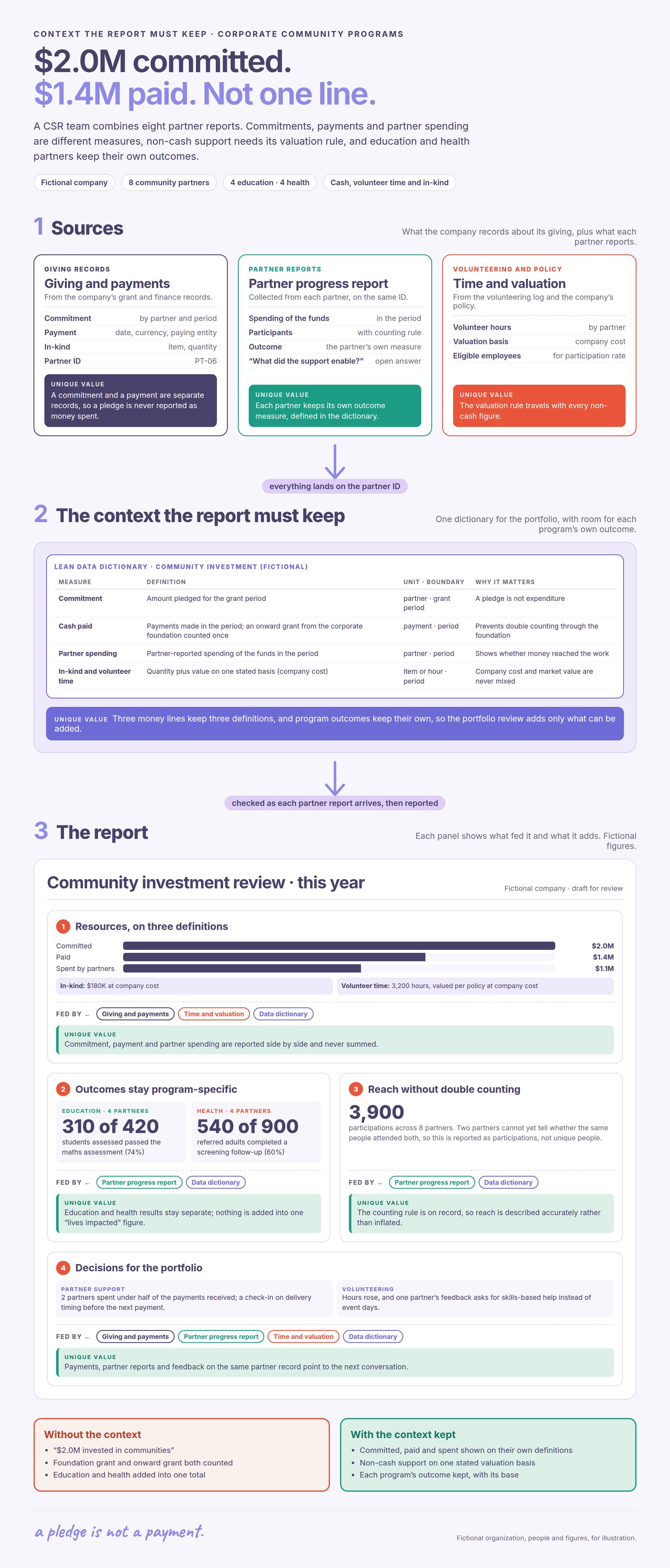
Do not aggregate two measures merely because they share a label. Check units, eligibility, observation periods and methods. Where a valid conversion is unavailable, present the results separately and explain the difference. Preserve version history when a definition changes.
Here is a community-investment review built that way across eight partners: shared definitions where comparison is valid, and education and health results presented separately rather than merged under one label.
Assess costs and value without forcing every outcome into money
Leadership may need to understand resources, alternatives and value. Start by identifying the decision: comparing delivery options, explaining a budget or assessing whether a program achieves a relevant objective. These questions do not all require a monetary estimate of social impact.
Cost per completion and cost per observed outcome can be informative if the cost boundary and denominator are clear. In the fictional example, total defined program cost divided by 80 answers a different question from cost divided by 36 known reports of skill use. Neither calculation alone establishes causal cost-effectiveness.
If a monetary valuation is appropriate, document the outcome evidence, valuation source, assumptions, possible overlap and uncertainty. A proxy from another context may not transfer. Use sensitivity analysis and explain what remains unvalued instead of presenting one ratio as the full value of the work.
Financial materiality is also distinct from assigning a monetary proxy to a community outcome. The IFRS S1 overview describes sustainability-related risks and opportunities relevant to an entity's prospects. A social-value calculation does not, on its own, establish that relationship.
Reduce the work of assembling evidence
Performance review often becomes expensive when collection, comments, metrics and documents are maintained separately. Each reporting cycle repeats cleaning, coding, matching, source checks and corrections. Those staff hours belong in the ownership assessment alongside configuration, training and ongoing review.
Sopact's approach connects collection, quantitative context, qualitative analysis and governance around the relevant records. The team owns definitions and interpretation. In codebook-based analysis, automated processing can apply the reviewed definitions to eligible responses and support reruns when they change; people review quality, exceptions and conclusions.
That changes the recurring work to evaluate: how much time is spent reapplying codes and rebuilding joins, and how much remains in configuration and review? The qualitative and quantitative analysis guide includes a visual workflow and an illustrative staff-hours model. Use your own volumes and tasks before making a savings claim.
Turn the review into an owned decision
Choose a cadence that matches the question. Delivery issues may need frequent review; meaningful outcomes may take months or years. Faster collection is useful only when the timing supports a legitimate decision and does not create unnecessary burden.
- Show results, definitions, coverage and relevant prior-period changes.
- Separate evidence gaps from performance against a target.
- Examine negative findings and plausible alternative explanations.
- Record the decision, responsible owner, next action and review date.
- Preserve the approved version used in a published report.
For communication, use How to Write an Impact Report and report examples. For software evaluation, continue to CSR software with a real workflow to test.
Watch: connect collection, context and analysis
This introduction explains Sopact's evidence workflow. It does not establish causal impact or certify compliance with a reporting standard.
Frequently asked questions
What is the difference between CSR performance and CSR metrics?
Metrics define what is measured and how. Performance assessment interprets relevant results against objectives, responsibilities and context, then informs decisions.
Are volunteer hours a useful CSR measure?
Yes, for a defined question about participation or delivery. They do not, by themselves, establish community benefit. Combine them with suitable evidence of experience and outcomes where those questions matter.
Does baseline and follow-up data prove impact?
No. It can show observed change among comparable records. Causal attribution needs an appropriate evaluation design and consideration of alternative explanations.
Must every partner use the same survey?
No. Agree the limited shared definitions and fields needed for comparison, map local instruments to them and allow locally useful questions. Keep incompatible measures separate.
Must CSR performance have a financial value?
No. Costs and monetary valuation can inform some decisions, but important outcomes may be better represented in their own units and through stakeholder evidence. Explain valuation assumptions when money is used.
How often should CSR performance be reviewed?
Use a cadence suited to delivery needs, expected outcome timing and decisions. Some issues need frequent attention; others require a longer observation window. Continuous updates do not replace considered review.
