


Related solution
Applications & Grants
Connect application evidence, human review and the next program stage.
Explore the solution →

USE CASE / SOFTWARE GUIDE
Competition judging software helps organizers collect entries, coordinate judges, apply scoring criteria and record selection decisions. Good software gives each judge the relevant evidence, makes the basis of a score understandable and reduces the administrative work around a judging round. Awards, pitch competitions and accelerator selection share these needs, but they do not always need the same platform.
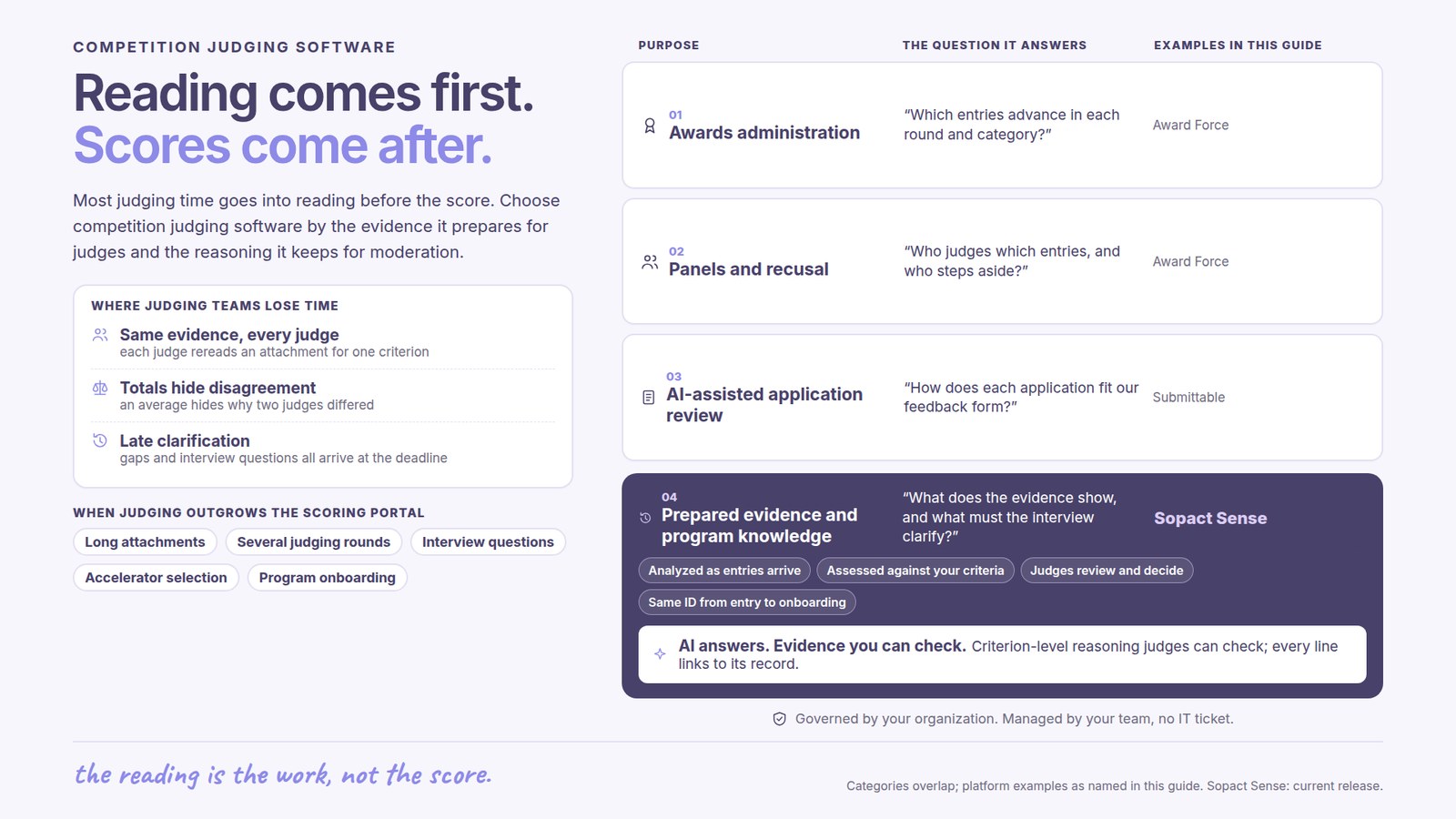
The difficult work is often the reading before the score: finding evidence across an entry and its attachments, distinguishing a supported claim from a persuasive description, and identifying questions that need an interview. A scoring portal can organize the panel while leaving much of that preparation to the judges.
AI can prepare criterion-based analysis as entries arrive, so people spend more of their time examining the evidence and exercising judgment. The distinction is more useful than a general promise of AI summaries. Sopact connects incoming analysis with AI Assistance and human review; where selection starts a continuing program, the evidence can also inform onboarding and later support.
Incoming entries are analyzed around the agreed criteria.
Reviewers inspect the evidence and identify interview questions.
The selected applicant’s context can inform the program that follows.
These programs often need categories, entry requirements, judging rounds, panel assignments and a clear winner-selection process. Public voting, entry fees or media galleries may also matter. The priority is a well-run competition and an understandable decision; long-term participant tracking may add little value.
The entry may combine a written application, business evidence and attachments. Judges need to understand the venture against the program’s criteria and identify what a presentation or interview must clarify. If selected founders receive ongoing support, their stated needs should remain available to the program team.
The decision can lead to a continuing relationship involving onboarding, agreed outcomes and progress reporting. Here, the application and assessment explain why support was offered. Carrying that knowledge forward helps later reviews address the original purpose rather than start from an empty reporting form.
Several judges may each read the same attachment to find the information relevant to one criterion. Organizing that evidence before deliberation reduces duplicated preparation. It also makes it easier to distinguish a missing answer from a negative finding.
Two judges may disagree because they noticed different facts, interpreted a criterion differently or reached different judgments from the same evidence. Averaging their scores does not resolve those distinctions. Keeping criterion-level reasoning visible gives moderation a more useful starting point.
If all reading begins after the deadline, incomplete evidence and interview questions arrive together. Analysis during intake can prepare those questions earlier, within the competition’s rules. It does not mean early applicants should receive a different standard or that selection must happen before the full pool is ready.
A summary tells a judge what the applicant said. A useful criterion assessment connects the relevant evidence with the competition’s questions, identifies uncertainty and prepares an issue for human consideration. That is a different benefit from merely shortening the entry.
The timing and access also matter. Analysis may run as an entry arrives, when it enters a configured review round, or when someone requests a summary. Establish when the result becomes available and who can use it. “Includes AI” does not answer those questions.
Sopact’s configured analysis runs as data arrives and is available in AI Assistance. Reviewers can examine the interpretation, ask about the evidence and decide which points require an interview or closer reading. People retain responsibility for selection; the benefit is reducing preparation that otherwise comes before their judgment.
The material being assessed matters as much as the trigger. A written proposal, a scanned document and a recorded performance are different evidence formats. Scope the formats the actual competition requires instead of assuming every AI feature can interpret every attachment.
Award Force documents qualifying, top-pick, voting and VIP judging modes, along with panel assignments, recusal options and criterion-level feedback. It is relevant when the central requirement is administering an awards or competition process across categories and rounds. Those operating features deserve attention independently of AI analysis.
Submittable Next’s Smart Reviewer evaluates applications against a configured feedback form and can be assigned automatically in a review round. Its documentation identifies the feature as beta and states that staff, rather than reviewers, can view its responses in the platform. Buyers should distinguish this workflow from a summary feature and confirm the proposed edition and access.
Sopact is relevant when substantial reading and interpretation are the constraint, and especially when selection begins a training, accelerator or grant program. Incoming analysis supports human review and remains useful for later questions. Its value is both earlier preparation and the ability to retain the applicant’s context after the decision.
Choose around the whole responsibility. Entry payments, public voting and event logistics are not interchangeable with evidence analysis. Where a specialist entry platform already serves those needs, scope any proposed exchange of application data rather than assuming a second platform automatically replaces it.
Criteria should describe the qualities the competition seeks, with enough shared meaning for judges to apply them consistently. A criterion called “potential” can mean different things to different panel members. Clear evidence expectations help the panel discuss the actual entry instead of discovering that it has been scoring different questions.
A simple illustration shows why the components matter. With relevance weighted at 40%, evidence at 35% and feasibility at 25%, scores of 4, 3 and 5 produce 3.90 out of 5. The total summarizes the assessment, but the lower evidence score explains what may need clarification. This is a fictional example, not a recommended rubric for every competition.
Useful software keeps that reasoning accessible during moderation. A missing score, a declared conflict or an unresolved tie needs the program’s agreed treatment; it should not disappear inside an average. The objective is a decision the panel can explain, not a ranking whose precision exceeds the evidence.
AI does not make criteria automatically appropriate or judgments automatically fair. Reviewers need room to challenge an interpretation, consider context and reach their own conclusion. A well-supported assessment makes this work easier to do.
Sopact’s typical setup estimate is two days to two weeks for the agreed workflow. That discussion should cover the entry material, criteria, analysis and access needed for a usable first round. A complex migration or integration may require a different scope.
Once configured, analysis is available as evidence arrives. The final decision follows the human process: reviewing the assessment, resolving questions, conducting interviews where required and deliberating as a panel. Faster preparation can help this process move sooner without pretending the committee’s work disappears.
Sopact reports that its approach can remove two to three months of review work in application processes it supports. Treat this as an experience-based estimate, not an industry-wide benchmark or a guaranteed saving for a particular competition. The relevant benefit is the repetitive reading and reconciliation removed from your judges’ work.
In the published Carnegie Mellon Project Olympus example, the application workflow launched in five days and a batch was assessed overnight against a custom rubric. The committee retained selection responsibility. That example demonstrates a specific launch and review process; it does not establish a universal completion time.
An award can finish with the decision and feedback to entrants. An accelerator may use the same application evidence to understand a founder’s initial needs, plan onboarding and inform mentoring. A grant program may use the proposal to agree outcomes and interpret later reports. These are different reasons to preserve the assessment and its context.
Continuity does not require sharing every judging comment with everyone delivering the program. The information needed for support can differ from confidential panel deliberation. Agree the relevant access and handoff as part of the workflow.
Sopact combines personalization with ongoing team support so the organization can maintain its process as questions and program needs change. For a continuing program, the benefit extends beyond choosing an applicant: the team starts delivery with a better understanding of the person or organization it selected.
It helps organizers manage entries, judges, scoring criteria and selection decisions. The appropriate platform depends on whether the main need is awards administration, substantive evidence review or selection that continues into a program.
A summary condenses the entry. Criterion-based analysis relates the evidence to the competition’s questions and can help identify gaps or interview topics. Human reviewers still decide how persuasive the evidence is.
Sopact’s typical estimate is two days to two weeks for the agreed scope. Analysis runs as evidence arrives once configured. Interviews, moderation and final decisions follow the program’s human process.
No. Selection-only awards may finish at the decision and feedback. Accelerators, training and grant programs can benefit from carrying relevant evidence into onboarding, support and later progress reviews.
AI can prepare evidence and draft assessments, but people should retain the program’s selection authority and review the interpretation. An automated score is not a substitute for a supported human judgment.
Continue with a purpose
Related solution
Connect application evidence, human review and the next program stage.
Explore the solution →Continue learning
Explore how program criteria guide evidence review.
Start learning →
Customer story
A five-day launch and custom-rubric assessments prepared for a human committee.
Read the story →Explore how Sopact can prepare entry evidence, support reviewer questions and retain the context your program needs after selection.
See it with your workflow →