play icon for videos

CSR Metrics: Indicators, KPIs, Scoring Formulas, and CSR Scorecard Methods

Reference library for CSR metrics — the indicator families, calculation formulas, CSR scoring and rating methodologies (MSCI, Sustainalytics, EcoVadis), and the four metric types every defensible CSR scorecard rests on.

Updated
May 18, 2026
360 feedback training evaluation
Use Case

Use case · CSR metric library

An analyst opens the CSR scorecard. Forty-seven indicators across workforce, community, environmental, and supplier categories. Some have formulas. Some have unit labels. Some are framework-tagged. Most are uncatalogued — there is no single document that says what each metric measures, how it gets calculated, whether it disaggregates, or whether it has informed a decision in the past year. This page is the reference card for fixing that — what CSR metrics are, how they are calculated, what scoring and rating methodologies exist, and how a defensible CSR scorecard gets built from indicator-level discipline upward.

01

The eight-stage metric design process — define through retire, what each stage produces, and which stages every defensible CSR metric has to pass through.

02

The eight standard indicator families with named example indicators and framework codes (GRI, SASB, IRIS+, B4SI, 2X Global).

03

Four metric types walked end-to-end — output metrics, outcome metrics with formulas, CSR scoring and ratings, and benchmark and longitudinal metrics.

Definition · 30-second answer

What CSR metrics are — and what separates a defensible metric from a documented one.

CSR metrics are quantitative and qualitative indicators that capture corporate social responsibility activity, outcome, and impact across environmental, social, and governance dimensions. They organize into four metric types — output metrics (counting what happened), outcome metrics (measuring change against baseline), composite scores and ratings (weighted aggregation), and benchmark and longitudinal metrics (context-providing comparisons). Each type has a different role in the scorecard.

A defensible CSR metric has six properties: an explicit formula written numerator-over-denominator with a defined unit; an outcome target the formula gets compared against; framework alignment to at least one external reporting standard (GRI, SASB, IRIS+, B4SI, 2X Global); disaggregation logic by stakeholder segment; a defined measurement cadence; and a documented retirement rule — if the metric has not informed a decision in six months, it is documentation, not a CSR metric.

The page covers how to build CSR metrics that pass the six-property test. It does not cover how to operate the year-round measurement system that produces the metrics — that is the CSR performance page. It does not cover what to measure in the first place (materiality, indicator selection methodology) — that is the CSR measurement page. It does not cover how the metrics get assembled into the annual report — that is the CSR reporting page. This page is the reference library for the indicators themselves: their formulas, their framework alignments, their scoring methodologies, and their families.

The reader: the CSR analyst who needs to look up how an indicator gets calculated, what formula goes into a composite score, which MSCI weighting applies to an industry sector, how to write a numerator and denominator that survive a sample audit. Not the operating model. Not the disclosure. The metric itself.

Process · the eight CSR metric design stages

The CSR metric design process, stage by stage.

Eight stages every CSR metric passes through before it earns a place on the scorecard. Skip a stage and the metric becomes documentation — countable, presentable, but unable to inform a decision. The stages most commonly skipped — specify, disaggregate, retire — are the ones that decide whether the metric library holds up under analyst review or external assurance.

01 · DEFINE

Name the construct precisely

What is the metric trying to measure — an activity, an outcome, an impact, a context. "Volunteer engagement" is not a defined construct; "percentage of full-time employees logging four or more volunteer hours per quarter" is. The definition decides whether the rest of the design choices have a stable target.

Strategic · co-designed

02 · SPECIFY

Write the formula explicitly

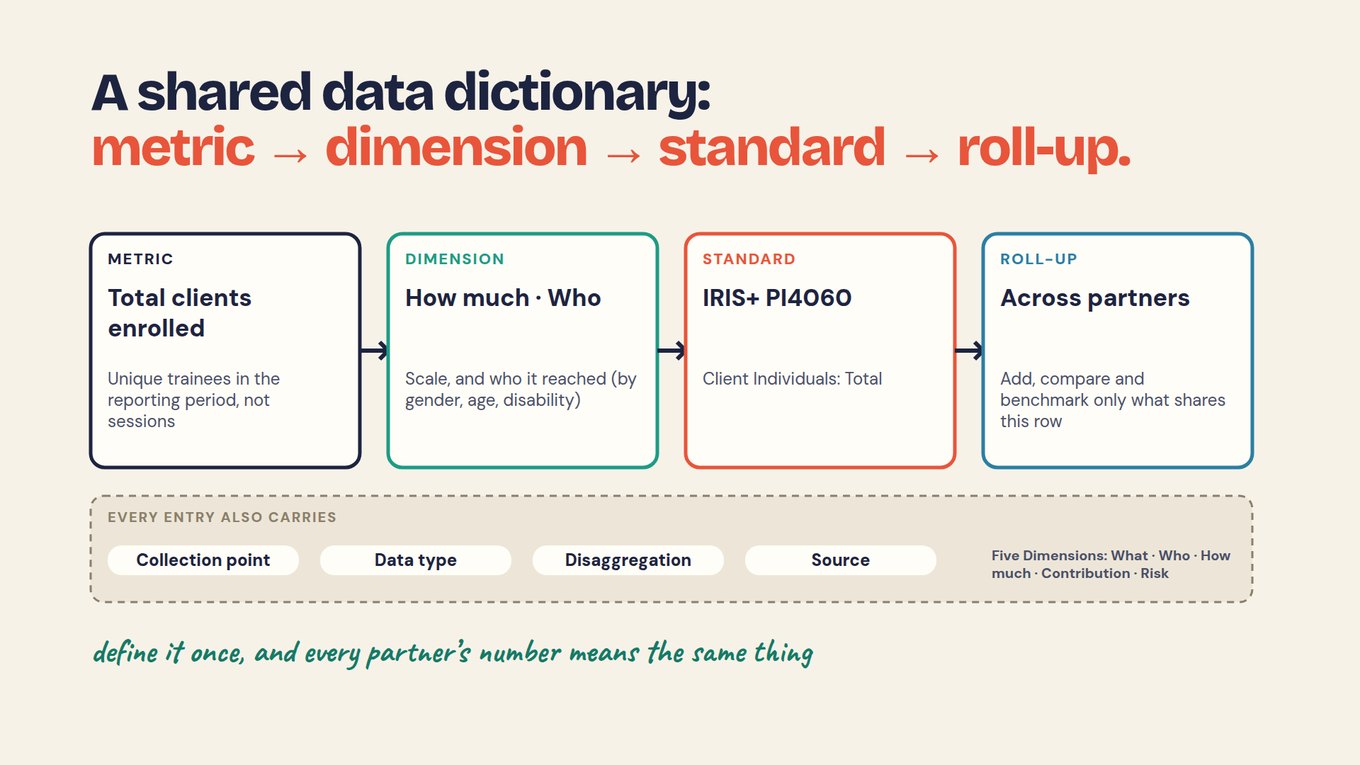
Numerator over denominator with defined unit. "(Employees with 4+ quarterly volunteer hours) ÷ (Total full-time employees in active roles) × 100, expressed as percentage." Each formula component is named, sourced, and unambiguous. Formula specification is what survives the sample audit.

Quantitative · formula-bound

03 · MAP

Align to framework indicator

Crosswalk the metric to at least one external reporting framework — GRI, SASB, IRIS+, B4SI, 2X Global, TCFD, ESRS. The mapping makes the metric portable across reports and crosswalk-able when frameworks update. Unmapped metrics become orphans at the next reporting cycle.

Reference · framework-anchored

04 · DISAGGREGATE

Define segment breakdowns

Every CSR metric has to be disaggregable by at least three stakeholder segments — demographics, geography, role, cohort, tenure, program type. The segment breakdowns get specified during design rather than retrofitted at reporting time. Retrofit-only disaggregation is incomplete by construction.

Equity · cross-tabulation

05 · THRESHOLD

Set target and tolerance band

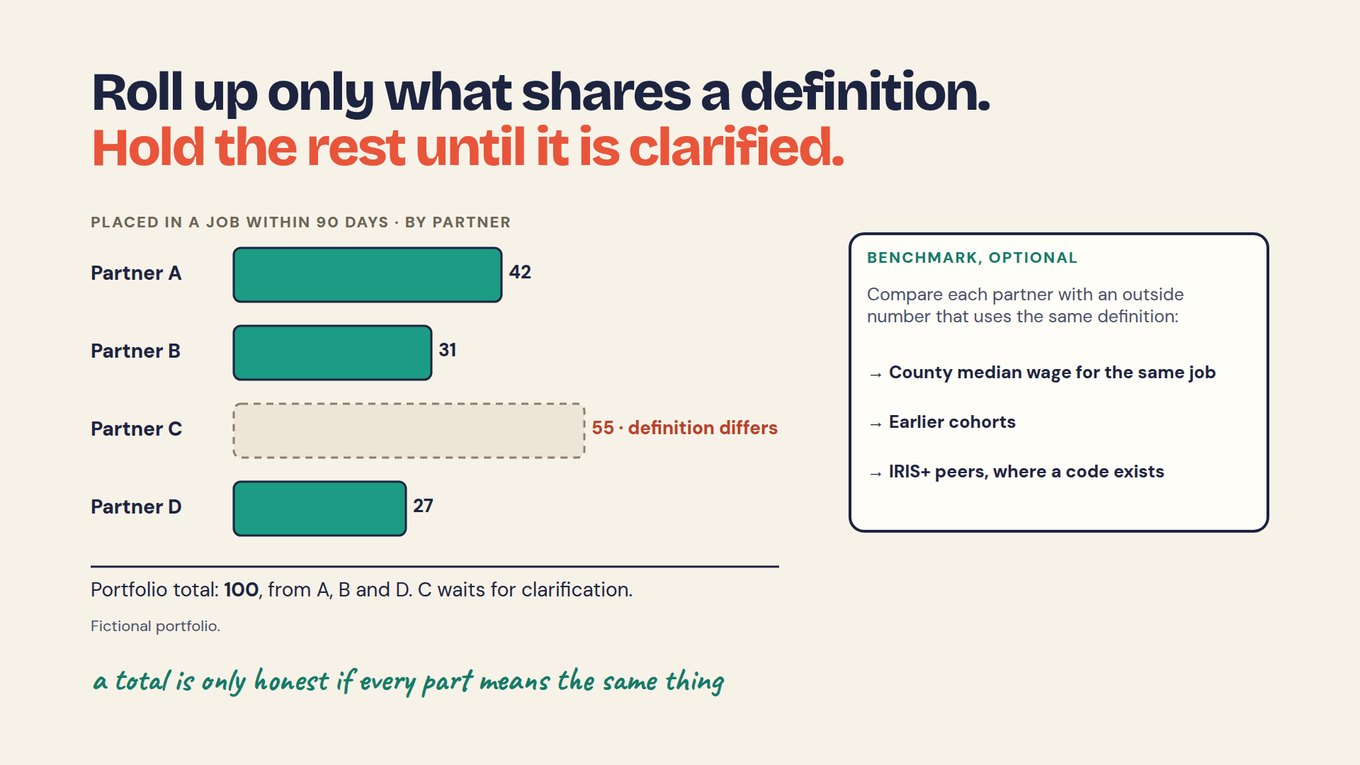
A metric without a target is a description. The target says what the program is trying to hit; the tolerance band says how much variance is normal and what triggers an alert. 75% job placement at 90 days · target 65% · alert if any cohort segment falls below 50%.

Decision · target-bound

06 · SOURCE

Name data instrument and cadence

Which instrument produces the data — intake survey, mid-program pulse, administrative system, audit log — and on what cadence — daily, weekly, monthly, quarterly, post-program, 90-day follow-up. Instrument and cadence together determine whether the metric can support its intended decision window.

Primary · instrument-bound

07 · VALIDATE

Sample audit and sanity check

Before a metric goes into a scorecard or external report, sample-audit a subset of the underlying data against the formula. AI theme codes get verified against analyst coding on at least 50 responses; numeric calculations get manually replicated on at least 20 records. Validation is non-optional for any metric that informs a board decision.

Quality · audit-validated

08 · RETIRE

Annual retirement audit

Every metric reviewed annually against one question — has this metric informed a decision in the past six months. Metrics that fail the test move to the appendix layer; metrics on the operating dashboard get re-validated. The retirement step is what prevents the scorecard from accumulating into the 47-indicator wall of charts most CSR teams operate today.

Discipline · annual cycle

The stages above describe how a single metric gets designed. The eight indicator families that follow describe the standard categories every CSR program eventually tracks — what each family measures, what example indicators belong to each, and which frameworks they align to.

Indicator families · what every CSR program tracks

The eight standard CSR indicator families.

Every CSR program eventually tracks across these eight categories. The named example indicators below are framework-anchored — each carries at least one external framework code (GRI, SASB sector code, IRIS+ identifier, B4SI metric, 2X Global indicator). The example list is not exhaustive; it is the starting indicator inventory every CSR analyst should be able to write, calculate, and disaggregate on demand.

01

Workforce engagement & DEI

Internal · employee outcomes

Employee-facing metrics covering engagement, retention, diversity, equity, and pay. The indicators most often tracked at the C-suite level and tied directly to performance reviews. Most material to industries where workforce is a primary differentiator.

Example indicators · turnover rate by demographic segment (GRI 401-1) · employee engagement score · pay equity ratio by gender and race (GRI 405-2) · representation in management (SASB CG-AA-330a.1) · training hours per employee (GRI 404-1)

02

Community investment outcomes

External · program outcomes

Outcomes for the people corporate community programs touch. The indicator family where the Activity Ledger vs outcome distinction matters most — dollars disbursed and program touchpoints sit alongside outcome ratios tied to baseline.

Example indicators · job placement rate at 90 days (IRIS+ OI8520) · participant income lift at 12 months (IRIS+ OI4347) · program completion rate (B4SI Direct Impact) · sustained behavior change at 6 months · cost per outcome

03

Volunteer engagement

Internal · participation

Employee participation in volunteer programs. The family often confused with community outcomes — these metrics describe what employees did, not what changed for the community. Both matter; both belong on separate scorecard rows.

Example indicators · volunteer participation rate (B4SI Inputs) · hours per participating employee · repeat participation rate · skills-based volunteering percentage · volunteer satisfaction score

04

Environmental performance

Operational · emissions and resources

Emissions, water, waste, energy, and biodiversity metrics tied to corporate operations and supply chain. The family with the deepest framework specification — CDP, TCFD, ESRS-E, SBTi all overlap on the underlying indicator set.

Example indicators · Scope 1 emissions tCO2e (GRI 305-1) · Scope 2 emissions market and location method (GRI 305-2) · Scope 3 emissions by category (GRI 305-3) · water withdrawal by source (GRI 303-3) · waste diverted from disposal (GRI 306-4)

05

Supplier responsibility

Value chain · upstream

Supplier audit, diversity, and remediation metrics covering labor practices, environmental compliance, and supply-chain transparency. The family that scales with the company's supply-chain footprint and that anchors CSRD Scope 3 disclosures.

Example indicators · suppliers assessed on social criteria (GRI 414-1) · suppliers with adverse impacts identified (GRI 414-2) · supplier diversity spend percentage · high-risk supplier remediation rate · audit completion rate

06

Customer & product responsibility

Downstream · product impact

Product safety, customer privacy, accessibility, and responsible-use metrics. The family most material for consumer-facing industries (technology, financial services, pharmaceuticals, food and beverage). SASB sector-specific standards dominate the indicator definitions here.

Example indicators · data breach incidents (SASB CG-MR-230a.2) · product-related health and safety incidents (GRI 416-2) · customer satisfaction score · accessibility compliance rate · responsible-use program reach

07

Governance & ethics

Organizational · governance

Board composition, ethics, whistleblower utilization, anti-corruption, and political-contribution metrics. The family that anchors the G in ESG — material to every industry, primary screen for investor and regulator scrutiny.

Example indicators · board diversity ratio (GRI 405-1) · whistleblower utilization rate · ethics training completion · corruption incidents (GRI 205-3) · political contribution disclosure

08

Cross-cutting equity & context

Denominator · disaggregators

The metrics that make the other seven families interpretable — disaggregation cross-tabs, denominator metrics, peer benchmarks, and longitudinal context. Often missing from scorecards; the family that distinguishes a defensible CSR scorecard from a CSR data export.

Example indicators · aggregate-vs-disaggregated outcome gap (rural-urban, racial-ethnic, gender) · cohort longitudinal trajectory · peer benchmark position (top quartile / median / bottom) · denominator metrics (program reach as percentage of addressable population)

The indicator argument. The eight families above cover what every CSR program tracks. Within each family, the specific indicators chosen vary by industry, materiality, and framework alignment — a financial services CSR program weights customer privacy and governance heavily; a pharmaceutical CSR program weights product safety and access; a heavy-industry CSR program weights environmental performance and supplier responsibility. The choice of which families to weight is part of csr-measurement. This page covers the indicators inside each family — formulas, calculations, scoring, ratings.

Data architecture · three layers behind every defensible metric

The data each CSR metric draws from — three layers, one indicator record.

Every CSR metric on a defensible scorecard rests on three data layers feeding the same indicator record. Primary stakeholder voice from participants, employees, communities, and suppliers carries the outcome signal. Live administrative data from operational systems anchors activity counts and produces the denominator. Archived baselines and benchmarks make the metric interpretable as change rather than as snapshot.

Layer 01 · Primary · stakeholder voice

Survey + qualitative collection

Outcome metrics, equity disaggregators, and qualitative context all originate here. The layer that distinguishes outcome metrics from activity metrics — without baseline tied to participant ID, no metric on this layer is comparable across time.

  • Intake baseline · pre-program measurement under participant ID
  • Post-program outcome surveys · pre-post change
  • Follow-up at 90 days, 6 months, 12 months
  • Stakeholder qualitative reflection · theme-coded
  • Demographic disaggregators · captured once, applied forever
  • Employee engagement and DEI surveys
  • Supplier responsibility self-assessment

Owned by Sopact · clean from source

Layer 02 · Secondary · operational systems

Administrative + activity records

Activity counts, dollar flows, and operational data from the systems the company already runs. The data that drives activity metrics directly and supplies denominators for outcome calculations.

  • HR system · workforce headcount, DEI demographics, turnover
  • Volunteer management platform · hours, participation
  • Grant management system · disbursement, partner activity
  • Procurement · supplier spend, diversity, audit logs
  • Environmental monitoring · emissions, water, waste
  • Customer systems · privacy incidents, product safety
  • Whistleblower & ethics hotline · incident logs

Integrated via Claude pipes & APIs

Layer 03 · Reference · benchmarks & frameworks

External benchmarks + indicator references

Framework indicator libraries, peer benchmarks, sector medians, and rating-agency methodology references. The layer that makes a metric framework-aligned and benchmark-relative.

  • GRI Universal & Sector Standards
  • SASB sector standards (now part of ISSB)
  • IRIS+ indicator library
  • B4SI metrics framework
  • 2X Global indicator set
  • Peer benchmarks · CDP, MSCI sector medians
  • Prior-cycle internal baselines · same metric, prior cohorts

Read via Claude · summarized into context

Sopact handles the primary layer at instrument level — stakeholder collection across waves under persistent participant ID with AI theme coding at submission. The administrative layer integrates via standard APIs or Claude pipes from the systems that own it — HR, volunteer management, procurement, environmental monitoring, ethics hotline. The reference layer arrives through Claude reading framework documentation and prior benchmark data into context. The three layers converge at the metric record so every indicator on the scorecard is anchored to source data that traces back to its origin.

CSR metric library · indicator × framework × type × cadence Live · 47 indicators tracked · 8 indicator families

Indicator inventory · workforce DEI family

5 indicators · sample family view · each row clicks through to formula, source instrument, framework crosswalk, and current cohort value

Family completeness · 8 of 8

100%

↗ all families tracked

Framework-mapped · indicators

42/47

↑ 5 unmapped

Decision-active · last 6mo

38/47

↓ 9 retirement-eligible

Turnover rate by demographic segment · GRI 401-1 spec → formula · numerator/denominator · monthly cadence · 6 disaggregators
Pay equity ratio by gender · GRI 405-2 spec → formula · base salary ratio · annual cadence · benchmark vs sector
Employee engagement composite score spec → weighted across 8 sub-indicators · semi-annual · framework cross-mapped
Representation in management · SASB CG-AA-330a.1 spec → percentage formula · quarterly · disaggregated by level and demographic
Training hours per employee · GRI 404-1 spec → average formula · monthly · disaggregated by role, level, demographic

Use cases · primary-data instruments that feed the metric library

Eight measurement instruments that populate the CSR metric scorecard.

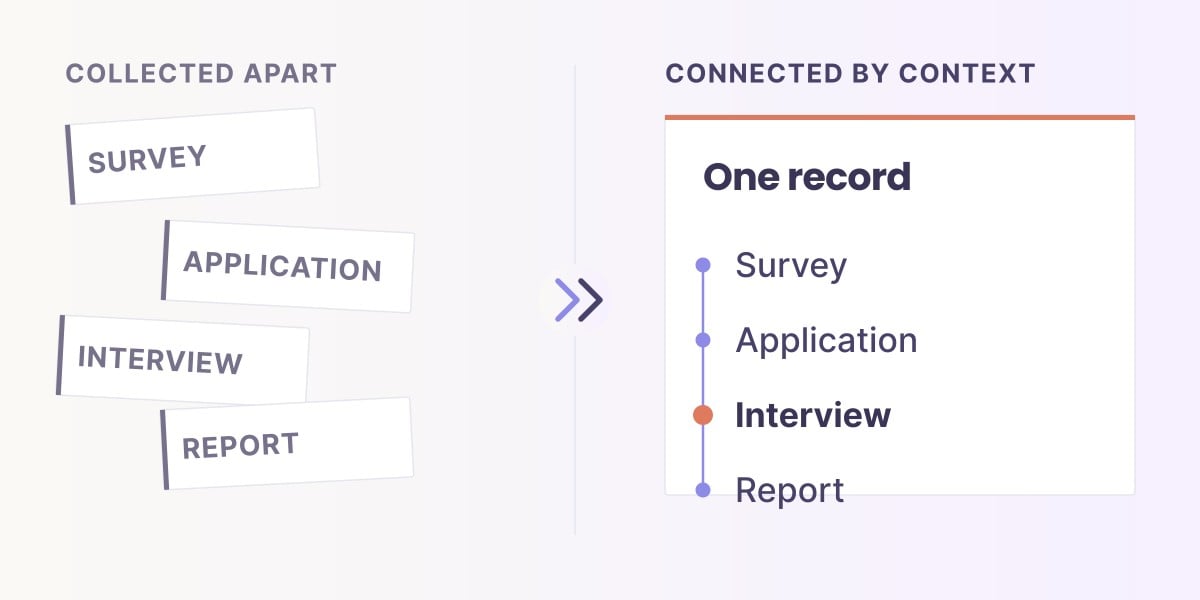
Each instrument is a different wave, a different cadence, a different metric type it supports. All instruments share one architectural choice — a persistent stakeholder identifier assigned at first contact and reused at every later wave, so pre-post change is a query rather than a manual merge.

01 · Intake

Baseline intake instrument

Feeds metrics in family · community investment outcomes (baseline) · cross-cutting equity (disaggregators captured at intake)
Source · pre-program survey under participant ID
Metric type produced · baseline values for later outcome calculations

The instrument that decides whether outcome metrics can be calculated at all. Without baseline tied to participant ID, end-state numbers are descriptions, not measurements of change.

02 · Post-program

Post-program outcome survey

Feeds metrics in family · community investment outcomes (primary)
Source · end-of-program survey paired to baseline by ID
Metric type produced · pre-post change ratios, completion rates, satisfaction

The instrument that produces the primary outcome ratios. Paired qualitative responses theme-coded at submission attach context to every quantitative outcome.

03 · Follow-up

90-day & 6-month follow-up

Feeds metrics in family · community investment outcomes (durability)
Source · short-form follow-up surveys at 90 days and 6 months
Metric type produced · job placement rates, retention, sustained behavior change

The instrument that distinguishes one-time outputs from durable outcomes. The 90-day employment number is the one funders and CFOs care about; the 30-day completion rate is the one program teams celebrate.

04 · Employee surveys

Employee engagement & DEI surveys

Feeds metrics in family · workforce engagement & DEI (primary)
Source · semi-annual employee survey paired to employee ID
Metric type produced · engagement composite scores, pay equity perception, retention drivers

The instrument that produces workforce DEI metrics with theme-coded qualitative attached. Cross-tab by demographic segment surfaces the equity gaps that aggregate scores hide.

05 · Supplier audit

Supplier responsibility assessment

Feeds metrics in family · supplier responsibility (primary)
Source · supplier self-assessment + audit log
Metric type produced · audit completion rate, high-risk supplier remediation, diversity spend

The instrument that produces Scope 3 supply-chain metrics. Persistent supplier ID across cycles means year-over-year improvement is a query rather than a reconciliation.

06 · Volunteer logs

Volunteer participation tracking

Feeds metrics in family · volunteer engagement (primary)
Source · volunteer management system + participation survey
Metric type produced · participation rate, hours per participant, repeat rate, satisfaction

The instrument family that traditional CSR programs lean on hardest. Joined to participant ID, the same activity records become cost-per-outcome — the ratio that lets the CFO compare program ROI across the portfolio.

07 · Environmental

Environmental performance tracking

Feeds metrics in family · environmental performance (primary)
Source · environmental monitoring systems + manual logs
Metric type produced · Scope 1/2/3 emissions, water withdrawal, waste diversion, energy use

The instrument family most heavily framework-specified — CDP, TCFD, SBTi, ESRS-E all overlap on the underlying indicator set. Calculation methodology choices (location-based vs market-based Scope 2) require documentation.

08 · Composite assembly

Scorecard composite-score assembly

Feeds metrics in family · composite scores across all families
Source · all instrument outputs synthesized with documented weighting
Metric type produced · CSR composite score, ESG composite score, family-level rollup

The instrument that turns indicator-level data into a single board-readable score. Documented weighting is non-optional — undocumented weights make the composite uninterpretable and indefensible at external review.

Shape 01 · Output metrics

Output metrics — counts of what the program did.

Output metrics count activities, transactions, and touchpoints. Workshops delivered, volunteer hours logged, dollars disbursed, participants enrolled, partners engaged. They are the easiest CSR metrics to compute because the data already lives in administrative systems. They are the most common starting point — and the most common destination — for CSR scorecards that mistake activity for performance.

Indicator family it lives in

Volunteer engagement · community investment (activity layer) · supplier responsibility (audit counts)

Calculation type

Simple count · sum · rate · participation percentage · no baseline required

Cadence

Monthly or quarterly from administrative systems · automatic where the source system supports it

Raw input

What goes in

"Our scorecard has eighteen output metrics. Workshops delivered: 47 last quarter. Volunteer hours: 8,400 last quarter. Dollars disbursed across forty community partners. Employee participation rate. Media impressions. The metrics all calculate cleanly — the source systems already produce the counts. The question we have never been able to answer with these eighteen numbers is whether any of the workshops produced an outcome. We have the activity. We do not have the change."

Source · volunteer management platform · grant management system · HR system
Plus · example counts: 47 workshops · 8,400 volunteer hours · $2.1M disbursed · 73% partner satisfaction average
Plus · data quality · clean from administrative system source · no participant ID linkage required
Plus · limit · activity tracking only · no baseline · no participant-level pairing · no follow-up

The role of output metrics

Output metrics are not the enemy. They are the activity layer that contextualizes outcome metrics. Eight thousand volunteer hours that produce a 78% job placement rate is a different story than eight thousand volunteer hours that produce a 42% placement rate. The activity number gains meaning when paired with the outcome.

Formula spec

How it is calculated

Volunteer participation rate

Numerator · employees logging ≥ 1 volunteer hour in period

Denominator · total full-time employees in active roles

Formula · (numerator ÷ denominator) × 100

Example · 2,847 ÷ 8,200 × 100 = 34.7%

Framework alignment · B4SI Inputs · simple participation rate. Cadence · monthly from volunteer management system. Disaggregators · by location, business unit, role, demographic segment.

Calculation discipline · numerator and denominator both explicitly named · unit specified (percentage) · period explicitly bounded
Common errors · changing the denominator definition (active roles vs total headcount) mid-cycle · double-counting hours from joint programs
Audit check · spot-validate by replicating the calculation on a 20-record sample · the validation step the retirement rule depends on

Scorecard fragment

What ships in the scorecard

Activity layer · 18 output metrics computed automatically from administrative systems · monthly rollup
Display rule · output metrics always paired with an outcome metric in the same row · no activity number presented in isolation
Retirement audit · 9 of 18 flagged as candidates for retirement to appendix · they pass the calculation test but fail the decision-impact test
Defensibility · each formula spec documented · audit replicable · framework crosswalk in place

Section landing

Output metrics belong on the scorecard as the activity layer · paired with outcome metrics they become cost-per-outcome ratios · presented alone they reproduce the Activity Ledger problem · the discipline rule is "no activity metric without a matching outcome metric on the same row"

Why this build works

Output metrics are the easiest CSR metrics to compute because the underlying data is administrative — clean by source, no participant ID linkage, no baseline required. The calculations are simple ratios or sums with explicit numerator and denominator. The instrument design step matters less here than for any other metric type because the source system handles most of the heavy lifting.

The architectural discipline at this level is presentation rather than computation. Output metrics displayed in isolation reproduce the Activity Ledger problem documented on the CSR performance page. Output metrics paired with outcome metrics on the same scorecard row become cost-per-outcome — the ratio that supports portfolio-level allocation decisions. The discipline rule for the scorecard layout is "no activity number without a matching outcome number on the same row."

Decision this metric type enables: portfolio-level activity tracking · cost-per-outcome ratios when paired with outcome metrics · operational dashboards for program teams · regulatory disclosure of activity counts for frameworks that require them.

Shape 02 · Outcome metrics with calculation formulas

Outcome metrics — calculating change against baseline.

Outcome metrics measure what changed for the people, communities, or systems the CSR program touched. They differ from output metrics in one architectural property: outcome metrics require a baseline tied to the same participant or stakeholder ID that produced the end-state measurement. The formulas are straightforward; the architecture is what makes them possible.

Indicator family it lives in

Community investment outcomes · workforce engagement & DEI (some indicators) · supplier responsibility (remediation outcomes)

Calculation type

Pre-post change · ratio of actual to target · percentage change · survival/retention rates

Cadence

Baseline at intake · post-program at completion · 90-day and 6-month follow-up · cohort scorecard at quarter close

Raw input

What goes in

"Our workforce training program runs 200 participants per cohort. We measure at intake, at graduation, and at 90 days post-program. Same participant ID across every wave. The calculation that the CFO actually cares about is the 90-day job placement rate against the 65% target. That metric has a specific formula, a specific denominator, and a specific exclusion rule for participants who withdraw before completion."

Source · intake baseline survey · post-program outcome survey · 90-day follow-up — all under participant ID
Plus · cohort 13: 200 enrolled · 184 graduated · 178 reached at 90-day follow-up · placement rate calculated against denominator definition
Plus · data quality · 93% baseline coverage · 92% post-program response · 89% follow-up reach
Plus · denominator decision · do we use enrolled, graduated, or reached as the base · the choice affects the placement number by 8 points

The denominator question

Outcome metric calculations are dominated by denominator decisions. Placement rate against "enrolled" vs against "graduated" vs against "reached at follow-up" produces three different numbers. The discipline rule is to document the denominator at design time and never change it mid-cycle.

Formula spec

How it is calculated

Job placement rate at 90 days · IRIS+ OI8520

Numerator · participants employed at 90 days post-program completion

Denominator · participants who completed the program and were reached at 90-day follow-up

Formula · (numerator ÷ denominator) × 100

Cohort 13 example · 139 employed ÷ 178 reached × 100 = 78.1%

Against target 65% · ratio = 78.1 ÷ 65 = 1.20 · indicator score 120% of target

Framework alignment · IRIS+ OI8520 (Employment) · also maps to B4SI Direct Impact. Cadence · per cohort at 90-day follow-up. Disaggregators · geography (rural/urban/suburban), demographic segment, prior employment status.

Income lift at 12 months · IRIS+ OI4347

Numerator · weighted average income at 12 months minus baseline income

Denominator · baseline income (for percentage form)

Absolute formula · mean(income_12mo) − mean(income_baseline)

Percentage formula · ((income_12mo − income_baseline) ÷ income_baseline) × 100

Cohort 11 example · ($42,300 − $28,100) = $14,200 absolute lift · 50.5% relative lift

Pairing requirement · each end-state value paired to the same participant's baseline by ID. Without ID pairing, an aggregate-mean lift overstates the change because new participants entering at higher baselines inflate the end-state mean.

Calculation discipline · numerator, denominator, unit, period — all named in the metric spec
Common errors · aggregate-mean lift without ID pairing · changing denominator definition between cohorts · excluding withdrawn participants without documenting the exclusion rule
Audit check · sample-replicate the calculation on 20 random participant records · verify ID pairing holds across waves

Scorecard fragment

What ships in the scorecard

Outcome row · placement rate at 90d · 78.1% against 65% target · indicator score 120% · disaggregated by geography (urban 78%, rural 71% post-stipend, suburban 76%)
Paired qualitative · theme-coded responses attached · "interview confidence" coded across 41% of post-program reflections · "transportation" coded in rural pre-intervention cohorts
Cohort comparison · Cohort 13 placement 78.1% vs Cohort 11 76.4% vs Cohort 9 71.2% · upward trajectory
Defensibility · each calculation replicable from raw data · ID pairing intact · denominator definition documented · exclusion rule named

Section landing

Quarterly cohort scorecard · CFO can answer the outcome question with comparable data across cohorts · funder report has formulas backing every claim · the calculation methodology survives external review

Why this build works

Outcome metric calculations are simple. The complexity sits below the formula — in the participant ID architecture that enables pre-post pairing, the baseline capture that establishes the comparison point, the denominator decision documented at design time, the exclusion rule for withdrawn participants. Once the architecture is in place, the calculation itself is a query rather than a project.

Most CSR teams skip the architecture and end up with outcome metrics that cannot be replicated, cannot be disaggregated, and cannot be defended at audit. The repair work always traces back to the same architectural choices: persistent ID at first contact, baseline before activities begin, documented denominator and exclusion rules. None of these decisions are technical — they are design decisions made before any code gets written.

Decision this metric type enables: portfolio-level outcome comparison across programs · cost-per-outcome calculation when paired with output metrics · funder reporting with replicable formulas · external assurance support · program redesign based on which interventions actually move outcomes.

Shape 03 · Composite CSR scores & ratings

CSR scoring and ratings — composite metrics with documented weighting.

Composite CSR scores combine multiple indicator-level metrics into a single number that supports executive and board decisions. External rating agencies — MSCI, Sustainalytics, EcoVadis, ISS ESG — publish similar composite scores for the same companies using different weighting methodologies. The same company can rank top-quartile in one rating system and below median in another. The methodology choice is where the score gets its meaning, and where most internal CSR scorecards lose defensibility.

Score type

Internal composite (program-level, portfolio-level) · external rating agency score (MSCI, Sustainalytics, EcoVadis, ISS ESG)

Calculation type

Weighted aggregation of indicator-level scores · industry-materiality-adjusted weighting · 0–100 scale or letter-grade scale

Cadence

Internal scores roll up quarterly for board · annually for external reports · external rating agency scores refresh on the agency's cycle (typically annual)

Raw input

What goes in

"Our board asks for a single CSR score every quarter. The challenge is documenting how the score is built — twenty-three indicators across four families, each with its own scale and unit, combined into one number on a 0–100 scale. The first iteration weighted everything equally and produced a number nobody trusted. The second iteration used materiality weights derived from a stakeholder survey and produced a number with a traceable rationale. The board now asks specific questions about indicator-level changes; the composite is the entry point, the indicator rows are where the conversation goes."

Source · indicator-level scores from all eight CSR indicator families
Plus · weighting logic — equal, category-based, materiality-driven, or stakeholder-priority
Plus · scale normalization — every indicator on a comparable scale before aggregation
Plus · documentation — every weight, every normalization, every aggregation rule recorded in the metric spec

The weighting question

Composite score weighting is the methodology choice that decides whether the score means anything. Undocumented weights are common; defensible weights are rare. External assurance providers ask for the weighting document before they ask for the underlying data.

Formula spec

How composite scores get calculated

Internal CSR composite score · materiality-weighted

Formula · Σ (indicator_score × indicator_weight) ÷ Σ (indicator_weight)

Step 01 · normalize each indicator to a 0–100 scale (z-score, min-max, or target-relative)

Step 02 · apply documented weights from stakeholder materiality survey

Step 03 · sum the weighted scores, divide by sum of weights, multiply by 100

Example · environmental 40% · social 35% · governance 25% · indicators scoring 82, 71, 88 respectively · composite = ((82×40) + (71×35) + (88×25)) ÷ 100 = 78.85

Critical · document weights before scoring · weight derivation traceable (stakeholder survey, materiality assessment, industry sector materiality map) · never change weights mid-cycle.

MSCI ESG Rating · industry-relative scoring

Methodology · industry-specific materiality map · weighted indicator scoring on key issues · relative to industry peers

Output scale · AAA (leader) · AA · A · BBB (average) · BB · B · CCC (laggard)

Each industry has its own weight map · the same indicator carries 15% weight in oil and gas and 3% in financial services

Sustainalytics ESG Risk Rating · unmanaged risk score

Methodology · exposure to material ESG issues minus management of those exposures

Output scale · 0–10 Negligible · 10–20 Low · 20–30 Medium · 30–40 High · 40+ Severe risk

Lower scores indicate less unmanaged risk · stronger ratings · the inverse of MSCI orientation

EcoVadis CSR Rating · 4-theme weighted score

Methodology · weighted score across Environment, Labor & Human Rights, Ethics, Sustainable Procurement

Output scale · 0–100 score · Gold medal 65+ · Silver 55-64 · Bronze 45-54 · No medal below 45

Theme weights vary by industry · evidence-based scoring requires documentation submission

The score interpretation rule · composite scores from different methodologies are not interchangeable · the same company can be top-quartile in MSCI and below-median in Sustainalytics · always name the specific rating system when discussing CSR scores externally

Scorecard fragment

What ships in the scorecard

Internal composite · 78.85 score · trending +2.1 points year over year · weights documented in metric spec
External rating panel · MSCI A · Sustainalytics 18.4 Low Risk · EcoVadis 67 Gold · industry-relative position above median
Drill-down rule · every composite score on the scorecard clicks through to its indicator-level breakdown · the breakdown shows which indicators moved the composite
Defensibility · composite formula documented · weights traceable to stakeholder materiality survey · external assurance provider can replicate calculation from underlying data

Section landing

Board scorecard with composite + drill-down layers · external rating tracking against peer benchmarks · investor relations using ratings as proxy reference points · ESG materiality assessment using stakeholder-derived weights

Why this build works

Composite CSR scores have a bad reputation because most of them are undocumented black boxes. A defensible internal composite score is mathematically simple — weighted aggregation of normalized indicator scores — but methodologically rigorous: weights derived from a stakeholder materiality survey, normalization rules documented, aggregation formula recorded, drill-down to indicator level always available. The external rating agencies are doing the same calculation with their own weight maps; understanding the methodology is what lets a CSR team interpret why MSCI and Sustainalytics rank the same company differently.

The discipline rule for composite scores: the score is the entry point to the indicator detail, not the final word. Every board scorecard composite needs to drill down to which indicators moved it and why. Composite scores presented in isolation without drill-down reproduce the undocumented black-box problem at a different scale.

Decision this metric type enables: board-level CSR performance review · external rating tracking and improvement strategy · investor ESG question response with named methodology · sector benchmark positioning · materiality assessment refresh based on stakeholder weight inputs.

Shape 04 · Benchmark & longitudinal metrics

Benchmark and longitudinal metrics — context that makes the rest interpretable.

A standalone outcome score is uninterpretable without context. 78% job placement at 90 days is a strong number — but compared against what. Against the program's target. Against last year's cohort. Against sector median. Against best-in-class. Benchmark and longitudinal metrics provide the comparison layer that turns isolated numbers into interpretable signals. The architectural commitment is access to comparison data: prior-cycle baselines, peer benchmarks, sector medians, longitudinal cohort trajectories.

Indicator family it lives in

Cross-cutting equity & context (primary) · contextualizes every other family

Calculation type

Percentile ranking against peer set · year-over-year delta · cohort trajectory slope · gap-vs-benchmark · quartile position

Cadence

Quarterly internal longitudinal · annual peer benchmark refresh (CDP, MSCI, sector medians) · cohort trajectory updated with each cohort close

Raw input

What goes in

"The CFO asked whether 78% job placement at 90 days was good. The honest answer was, 'compared to what.' Against our 65% target it was 120% of target. Against our prior three cohorts averaging 76% it was a 2-point improvement. Against the B4SI sector median of 68% for workforce programs it was 10 points above median. Against best-in-class workforce programs reporting 84%, we were 6 points below the leader. All four comparisons were true. All four lived on different rows of the same scorecard. Choosing which benchmark to lead with was the conversation."

Source · internal cohort longitudinal data + external peer benchmark sources (B4SI, CDP, MSCI sector medians, industry reports)
Plus · internal trajectory · Cohort 11 76.4% · Cohort 12 75.8% · Cohort 13 78.1% · trending positive
Plus · peer benchmark · B4SI workforce programs sector median 68% · top quartile 81%
Plus · gap analysis · vs target +13pp · vs prior cohort average +2pp · vs sector median +10pp · vs top quartile −3pp

The benchmark choice

Which benchmark to use depends on the audience. Board comparisons against target. Funder comparisons against sector median. Investor comparisons against best-in-class peer set. Internal program team comparisons against prior cohort. The same outcome number tells four different stories at the four different comparison points.

Formula spec

How benchmark metrics get calculated

Peer-relative position · sector benchmark

Formula · (company_value − sector_median) ÷ sector_std_deviation

Output · standard-deviation position · top quartile if ≥+0.67 · median if within ±0.67 · bottom quartile if ≤−0.67

Example · company 78.1% · sector median 68% · sector std dev 7.5pp · position = (78.1−68) ÷ 7.5 = +1.35 std dev · top quartile

Year-over-year change

Absolute delta · current_period − prior_period

Percentage delta · ((current − prior) ÷ prior) × 100

Cohort 13 vs Cohort 11 · 78.1% − 76.4% = +1.7pp absolute · 2.2% relative improvement

Longitudinal trajectory · cohort regression

Method · linear regression of cohort outcome against cohort number · slope = trajectory direction · R² = consistency

Cohorts 9–13 placement rates · 71.2 · 73.8 · 76.4 · 75.8 · 78.1 · slope +1.6 pp per cohort · R² = 0.87

Interpretation · positive slope + high R² = consistent improvement · positive slope + low R² = improvement with high cohort-to-cohort variance · need to investigate the variance source.

Equity gap metric · disaggregated benchmark

Formula · (segment_value − aggregate_value) per segment

Alert threshold · |segment_gap| > 10pp from aggregate triggers equity flag

Cohort 13 rural vs aggregate · rural 71% · aggregate 78.1% · gap −7.1pp · within tolerance · prior cohort gap was −14pp · intervention closed it

Scorecard fragment

What ships in the scorecard

Benchmark row · 78.1% placement at 90d · top quartile of B4SI peer set · +1.7pp year over year · trajectory slope +1.6 pp per cohort
Multi-comparison view · same outcome shown against target, prior cohort, sector median, top quartile · four comparison points visible at scorecard view
Equity gap closure · rural-urban gap closed from −14pp to −7pp post-stipend intervention · within tolerance band
Defensibility · benchmark source named · methodology cited (B4SI sector classification) · refresh date documented · gap calculations replicable

Section landing

Board scorecard with full context · investor relations briefing with multi-comparison views · funder reports answering equity questions with substantive data · longitudinal trajectory shown for executive-level program decisions

Why this build works

Benchmark and longitudinal metrics turn a snapshot CSR scorecard into a comparison-ready scorecard. The architectural commitments are external — access to peer benchmark data and internal — preservation of prior-cycle baselines that survive year-over-year. The first is a data-sourcing question; the second is an architectural one. Most CSR teams lose their longitudinal data at the year-end production cycle because the data architecture treats the report as the artifact rather than the data as the artifact.

The discipline rule for benchmark metrics: name the benchmark, document its refresh date, and never present a single comparison in isolation. The board scorecard shows the outcome against target. The funder scorecard shows the outcome against sector median. The investor briefing shows the outcome against best-in-class. All four comparisons sit in the same data architecture; the choice of which one to surface depends on the conversation.

Decision this metric type enables: board interpretation of outcome scores · investor positioning against peer set · funder equity reporting with substantive comparison · multi-year program trajectory understanding · equity gap monitoring across cohort cycles.

For the operating side of CSR metrics

The four metric types above are the reference layer — what indicators exist and how they get calculated. For how the metrics actually run year-round — the cadence, the decision loops, the four maturity shapes of CSR measurement as an operating system — the CSR performance page covers the operational layer that sits on top of this metric library.

Read the CSR performance guide →

End-to-end · three metric calculation walkthroughs

Three CSR metric calculations from raw data to scorecard cell.

Three worked calculations showing how a CSR metric travels from primary stakeholder data through formula application to the final scorecard display. Each chain is replicable from the source data — the metric specs documented in §03 produce each end value through the same five steps: source, normalize, calculate, validate, contextualize.

Chain 01 · SROI ratio · social return on investment calculation

Workforce training program · 200 participants · 36-month longitudinal trace

01

Primary · baseline + outcome data

Cohort 11 baseline + 36-month follow-up · 200 enrolled · 184 graduated · 178 reached at 90 days · 142 reached at 36 months · income data captured at intake, 90 days, 12 months, 24 months, 36 months under participant ID.

02

Secondary · proxy values

Proxy library values · placement value $4,200 per participant year (sector-derived) · sustained employment value $14,200 per participant at 36 months (national household income survey average for the demographic) · drop-off rate applied (40% at year 2, 60% at year 3 per sector benchmarks).

03

Computation · SROI ratio

Outcome value at 90 days · 139 placed × $4,200 = $583,800. Adjusted for drop-off at 36 months · 142 × $14,200 × 0.4 = $806,560. Total adjusted outcome value · $1,390,360. Program cost · $580,000. SROI ratio · 1,390,360 ÷ 580,000 = 2.40 : 1.

04

Validation · audit replication

Sample-replicate the calculation on 20 random participant records · verify proxy value application is consistent · verify drop-off curve matches the cohort's actual retention pattern · audit pass.

05

Context · benchmark comparison

SROI 2.40 : 1 · vs sector benchmark for workforce programs (median 1.8 : 1) · top-tercile position · trajectory across cohorts shows SROI compression from 1-year ratios (typically 8 : 1) to 3-year ratios (2.40 : 1) as drop-off adjustments compound.

Destination

Cohort 11 SROI ratio: 2.40 : 1 · top-tercile against sector peers · derived from primary baseline + 36-month follow-up paired by participant ID · proxy values traceable to national income surveys · audit-replicable from raw data. The funder report leads with the ratio; the methodology document supports it; the participant-level trace is available on request.

Chain 02 · CSR composite score · weighted aggregation across 23 indicators

Quarterly board scorecard · materiality-weighted composite

01

Primary · indicator-level scores

23 indicators across 8 families · each indicator scored against target · scores normalized to 0–100 scale · environmental indicators averaging 82 · social averaging 71 · governance averaging 88 · cross-cutting equity averaging 76.

02

Reference · materiality weights

Weights derived from stakeholder materiality survey (Q1 2026, N=420 across employees, customers, community, investors) · environmental 32% · social 38% · governance 22% · cross-cutting equity 8% · weights documented in metric spec.

03

Computation · composite formula

Composite = ((82 × 32) + (71 × 38) + (88 × 22) + (76 × 8)) ÷ 100. Computation · (2,624 + 2,698 + 1,936 + 608) ÷ 100 = 78.66. Final composite · 78.7 of 100.

04

Validation · methodology audit

External assurance provider reviews · weighting derivation document · indicator normalization rules · aggregation formula · sample-replicate composite from raw indicator scores · audit pass with weighting traceable.

05

Context · external rating comparison

Internal composite 78.7 · external rating context · MSCI A (industry-relative leader) · Sustainalytics 18.4 Low Risk · EcoVadis 67 Gold · all four scores converge on "above-average performer" interpretation despite different methodologies.

Destination

Q1 2026 board scorecard · composite 78.7 · year-over-year +2.1 points · weighting traceable to stakeholder materiality · drill-down to each of the 23 indicators available on click · external assurance provider replicates from raw data without methodology questions. The composite is the entry point to the conversation; the indicator detail is where the board asks the substantive questions.

Chain 03 · Equity gap calculation · aggregate vs disaggregated outcome

Workforce program rural-urban gap · Cohort 12 to Cohort 14 trajectory

01

Primary · aggregate outcome

Cohort 12 aggregate placement at 90 days · 178 graduates reached · 128 employed · aggregate placement rate 72.0%. Aggregate scorecard shows program tracking above 65% target — appears to support program renewal.

02

Disaggregation · segment breakdown

Same 178 graduates disaggregated by intake geography (collected at participant ID assignment) · urban subset 137 of 178 (107 employed, 78.1% placement) · rural subset 41 of 178 (24 employed, 58.5% placement) · 14pp gap exposed.

03

Computation · gap metrics

Aggregate-vs-segment gap · urban (+6.1pp) · rural (−13.5pp). Within-program equity gap (urban − rural) · 19.6pp. Threshold check · |segment gap| > 10pp triggers equity alert · rural segment triggers · qualitative theme attached: "transportation barrier" coded across 22 of 41 rural participants.

04

Intervention computation

Cohort 14 post-intervention (transportation stipend) · rural subset 38 of 187 (27 employed, 71.1% placement) · urban subset 138 of 187 (105 employed, 76.1% placement) · gap closed to 5.0pp · below alert threshold.

05

Context · trajectory benchmark

Equity gap trajectory across cohorts · Cohort 12 −14pp · Cohort 13 −9pp · Cohort 14 −5pp · trajectory shows intervention working. Vs B4SI sector benchmark · rural-urban gap median −18pp · program now below sector median for equity gap (better-than-average equity performance).

Destination

Equity scorecard row · rural-urban gap −5.0pp Cohort 14 (improving from −14pp) · "transportation barrier" theme attached · intervention cost $180k · gap closure measurable across three cohorts · funder equity report has formula-backed gap measurements and a documented intervention story. The aggregate scorecard had 72% placement; the disaggregated scorecard surfaced the equity problem that the aggregate hid; the calculation chain produces the funded intervention and the validated closure.

Carry-forward · sibling reading in the cluster

Where this metric library connects in the rest of the CSR cluster.

The CSR performance page covers how the metrics defined here run as an operating system — cadence, decision loops, the four maturity shapes of CSR measurement. The CSR measurement page covers the design layer — materiality, indicator selection methodology, target setting — and feeds into the metric specs documented above. The CSR reporting page covers how the metrics get assembled into the annual artifact — frameworks, format anatomy, and four reporting shapes. The CSR software page covers the tools layer — platforms, vendor comparison, and how to evaluate against the metric architecture. The impact-assessment overview situates CSR alongside social, environmental, and organizational assessment as the four working domains of impact measurement.

FAQ · CSR metrics, scoring, and calculation

Common questions about CSR metrics and calculations.

What are CSR metrics?

CSR metrics are quantitative and qualitative indicators that capture corporate social responsibility activity, outcome, and impact across environmental, social, and governance dimensions. They organize into four types — output metrics (counting what happened), outcome metrics (measuring change against baseline), composite scores and ratings (weighted aggregation of multiple indicators), and benchmark and longitudinal metrics (context-providing comparisons). A defensible CSR metric has an explicit formula, an outcome target, a defined cadence, framework alignment (GRI, SASB, IRIS+, B4SI, 2X Global), and disaggregation logic by stakeholder segment.

What are CSR KPIs?

CSR KPIs (key performance indicators) are the small subset of CSR metrics chosen as primary decision drivers — typically five to twelve indicators tracked at the leadership level and tied to budget decisions, executive performance reviews, and external commitments. Strong CSR KPIs share five properties: explicit outcome target, formula written numerator-over-denominator, disaggregation logic, defined cadence, and framework alignment. The retirement rule applies: if a KPI has not informed a decision in six months, it is documentation rather than performance measurement.

How is CSR calculated?

CSR calculations fall into three main types. Ratio metrics divide actual outcome by target — if a workforce program targets 65% job placement at 90 days and achieves 72%, the indicator score is 110%. Composite scores aggregate multiple indicators with documented weighting — for example, 40% environmental, 35% social, 25% governance produces a single CSR composite score. Benchmark-relative metrics express performance against peer median or sector benchmark — top quartile, median, bottom quartile. Each calculation type has different uses; the choice depends on what decision the metric needs to support.

What is a CSR scorecard?

A CSR scorecard is a structured display of a company's CSR metrics organized to support decisions. A defensible scorecard contains five components: an indicator-level layer (each metric with its formula and current value), a target comparison layer (actual versus target ratios), a disaggregation layer (segment-level views surfacing equity gaps), a qualitative evidence layer (theme-coded stakeholder voice attached to each indicator), and a longitudinal layer (trend across cohorts and time periods). Scorecards differ from CSR reports — they are operational artifacts updated continuously rather than annual artifacts assembled at cycle close.

What are CSR ratings and how are they calculated?

CSR ratings are composite scores assigned by external rating agencies — MSCI ESG Ratings, Sustainalytics ESG Risk Ratings, EcoVadis CSR ratings, ISS ESG, and others. Each agency uses its own indicator framework and weighting methodology. MSCI ESG ratings express industry-relative scores from AAA to CCC based on weighted ESG metrics specific to industry materiality. Sustainalytics measures unmanaged ESG risk on a 0–100 scale with risk categories from Negligible to Severe. EcoVadis scores companies on four themes (Environment, Labor & Human Rights, Ethics, Sustainable Procurement) with a 0–100 weighted composite. The ratings are not interchangeable — different methodologies produce different rankings for the same company.

What are common CSR indicators?

CSR indicators organize into eight standard families. Workforce engagement and DEI metrics (turnover, engagement scores, pay equity ratios, diverse hiring rates — GRI 401-1, GRI 405-2). Community investment outcomes (program participation, placement, retention, sustained behavior change). Volunteer engagement (participation rates, hours, retention, satisfaction). Environmental performance (Scope 1/2/3 emissions, water withdrawal, waste diversion — GRI 305, SASB sector standards). Supplier responsibility (audit completion, high-risk supplier remediation, supplier diversity — GRI 308, GRI 414). Customer and product responsibility (product safety, customer privacy, accessibility). Governance and ethics (board diversity, whistleblower utilization, ethics training). Cross-cutting equity and context metrics (disaggregation across all of the above).

What is the difference between output metrics and outcome metrics?

Output metrics count what a program did — workshops delivered, volunteer hours logged, dollars disbursed, participants reached. They answer the question "did we do it". Outcome metrics measure what changed for the people the program touched — job placement rate, income lift, sustained behavior change, retention at 6 months. They answer the question "did it work". Both belong in a CSR scorecard, but only outcome metrics support the budget and program-design decisions that distinguish performance measurement from documentation. The architectural difference is that outcome metrics require baseline tied to participant ID — output metrics do not.

How do you choose CSR KPIs?

Strong CSR KPI selection runs through six filters. Materiality — the KPI maps to a topic that matters to stakeholders and to the business strategy. Outcome orientation — the KPI captures change, not just activity. Decision impact — if this KPI changed by 20%, the team would do something different. Framework alignment — the KPI maps to at least one external reporting framework (GRI, SASB, IRIS+, B4SI, 2X Global). Measurability — there is a clean data instrument and an instrument cadence that can support the measurement. Disaggregation viability — the KPI can be broken out by stakeholder segment to surface equity gaps. A KPI that fails any one of the six filters belongs in the appendix rather than on the operating dashboard.

What is a good CSR rating?

A good CSR rating depends on the rating system and the industry context. MSCI ESG ratings of AAA or AA are leaders; BBB to A are average; B or CCC are laggards. Sustainalytics ESG Risk Ratings below 10 are Negligible Risk; 10–20 Low; 20–30 Medium; 30–40 High; above 40 Severe — lower scores indicate less unmanaged risk and are therefore stronger ratings. EcoVadis scores above 65 earn the Gold medal; 55–64 Silver; 45–54 Bronze; below 45 no medal. Industry-relative position usually matters more than the absolute number — a top-quartile rating against industry peers is a stronger signal than a numerically higher rating in a low-bar sector.

How are CSR composite scores weighted?

Composite CSR scores combine multiple indicators with documented weighting that reflects materiality and strategic priority. Common patterns include equal weighting (every indicator counts the same), category weighting (environmental 40%, social 35%, governance 25%, or similar), materiality-driven weighting (the more material a topic to the company's industry, the higher its weight), and stakeholder-priority weighting (weights derived from stakeholder materiality surveys). External rating agencies like MSCI use industry-specific materiality maps to assign weights — the same indicator carries a different weight in oil and gas versus financial services. Documented weights are essential — undocumented weights make the composite score uninterpretable.

How often should CSR metrics be measured?

Cadence depends on the metric type and what decision it supports. Output metrics (activity counts) can be measured monthly or even weekly from administrative systems — they are continuous by nature. Outcome metrics with explicit baselines are measured at intake, mid-program, post-program, and at 90-day and 6-month follow-up — the cadence that lets pre-post change be computed. Composite scores roll up quarterly for board decisions and annually for external reports. Benchmark metrics align to the data refresh of the benchmark source — peer benchmark refreshes annually; sector benchmarks may refresh quarterly. The discipline rule: the cadence has to be fast enough that the metric can still inform a decision while the program is running.

What is the CSR Index?

The term CSR Index refers to several different things depending on context. Some uses refer to country-level or sector-level composite indices that aggregate corporate CSR performance — for example, sector-level CSR scoring published by research firms. Other uses refer to internal composite scores a company maintains across its own programs — an internal CSR Index that aggregates workforce, community, environmental, and governance performance into a single number for executive reporting. Still other uses refer to external public-facing rankings — for example, sustainability indexes used in investment screening like the Dow Jones Sustainability Index. The methodology varies dramatically across these definitions, so the specific index always needs to be named.

Book a walkthrough

Your CSR metric library could be reference-grade by next quarter — every indicator with a documented formula, framework crosswalk, disaggregation logic, and retirement audit on file.

A 60-minute working session with the Sopact team. Bring your current CSR scorecard and one indicator family you want to formalize. Leave with a metric spec template, a framework crosswalk for your indicators, and a preview of how your scorecard would look with formula-backed indicator rows.