When is Sopact an alternative to Blackbaud Grantmaking?
Sopact is worth evaluating as a Blackbaud Grantmaking alternative when the work that strains your team is the evidence rather than the administration: application reviews nobody can retrace later, reporting questions grantees struggle to answer, and board reports rebuilt by hand from proposals, progress updates and staff notes. Test a redesigned evidence workflow on one program, against your existing grant administration, financial handoffs and historical records, before deciding what to replace.
Unmesh Sheth, Sopact’s founder, hears a version of this in his conversations with grant managers who have spent years configuring the platforms they bought. The applicant portal works and the payment schedule runs. Then the board asks what the portfolio achieved, and a program officer reopens the proposal files, the progress updates and her own notes to assemble the answer one more time. Nothing in the system has failed. The evidence inside it was never arranged to be read together.
This comparison is about Blackbaud Grantmaking. Scholarship selection has different requirements; see Blackbaud Award Management alternatives for that decision.
What Blackbaud Grantmaking already does
Blackbaud’s product documentation describes configurable grant workflows, an applicant portal, collaborative review with custom scoring rubrics, payment schedules, relationship records, dashboards, audit tracking and permissions, along with analysis of trends over time. It would be inaccurate to describe the product as a file store whose records stop being useful when an award closes. Source: Blackbaud Grantmaking product overview.
Its May 2026 product briefing also discussed AI-supported review and previewed impact insights drawn from approved grantee reports, with some capabilities described as upcoming. Confirm what is available in the edition and configuration you would use, because a roadmap announcement is not a deployed workflow. Source: Blackbaud’s May 2026 product briefing.
So start from your unresolved work, stated specifically: “Our program officer cannot explain a portfolio finding without reopening twenty reports.” Then check whether configuration, training or a different workflow fixes that problem before committing to a move.
Redesign the evidence workflow before moving the old forms
Copying applications and report templates into a new tool carries the old process along with them, including the questions nobody reads and the handoffs nobody owns. The better sequence is to untangle the workflow one thread at a time. Choose the decision your team finds hardest to make with confidence, redesign the evidence that feeds it, prove the change on one program, and only then pull the next thread.
A fictional example keeps the threads concrete. A foundation supports local training providers. One proposal promises to enroll a cohort and improve participants’ employment prospects; six months later the grantee reports attendance, course completion and several participant stories. At every moment below, a useful workflow keeps the commitment and the update connected, and keeps delivery activity separate from an employment outcome. The benefit to test is a shorter path from a new submission to a checked answer.
| Moment in the grant | What the team needs | What should remain visible |
|---|---|---|
| Application review | Assess relevant evidence against agreed criteria. | Proposal source, criterion, reviewer judgment and unresolved questions. |
| Award agreement | Turn the selected proposal into an approved reporting plan. | Agreed measures and dates, including changes from the original proposal. |
| Progress review | Read structured results and narrative in their grant context. | Grant identifier, reporting period, source document and clarification status. |
| Portfolio discussion | Understand comparable results and exceptions across grants. | Definitions, denominators, missing reports and the evidence behind findings. |
| Next cycle | Improve questions and review practices without erasing history. | Previous definitions, change decisions and who approved them. |
A generated summary has a place here only once it is checked: a well-written paragraph can still mix a proposed target with an achieved result.
WATCH · WHERE THE TANGLE COMES FROM
Why a grant cycle stays long after the configuration is done
Before redesigning anything, it helps to see how the tangle forms. Unmesh does not single out a vendor; he walks through the custom fields, reviewer preferences, rubric setup, approval steps and exports that build up on any long-configured platform, then argues for thinking about the grant end to end and starting with application review. Watch the onboarding-call chapter closely, because it covers the handoff where an approved proposal becomes a reporting plan, the point this page treats as the hinge of the whole evidence workflow.
Jump to: 2:29 — Custom fields, reviewer preferences, exports · 6:30 — Think end to end, start with applications · 8:14 — The onboarding call becomes the reporting plan
Use this in your evaluation: Pick one recently closed grant and trace it while you watch. Mark every point between application and final report where its evidence was re-entered, re-read or exported. Those points are the threads to redesign, roughly in the order the sections below take them.
First thread: application review someone can inspect
Unmesh’s first practice is to think about the whole grant, then start with the application, and within applications, with fellowships or scholarships rather than large grants that need heavy due diligence. For a Blackbaud Grantmaking team, that points to one smaller program’s review as the first thread. It may already sit outside the main system. The deck behind the video mentions a foundation whose three fellowship programs run outside its main platform, and a program like that can be tested without touching the configured core.
Ask each vendor to run a real review task on authorized sample material. Bring a rubric with clear definitions, an application that meets it, one with missing evidence and one whose narrative is persuasive but does not answer the criterion. The third case matters most, because it is the one where a fluent summary can mislead a tired reviewer.
In the Sopact workflow, an Intelligence Cell, a prompt your program team writes against the rubric, reads each application and its attachments as they arrive and drafts an assessment linked to the supporting passage. Check how that link opens and how reviewers record corrections. The suggested assessment, the reviewer’s judgment and the final selection should stay distinct, so a reviewer can disagree without losing the original evidence or the reason for the change.
Do not treat agreement with past awards as the only measure of quality, since earlier decisions may have carried unstated constraints. Read the disagreements to learn whether they point to a weak criterion, missing context or an error in the draft. The Applications, awards & grants course is a practical place to define intake and assessment before you evaluate software.
Second thread: reporting questions grantees can answer
Reporting is usually designed as a template, and grantees spend the year translating their work into it. The video suggests agreeing the plan at the start of the relationship instead: soon after approval, a 60- to 90-minute onboarding call settles what the grantee is aiming for, who is responsible for what, which measures will be reported and the theory of change behind them. The transcript drafts the reporting plan, and program officer and grantee agree the handful of measures to review each quarter or year.
For the training-provider example, that conversation is where enrolled participants, attendance entries, completions and employment status get separated. Agree who is counted, when they are observed and how a missing follow-up is recorded. A portfolio total should never hide that one provider measures employment at three months and another at twelve.
Keep common fields few, used only where comparison is necessary, and store stable organization details once. Where the grantee already keeps the evidence, such as a social audit or financial report, ask them to update that document instead of retyping its figures into a form. A rubric then checks what is complete, and the grantee’s ID tells you exactly whom to ask for what is missing.
Then ask Sopact a question that needs numbers and narrative together: which providers report lower completion, what explanations appear in their updates, and which reports still need clarification? Inspect the records included, not only the answer, and build the board report from approved findings with source, period and limitations attached. For planning the output, see the impact-report writing ebook and report examples.
Third thread: one grantee ID from application to final report
The first two threads hold only if everything a grantee submits lands on the same record. Sopact gives each applicant and grantee organization one persistent ID, and every later record attaches to it: the proposal and its review, the award and the agreed reporting plan, each progress report and its clarifications. Organization, application, award and report stay distinct records, connected rather than merged, so a repeat grantee or an organization holding two awards does not blur into one story.
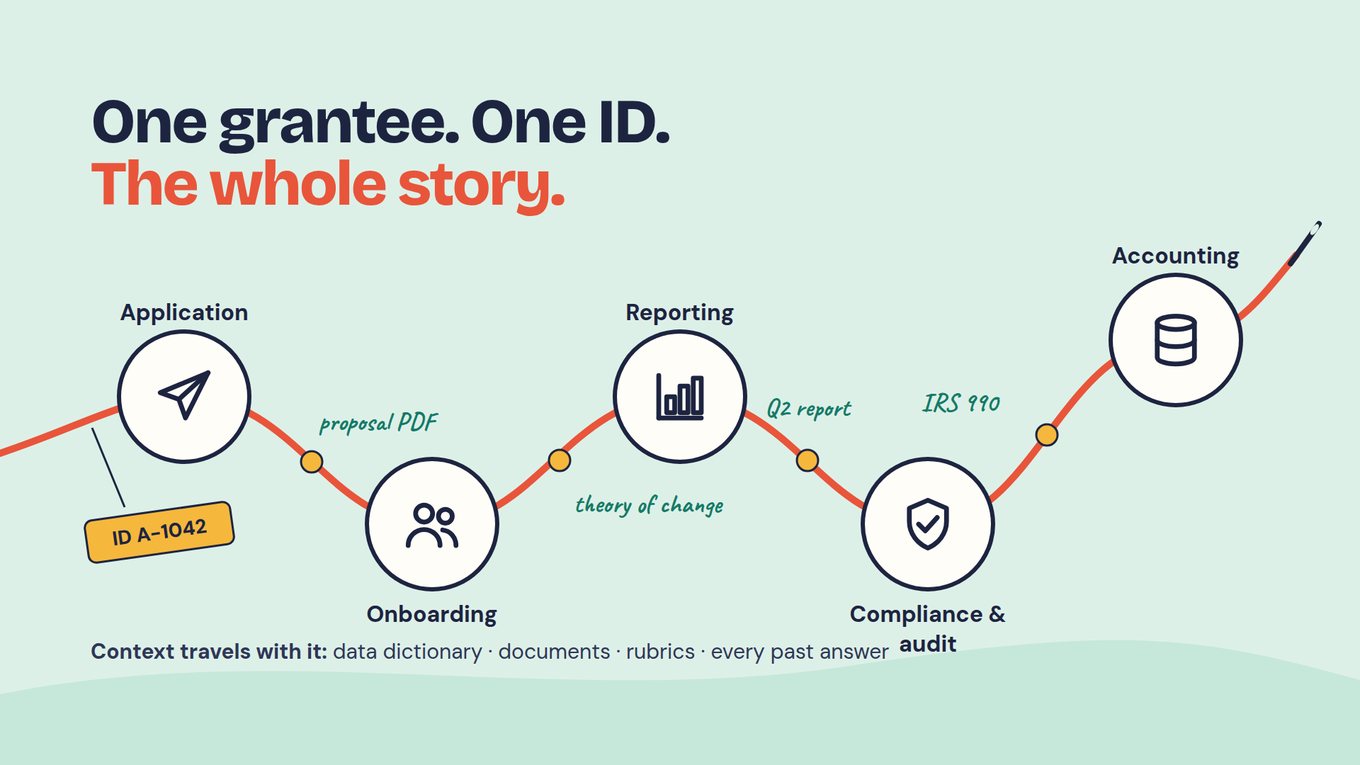
On that record, an Intelligence Row summarizes each grantee across application, agreement and reports, and the AI Assistant answers plain-language questions with the sources behind each answer; Claude or ChatGPT can query the same records through MCP. Give the portfolio its context before asking it anything: the data dictionary, reporting requirements, timelines and the red flags your team already watches for. That context is what makes a later comparison across grants mean something.
Preserve the financial and operational handoffs
Approving a grant is not the same as paying it. Write down where budgets, commitments, installment schedules, accounting entries and disbursements are authoritative. An evidence workflow should exchange the information those operations need without creating a second, competing version of it. In the sequence Unmesh describes, accounting is connected later, through APIs or MCP, one step at a time and after the evidence threads are working.
Before assuming that Sopact replaces a Blackbaud integration, see the exact handoff demonstrated: approved grant identifier, amount, status, responsible staff member and the handling of an amendment. Confirm who maintains the connection. A downloadable list is not a tested integration, and keeping the existing financial arrangement in place is often the sensible choice. The decision should follow your required controls and workload, not an expectation that one tool must own everything.
Evaluate who owns ordinary changes
A redesigned workflow is only an improvement if the staff member who will run it can maintain it. Have a program officer add a reporting question, revise a definition and adjust a board view, and note the help needed and whether existing records still read correctly; repeat the exercise in your current configuration, since the improvement may be available without a migration. Test permissions with your real roles too: a grantee should not inherit internal deliberations because records are connected, and a board view may need aggregated findings without participant-level detail.
Evaluate one complete program, including the awkward records
Choose a contained pilot with authorized records and a named owner. Include a repeat grantee, two awards to one organization, a revised agreement, a late update and a report with an unsupported outcome claim. Clean demo data will not show you where the threads snag.
- Document the baseline. Record the current effort for preparation, assessment, follow-up and report review.
- Map records and files. Keep organization, application, award and report identities distinct and connected, and resolve ambiguous matches explicitly.
- Test the application review. Inspect draft assessments, supporting passages, errors, omissions and reviewer corrections.
- Run one onboarding conversation. Turn it into a reporting plan and check the plan against the approved proposal.
- Build a recurring report. Check how approved results, missing submissions and incompatible measures appear.
- Change the workflow. Have its future owner revise a question or definition and explain the effect on history.
- Test permissions and exports. Verify what each role can see and what remains usable outside the pilot.
Confirm the export available from your Blackbaud configuration before planning an import; structured records, attachments, historical changes and permissions may each need different handling, and files do not arrive linked to the right award on their own. Keep the current system authoritative for agreed operations while the pilot runs, and avoid asking grantees to submit duplicate live reports.
Be clear about what the pilot can prove. Every AI finding should open to the passage it came from and the criteria version used, and a missing answer should look different from a weak one. Every award is a human decision, and staff verify AI drafts before they reach a reviewer’s score sheet or a board slide. One program can show whether the path from submission to checked answer got shorter and whether staff trust the sources. It cannot show that a grant caused an outcome; that needs an evaluation design.
Measure the total work, then decide
Count implementation, training, data matching, definition upkeep, review, correction and recurring report preparation. Where two systems remain, count synchronization and reconciliation too. For scale, Unmesh notes that a traditional grant-system implementation runs six to nine months, the main argument for proving one thread before committing to more.
Ask whether the final checked report took less effort, whether staff could explain its claims and whether the next cycle reused the work. If the existing setup can deliver the improvement, refine it. If evidence review and reporting remain the bottleneck, extend a focused Sopact workflow to the next program. Replace the wider arrangement only when the complete operational case has been shown. For other options, see grant management software comparisons.
Common questions
Does Blackbaud Grantmaking stop at award administration?
No. Its published capabilities include relationship records, collaborative review with custom scoring rubrics, dashboards, audit tracking and analysis of trends over time. Compare the specific task your team struggles with, such as explaining a portfolio finding without reopening every report, instead of assuming there is no post-award capability. If the current configuration can handle that task and staff can maintain the change, that beats any migration.
Does Blackbaud have AI for grantmaking?
Blackbaud has published AI-related grantmaking plans and product updates, including a May 2026 briefing on AI-supported review and impact insights from approved grantee reports, some described as upcoming. Verify availability, scope and release status for the edition you would use, and separate current functionality from a preview. Test any AI feature by whether each finding opens to its source and reviewers can correct it with a recorded reason.
Can Sopact work alongside Blackbaud Grantmaking?
Yes, for a scoped workflow such as one program’s application review and reporting, provided the data exchange, permissions and correction process are verified first. Decide which system is authoritative for each record and responsibility: a sensible split keeps the award, payment and relationship record in Blackbaud, while the pilot program’s evidence is read and reviewed in Sopact on one grantee ID. Agree how approved results return, so staff are not maintaining two versions of the same grant.
Which part of the workflow should we redesign first?
Start with application review on a small program, such as a fellowship or scholarship, where less money is at risk and the cycle is short. Then redesign the award handoff: an onboarding conversation that produces the reporting plan, so grantees report against measures they agreed to. Put both on one grantee ID before touching financial integrations. Each step should prove itself on a real cycle before the next begins.
What makes a pilot successful?
It produces a checked, useful result through a process the team can maintain. Measure staff effort against the baseline, the quality of the evidence behind each finding, how exceptions such as a revised agreement or a late report were handled, and whether the people who will run the next cycle can change a question without help. A pilot that saved time but left findings nobody could trace has not succeeded.