Which Blackbaud Award Management alternative should you evaluate?
For most scholarship offices, the alternative worth evaluating is a second way to run one award cycle’s essay reading and recipient follow-up, while Blackbaud Award Management keeps the fund matching, campus connections and stewardship it already handles. Sopact fits that role: it reads each application as it arrives, keeps the committee’s reasoning next to the evidence and follows each recipient on the same record after the award.
The strain tends to show in two places. During the window, matching can work well while the reading still depends on committee members working through a season of personal statements, each interpreting the rubric slightly differently. After the award, a donor asks how the students they funded are doing, and the answer begins with an export and a round of emails. Neither is a matching problem, and neither calls for replacing the award platform. The scholarship management software guide compares the wider category; this page is about what to keep, what to test and how to test it on one small award cycle.
What Blackbaud Award Management already does for a campus
Blackbaud describes automatic scholarship matching and recommendations, student-information-system imports, committee access, permissions, renewal data and single sign-on. Its product page also describes donor reporting and post-acceptance workflows. Source: Blackbaud Award Management. Those capabilities matter most where scholarship administration is tied into campus systems, and they are the reason to move nothing without evidence.
A university administering hundreds of opportunities mostly needs those connections preserved; a community provider running one selection a year may care more about evidence from recipients over time. Either way, write down before any demonstration the question your current setup cannot answer efficiently, and why: data never collected, definitions never agreed or records that do not connect.
Eligibility, ranking and allocation are three different decisions
Many scholarship disputes, and many disappointing software pilots, come from treating three decisions as one. Eligibility asks whether a student meets a fund’s rules. Ranking asks how well the application evidence meets the selection criteria. Allocation asks which eligible, ranked students receive which awards, within the money available and alongside other aid the institution administers. Each rests on different evidence and belongs to different people.
| Decision | The question it answers | The evidence it rests on | What AI should and should not do |
|---|---|---|---|
| Eligibility | Does this student meet the fund’s rules? | Enrollment, program of study, donor restrictions and other rule-based fields, usually from the student system. | Flag a missing document or a record needing clarification. A missing enrollment confirmation should prompt a request, not an automatic rejection. |
| Ranking | How strongly does the application meet the criteria? | Essays, statements, recommendation letters and the rubric. | Read every essay against the rubric as it arrives and cite the passage behind each draft score, for a reviewer to confirm or correct. |
| Allocation | Who receives which award, and how much? | Fund balances, restrictions, other aid and the committee’s decisions. | Very little. A strong essay does not override a fund restriction, and a high score does not settle how an award interacts with other funding. |
Keeping them apart is also how to evaluate an alternative fairly. If matching across many funds is central to your work, reproduce your real rules in the demonstration, including overlapping opportunities and a student whose information changes mid-cycle. A system that reads essays well is not a matching engine. The video below addresses the middle decision, ranking, which is where committee reading time goes.
WATCH · THE RANKING STEP, BUILT FROM SCRATCH
Read every application against the rubric as it arrives
Unmesh Sheth, Sopact’s founder, builds the ranking step in under five minutes. He sets up an intake built around open questions in the applicant’s own words, attaches a prompt to each field so an Intelligence Cell reads every answer the moment it arrives, then questions the pool in Claude, noting that ChatGPT works the same way. His example is a workforce-training program, and the barriers it draws out of applicants’ statements, such as transportation, childcare and no clear goal, are the detail a scholarship committee reads for and a first-term check-in should come back to.
Jump to: 0:28 — Barriers in applicants’ own words · 0:47 — A prompt on every field · 2:42 — Asking which applicants need support
Use this in your evaluation: Pick the essay question your committee argues about most and write down what a strong, an adequate and a weak answer look like. That description is the first prompt you would test.
Rank on evidence the committee can open
In a Sopact cycle, each applicant gets one persistent ID at submission, carried from application to award to every later check-in. Each field that needs judgment, such as the personal statement or a recommendation letter, gets an Intelligence Cell: a prompt drafted from the rubric that names the criterion, describes a sufficient answer and says what falls short. It returns a draft assessment with the passage it relied on. An Intelligence Row pulls each applicant’s fields into one summary, and the AI Assistant takes committee questions in plain language and answers with its sources; Claude or ChatGPT can query the same records through MCP.
When the window closes, every application has had the same first read, and committee time can go to files where a draft and a reviewer disagree or where a student’s circumstances need discussion. That depends on an agreed meaning for each criterion: leadership or motivation produces inconsistent scores on a shared scale, and a prompt inherits the vagueness. Calibrate on a past cycle with an incomplete application, a short essay that answers the criterion directly and a polished one that never does. Check that missing evidence is flagged rather than scored as weakness, and that reviewer corrections are kept.
Start with one small award cycle
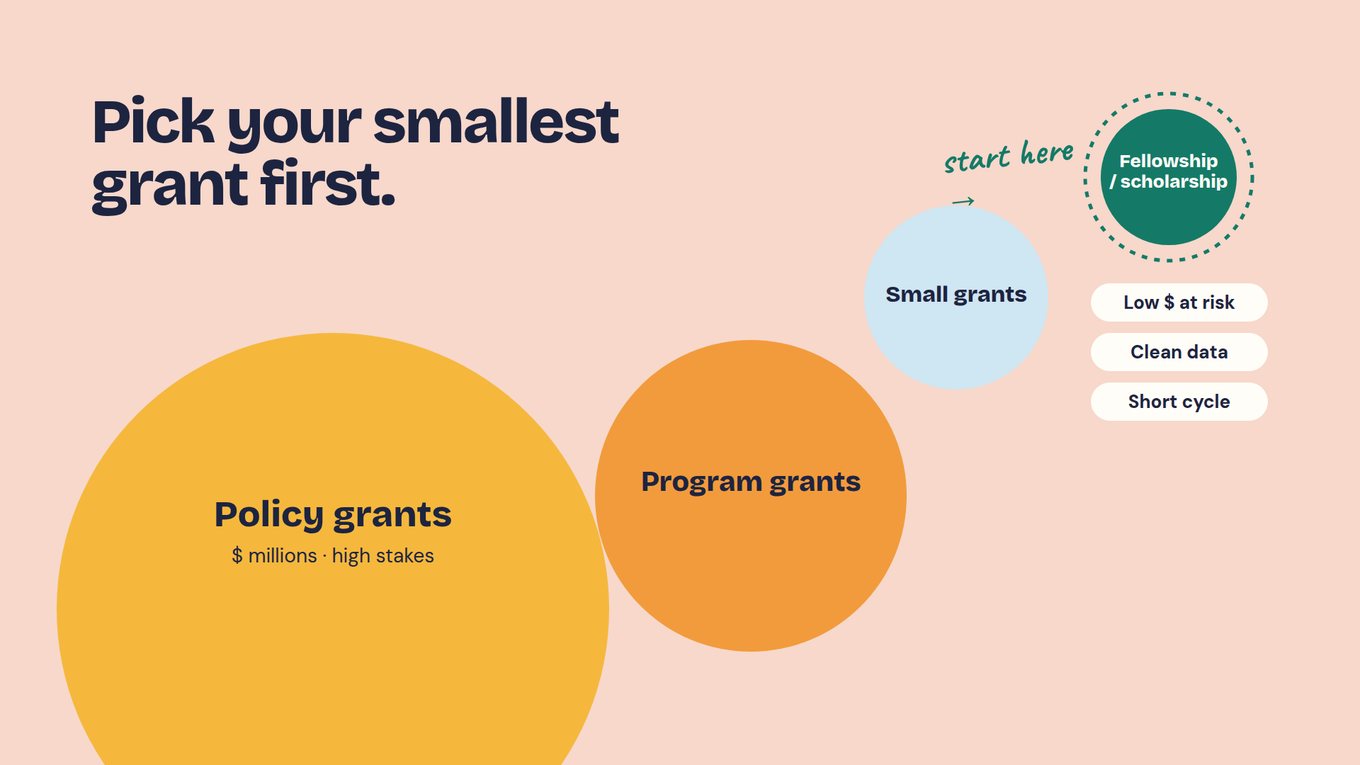
The companion video at the end of this page argues for bringing AI in at application review first, and on a scholarship or fellowship before any large grant that carries heavy due diligence. For a scholarship office on Blackbaud, the smallest sensible unit is one award cycle for one fund: an endowed scholarship with its own essay prompt, a partner-funded award with a small committee, or a program already run outside the main system on a form and a spreadsheet.
Typical timelines from Sopact’s work with application programs are about two weeks to set up the intake, rubric and prompts, one day for AI to read and score every application, and one to two weeks for human judgment and follow-up with applicants. One fund can run through that inside a single season while Blackbaud keeps handling matching, awarding and stewardship for everything else.
- Fix the boundary. Name the authoritative source for student identity, eligibility, allocation, payment and donor reporting, and confirm they stay in Blackbaud and campus systems.
- Rebuild the intake around the rubric. Keep the eligibility fields, map each criterion to the question that evidences it and add the open questions you will ask recipients again later.
- Calibrate on last year’s applications. Compare the Intelligence Cell drafts with how the committee scored, criterion by criterion.
- Run the live cycle alongside the current process. Include a returning applicant, a student eligible for two awards and a missing document, and record every override with its reason.
- Hand the decision back. Return the committee’s selections to Blackbaud for allocation and check the transfer record by record.
- Make a routine change. Have the staff owner revise a criterion mid-cycle and explain what happens to applications already read.
Judge the pilot on the whole job, not the speed of an essay summary: committee reading, clarification requests, matching corrections, report preparation and the cost of running two systems. A sample import does not prove the whole scholarship operation can move.
Follow recipients without overstating what the award caused
The ID that carried the application carries the recipient afterward, so follow-up does not depend on rematching students by name each term. Define the question first: continued enrollment, completion and employment are different outcomes with different observation periods. Use authorized administrative data for what the institution already holds, and ask recipients only for context: whether a barrier they named on the application remains, what support helped, why plans changed. If several recipients named transportation when they applied and name it again at the first-term check-in, that calls for a conversation about support, not a mark against any student.
The limits of an AI-assisted workflow belong here. People make every award, and AI output is a draft to be checked against its source before anyone relies on it. When some recipients do not respond, report the coverage rather than presenting respondents as every awardee. Linked records cannot show that the scholarship caused higher graduation; that claim needs an evaluation design. Keep student support apart from donor storytelling too: a student describing a hardship is asking for help, so define who sees each answer and require review before any identifiable story is shared.
Unmesh ends the video with a distinction worth keeping: “It’s not impact measurement. It’s a result-based learning process.” The reason to follow recipients is to act while they are still enrolled.
After the first cycle, decide what moves next
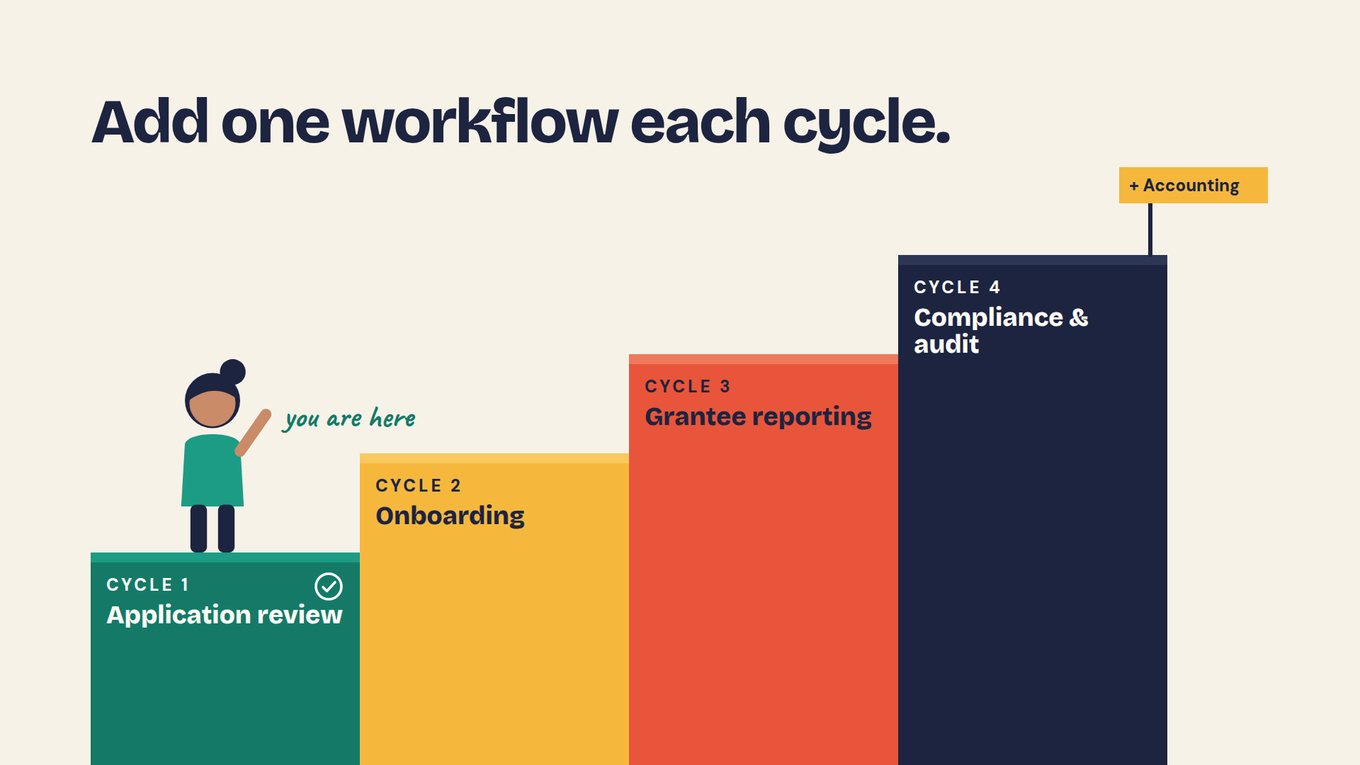
If the pilot holds up, the next step is another workflow on the same student record, not a migration. The companion video’s roadmap adds one workflow per cycle, from application review through onboarding, reporting, and compliance and audit, with accounting connected along the way. A Blackbaud campus reads it with one question at each step: does this work move, or does Blackbaud keep doing it well? Renewals are a natural second candidate, since a renewal is a review that returns every year; donor stewardship may never need to move.
Keep the current setup when the remaining problem can be solved inside it. Run a complementary workflow when reading and follow-up are the bottleneck, agreeing which system owns each record. Replace more only after the operational requirements, from SIS connections to payments, have been demonstrated on your own cycles.
THE BIGGER PICTURE
Why the pilot starts with one scholarship
The companion video tells the story the roadmap comes from. It follows Maya, a composite of the grant leads Sopact talks to, whose foundation sees about 800 applications a cycle on a platform configured over more than a decade, and argues that the lowest-risk way to bring in AI is to begin with the smallest program and add one workflow at a time. Share it with the dean, director or advancement lead who asks why the pilot touches one fund and leaves the rest alone.
Jump to: 4:12 — Collect once, analyze on arrival · 4:50 — Pick your smallest grant first · 5:11 — Add one workflow each cycle
Common questions
Does Blackbaud Award Management support renewals and stewardship?
Its product page describes renewal data, donor reporting and post-acceptance workflows, alongside matching, SIS imports and committee access. Evaluate your own requirements in your configuration rather than assuming those functions are missing. The question for an alternative is narrower: whether essay reading and recipient follow-up, if they still take the most staff time, would be faster and clearer to check in a second workflow run alongside Blackbaud.
Is AI-assisted essay review the same as scholarship matching?
No. Essay review assesses application evidence against selection criteria. Matching and allocation apply each fund’s eligibility rules, restrictions and budget, and interact with other aid the institution administers. An Intelligence Cell can read every essay against your rubric and cite its evidence, but it is not a matching engine. If your program needs both, test both, using your real rules and a student who qualifies for more than one fund.
Do we have to leave Blackbaud to try Sopact?
No. The approach on this page runs one award cycle for one fund in Sopact while Blackbaud stays the record for matching, awarding, stewardship and campus connections. Agree before the cycle opens which records the pilot creates, who owns them and how the committee’s selections return to Blackbaud. Compare staff effort and evidence quality before deciding whether a second workflow, such as renewals, should follow.
Can recipient follow-up show the scholarship’s impact?
It can show observed progress and what recipients report, provided identities, dates and definitions are sound and response coverage is reported beside every finding. A persistent ID lets a first-term check-in sit next to the original application, so changes are visible and open to question. Saying the scholarship caused an outcome is a different claim, and it needs an appropriate evaluation design rather than connected records alone.
Does Sopact replace the student information system or the bursar’s system?
No. Sopact works alongside the student information system and finance systems, and it does not move scholarship funds. Keep payment and accounting responsibilities explicit, and verify the handoff during the pilot: how selections return for allocation, how disbursement status comes back to the student’s record and who resolves a mismatch. Confirm identifier mapping, refresh frequency and access rules before relying on any connection.