What is AI grant management software?
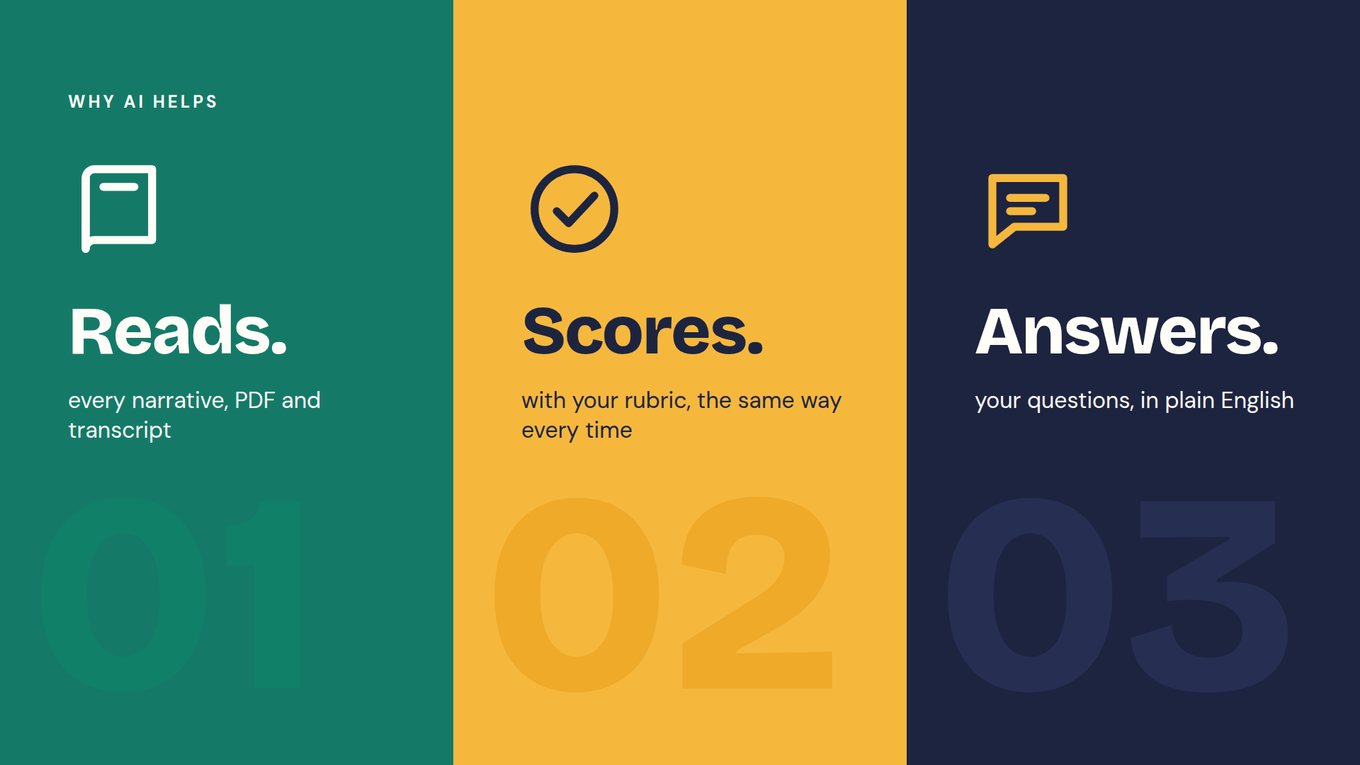
AI grant management software is grant software in which AI reads every application, report and document as it arrives, scores it against the funder’s own rubric, and answers staff questions in plain language with the sources behind each answer. The question is where that AI sits: inside the flow of evidence across the whole grant round, or on top of existing forms as a feature that drafts text.
In his video on why grant systems still feel slow, Unmesh Sheth, Sopact’s founder, describes a conversation he keeps having with grant managers who have spent years on Submittable, Fluxx or Foundant. They built the workflows and configured the approval steps. Nothing is broken, but every cycle still takes too long, and when the board or an auditor asks a question, the answer starts with an export to Excel. So those teams start asking how to use AI in their grant management system.
This guide answers that question for funders administering grants, not applicants writing them: what separates AI as a coat of paint from AI that does the reading, where the decision boundary sits at each stage, why application review comes first, and how to test a vendor’s claims on your own material.
A coat of paint versus AI that reads, scores and answers
Unmesh grounds the problem in Maya, a composite of the grant leads we talk to. Her foundation gives about $25 million a year, sees roughly 800 applications a cycle, manages 380 live grants and holds 12,000 profiles on the same heavily configured platform it has used for more than a decade. Every exception became a custom field, every reviewer preference another rubric version, every new program another approval step. Each cycle now takes two to three months to configure before anyone reads an application.
AI added to that setting sits on top of the configuration rather than changing it. Unmesh calls this lipstick on a pig: a summarize button on a record, a drafting assistant in a form. The narratives still wait for a reviewer, the rubric still lives in a spreadsheet, and the board’s question still needs an export. The AI shows up in the demo and is missing from the work.
AI-native means the reading is part of how data comes in. Each answer, essay or document is analyzed on arrival with a prompt the team configures, scored against the program’s rubric, and stored on the applicant’s or grantee’s record so it can be questioned later.
| Task | AI as a coat of paint | AI that reads, scores and answers |
|---|---|---|
| Reading narratives and PDFs | A summary on request, one record at a time. | Every answer and document analyzed as it arrives, with a configured prompt. |
| Applying the rubric | Rubric kept in a separate sheet; reviewers start each score from scratch. | The same rubric applied to application one and application 800, with the supporting passage. |
| Grantee reports | Stored as attachments until someone opens them. | Checked on arrival for what is complete and what is missing against the reporting plan. |
| A board or auditor question | Export, pivot, rebuild the table. | A plain-language question across the portfolio, answered with the source documents. |
The video below is Unmesh’s own account of these conversations. Watch why each cycle is long, his two best practices on where to start and how far to go, and the due-diligence point, where the gap between stored and read documents is widest.
Jump to: 2:29 — Why every cycle takes so long · 6:30 — Think end to end, start with applications · 7:40 — Don’t boil the ocean · 13:19 — Due diligence one chat away
Where the decision boundary sits
AI-native does not mean AI decides. Rules check whether a required attachment is present; calculations total a budget or a weighted score; interpretation judges whether a narrative supports a criterion. Only the third needs a language model, and all three produce inputs to a decision a named person makes.
| Stage | AI prepares, on arrival | People decide |
|---|---|---|
| Intake and eligibility | Missing documents, rule checks, apparent contradictions between budget and narrative. | Whether an ambiguous case is eligible, and any exception. |
| Merit review | A proposed score per criterion, with the passage behind it and a confidence level. | Each reviewer’s score, moderation and the shortlist. |
| Award | A summary of recommended applications and their open questions. | The award, amount, scope and conditions. |
| Onboarding | A draft theory of change and reporting plan from the onboarding conversation. | The reporting plan both sides agree to. |
| Grantee reporting | What is complete and what is missing against the approved plan. | Whether a gap is an error, an approved change or a concern. |
| Compliance and audit | Red flags, benchmarks and comparisons from grantee and public data. | Whether a flag warrants follow-up, and what the board is told. |
Give every output an owner, so a proposed flag never quietly becomes a rejection and a confident summary never becomes an accepted outcome. The proposal as received, the scope as awarded and each report as filed are different records, linked but never merged.
Where the boundary needs extra care. Some review settings prohibit this use outright. NIH prohibits scientific peer reviewers from using generative AI to analyze applications or formulate critiques; that is a specific peer-review rule, not a universal one, so confirm what applies to each program. Check what each service processes, who sees its outputs, and the retention and model-training terms of the actual configuration. Test a document containing instructions addressed to the AI: submitted content is evidence, never permission to change the rubric or reveal another applicant’s data. Staff must be able to override any draft on the record. And a pattern across grantees is a finding to investigate, not proof of impact, until an evaluation design stands behind it.
Start with application review
Unmesh’s first best practice is to think end to end and start at the front, where the change shows fastest. On top of the configuration months, the deck behind his companion video counts another two to three months of reviewers reading, re-reading and reconciling scores. AI-native review asks for the narrative and documents once, runs the rubric on each application as it arrives, and leaves people to decide from a consistent, explainable analysis.
Pick the program carefully. A large grant needing heavy due diligence is a poor first test; a fellowship or scholarship, with fewer dollars at risk and a short cycle, shows results within one round. In one university program Unmesh describes, another vendor had quoted three months to go live; the program went live in a week, and three weeks later it had 3,000 applications scored.
The walkthrough below shows step one on an accelerator and workforce-training intake. Watch for the moment each field gets its own prompt, which is what makes analysis happen on arrival rather than on request, and for the ten-strongest request at the end.
Jump to: 0:28 — Barriers pulled from applicants’ own words · 0:47 — A prompt on every field · 3:25 — The ten strongest, as a shareable report
In Sopact’s terms, the Intelligence Cell analyzes each answer or document on arrival with the prompt you configure, the Intelligence Row summarizes each applicant, and the AI Assistant answers plain-language questions with sources; Claude or ChatGPT can query the same data through MCP. For the review method underneath, use the grant application review guide, the application scoring rubric guide and AI application review software.
What analysis on arrival should mean, and how to measure it
Analysis on arrival means a configured event, such as a completed submission, an uploaded attachment or an imported report, starts the agreed processing. It does not mean every file is understood instantly or accepted automatically. Staff should see whether each item is received, queued, processed, failed or awaiting review, because a document visible in storage may still be unreadable or outside the configured scope.
- ReceiveIdentify the grant, source and version.
- ProcessApply the agreed rules and analysis.
- ReviewResolve uncertainty, failures and corrections.
- RetainKeep the accepted result with its evidence.
Test a scanned PDF, a missing page, an updated attachment and a retry; reprocessing should not create duplicates or overwrite an approved decision.
Illustrative pilot example. A team receives 100 applications. The system processes 90; 10 need a retry or manual handling, so processing coverage is 90 ÷ 100 = 90%, and the review queue still has to account for all 100. Staff then check 20 of the processed applications and find that 18 meet their agreed evidence-quality criteria. That is 90% acceptance in the checked sample, which says nothing certain about the whole batch if the sample was chosen for convenience.
Keep received, processed, checked and accepted counts separate, alongside errors, exceptions and correction time, and include difficult cases in the test set. Record processing time and staff effort separately: a background job can finish quickly while people spend hours reconciling missing files.
After the award: one grantee record from onboarding to audit
The reading that speeds review carries through the round, provided each grantee has one persistent ID linking the application, award, reports and conversations. Unmesh’s next step after review is onboarding: a 60 to 90-minute call after the award to agree goals, responsibilities, the metrics to report and a theory of change. The transcript drafts the theory of change, both sides agree on it, and it becomes the reporting plan.
Reporting then changes shape. Instead of keying metrics into a portal, grantees update documents they already maintain, such as a social audit or financial report. A rubric checks each report on arrival for what is complete and missing, and the grantee ID lets staff go back and ask for the missing piece. Check reports against the approved commitment, not the original request, or a smaller award or changed target will look like an exception.
Portfolio context is what makes those reports comparable. Unmesh lists what it includes: a data dictionary, the reporting requirements, the timelines and the red flags. Define each indicator’s unit, population and period before aggregating; two grantees reporting “people reached” may be counting different things, and a language model cannot fix that by aligning labels.
Compliance and audit is where the difference from stored files is sharpest. Grantee reports, financials and audited statements can be read alongside public data such as IRS Form 990 filings, Bureau of Labor Statistics data and state registries, to surface red flags, benchmark against peers and compare over time.
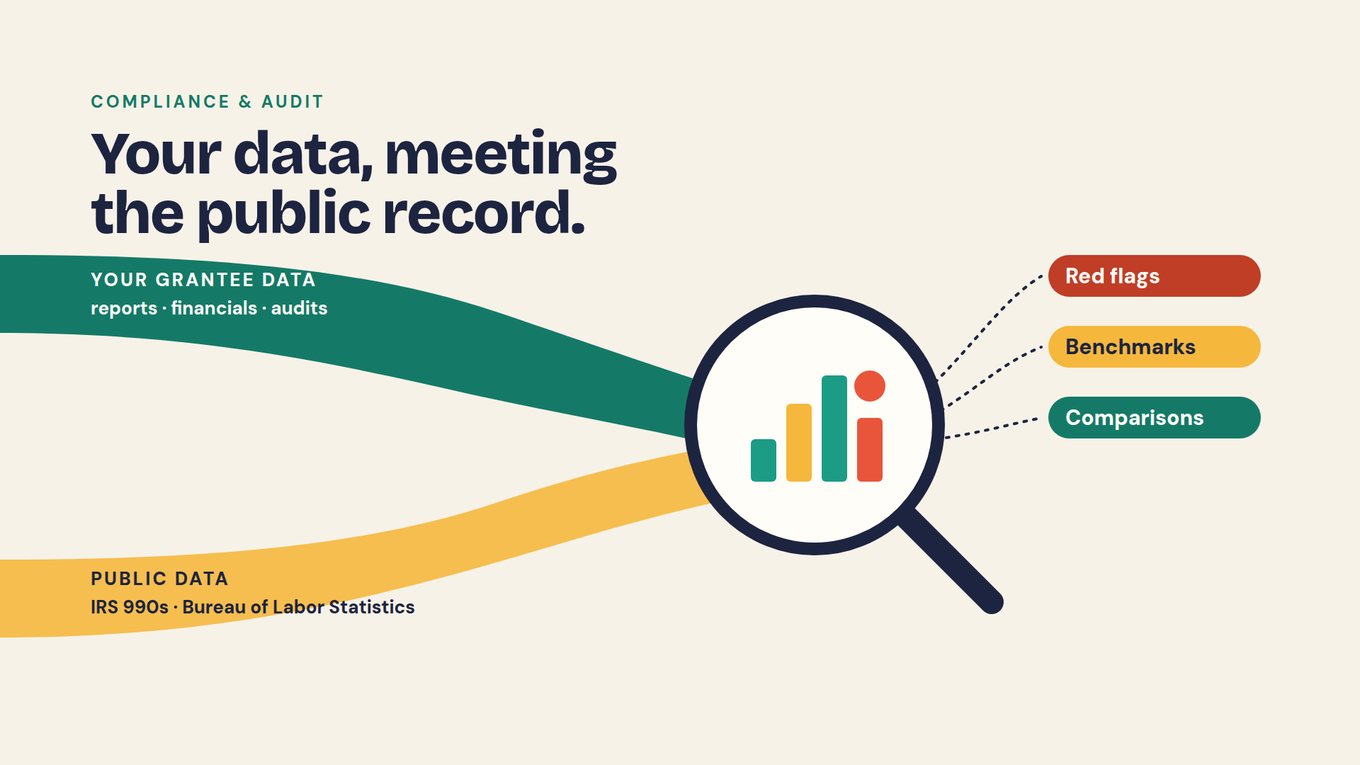
Unmesh describes this as due diligence one chat away: the documents are already read, so the board’s compliance question is asked rather than assembled from folders. Accounting connects through MCP servers or APIs, so spend against budget per grantee comes back onto the record. For the continuing record, see grant outcome tracking; for collection and review, grant reporting; and for identity, definitions and source versions, the portfolio data management guide.
Evaluate AI features with observable tests
Run every vendor through the same representative material and record whether each requirement is standard, configured, dependent on another system or unavailable. “AI-native” is a claim to test with this table.
| Feature | What to test | A useful result |
|---|---|---|
| Arrival analysis | A completed submission and a revised attachment. | Visible processing status and the correct version. |
| Eligibility support | A clear rule, an ambiguous answer and missing evidence. | The deciding evidence and a human exception path. |
| Review assistance | A criterion with conflicting passages. | A reviewable interpretation that preserves uncertainty. |
| Plain-language questions | A question across all applicants that no dashboard was built for. | An answer with the source passages, which staff can check. |
| Longitudinal context | Two applications and one approved award. | Related history without mixing decisions or permissions. |
| Report analysis | A revised target and a report from the wrong period. | A comparison against the approved commitment. |
| Portfolio reporting | A missing report and incompatible indicator definitions. | Coverage and exclusions visible beside the aggregate. |
| Operational control | A failed file, retry and staff reassignment. | No lost application, duplicate decision or hidden failure. |
| Portability | Export a completed award with its review history. | Documents, versions and rationale remain usable. |
Existing grant platforms also provide AI review. Submittable’s Smart Reviewer overview describes evaluation against configured criteria alongside the review team. A fair comparison tests the specific workflow on your material rather than assuming any platform only stores forms.
For foundation-specific administration and board requirements, continue with grant software for foundations.
Pilot one workflow while the current system keeps running
Unmesh’s advice on migration is to move one step at a time and keep the current system intact while low-risk workflows move first. Traditional grant-system implementations, he notes, take six to nine months; one application round can prove or disprove the approach, and each later step builds on the same grantee ID.
- Pick one program. A fellowship or scholarship round with a short cycle and a rubric the team already trusts.
- Fix the baseline. Record how long the last round took from intake to shortlist, with the same start and end points you will use for the pilot.
- Run review on arrival. Configure the rubric as prompts, let reviewers score from the analysis, and keep the decision with the panel.
- Measure the whole workflow. Coverage, accepted outputs, corrections, exceptions and staff hours, not only processing speed.
- Add the next cycle. Onboarding next, then grantee reporting, then compliance and the accounting connection.
Count setup, data preparation, training, corrections and ongoing administration in the cost alongside software fees, separating one-time from recurring effort. Use Sopact pricing alongside a scoped implementation discussion. Promotora Social México’s public story shows application documents, identifiers, rubric evidence and decisions brought together, with its reporting and integration work described as still being tested.
To learn the connected process, start the Grant Intelligence course; for the reporting output, use the impact report writing guide and report examples and dashboards. Expand when the team can explain the result, handle the exceptions and repeat the workflow on the next set of submissions.
Frequently asked questions
What is AI grant management software?
It is grant software in which AI reads applications, reports and documents as they arrive, scores them against the funder’s rubric and answers staff questions with sources, across the whole grant round rather than in a single feature. The tests are whether analysis happens on arrival, whether each result shows its evidence, and whether people keep the decisions. It is different from AI grant writing, which helps applicants draft proposals.
What is the difference between AI-native and AI added to an existing platform?
AI added to an existing platform usually sits on top of the configuration, as a summary button or drafting assistant, while narratives still wait to be opened and questions still end in an export. AI-native means each answer and document is analyzed as it arrives, scored against your rubric and stored on the record. Test it by submitting a real document mid-demonstration and asking a question no dashboard was built for.
Can AI decide which application receives funding?
Not in the workflow described here. AI prepares the evidence: eligibility checks, proposed criterion scores with supporting passages, and shortlists such as the ten strongest applications. Reviewers score independently, the panel moderates, and an authorized person makes and records the award. Check, too, whether a program’s rules restrict AI use at all; NIH, for example, bars it from scientific peer-review critiques.
Why start with application review?
It is where the change shows fastest. The old pattern spends two to three months configuring each cycle and two to three months of reviewers reading, re-reading and reconciling scores. Reading each application against the rubric as it arrives shortens that stretch without changing who decides. A fellowship or scholarship keeps the dollars at risk low and the cycle short, so results show within one round.
Do we have to replace our grant management system?
Not to start. Unmesh’s advice is to keep the current system running and move one low-risk workflow first, such as a single fellowship or scholarship round, then add onboarding, reporting and compliance cycle by cycle. Traditional implementations take six to nine months, while a contained pilot shows within one cycle whether the approach works. Test the handoff, permissions and record ownership before moving anything larger.
How do you measure an AI pilot?
Count received, processed, checked and accepted records separately so coverage and quality are both visible. Add material errors, unresolved exceptions, correction time and staff hours, and compare against a baseline with the same start and end points. Fast processing means little if people then spend hours reconciling failed files. Expand when the team can explain the results and repeat the workflow on the next round.