play icon for videos

Workforce Case Management Software · WIOA-Ready · Sopact

Workforce case management software for WIOA, reentry, and vocational training. One participant record from intake to placement to 12-month retention.

Updated
May 29, 2026
360 feedback training evaluation
Use Case
Workforce Case Management Software · WIOA-Ready · Sopact
The thesis · WIOA paperwork → workforce intelligence

Beyond WIOA paperwork.
One persistent participant record from intake to year-1.

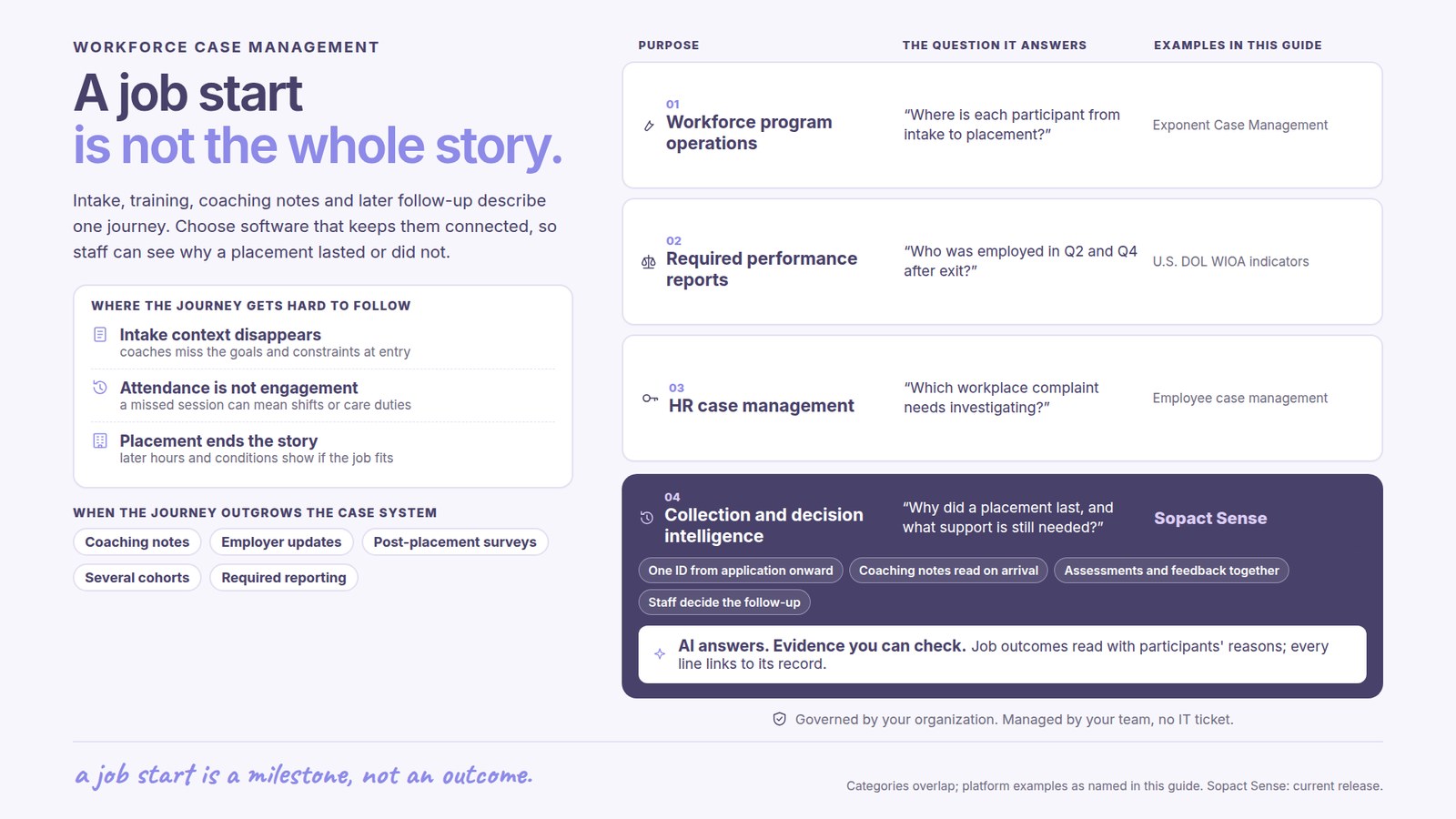
The workforce case management software your team uses was designed when the bottleneck was state MIS data entry — get the WIOA elements in, file the quarterly. That bottleneck moved.

Data entry is solved. The new bottleneck is the workflow that reads every coach case note on arrival, surfaces participant disengagement mid-cohort, and keeps one persistent participant record from intake through 12-month retention follow-up.

That is the difference between workforce case management — WIOA paperwork and the quarterly — and workforce intelligence: one persistent participant record, with placement and retention attributed back to the original training cohort.

AI without a workflow is a clever intern with no desk. The workforce teams winning with AI are the ones whose coach notes have a place to land — one record, one ID, one story.

01 · INTAKE
Eligibility & skills
WIOA eligibility, baseline skills inventory, court-referral context
02 · TRAIN
Cohort enrollment
Training cohort, credential progress, supportive services
03 · COACH
Case notes read
AI on arrival · disengagement surfaces mid-cohort
04 · PLACE
Placement
Hire date, wage, employer, position
05 · RETAIN
90-day & year-1
WIOA performance metrics · one query
Definition · for the AI-overview reader
Direct answer

What is workforce case management software?

Workforce case management software runs the full workforce-services lifecycle — eligibility intake, skills inventory, training-cohort enrollment, coach case notes, placement, and 90-day / 12-month retention follow-up — on one persistent participant record. It generates WIOA performance reports, placement rate calculations, wage-gain stats, and retention cohort reports as queries rather than as reconstructions across separate systems.

Used by:

  • WIOA Title I/II/III service providers (Adult, Dislocated Worker, Youth)
  • American Job Centers and One-Stop Career Centers
  • Workforce Development Boards (WDBs) tracking sub-recipient performance
  • Vocational and apprenticeship training providers
  • Reentry and second-chance employment programs
  • Adult basic education and HSE / GED programs
  • Sector-based training (healthcare, construction, IT, manufacturing)
Adjacent terms

WIOA software, workforce development case management, vocational case management software, reentry case management software, employment training case management, job training program software — different terms point to the same software category.

Not the same as

An LMS (Canvas, Moodle) delivers curriculum. An ATS tracks job applicants for an employer. Workforce case management software tracks the participant through the program — with placement and retention as the outcome.

The shift · why state MIS-only is breaking

The era of WIOA paperwork
as the system is over.

The workforce case management software your provider uses was designed when the bottleneck was state MIS reporting — capture the WIOA elements, file the quarterly performance report.

MIS reporting is solved. The new bottleneck is the workflow that reads every coach case note on arrival, surfaces participant disengagement mid-cohort, and keeps one persistent participant record from intake through 12-month retention follow-up. The participant is the unit of work, not the WIOA quarterly.

The era that ended

WIOA Paperwork

What replaces it

Workforce Intelligence

Coach writes case notes in Word docs; WIOA elements re-entered in state MIS overnight.
Coach writes in Sopact, AI reads on arrival, WIOA elements populate automatically.
Participant disengagement surfaces in the quarterly performance report. Already dropped out by then.
Disengagement signals surface mid-cohort — coach can re-engage before the dropout.
Placement and retention live in different systems. Year-1 retention impossible to join back to intake.
Placement, wage, and 12-month retention on the same persistent participant ID. WIOA performance is one query.
Reentry context (court referrals, RNA score) lives in a separate reentry system. Workforce coach can’t see it.
Reentry context attached to the same participant record. Workforce + reentry coordination on one record.
Cohort comparisons across years blocked by WIOA element changes between PYs.
Data dictionary versions every indicator. PY 2026 cohort comparable to PY 2024 cohort on the same definitions.

The WIOA quarterly was downstream. Now the work knows the quarterly.

From the field · Open Play Foundation

An impossible reading, caught in minutes.

For years, Open Play’s data sat in paper logs. The foundation needed real-time evidence, not a quarter-end export.

After heavy rain, Open Play’s water purification system reported it had run out of rainwater — which Marco knew was impossible. Because the figures were live, he cross-checked in minutes and surfaced a probable reservoir leak. Same logic for workforce programs: when every coach case note is read on arrival and disengagement signals surface mid-cohort, the impossible reading — the participant marked “active” but the case note describing no contact for three weeks — shows up on Tuesday, not in the WIOA quarterly.

“Those statistics that we’re now running on Sopact immediately showed me there’s something significantly wrong … things like that, we would never have been able to do in the past.”

Marco Botha, CEO, Open Play Foundation
Buyer fit · six workforce-program shapes

Six workforce shapes.
One participant record.

The funding stream changes, the credential goal changes. The participant record underneath does not.

01WIOA Title I Adulteligibility → train → place
02WIOA Title I Youtheligibility → element → outcome
03Reentry / second chancecourt referral → train → place → recidivism
04Vocational / apprenticeshipenroll → credential → journey-worker
05Adult basic ed / HSEassess → instruct → HSE earned
06Sector-based partnershipemployer demand → cohort → placement
What you collect

Intake & service data

What you report

Placement & retention

WIOA Title I Adult. Eligibility documents, skills baseline, individual employment plan.
Employment in Q2/Q4 post-exit, median earnings, credential attainment.
WIOA Title I Youth. 14 program elements, education status, occupational skills training.
Placement in education, employment, or military; credential attainment.
Reentry / second chance. Court referral, RNA score, sentencing, supervision context.
Recidivism at 6/12/24 months, employment at placement, wage retention.
Vocational / apprenticeship. Cohort enrollment, instructor notes, credential progress, supportive services.
Completion rate, journey-worker placement, retention at 12 months.
Adult basic ed. Baseline TABE/CASAS, instructional hours, gain assessments.
Measurable skill gains, HSE attainment, post-secondary transition.
Sector partnership. Employer demand, cohort curriculum, work-based learning.
Placement with partner employer, wage at placement, employer satisfaction, retention.
The record continues · intake to year 1

Same participant ID. Five moments.
WIOA performance as one query.

In legacy workforce software, placement and retention live in different systems. In workforce intelligence, the record continues on the same persistent participant ID.

01Intake
Eligibility & skills
  • WIOA eligibility
  • Skills inventory
  • RNA (reentry)
  • Persistent ID assigned
02Plan
Individual employment plan
  • Training cohort
  • Placement goal
  • Supportive services
  • Service plan signed
03Train
Coach & cohort
  • Case notes read
  • Disengagement flagged
  • Credential progress
  • Mid-cohort drift signals
04Place
Job placement
  • Hire date
  • Wage at placement
  • Employer
  • Position type
05Retain
90-day & year-1
  • Q2 post-exit employment
  • Q4 median earnings
  • 12-month retention
  • WIOA performance ready
1 ID

One persistent participant ID carries every intake, coach note, training milestone, and retention check from intake through year-1 follow-up.

Compared to legacy workforce vendors

How Sopact compares to
Salesforce, ETO, mWorkforce, Geographic Solutions.

Most workforce evaluations include the state-mandated MIS plus a case-management overlay. Each was built for compliance.

Capability
Sopact
Salesforce Vlocity
Bonterra ETO
mWorkforce
Geographic Solutions
AI reads coach notes on arrival
Yes · native
Einstein add-on
No
No
No
WIOA performance metrics
Yes
Custom build
Yes
Yes · native
Yes · native
Reentry RNA & recidivism
Yes
Custom build
Custom build
Limited
Limited
One participant ID intake to year-1
Yes
Yes
Per program
Yes
Yes
Disengagement signals mid-cohort
Yes
Workflow rules
Workflow rules
Limited
Limited
Citation trail to source paragraph
Yes
No
No
No
No
Mobile / offline note capture
Yes
Limited
Limited
Limited
Limited
Configuration in natural language
Yes
No
No
No
No
Encryption, RBAC, audit logging
Yes
Yes
Yes
Yes
Yes
Time to first cycle live
Days
6–12 months
3–6 months
3–6 months
3–6 months
How to read this table

State-mandated MIS like Geographic Solutions or mWorkforce ship with WIOA elements baked in. Sopact often runs alongside as the AI reading layer — the state MIS owns compliance; Sopact owns the coach-note intelligence.

Pricing · by complexity, not by participant count

Sopact prices by the complexity
of what you actually run.

No per-seat tax. No per-participant meter. The line items are the things that drive work.

What every deployment includes
1

Custom data dictionary

WIOA elements, your training cohort schemas, credential codes, placement outcomes.

2

Built-in Sopact skills for workforce

Coach Note Reader, WIOA Performance Tagger, Disengagement Detector, Placement Tracker, Retention Cohort — turned on by default.

3

Form, banner, and report design

Logo, color palette, intake form styled to your program. Employer-facing pages match your identity.

4

Mixed-method auto-indicators

Closed-ended WIOA fields and open-text coach notes scored together with citation trails.

5

Definitive reporting

WIOA quarterly performance, placement reports, wage-gain stats, retention cohorts, recidivism tracking — one query each.

What scales the complexity
Programs

Number of programs sharing one participant

WIOA Title I only is simplest. Title I + Reentry + Adult Ed sharing one participant adds dictionary depth.

Cohort cadence

One cohort per quarter is simplest. Multiple parallel cohorts with cross-cohort drift comparison adds depth.

Field depth

Office-based intake is simplest. Field coaches and home visits with offline sync adds infrastructure.

Custom skills

Built-in skills cover common patterns. Sector-specific (healthcare, construction, IT) or state-specific WIOA modifications compose.

Longitudinal depth

12-month retention is light. 3-year recidivism (reentry) or year-3 wage retention adds depth.

MIS integration

Standalone is simplest. Running alongside Geographic Solutions or mWorkforce as the AI reading layer adds integration.

Days
Time to first WIOA-aligned cohort live
1 ID
Persistent participant ID from intake to year-1 retention
1 query
WIOA quarterly performance report
100%
Coach notes read on arrival
Pricing in one line

A small WIOA Title I provider with one cohort pays less than a multi-program federation running Title I + Title II + Reentry + apprenticeship. Talk to us with your program list; we will quote against it directly.

Security · controls we provide, named honestly

Encryption, RBAC, audit logs.
Enterprise-grade AI under SLA.

Workforce participant data is sensitive — especially in reentry where criminal-justice information rules apply.

Encryption

At rest and in transit

AES-256, TLS 1.3, encrypted backups.

Access & audit

Role-based, fully logged

Field-level RBAC, SSO, MFA, audit trail.

AI under SLA

No training-data retention

Enterprise SLAs, no training-data retention.

On HIPAA, FERPA, criminal-justice information, and regulated regimes

Sopact is not currently HIPAA-certified or covered by a Business Associate Agreement (BAA). Reentry programs subject to criminal-justice information system (CJIS) rules, workforce programs touching educational records (FERPA), or programs handling health information should evaluate these controls against their own compliance program.

Stage 05 · four workforce-report shapes

Four report shapes,
tied to workforce programs.

Reports are questions. Workforce programs produce four distinct shapes.

Missing

Incomplete WIOA documentation

Eligibility documents missing, follow-up not completed, credential not entered, placement not verified.

Unusual

Cohort drift signals

Disengagement rate spiking, placement rate dropping, wage-at-placement declining, retention falling.

Comprehensive

One participant’s journey

Intake through 12-month retention, with every coach note, credential, and placement event. Two-click drill-down.

Aggregate

WIOA quarterly & funder reports

WIOA Q1–Q4 performance, placement rates, median earnings, 12-month retention, recidivism cohorts — all queries.

What makes it unique · four properties

Four properties a state MIS
or LMS cannot offer.

Strip away the marketing and four properties separate workforce intelligence from everything before it.

1

Definitive AI — same input, same answer

For WIOA performance reporting a federal monitor will scrutinize, variance is disqualifying.

2

One participant ID intake to year-1

Placement at 90 days and 12-month retention on the same persistent record as the intake assessment.

3

Disengagement signals mid-cohort

The coach sees who’s drifting toward dropout before the WIOA quarterly closes, with citation trail to the supporting note.

4

Enterprise-grade security controls

Encryption, role-based access, no training-data retention, complete audit trail.

Buyer fit · by program complexity

From small WIOA providers
to multi-program federations.

The architecture is the same; the configuration scales with the program portfolio.

Small · one program

Single WIOA Title

15-staff WIOA Title I Adult provider. Live in a week.

WIOA Title Ivocationalapprenticeship
Medium · multi-program

Title I + Reentry + Adult Ed

30-staff provider with multiple programs. Same participant across Title I and reentry. Cross-program disengagement signals.

Title Ireentryadult ed
Large · WDB / state association

Multi-site federation

Workforce Development Board overseeing sub-recipients, multi-site, state MIS integration, federation reporting.

WDBmulti-sitestate MIS
Common questions

Asked, answered, on the page.

Ten questions that come up in nearly every workforce CM evaluation.

Q1What is workforce case management software?
Workforce case management software runs the full workforce-services lifecycle — eligibility intake, skills inventory, training cohort, coach notes, placement, and 90-day / 12-month retention.
Q2What is the best case management software for workforce development?
The best software (1) supports WIOA performance metrics out of the box, (2) keeps one persistent participant ID intake to 12-month retention, (3) generates placement/wage reports as queries, and (4) reads coach notes on arrival.
Q3Does Sopact support WIOA Title I/II/III performance reporting?
Yes. Sopact supports WIOA performance reporting elements — credential attainment, measurable skill gains, employment in Q2/Q4 post-exit, median earnings — as queries against the persistent participant record.
Q4What is the best software for reentry case management?
For reentry, the best software (1) handles court-referral context and risk-needs assessment, (2) supports field navigators with offline note capture, (3) tracks recidivism on the same participant ID as the training record, and (4) reads case notes on arrival.
Q5How is Sopact priced for workforce programs?
Sopact pricing is based on the complexity of the use case, not seat counts or participant volume.
Q6What security controls does Sopact provide?
Sopact provides AES-256 encryption, TLS 1.3, role-based access, SSO, MFA, audit trail. AI under enterprise SLAs with no training-data retention. Sopact is not currently HIPAA-certified or covered by a BAA; reentry programs subject to CJIS or FERPA should evaluate these controls.
Q7How does AI improve workforce case management?
AI reads every coach case note on arrival and tags themes against the service plan, training cohort, and placement goal. Risk signals (attendance drops, disengagement) surface to the supervisor in real time.
Q8Can workforce case management software track placement longitudinally?
Yes — when the platform is built around one persistent participant ID. Placement, wage at placement, employment in Q2/Q4 post-exit, and 12-month retention all live on the same participant record.
Q9What about Salesforce vs ETO vs mWorkforce?
Salesforce Vlocity is enterprise-flexible but requires significant integrator time. Bonterra ETO is closer out of the box. mWorkforce and Geographic Solutions are state-mandated MIS in many states. None read coach notes on arrival.
Q10What questions should I ask before buying workforce case management software?
Six questions: (1) Are WIOA elements supported out of the box? (2) Does the same participant ID survive from intake to year-1 retention? (3) Is the WIOA quarterly one query or a reconstruction? (4) Can field coaches write notes offline? (5) Do disengagement signals surface mid-cohort or only at year-end? (6) When the federal monitor asks why this outcome, is the supporting note two clicks away?
Where workforce sits in the bigger story

Workforce is one shape
of case intelligence.

Sopact treats workforce as one of six case-intelligence shapes — with WIOA-aligned configuration and field-first design.

Umbrella
Workforce is one of six case shapes.
Use case
Year-1 retention joined to year-0 intake on one participant ID.
Use case
Coach notes read on arrival; disengagement surfaced mid-cohort.
Use case
Pre/post training assessments tied to placement outcomes.
Use case
Workforce within a multi-program nonprofit portfolio.
Engine pillar
Every participant on one record.

Bring your last WIOA quarterly. Sixty minutes is enough.

One WIOA quarterly performance report, one cohort of coach notes, your placement and retention data. We’ll walk through how Sopact would read the notes on arrival, surface disengagement signals, and produce the next quarterly as one query.

Book a 60-minute working sessionFormat · 60 min · with Unmesh Sheth