play icon for videos

Outcome Tracking Software for Nonprofit Programs

Outcome tracking software follows whether participants are improving, not just attending. Sopact reads every caseworker note, survey, and check-in on arrival - and flags the participant whose outcome is at risk.

Updated
May 22, 2026
360 feedback training evaluation
Use Case
Outcome tracking software · The note that goes unread

Your caseworkers already wrote down who’s at risk.

Sopact reads every caseworker note, intake form, and check-in the day it arrives. It flags the participant whose outcome is slipping — while there is still a term left to change it. It is built for the program teams who are paid to catch that, not to file a report once the year is over.

Day 1 The AI reads each note the day it lands
Week 1 First at-risk participants surfaced
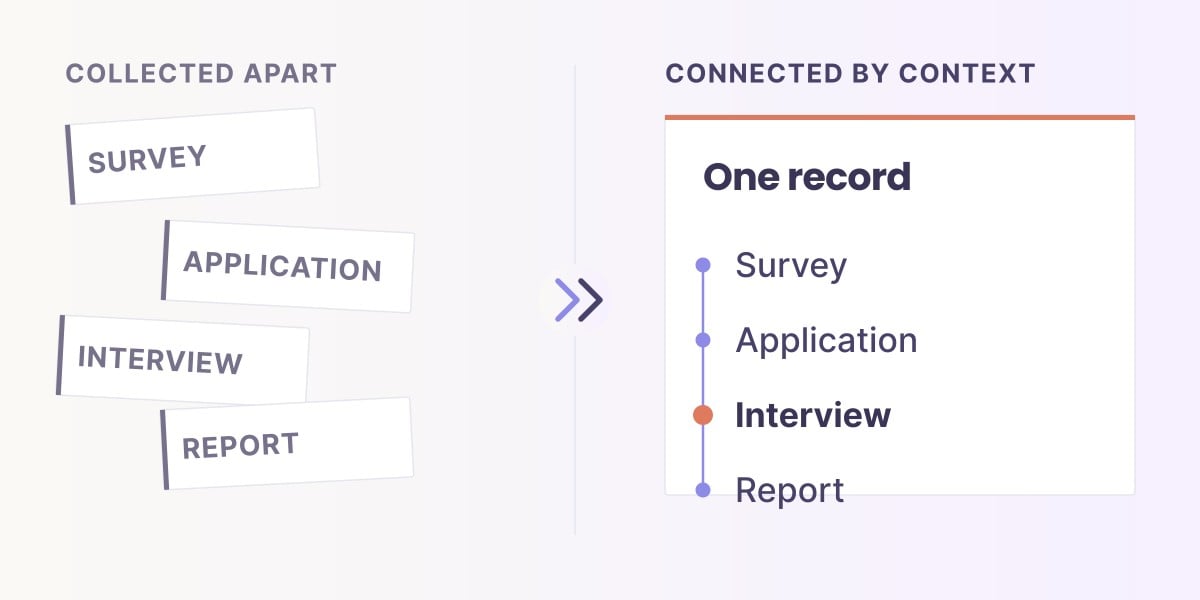
1 record Every note and survey, per participant
2014 Sopact building for this work since
The short answer

What is outcome tracking software?

The short answer

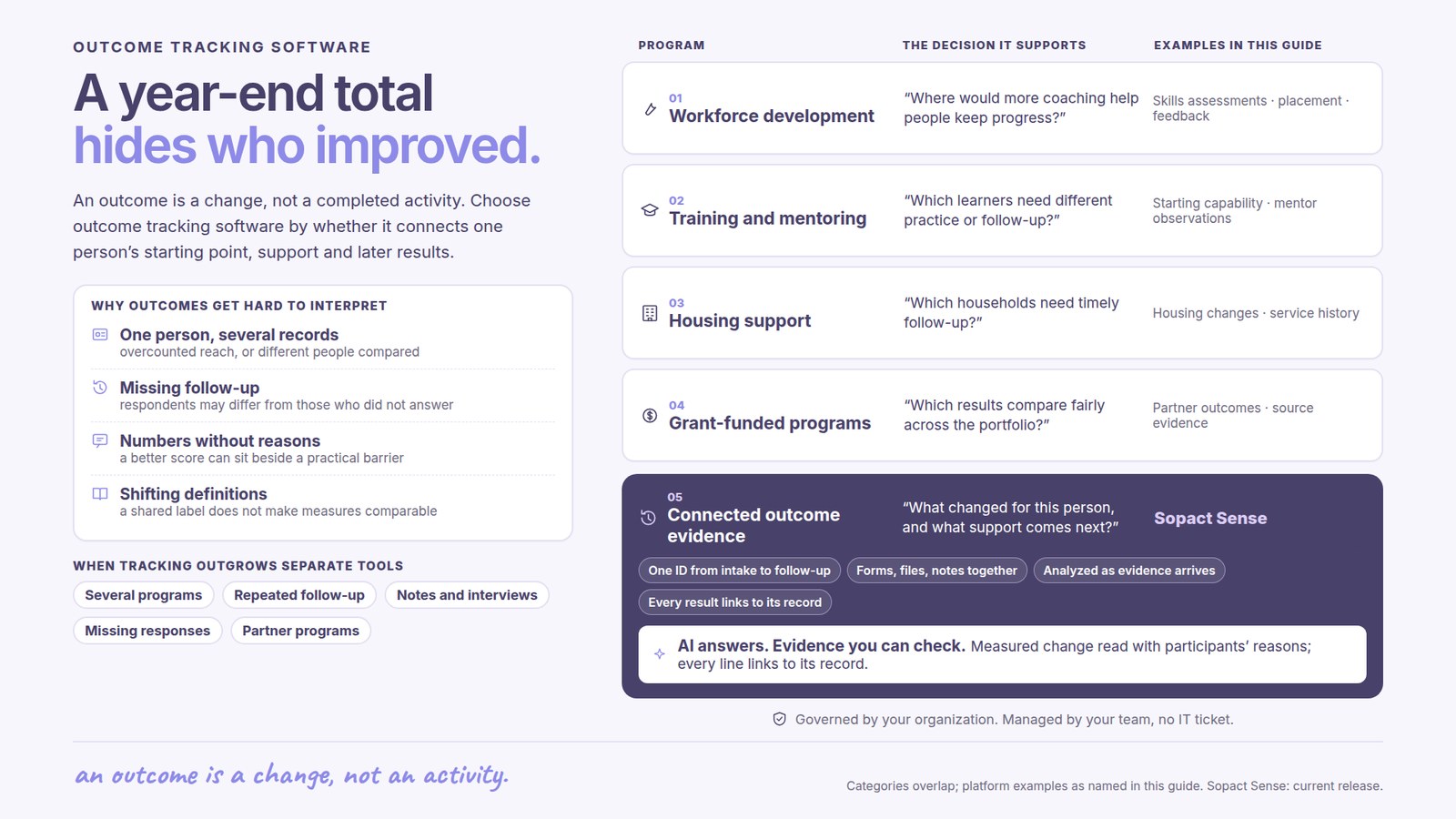
Outcome tracking software is the system a nonprofit or direct-service program uses to follow whether participants are actually improving — not just whether they attended. The weak version records the structured fields and leaves the caseworker notes, open-ended answers, and check-ins unread. The strong version reads every note and survey on arrival, ties it to one record per participant, and surfaces who is at risk while there is still time to act.

Attendance tells you a participant showed up. An outcome tells you whether anything changed. Software that only counts the first is a roster, not an outcome tracker.

Where the signal lives

Six places an outcome shows up — and the two your software reads

A participant’s progress is recorded in six places over a program year. Most outcome tracking software reads the two that are already numbers. The other four — where the early signal of trouble actually sits — are stored and never opened.

Source 01 · Read
The intake form

Age, school, household, referral reason. Captured cleanly and read reliably — the part of the record that was never the problem.

Source 02 · Read
Attendance & sessions

Who came, how often, to which session. Counted accurately. It tells you a participant is present — not whether the program is working.

Source 03 · Unread
The caseworker note

“Helped interpret the teacher’s instructions today — more settled than last term.” The richest signal in the file. Filed as text, almost never read across the caseload.

Source 04 · Unread
The open-ended answer

The survey question that is not a number — what felt hard, what changed, what the participant would tell a friend. Exported, then skipped.

Source 05 · Unread
The mid-point check-in

The quiet conversation halfway through, where a participant first mentions the thing that will pull them off course. Written down, rarely revisited.

Source 06 · Unread
The exit reflection

What the year meant, in the participant’s own words. The qualitative outcome a board actually asks about — and the one a number field cannot hold.

Where the risk hides

The four unread sources are not the soft data. They are where a participant first signals they are slipping — weeks or months before it shows up in attendance. Outcome tracking software that reads only the two numeric sources is reading the program after the fact.

What the software is asked to do

Outcome tracking is six jobs. Most tools do two.

The categories of software a program assembles are each good at their own job. The trouble is the jobs in the middle that no single tool in the stack owns.

The job What most programs use Where it stops With Sopact
Record the participant A case management system — Apricot, Penelope, Salesforce NPSP, Sumac Stores contacts, services, attendance — activity, not outcome One record per participant, structured and narrative on the same timeline
Ask the questions A survey tool for pre and post questionnaires Each round is a separate export with no link to the last Intake, mid-point, and exit tied to one Persistent Contact ID
Link the rounds A spreadsheet, matched by name or email A reconciliation nobody fully trusts — the at-risk participant is lost in the merge Deduplicated at the source; every note links to the right record
Read the notes Nothing — the notes sit in the case file The richest signal in the program is never analyzed across the caseload The AI reads every note and open answer against your outcomes, on arrival
Spot who is at risk A caseworker’s memory, one participant at a time Visible only to the worker who wrote it — invisible to the program A standing risk view across the whole caseload, updated as notes land
Report to the funder A dashboard, assembled by hand from three systems Weeks per cycle, on data already months old Generated from the live record — every figure traceable to a source note

This is the outcome-tracking stack most direct-service programs inherit. The cost is rarely the licences. It is the analyst hours the handoffs require every cycle — and the at-risk participant who is missed in between. Product names are trademarks of their respective owners.

The big picture

Outcome tracking was built for the case-management era

For thirty years, the software a direct-service program ran was a case management system, and it did one job well: it recorded what happened. A contact, a service, a session, an attendance mark. That was the right design for an era when the question a funder asked was “how many did you serve.” The system tracked activity, because activity was what had to be proven.

But knowing a participant attended is not knowing a participant improved. The outcome — the confidence, the resilience, the path out — was always recorded too, in the caseworker’s notes and the open-ended answers. It was just never read. The case management system stored that text as an attachment and moved on. The signal that a participant was slipping sat in a file, in plain language, and nobody had the hours to read it across a caseload of hundreds.

Bolting AI onto that era does not fix it — it usually makes it heavier. A configured case management system already charges for every workflow change and carries a long implementation; adding an AI summary on top adds another layer to maintain and another migration to survive. The shift that matters is not a feature. It is moving the reading to the front: an outcome is read the moment the note lands, not assembled from an export a year later. The case-management era tracked what happened. The work now is to read it in time to change it.

The honest version

This page does not argue case management systems are bad — they are good at the records job they were built for. It argues that recording activity and reading outcomes are two different jobs, and that a program needs the second one done on arrival, not bolted on at the end.

What Sopact does differently

It reads the note the day it lands — and routes the next move

Sopact is a risk-intelligence layer that reads what a program already collects. It does not replace the case management system that holds the records. It reads the material that system stores and never interprets — the caseworker notes, the open-ended survey answers, the intake interviews, the check-ins — and it does the reading against the outcomes the program defined, the moment each one arrives.

Three things happen on every record, in order. None of them waits for the end of the year.

1
Read on arrival

Every caseworker note, survey answer, and check-in is read against your outcomes the day it lands — in any language it was written in, tied to one Persistent Contact ID. Nothing is filed unread.

2
Score against your outcomes

The AI scores each record on the outcomes you defined — confidence, resilience, engagement, the path the program is built to move — and keeps the source sentence behind every score. The story sits beside the number.

3
Route the action

A standing risk view shows which participants are slipping, across the whole caseload. The program pairs a struggling participant with a different mentor, or flags a check-in — while there is still a term left to act, not a report to write.

Why reading on arrival is the difference

A case file read at year end is a record of what happened. A note read on arrival is a chance to change what happens next. The same caseworker note is either evidence or an intervention — the only variable is when it gets read.

AI in outcome tracking

What AI changes — and the question that separates the real ones

AI in outcome tracking is worth being precise about, because the label is now on almost everything. Two paragraphs, then the test.

What AI genuinely changes is the cost of reading open-ended responses and caseworker notes against a defined set of outcomes — the work a consultant once did by hand over weeks. Done well, it collapses the gap between when a note is written and when its meaning is known. That is the single change that makes a continuous outcome view possible at all.

What AI does not change is where the reading has to sit. There is a real difference between asking a general AI to summarize an export and a platform reading each record against your framework on arrival. Run the same caseload through a chat window twice and the scores drift — a four one day, a three point eight the next — because nothing holds the definitions still.

An open AI window, on the export

You paste the spreadsheet into a chat window and ask for the themes. It works — once. There is no fixed definition of what “confidence” means, no link between this round and the last, and no source sentence behind the score. Ask again next month and the answer has moved, because nothing held it in place.

Answer drifts No locked outcomes No participant link Re-done by hand each round

Sopact, reading on arrival

The outcomes are defined once and held. Every note is read against that same definition, tied to the same Persistent Contact ID, with the source sentence kept behind every score. Ask the same question in March and in June and the method is identical — what changed is the participant, not the ruler.

Locked answer Outcomes defined once One record per participant Cited to the source note
The one question to ask

Ask any AI outcome tool: run the same caseload twice, a month apart — does the score hold, and can you see the sentence behind it? A locked answer is an outcome you can defend. A drifting one is a guess with a confidence interval.

Who it is for

Built for programs where the outcome lives in a note

Youth development, human services, community programs — different funders, different participants, the same shape: a person supported over a long span, by a caseworker whose notes hold the real signal.

Youth development
After-school & mentoring programs

A participant supported from primary school to graduation, across a changing caseworker each year. The outcome — confidence, resilience, staying on a path — is written in notes, not numbers.

Time

A new caseworker reads a participant’s full history in minutes, not by leafing through a paper file.

Money

The annual funder report builds from the record — no scramble, no outsourced coding cycle.

Risk

A participant drifting toward dropout is flagged in week one, while a mentor change can still change the year.

Human services
Family & case-managed support

Long case files, heavy caseloads, and a documentation tax that grows every year. The early sign that a family is destabilizing is in the case note, read by one worker.

Time

Caseworkers spend the hour on the participant, not on re-keying notes into a reporting system.

Money

One layer reads what the case management system already stores — no second data team to staff.

Risk

A destabilizing case is visible to the program, not only to the worker who happened to write the note.

Community programs
Place-based & multi-site work

Several sites, several languages, one set of outcomes. The signal of what is working at one site is buried in notes the central team never reads.

Time

Every site’s notes land on one structure — the cross-site view is read, not assembled.

Money

The board report is generated once from the live record, in the languages the notes arrived in.

Risk

A site quietly underperforming is caught from its own notes, not from a year-end audit.

The same shape, different labels

A youth mentoring nonprofit, a family services agency, and a multi-site community program all run the same loop: a participant, a caseworker, a note. They differ on the funder’s template and the number of sites — not on where the outcome hides, and not on what it costs to miss it.

How to choose

Start from the note that goes unread, not a feature list

Most outcome tracking software searches start with the wrong question. “Which platform should we buy” returns a shortlist of case management systems and dashboards that all demo well. The useful question is narrower: walk one participant from intake to exit, and find the seam where the work stalls.

If the same participant scatters across survey rounds with no reliable link, the gap is persistent identity — and the fix is one record per participant, not a faster survey. If caseworker notes and open-ended answers pile up unread, the gap is qualitative analysis — and the fix is software that reads text, not one that stores it. If the funder report takes weeks of assembly, the gap is a report that does not build from the record. And if a participant’s decline is always noticed late, the gap is that nothing reads the caseload — only individual workers do.

That diagnosis decides whether you need a better single tool or a different layer over the whole process. A program that skips it buys a faster version of the case management system it already had — and the note that held the signal is still sitting unread, in exactly the same place.

The test

Take one caseworker note from three months ago that, in hindsight, showed a participant starting to slip. Ask of any tool you are evaluating: would this have surfaced that note in time? If the answer is “only if someone went looking,” it tracks activity, not outcomes.

Go deeper

Outcome tracking runs the program. Impact measurement proves it to the funder.

This page is the program-team view — reading the notes, spotting the participant at risk, acting while there is still time. The impact measurement guide is the next step: how the evidence that tracking produces becomes a defensible answer to the question a board and a funder ask — what changed, for whom, and how do you know.

Every caseworker note read against your outcomes, in any language
One Persistent Contact ID — intake to exit, on a single record
A standing risk view, not a report written a year too late
FAQ

Outcome tracking software, answered

What is outcome tracking software?+

Outcome tracking software is the system a nonprofit or direct-service program uses to follow whether participants are actually improving — not just whether they showed up. The weak version records structured fields and leaves caseworker notes, open-ended responses, and check-ins unread. The strong version reads every note and survey the day it arrives, links it to one record per participant, and surfaces who is at risk while there is still time to act.

What is the difference between outcome tracking and outcome measurement?+

Outcome measurement is the one-time act of scoring whether a result occurred — often at the end, for a report. Outcome tracking is continuous: it follows each participant across intake, mid-point, and exit, so a decline is visible while the program can still respond. Measurement produces a number for a funder. Tracking produces a signal for a caseworker. A program that needs to change outcomes, not only report them, needs the second.

What does outcome tracking software do that a case management system does not?+

A case management system records contacts, services, and attendance — it is built to track activity. It rarely reads the caseworker’s narrative note, the open-ended survey answer, or the intake interview. That unread text is where the early signal of a participant falling behind usually lives. Outcome tracking software, done well, reads that text against your defined outcomes and turns it into a risk signal, rather than storing it as an attachment nobody opens.

What are examples of outcome tracking software?+

Programs usually assemble outcome tracking from several tools: a case management system such as Apricot, Penelope, Salesforce NPSP, or Sumac for records and attendance, a survey tool for pre and post questionnaires, a spreadsheet for matching participants across rounds, and a dashboard for the funder report. Each covers part of the job. An integrated outcome tracking platform such as Sopact does the part the stack skips — reading the open-ended responses and notes against the outcomes, on arrival. Product names are trademarks of their respective owners.

What is the best outcome tracking software for nonprofits?+

The best fit depends on where the current process breaks. If participants scatter across survey rounds with no reliable link, the gap is persistent identity. If caseworker notes and open-ended answers pile up unread, the gap is qualitative analysis. If the funder report takes weeks to assemble, the gap is a report that builds from the record. Sopact is built for the third and fourth of those, and is designed to be run by the program team rather than a dedicated analyst.

Can outcome tracking software track participant outcomes longitudinally?+

Longitudinal tracking depends on one thing: a persistent identifier that ties every form, note, and survey to the same participant across years. Many tools treat each survey round as a fresh export, so the link is rebuilt by matching names or emails — a reconciliation nobody fully trusts. Sopact assigns a Persistent Contact ID at intake, so a participant met at age eight and again at seventeen is one record, and the change over that span is readable.

How does AI help with outcome tracking?+

AI changes the cost of the most expensive step: reading open-ended responses and caseworker notes against a defined set of outcomes. Work that once took a consultant weeks of manual coding now runs in minutes, and re-runs every time new data arrives. The distinction that matters is when the AI runs. AI applied to the final export only speeds up the report. AI applied on arrival reads each note as it lands and flags the participant at risk in week one, not at year end.

Does outcome tracking software replace our case management system?+

Not necessarily. Many programs keep the case management system they have for records, scheduling, and compliance, and add outcome tracking as the layer that reads what that system collects but never interprets — the notes, the narratives, the surveys. Sopact is designed to run alongside an existing system rather than force a migration. The question to ask is not which system stores the data, but which one reads it against your outcomes.

How is outcome tracking software different from a survey tool?+

A survey tool collects responses and ends its job when the response is submitted. It does not link rounds, read the open text, or tell you which participant is slipping. Outcome tracking software treats the survey as one input among several — intake forms, caseworker notes, check-ins, attendance — and reads all of them against the outcomes you defined. The survey asks the question. Outcome tracking keeps the answer current.

How much does outcome tracking software cost?+

Pricing ranges widely, from per-seat case management licensing to integrated platforms quoted on request; confirm current figures with each vendor, since pricing changes. The more useful question is total cost. A stack of single-purpose tools carries a hidden cost in the analyst hours spent matching participants and assembling reports every cycle, plus the change-request tickets a configured case management system charges for each workflow edit. Compare what each option leaves your team doing by hand.

Can outcome tracking software track qualitative outcomes alongside quantitative metrics?+

This is the gap most tools leave open. Numbers served and attendance are simple to count; confidence, resilience, and trust show up in stories and caseworker notes, not in a number field. Sopact reads the qualitative evidence — the narrative, the interview, the open-ended answer — against the same outcomes as the quantitative metrics, and puts the story beside the number on one participant record. The result a board and a funder ask about is usually the qualitative one.

What outcome tracking software works for human services and youth programs?+

Human services, youth development, and community programs share a shape: a participant supported over a long span, by a caseworker whose notes hold the real signal, against outcomes that are mostly qualitative. The tooling problem is the same — the notes go unread and the decline is seen late. Outcome tracking software fits when it reads those notes against the program’s outcomes. Sopact is built for exactly that pattern, across youth, human services, and community settings.

How do I choose outcome tracking software?+

Start from where your current process breaks, not from a feature list. Walk one participant from intake to exit and find the seam where the work stalls. If the same person scatters across survey rounds, the gap is identity. If caseworker notes pile up unread, the gap is qualitative analysis. If the report takes weeks, the gap is a report that generates from the record. The diagnosis decides whether you need a better single tool or a different layer over the whole process.

Product and company names referenced on this page are trademarks of their respective owners. Information is based on publicly available documentation as of May 2026 and may have changed since. To suggest a correction, email unmesh@sopact.com.