


Related solution
Case Management
Connect participant context with notes, feedback and program understanding.
Explore the solution →

USE CASE / SOFTWARE GUIDE
Case management software helps service teams organize intake, assessments, case plans, notes and follow-up around the people they support. Good software makes the current situation understandable to the next staff member, keeps agreed actions visible and connects the service history with the participant’s progress.
The difficulty is more than storing a case file. A person may return in another year or receive support from several programs. Notes explain circumstances that a form misses, while outcome surveys may arrive after a case closes. When these records remain separate, staff reconstruct the history repeatedly and managers learn about recurring needs only during reporting.
AI now helps with documentation, summaries and analysis across several case-management platforms. Sopact focuses on connected program evidence: bringing forms, files and feedback together, analyzing new information as it arrives and making that analysis usable through AI Assistance for follow-up and program decisions.
Understand the participant’s history and recent changes.
Read feedback alongside assessments and service evidence.
Explain progress using the same evidence staff work with.
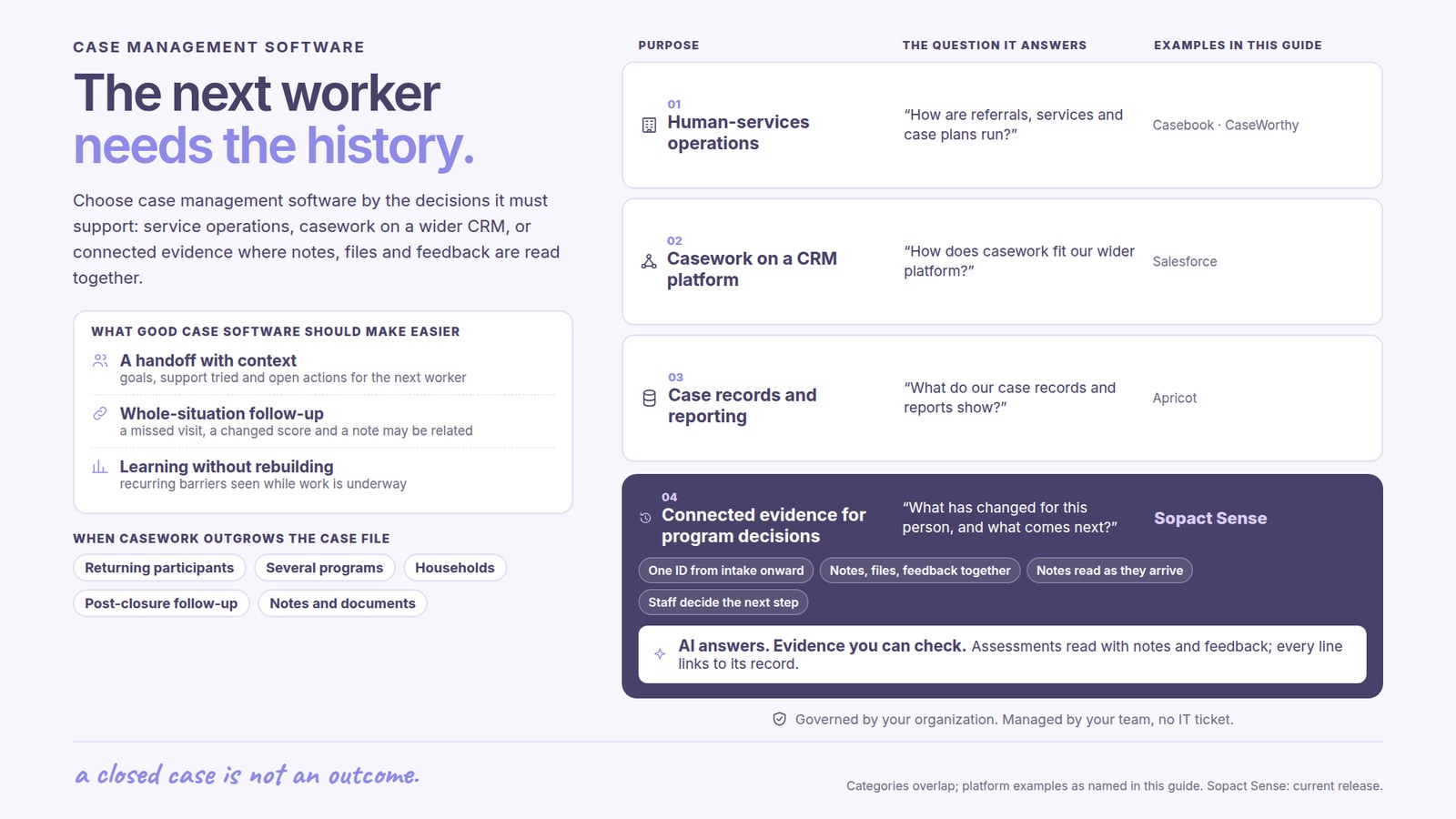
A new worker needs more than a list of encounters. They need the participant’s goals, the support already tried, recent observations and outstanding actions. A useful record reduces repeated explanation while leaving room for the participant to correct or update the account.
A missed appointment, a changed assessment and a new concern in a note may be related. Seeing them together helps staff decide what to ask next. The value is a more informed response, not an assumption that the system can infer the right action from a score.
Casework contains information about recurring barriers and the support people find useful. When that evidence can be examined across a program, managers can adjust delivery while work is underway. Reporting then draws from the same evidence rather than becoming the only time anyone analyzes it.
Organizations coordinating referrals, services and case plans need the operational workflow to fit their responsibilities. Casebook describes configurable intake, assessments and reporting across programs. CaseWorthy addresses broader human-services workflows. These are relevant starting points when operational case administration is the main purchase.
Some organizations want casework connected with a wider institutional platform. Salesforce Nonprofit Cloud includes case plans, referrals, participant profiles and repeated assessments. Apricot combines nonprofit records and reporting with AI-assisted capabilities. Their scope extends beyond storing contacts or producing reports.
Sopact’s emphasis is understanding the participant and program evidence together. It is relevant when staff repeatedly read and combine notes, assessments, files and feedback to answer practical questions. Where an existing system already handles specialist administration, define whether the evidence workflow should complement it or whether a broader replacement is appropriate.
For a researched shortlist by purpose, see case management software options for nonprofits. Healthcare, legal practice and other specialist settings can have different operational requirements; a general program guide should not be treated as a universal shortlist.
One person can have several enrollments, receive different services and return after a long gap. A household can include several people with different needs. Connecting these relationships should preserve the distinctions: a new enrollment is not automatically a new participant, and support for one household member is not evidence of an outcome for everyone.
This matters when staff interpret change. A current note should remain associated with the relevant time and program, while an old assessment should not silently become the person’s present condition. Closing one case may complete an administrative task without ending the need for later outcome follow-up.
Sopact’s public product documentation describes related forms and analysis of written responses and PDFs. Within an agreed program workflow, that connection allows earlier context to remain useful when new evidence arrives. The longitudinal data collection guide explains repeated collection in more detail.
A note summary reduces reading time. Continuing analysis can do more: it makes incoming observations available for questions alongside earlier assessments, feedback and files. Staff can examine the evidence relevant to a current concern without first producing a new export and analysis brief.
In Sopact, analysis becomes available as data arrives in the configured workflow. AI Assistance can help staff explore that connected evidence, with original sources available for closer review. For a training participant, this might mean considering a mentor’s new observation alongside the learner’s initial goals and recent feedback before the next conversation.
At program level, the same approach can help examine recurring barriers or different experiences across participant groups. Staff can move between the pattern and the accounts behind it. Qualitative analysis adds explanation to quantitative results; it does not turn an observation into a proven cause.
The practical distinction is the work removed between receiving information and using it. Note capture, summaries, participant context and cross-program analysis each serve a purpose. Judge the system by the decisions it supports and the preparation it reduces, with people retaining responsibility for action.
A data dictionary explains what the organization means by the information it collects. In casework, terms such as “enrolled,” “service completed,” “case closed” and “outcome achieved” can otherwise mean different things to different teams.
For example, a workforce program might define a completed training session separately from completion of the whole course. Employment status should have an observation date and a stated source. A missing follow-up is an unknown result, not evidence that someone remained unemployed. These distinctions make program totals easier to explain.
Shared definitions help AI analysis as well as reporting because they provide the context in which a question should be interpreted. Program-specific detail can remain alongside common measures. The aim is to preserve meaning as information moves from an individual record to a program or portfolio view.
The Girls Inc. of Metropolitan Dallas implementation addresses records spread across programs and fiscal years. Its design connects attendance, assessments and qualitative feedback around the same participant, with staff access and privacy included in planning.
The intended benefit is a history that grows with the participant, making relevant evidence easier for staff to find and interpret. This is an ongoing implementation example, not a claim that software alone has already improved participant outcomes.
Sopact’s typical setup estimate is two days to two weeks for an agreed scope. The initial program, existing records and required analysis should be clear before work begins. Complex historical migration, external systems and specialist requirements need their own scope discussion.
The daily benefit comes from staff being able to use incoming evidence without waiting for a periodic analysis project. The continuing benefit comes from preserving program knowledge as staff, forms and reporting requirements change.
Sopact’s approach combines self-governance with personalization and ongoing team support. Your team manages its data and questions, with support as the program evolves. Select software around the service decisions and participant understanding it should improve, then ensure the operational responsibilities are covered.
Case management software organizes intake, assessments, plans, notes and follow-up around people receiving services. Good software helps staff understand the current situation and use the history to coordinate support.
Contact management keeps information about a person or organization. Case management adds service context such as needs, plans, encounters, referrals and follow-up. Some broader CRM platforms include dedicated case and program capabilities.
Sopact analyzes incoming forms, files and feedback within an agreed program workflow. That analysis remains available through AI Assistance alongside related evidence, helping staff prepare for follow-up and understand program patterns.
No. Closure is an administrative status whose meaning depends on the service. Outcomes describe changes in the participant’s situation and may need later evidence.
Yes. Sopact supports offline collection and multiple languages. Agree the collection channels and operational requirements for the particular program during setup.
Continue with a purpose
Related solution
Connect participant context with notes, feedback and program understanding.
Explore the solution →Continue learning
Explore how connected evidence supports the next service decision.
Start learning →
Customer story
An implementation connecting participant evidence across programs and years.
Read the story →Explore how Sopact can connect participant histories, incoming feedback and program analysis for your team.
See it with your workflow →