


Related solution
Case Management
Keep notes, assessments and check-ins connected to the person.
Explore the solution →

USE CASE / SOFTWARE GUIDE
Housing case management software helps housing providers coordinate intake, assessments, housing plans, services and follow-up for people and households. Good software helps staff understand the current situation, see what support is still needed and follow housing stability beyond placement. It should also fit the program’s required operational and reporting systems.
A housing status alone rarely explains whether someone is secure. Rental assistance records may sit apart from case notes, landlord correspondence and resident feedback. Staff can see that a household was housed but still need to reconstruct what happened afterward, especially when a person returns or moves between programs.
AI can make that narrative evidence useful sooner. Sopact connects forms, files and feedback with participant, household and program context, so incoming analysis supports staff questions through AI Assistance. Its value is understanding the housing journey and recurring support needs while the program is active; required HMIS and housing administration remain distinct buying considerations.
Bring current observations together with earlier support.
Read housing measures with the resident’s explanation.
Use the evidence in the next support conversation.
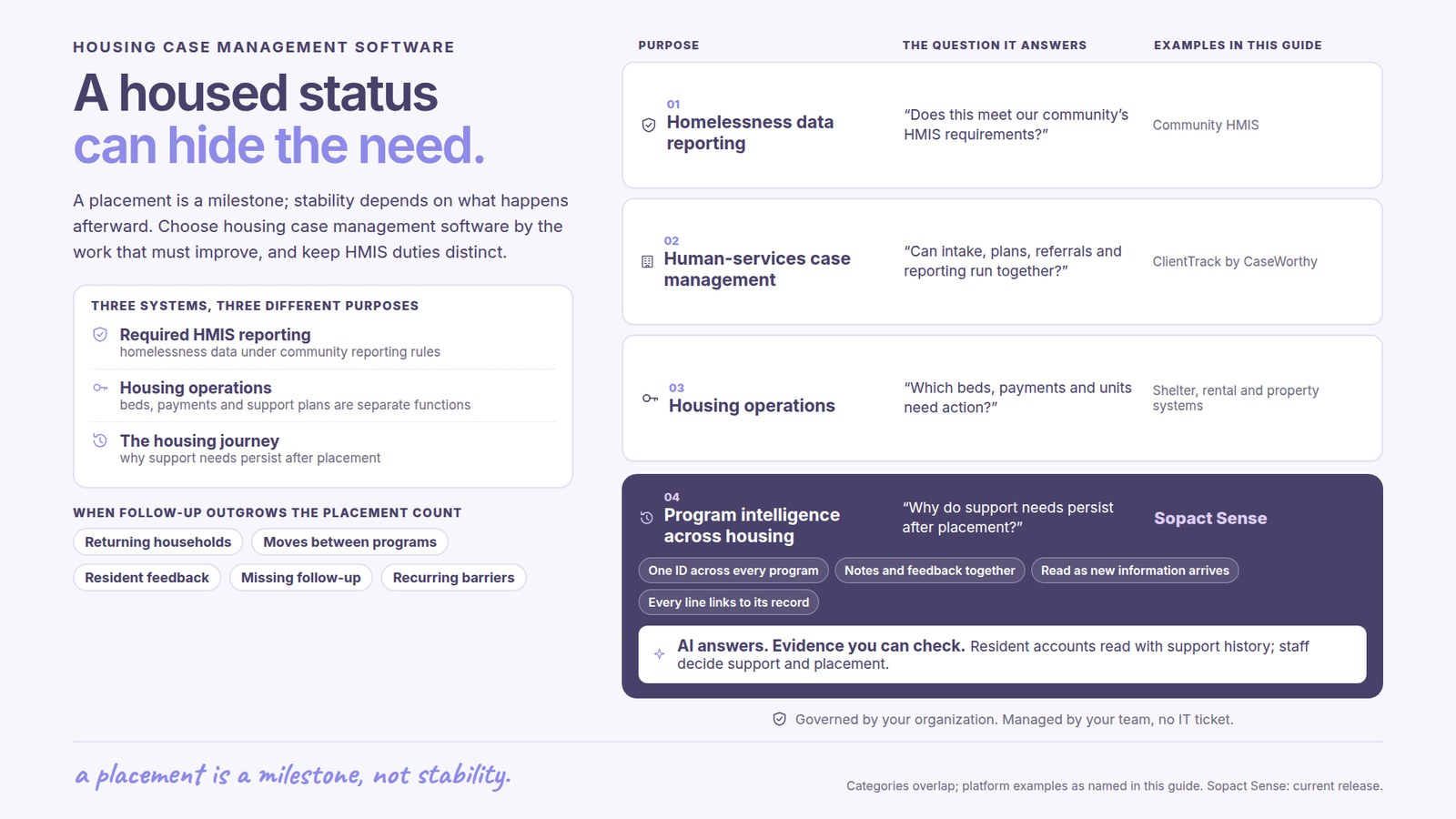
An HMIS organizes homelessness-service information under a community’s reporting arrangements. The HUD HMIS Data Standards distinguish people, project enrollments, household relationships and dated observations. For an applicable program, the local HMIS Lead is an essential participant in the software decision. A general case-management product is not automatically a replacement for that system.
Shelter operations, rental-assistance administration and property management have different requirements. Bed availability, a payment approval and a resident’s support plan are related, but they are not the same function. Start with the responsibilities the organization must perform, then identify the evidence needed to understand the resident’s experience.
Sopact is relevant when forms, notes and feedback need to become useful together. The team can investigate why follow-up is difficult or why support needs persist after placement. Existing operational systems can remain the source for their own records, with any data exchange included in the agreed scope.
A placement is a milestone. Stability also depends on what happens afterward: the resident’s experience of the home, affordability, access to services and changing circumstances. Staff need enough context to distinguish a resolved problem from a concern that has merely moved out of view.
For example, a resident may report that the housing itself is satisfactory but the move made travel to work difficult. The placement count looks positive while the follow-up identifies a practical barrier. Connecting the resident’s words with the support history gives staff a more useful starting point for a conversation.
Repeated notes can also reveal a program issue. If several residents describe the same difficulty reaching a service, leadership can examine availability or referral arrangements. That is operational learning during delivery, rather than a narrative assembled only for the annual report.
ClientTrack by CaseWorthy describes intake, service plans, referrals, documentation and reporting, with experience in HMIS implementations. It is a relevant option when the purchase centers on operational human-services case management and required housing workflows.
Sopact’s focus is AI-native collection and decision intelligence across programs. Quantitative housing information can be considered alongside case notes, resident feedback, interviews and documents. The team can ask what changed and inspect the evidence, without treating every new question as a separate export and coding project.
A housing provider may need both purposes. The useful choice is whether to replace an operating system, improve the analysis around it, or connect evidence from several programs. The case-management buying guide covers the broader platform decision.
The same person may receive prevention support, later enter another housing program and return for help after an apparent resolution. A continuing history lets staff interpret a new request against earlier circumstances without assuming that an old concern is still current.
Sopact makes analysis available as new information arrives in the configured workflow. Through AI Assistance, authorized staff can explore the connected sources: what the resident said, what assistance was recorded and what remains unclear. A worker can prepare for the next conversation; a manager can examine recurring barriers across the program.
The difference from a one-off note summary is continued use. New feedback adds to the context for later questions and reporting. Staff still make support, eligibility and placement decisions through the program’s established process; a generated interpretation is evidence to review.
Housing retained at exit and housing retained three months later answer different questions. A shared data dictionary keeps the meaning, source and observation period clear so the team does not substitute one for the other.
Suppose 100 households are due for follow-up, 70 respond and 60 report that they remain housed. The evidence describes 60 confirmed reports among 100 due, or about 86% of respondents. It does not establish an 86% retention rate for all 100 households. A useful report shows both the result and the coverage.
Resident feedback and staff notes can help explain why circumstances differ. Leadership can use those findings to reconsider support while funders receive a clearer account of what is known. The longitudinal software guide develops this follow-up problem.
Sopact’s typical setup estimate is two days to two weeks for an agreed collection and analysis scope. Historical records, information exchange and program requirements shape that scope. This estimate concerns the agreed Sopact workflow, not replacement of an entire community’s HMIS.
Personalization and continuing Sopact support help staff maintain the definitions and questions that matter to their program. Household information should be available according to staff responsibilities and permitted use, rather than treating a connected history as permission to share every note.
The purchasing benefit is practical: less reconstruction before a meeting, better visibility of recurring barriers and reporting that grows from ongoing work. The case-management solution explains Sopact’s connected-evidence approach.
It helps housing providers coordinate assessments, plans, services, notes and follow-up. Good software supports both current assistance and an understandable history of housing stability.
No. Their functions can overlap, but HMIS has specific homelessness-data and reporting responsibilities. The relevant HMIS Lead and program requirements should inform the system choice.
Sopact can be scoped for connected collection and analysis alongside existing systems. The permitted evidence, available exports or integrations and responsibilities must be agreed for that workflow.
It can help interpret incoming notes and feedback alongside structured information, making evidence available for current staff questions and program learning. Staff retain responsibility for support and placement decisions.
No. Placement and later stability are different observations. Follow-up timing, response coverage and residents’ explanations help establish what the program actually knows.
Continue with a purpose
Related solution
Keep notes, assessments and check-ins connected to the person.
Explore the solution →Continue learning
Explore how collection and analysis support continuing service decisions.
Start learning →
Customer story
A youth-program implementation designed to connect participant evidence across years.
Read the story →Explore how Sopact can connect resident feedback, case evidence and follow-up for your housing program.
See it with your workflow →