play icon for videos

Human Services Case Management Software That Proves Outcomes

Human services case management software (human services software) that holds one client record from intake to the multi-year outcome - reading the case note as it arrives, so the CSBG ROMA or HMIS report is one query, not a year-end rebuild.

Updated
June 7, 2026
360 feedback training evaluation
Use Case
Use Case · Human Services · Built for the AI era

Beyond human services case management.
Human services case intelligence has begun.

The case management software most human services agencies run was built to collect — land the intake, log the service, file the year-end report. Collection is solved. The new bottleneck is the workflow that reads every case note on arrival — and surfaces the risk before it becomes a crisis.

The client is the unit of work, and the client record has to be intelligent. When the intake assessment, the services delivered, the case note, and the follow-up survey all live on one record — one ID, one story — the outcome the funder asks about shows up on Tuesday, not at year-end. That is the difference between case management and case intelligence.

Direct answer

What is human services case management software?

Human services case management software is a platform that holds one persistent record per client across every interaction — referral, eligibility screen, intake assessment, service plan, case notes, services delivered, and outcome follow-up — so case workers, supervisors, and program directors get answers without a spreadsheet merge. It replaces the common stack of intake form, case-note documents, services log, and year-end outcome report with one connected record that carries the same client ID from first contact through the multi-year follow-up.

It is also searched as human services software, social services case management software, or simply human services case management — all naming the same need: one intelligent client record that proves outcomes, not just logs services.

Used by:

  • Community action agencies (CSBG, LIHEAP, food security)
  • Social service and family service nonprofits
  • Housing, shelter, and homelessness programs (HMIS / CoC)
  • Workforce, reentry, and youth-development programs
  • Multi-program agencies coordinating one client across teams

Not the same as a CRM (Salesforce, Blackbaud) that tracks donors, or an EHR (Epic, Cerner) that tracks clinical encounters and billing. Case management software tracks clients through a service-delivery lifecycle, with case-note narrative and outcome evidence at the center.

The shift

The era of human services case management is over.

For two decades the category was defined by configuration: buy a deep system, spend three to nine months mapping your programs into it, and get a structured record of what was delivered. That was the right tool for the problem of the 2000s — getting the service log out of the filing cabinet. Collection is now solved. Every platform in this category runs a basic intake → service → outcome flow.

The work moved. The hard part is no longer logging the service — it is reading the case note, the assessment, and the follow-up survey as they arrive, and carrying one client across every program so the outcome story is one query. AI without a workflow is a clever intern with no desk. The agencies winning with AI are the ones whose case data has a place to land — one record, one ID, one story.

The configuration era The case-intelligence era
Buy deep, configure for months, log what was delivered Live in days, read what changed, surface risk as data lands
A separate case per program, reconciled by name at year-end One client ID across every program, full history two clicks away
Case notes filed as documents, sampled by a supervisor monthly Every note read on arrival; risk and drift surfaced before Monday
Outcome surveys land in a spreadsheet nobody links back to intake Baseline and follow-up on the same record, scored together
The CSBG ROMA and HMIS reports are two multi-week rebuilds Each report is one query off the same records, note attached
Collection is solved. The new bottleneck is the workflow that reads every case note on arrival — and surfaces the risk before it becomes a crisis.
From the field

Marco Botha didn’t want a new dashboard. He wanted to know what was hiding in his data.

Open Play Foundation had been running programs for years. The case notes, attendance logs, and outcome surveys lived in different systems, the way they do at almost every human services agency. The structured system recorded what was delivered. It was never built to read what changed. Until those records lived on one client, Marco couldn’t see what was happening across the caseload — only what each spreadsheet told him.

“Those statistics that we’re now running on Sopact immediately showed me there’s something significantly wrong … things like that, we would never have been able to do in the past.” Marco Botha, CEO, Open Play Foundation

Same logic for a community action case worker: when the eligibility screen, intake assessment, services delivered, case note, and follow-up survey all live on one client record, the impossible reading shows up on Tuesday, not at year-end. Nobody reassembles four systems for the funder report. The pattern that was buried across files — the family quietly sliding backward, the program that isn’t moving anyone — becomes a single query.

The spine

Five stages, one client record. The spine a configured legacy stack was never built to hold.

Every client passes through the same five stages on the way from referral to outcome. Case intelligence builds the spine once; every program plugs into it. This is what a system bought to log services can’t do.

Stage 1

Intake

The client arrives with structured fields, open-ended answers, eligibility documents, and assessments in one form. A consent PDF and a risk score land on the same record — not in a folder.

Stage 2

Framework

Your theory of change, logic model, or CSBG ROMA outcome rubric — encoded as the framework every client record gets evaluated against. The funder’s questions, built in.

Stage 3

Data dictionary

Every field, every code list, every program’s definitions live in one dictionary — configured in plain English, not by a consultant on retainer. This is what keeps the record readable after the case worker leaves.

Stage 4

Transformation

Built-in skills do the work: Case-Note Reader, Outcome Rubric, Cohort Roll-up, Theory-of-Change scoring. AI reads each case note on arrival and codes it with attribution — not a black box.

Stage 5

Definitive reports

CSBG ROMA, HMIS / CoC, United Way community impact, and the Form 990 Schedule I program detail — each one query, each number citing its case note. Clean exports drop into Looker Studio, Power BI, or Tableau.

Program shapes

Six human services program shapes. The same year-end reconstruction under each one.

Whatever an agency runs, the services get logged and the outcome evidence ends up scattered across notes, surveys, and spreadsheets. Each lifecycle below has its own intake, its own outcomes, and its own funder report — and one client record holds them all on one ID.

01 · Eligibility & benefits

SNAP, TANF, GA

Eligibility screening, document verification, benefit issuance, and recertification. Compliance is constant; the outcome question — did the household stabilize — never gets asked because the data is spread across forms.

02 · Maternal & child

WIC & family support

Enrollment, nutrition assessments, visit schedules, and developmental follow-up across a long arc. Continuity across visits is the whole point — and the hardest thing to keep when the child grows out of one program into the next.

03 · Energy assistance

LIHEAP & weatherization

Seasonal application surges, eligibility, vendor payments, and weatherization referrals. The same household reappears every winter; without a persistent ID, each year starts from a blank form.

04 · Housing & homelessness

HMIS, CoC, ESG

Intake, case notes, service plans, and stable-housing outcomes at 6 and 12 months — under federal HMIS data standards. “How many reached stable housing?” should be one query, not a file-by-file review.

05 · Workforce & CSBG

WIOA, CSBG ROMA

Applications, skills assessments, training, placement, and earnings follow-up — reported against ROMA national performance indicators. The outcome the funder asks about, cohort by cohort.

06 · Multi-program family

One household, every program

The same household in food security + housing + workforce at once. The agency sees the whole story on one ID; the funder report stops double-counting the family across three programs.

Before Sopact vs. after Sopact, by program shape

Program shapeBefore (configured legacy + spreadsheets)After (one intelligent client record)
Eligibility & benefitsScreening, verification, and recert in separate forms; stabilization never measured.One household record; eligibility, benefits, and outcome on the same ID over time.
Maternal & childSame family appears with three spellings; cross-visit comparison never completes.Persistent client ID from enrollment forward; developmental follow-up automatic at any scale.
Energy assistanceEach winter starts from a blank application; weatherization referral lost.Returning household recognized; prior history and referral status on one record.
Housing & homelessnessOutcome surveys never connect to intake; the HMIS submission is a manual rebuild.Outcomes connect natively to intake and services; HMIS / CoC report is one query.
Workforce & CSBGAssessments in one tool, placement in another; ROMA report = 2-week reassembly.Pre/post and placement native to the record; CSBG ROMA report on demand.
Multi-program familyOne case per program; the same household double-counted in the report.One client ID; each program contributes to one record; no double-counting.

In every shape the service still gets logged. What moves is the outcome evidence — out of the year-end reconstruction and onto the record, read as it arrives.

One client, five moments

The same client ID, from referral to year three.

Most agencies lose continuity at every tool boundary — the intake is in one place, the case note in another, the follow-up in a third. Case intelligence keeps client #14837 the same client at every moment: referral, intake, service, 6-month check-in, year-3 outcome.

Day 0
Referral

Client referred in with eligibility documents. Client #14837 created. The document is part of the record, not an attachment.

Week 1
Intake

Baseline assessment and consent forms land on #14837. AI reads the intake note and codes the presenting needs.

Weeks 2–12
Service

Case notes and a mid-program check-in link to the same record. No re-matching, no name reconciliation.

Month 6
Follow-up

Outcome survey and stable-housing status update #14837. A unique link lets the client fill the one missing field — no duplicate record.

Year 3
Outcome

Three-year stability and recidivism — all queryable on one ID. The CSBG ROMA report writes itself; nothing was reassembled by hand.

Vendor comparison

Sopact vs. the human services case management systems agencies already know.

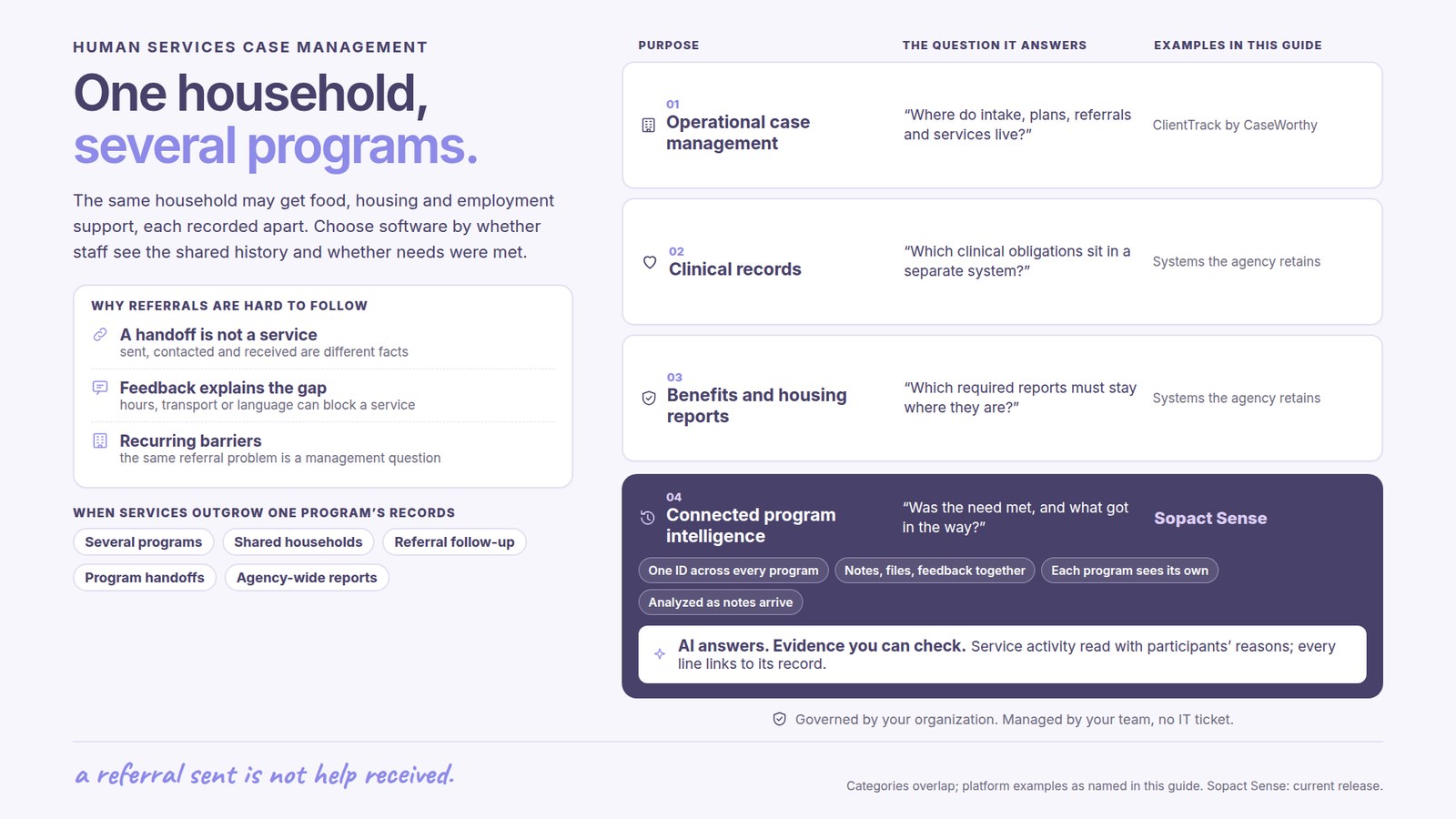
These are real, capable systems — CaseWorthy and ClientTrack run large multi-program agencies; Apricot and Casebook are widely deployed; myOneFlow serves the smaller end. The rows below aren’t about whether they log a service. Every one of them does. They ask the third question a funder, board, or auditor asks: does the software read the case note, carry one client across programs, and hand you the outcome report as one query.

Capability Sopact Bonterra Apricot CaseWorthy Casebook ClientTrack myOneFlow
Time to first cycle live Days 2–4 mo6–9 moWeeks6–9 moWeeks
AI reads case note / assessment on arrival Yes · native NoNoNoNoNo
Rubric scoring & citation trail Yes · native NoCustom buildNoCustom buildNo
One client ID across programs Yes · native YesYesPartialYesPartial
CSBG ROMA / HMIS report as one query Yes · native PartialYesPartialYesLimited
Encryption, RBAC, audit logging Yes YesYesYesYesYes
Configuration in natural language Yes · native ConsultantConsultantPartialConsultantPartial
White-label forms / banner / reports Yes PartialPartialLimitedPartialNo
Built for small organizations (under 15 staff) Yes Heavy liftHeavy liftYesHeavy liftYes
Multi-site / multi-program Yes YesYesPartialYesLimited
Longitudinal outcome tracking (1–3 yr) Yes · native Custom buildCustom buildPartialCustom buildNo

Honest reading: the legacy platforms win on depth and on being a system of record agencies already trust. Where they were never designed to compete is the case-intelligence layer — reading the note on arrival, scoring against a rubric with a citation trail, and being live in days rather than quarters.

Where it fits

Built for outcome programs — and honest about where it isn’t.

There’s no seat math and no tier puzzle. The real question is fit. Sopact is purpose-built for a specific kind of program, and it’s most powerful when three things are true — and most honest about the two places it won’t pretend to be the system of record.

Where Sopact is strongest

01 · You’re measured on outcomes

Not just throughput

If your funder asks whether the family’s stability, capability, or mission metric changed over time — not only how many were served, submitted, or disbursed — that is the exact question Sopact is built to answer.

02 · You follow people over time

Months and years, one ID

The longitudinal arc is where Sopact is strongest — the same client from intake to the year-3 outcome on one record. A one-touch interaction idles the engine; a long arc fires it.

03 · Your evidence is narrative

Notes, essays, reflections

When the proof of change lives in case notes and reflections, Sopact codes it on arrival — and every number traces back to the source. Not “clients felt more stable” but “38 of 120 exit assessments, e.g. client #2841: I finally have a lease in my name.” The deep cell nobody else can query.

Where we’re honest about the edges

The boundary · Cadence

Mid-program tempo, not real-time crisis

Sopact is built for program cadence — intake, services, follow-up. Real-time crisis tempo (intensive/ACT, emergency dispatch) is a wall we don’t engineer around, and we’ll say so on the first call.

The boundary · System of record

We layer on top — we don’t replace

If your program needs Sopact to be the EHR, billing system, HMIS, or SIS, that’s the wrong shape. Sopact is the case-intelligence layer that sits on top of those systems of record.

And it goes live in days, not quarters.

The whole spine — data dictionary, built-in skills, white-label forms, mixed-model auto-indicators with attribution, and definitive reporting (CSBG ROMA, HMIS / CoC, United Way, Form 990 Schedule I) — is configured in plain English, not by a consultant on retainer. That is why the first intake-to-report cycle is live in days while a legacy build runs three to nine months.

DaysTo first live intake-to-report cycle
3–9 moLegacy config time we beat
4–6 wkAnnual reporting overhead removed
2–3×Integrator-to-license cost we don’t charge
Report shapes

Four report shapes a human services agency actually needs.

The annual funder report gets the attention. But the day-to-day reports that change how a program runs are simpler — and rarely built, because the evidence is stuck in case notes and spreadsheets. Case intelligence ships all four.

01 · Missing

What we should have collected and didn’t

Clients with a baseline assessment but no exit survey. Cases with no 6-month follow-up logged. Surfaces the gap before the CSBG ROMA deadline does.

02 · Unusual

Records that don’t look like the rest

A household whose stability score dropped between intake and review. A case note flagging a risk nobody escalated. The supervisor sees what to look at before Monday.

03 · Comprehensive

The full funder report on demand

Outcomes, participation rates, pre/post movement, and coded case-note themes — the CSBG ROMA or HMIS report as one query, in whatever format the funder wants.

04 · Aggregate

The board-ready agency view

Year-over-year outcome movement, cross-program enrollment overlap, retention curves. The story for the board meeting — not the raw export.

Buyer fit

Sized for the agency you actually run.

Sopact is used by 12-person community action teams and by 60-person multi-program agencies. The system is the same; the complexity dial moves.

Small

Single-program agencies (under 15 staff)

A community action agency running one CSBG track. A family-services nonprofit with 150 active clients. The team currently running on an aging case system plus three spreadsheets.

Tags: single-program, no dedicated admin, spreadsheet-to-system migration, first defensible ROMA report.

Medium

Multi-program agencies (15–40 staff)

An agency running food security + housing + workforce on one client. A program team reporting to several funders with different outcome questions and overlapping households.

Tags: multi-program, multi-funder, longitudinal tracking, HMIS integration, board reporting.

Large

Networks & multi-site (40+ staff)

An agency with several sites and sub-programs. A network rolling up outcomes across affiliates. A team that needs a client ID to survive across locations and county lines.

Tags: multi-site, network rollup, white-label, API/BI integration, cross-program analytics.

Where it fits less well

If you need a clinical EHR with medical billing, or a pure donor-management CRM, Sopact is not that tool — and we’ll say so on the first call. Sopact is the case-intelligence layer for the service-and-outcome lifecycle, sitting alongside those systems rather than replacing them.

FAQ

What agencies ask before they pick case management software.

Questions on human services case management software — also searched as human services software or human services case management — from pricing and security to how it compares to the systems agencies already run.

What is human services case management software?

Human services case management software is a platform that holds one persistent record per client across every interaction — referral, eligibility screen, intake assessment, service plan, case notes, services delivered, and outcome follow-up — so case workers, supervisors, and program directors get answers without a spreadsheet merge. It replaces the common stack of intake form, case-note documents, services log, and year-end outcome report with one connected record that carries the same client ID from first contact through the multi-year follow-up.

What is the best human services case management software for small agencies?

There’s no single best tool, because most platforms in this category were built to collect service data, not to read outcome evidence. For a small agency under 15 staff, the deciding factors are time to first cycle live, whether the software reads case notes and assessments on arrival, and whether one client ID carries across programs. Legacy platforms like CaseWorthy and ClientTrack are deep but take months to configure; Sopact is built to be live in days and to surface the outcome as data lands.

How is Sopact priced for human services agencies?

Sopact is priced by use-case complexity, not seats or records — and we don’t charge per case worker. A 12-person community action agency running one program pays less than a 50-person multi-site agency running six. Pricing reflects programs sharing one client, multi-site footprint, longitudinal depth, custom rubrics, white-label depth, and API/BI integration such as HMIS. There are no Starter / Agency / Enterprise tiers.

Is there free human services case management software?

There are free and low-cost options — government-provided HMIS instances, Salesforce’s 10 free nonprofit licenses, and spreadsheet-plus-form stacks. They cover basic service logging, but outcome work outgrows them fast: no persistent client ID across programs, no case-note reading on arrival, no qualitative analysis. A free tool that forces a year-end hand reconstruction to prove outcomes isn’t actually free once staff time is counted.

What security controls does Sopact provide for sensitive client data?

Sopact provides AES-256 encryption at rest, TLS 1.3 in transit, role-based access control down to the field level, full audit logging of every record touch, and SOC 2 Type II controls. Sopact is not currently HIPAA-certified — if your program handles Protected Health Information under HIPAA, talk to us about whether your specific workflow falls inside or outside the HIPAA boundary before implementation. We’ll be specific about your scope rather than overstating our posture.

How is human services case management software different from a CRM or an EHR?

A CRM (Salesforce, Blackbaud) tracks donors and relationships. An EHR (Epic, Cerner) tracks clinical encounters and billing. Human services case management software — also called human services software or simply human services case management — tracks clients through a service-delivery lifecycle, with case-note narrative and outcome evidence at the center. The unit of work is the client, and the client record has to carry the whole journey from referral to multi-year outcome.

Can it track one client across multiple programs?

It should. A community action agency often serves the same household in food security, housing, and workforce at once. Legacy systems create a separate case per program, so the household is double-counted and the cross-program story has to be reassembled by name. Sopact carries one client ID across every program, so the full history is one record and the funder report stops double-counting.

Which funder reports can the software produce — CSBG ROMA, HMIS, Form 990?

Outcome-focused case management software should produce the reports a human services funder asks for as a single query off the same records: CSBG ROMA outcomes, HMIS / CoC submissions, United Way community-impact reports, and the program-services detail behind Form 990 Schedule I. The difference is that each number carries the supporting case note, so the report is defensible, not a year-end reconstruction.

How does Sopact compare to Apricot, CaseWorthy, Casebook, ClientTrack, and myOneFlow?

Those are real, capable systems — CaseWorthy and ClientTrack run large multi-program agencies; Bonterra Apricot and Casebook are widely deployed; myOneFlow serves the smaller end. They win on depth and on being a system of record agencies already trust. Where they weren’t designed to compete is the case-intelligence layer: reading the case note on arrival, scoring against a rubric with a citation trail, configuring in plain English, and being live in days rather than the 6–9 months a CaseWorthy or ClientTrack build typically takes.

How do agencies migrate from a legacy case system or spreadsheets?

Migrate in four stages: stop new intake from flowing into the old spreadsheet, pilot with one program and roughly 50 current clients, standardize all new intake through Sopact with a unique client ID assigned at referral, then backfill historical data in priority order. Full migration for a small agency typically takes 4–8 weeks, and most teams never backfill the oldest 30–40% of records — and nothing breaks.

Related use cases

Where to go next, depending on your agency.

Adjacent · Domain

Social work case management

The field-and-caseload sibling — child welfare, behavioral health, APS — with offline and mobile support for field social work.

Adjacent · Domain

Nonprofit case management

The same spine for any mission-driven program team proving outcomes to a funder.

Adjacent · Function

Program evaluation

For the outcomes question: linking baseline to result, coding case-note feedback, building the funder-ready story.

Adjacent · Method

Longitudinal study

Intake / 6-mo / year-1 / year-3 on one client ID — what the persistent-ID thread makes possible.

Adjacent · Framework

Theory of change

The framework the spine encodes — so every client record is scored against the outcomes you promised funders.

Product

Sopact Sense

The case-intelligence engine your client data is configured on top of — intake, AI reading, and reporting on one record.

Stop rebuilding the funder report. Start reading the case note.

No demo theater. No discovery phase. Tell us what you run, who comes through intake, and which funder reports you owe — CSBG ROMA, HMIS, United Way. We’ll show you what the first 30 days look like on Sopact.