


Related solution
Case Management
Connect participant context with notes, feedback and program understanding.
Explore the solution →


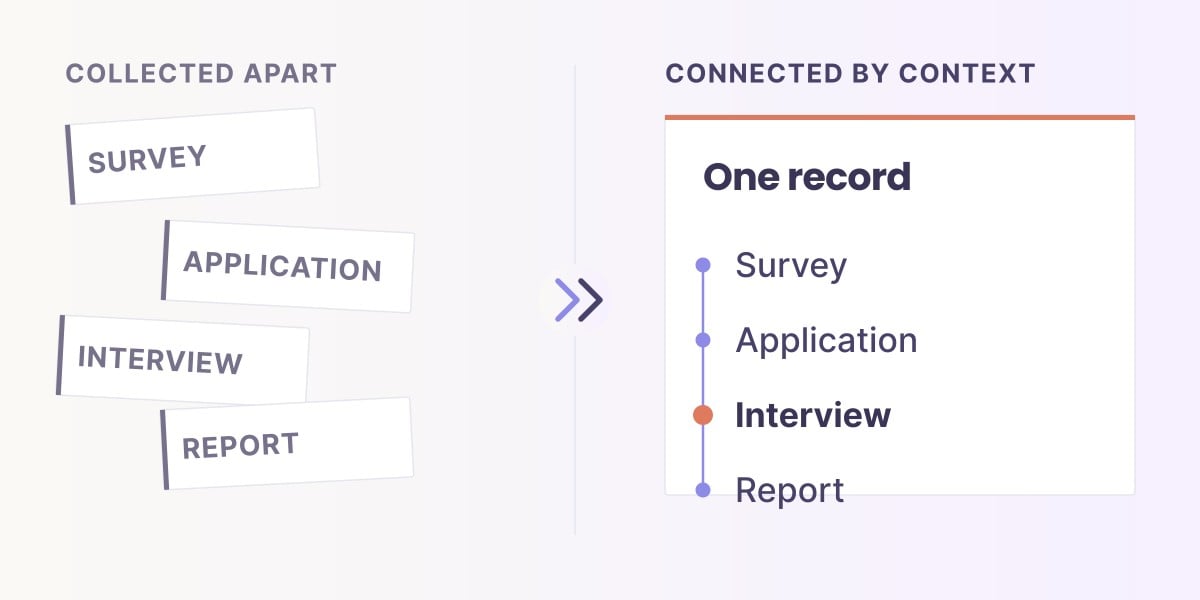
Live webinar: Wednesday, October 7, 2026 | 9:00 AM PT
Building context across your data. In 30 minutes, see how to connect data and definitions across teams, with the right permissions and governance, so scattered data points become intelligence your teams and AI can actually use.
Save your spot (free)USE CASE / SOFTWARE GUIDE
Case management software helps nonprofits organize intake, participant records, services, case notes and follow-up. Good software gives staff a useful view of the person they are supporting and gives program leaders a reliable account of the work. The best choice depends on whether your main need is coordinating services, sharing referrals, administering complex programs or understanding participant progress.
Those needs become urgent when staff repeat intake, reconstruct histories before meetings and assemble funder reports from separate spreadsheets. A shared database can improve recordkeeping, but the buying decision also concerns what staff can understand from the evidence and how quickly they can use it.
AI is expanding the category through note preparation, participant summaries and analysis. This guide covers six platforms with different strengths. Sopact’s focus is connecting forms, files and feedback across programs, making incoming analysis available for staff questions and continuing support.
Keep intake, referrals and required actions visible.
Read new information with the person’s earlier context.
Use connected evidence for support and reporting.
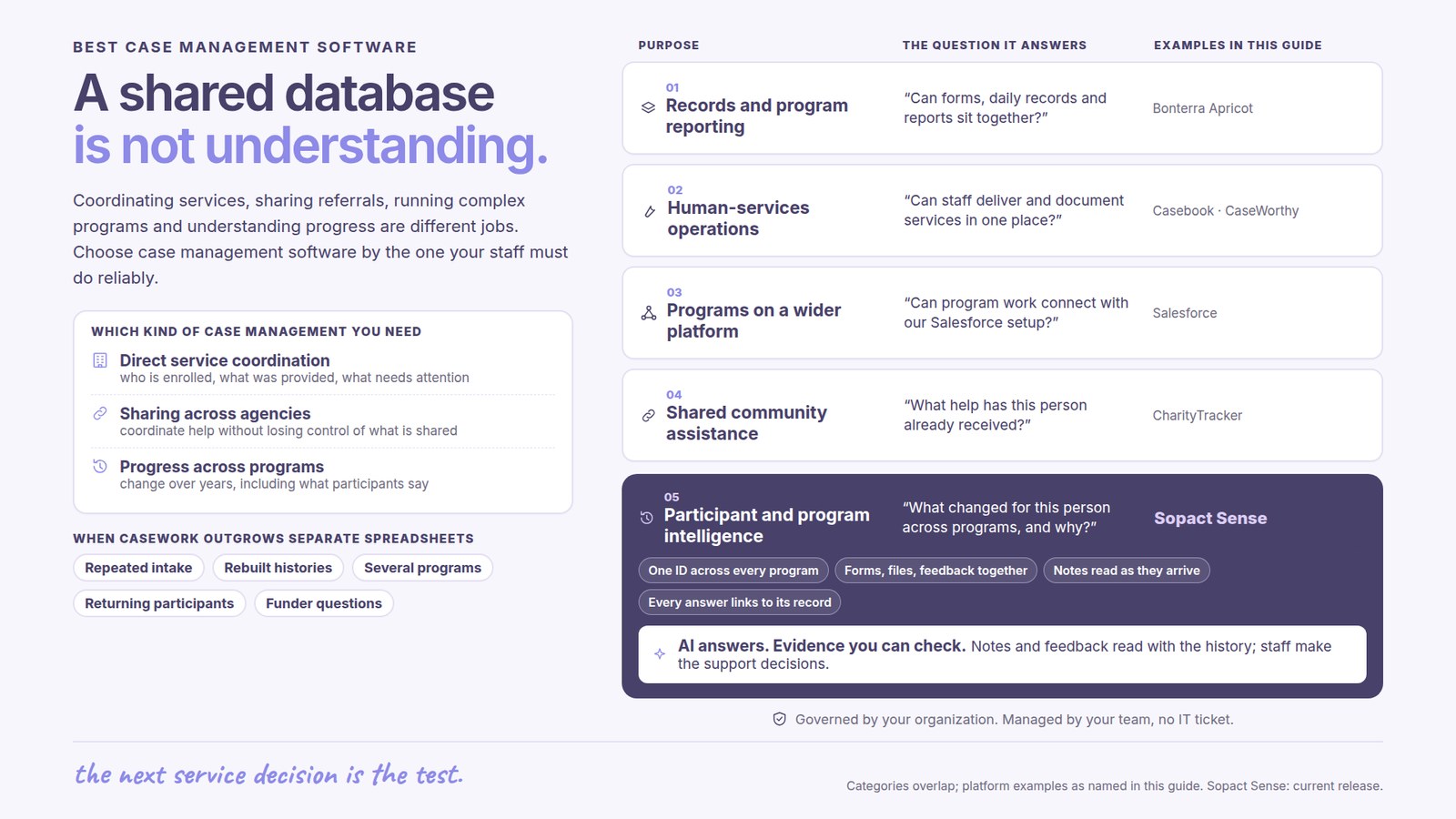
A housing, youth or family-services team needs to know who is enrolled, which services have been provided and what needs attention. Scheduling, referrals, assessments and case plans can be more important than a sophisticated analysis feature. Where a contract requires a particular record or report, that requirement belongs in the initial scope.
A community network has a different challenge: participating agencies need to coordinate assistance without losing control of what they share. The value comes from relevant shared visibility and a workable referral process, supported by appropriate access agreements.
A participant may receive mentoring, training and other support over several years. Teams need to understand change across that experience, including what the participant says about it. This calls for connected quantitative and qualitative evidence alongside operational records. The categories overlap; use them to identify the responsibility that matters most.
The following options are organized by purpose, not ranked from first to last. Product information was reviewed in October 2026. Sopact publishes this guide; the descriptions link to each provider’s own material.
Apricot combines participant records, forms, enrollment, referrals and reporting. Its Que capabilities include participant snapshots, note capture and plain-language data analysis. It is relevant to nonprofits that want case documentation and program visibility within the same operational system. Explore Apricot.
The useful distinction is the full package: forms, daily records and reporting, with AI assisting parts of that work. Compare the editions and capabilities required for your programs and who will maintain the forms and reports as needs change.
Casebook covers intake through reporting, with configurable workflows, shared client information, standardized assessments and multiple programs. It is relevant when staff need a common operational environment for delivering and documenting services. Explore Casebook.
Consider the way your team handles recurring visits, relationships and required reporting. A good fit should reduce the effort to record useful information while retaining the details different programs need.
CaseWorthy is relevant to organizations bringing several human-service workflows and reporting responsibilities together. Its platform supports configurable processes, client information and service coordination. Explore CaseWorthy.
Its Cara AI page describes case summaries, natural-language questions and task assistance, while its availability FAQ still asks readers to follow development updates. Confirm which capabilities are available in the proposed deployment. Assess the operational platform on its current fit rather than assuming every announced AI feature is included.
Salesforce provides program and case-management capabilities including guided intake, referrals, personalized case plans, assessments and outcomes. Its nonprofit offering goes beyond fundraising records. It is relevant when an organization wants program operations connected with its wider Salesforce environment. Explore Salesforce program management.
The purchase includes decisions about editions, related products, configuration and ongoing administration. Agree which team or partner will own those responsibilities; a broad platform is most useful when the resulting workflow fits the staff using it.
CharityTracker emphasizes collaboration among nonprofits, assistance records, referrals, remote intake and reporting. It is especially relevant when several agencies need to understand services already provided and coordinate the next response. Explore CharityTracker.
The central benefit is collaboration around assistance. Consider the participating network, the information each organization should see and how the shared record supports your local service model.
Sopact focuses on the evidence behind support and program decisions. Intake, assessments, notes, files and participant feedback can inform analysis as new information arrives, with the results available through AI Assistance. It is relevant when staff spend too much time reconstructing histories or coding narrative evidence for each reporting cycle.
The Case Management solution emphasizes continuing participant context and program learning. Specialist billing, mandated reporting formats and other operational requirements should be included explicitly when defining the scope.
Faster note writing helps the caseworker document an encounter. A participant summary helps a colleague prepare for a meeting. Analysis across participants helps a manager understand recurring barriers. These are different benefits, even when all three are described as AI.
For a nonprofit, the strongest use may be the connection between them. A concern recorded during a visit can inform the next conversation and contribute to an emerging program pattern. That becomes harder when staff must export and reassemble the evidence before asking each question.
Sopact’s AI-native approach analyzes incoming evidence within the configured program context and makes it available for continuing questions. Staff can examine the underlying material and apply professional judgment. Compare the effort removed from the whole process, including preparation and follow-up, rather than the speed of generating a summary alone.
Consider a youth program where attendance improves but confidence scores remain flat. Comments may reveal that participants feel more comfortable attending but still need help speaking in a group. Together, the evidence suggests a different response from either attendance or the score alone. This is an illustrative buying scenario, not a reported customer result.
Sopact connects qualitative and quantitative information with the participant and program context. A manager can examine what changed, whose experience differs and which evidence supports the interpretation. The same record can then inform a staff handoff, a program adjustment and a funder’s question.
This is also why a fiscal-year report should not erase participant history. A returning person, a new enrollment and a new service are different things. Preserving those distinctions makes both individual follow-up and program totals more meaningful.
A usable case workflow involves more than importing contact details. The scope should cover the initial programs, relevant historical records, required reports and staff responsibilities. The amount of preparation depends on the condition of existing data and the complexity of the services.
Sopact’s typical setup estimate is two days to two weeks for an agreed scope. Analysis becomes available as data arrives in the configured workflow, helping staff review information while it is relevant. That estimate is not a promise for every migration or integration.
Self-governance means the nonprofit retains control of its collection and analysis, with personalization and continuing Sopact team support as the programs evolve. Clarify routine ownership with every provider: who can change a form, who understands the reports and where staff turn when the service model changes.
Sopact’s Girls Inc. of Metropolitan Dallas story describes an implementation connecting participant records across programs and fiscal years. The work brings attendance, assessments and feedback around the same participant, with privacy and staff responsibilities considered during planning.
It illustrates a concrete purchasing need: keeping a participant’s experience understandable as she returns across programs and years. The account describes an implementation and its intended benefits, rather than a measured improvement in long-term outcomes.
Start with the work your staff must accomplish reliably. Service-heavy organizations may prioritize operational coordination. Community networks may prioritize shared assistance. Teams struggling to interpret program evidence may prioritize connected analysis. Several platforms span more than one purpose.
For a broader explanation of the category, read case management software. If repeated participant follow-up is the central challenge, the longitudinal data collection guide explains the underlying continuity requirements.
The best fit depends on the service model. This guide considers Apricot, Casebook, CaseWorthy, Salesforce Nonprofit Cloud, CharityTracker and Sopact for different operational, collaboration and program-intelligence needs.
A CRM can support case management when its program, service and case capabilities fit the work. Contact storage alone does not provide the required service history, case plans, referrals or outcomes.
No. AI can prepare notes, summarize evidence and assist analysis. Staff remain responsible for interpreting circumstances and making support decisions.
Sopact’s typical estimate is two days to two weeks for an agreed scope. Historical migration, integrations and specialist requirements must be considered separately in that scope.
Continue with a purpose
Related solution
Connect participant context with notes, feedback and program understanding.
Explore the solution →Continue learning
Explore how connected evidence supports the next service decision.
Start learning →
Customer story
An implementation connecting participant evidence across programs and years.
Read the story →See how Sopact can bring participant records, feedback and program analysis into the decisions your team makes every day.
See it with your workflow →