


Own routine changes
Authorized staff can maintain collection design after setup, with support when needed.


Alchemer Alternatives · BUYER’S GUIDE
Enterprise survey and feedback platforms collect responses, analyze results and support follow-up. Alchemer alternatives differ in research methods, feedback operations and whether the work centers on a survey, a customer experience or an ongoing program.
Compare SurveyMonkey for survey operations, Qualtrics or QuestionPro for research needs, and Sopact for connected program collection and analysis. Keep Alchemer’s current Survey, Workflow, Pulse and Iris scope in the evaluation; AI-native branding alone is not a reason to switch.
✳ DECISION INTELLIGENCE FOR PROGRAMS & PORTFOLIOS
Sopact is an AI-native data collection platform. It connects forms, supported files, interview transcripts, feedback and history so teams can investigate change and decide where to act.
For teams comparing Alchemer, the distinction is program-centered collection and analysis: connect survey responses with files, interview transcripts and collection stages around the decisions your program needs to make.
START HERE
Four alternatives, plus Alchemer. Compare the proposed product configuration, not a survey editor against an entire platform.
| Option | Consider it for | Tradeoff to understand | Explore |
|---|---|---|---|
| SopactAI-native data collection | Program forms, files and history analyzed together | Needs an internal data owner and configured relationships; specialist operational functions must be checked separately. | Review ↗ |
| Alchemer | Surveys and customer-feedback operations | Survey, Workflow and Pulse address different jobs; compare the proposed combination, not the survey editor alone. | Review ↗ |
| SurveyMonkey | Organization-wide surveys and survey analysis | Useful for survey-led decisions. Its multi-survey analysis excludes file uploads and contact custom data—not the entire platform. | Review ↗ |
| Qualtrics | Research and experience-management requirements | Strong research and experience scope; select the products and administration model your program actually needs. | Review ↗ |
| QuestionPro | Research studies and insight workflows | Evaluate the study methods and research workflow first; continuing program records are a separate requirement. | Review ↗ |
NARROW THE CHOICE
SurveyMonkey is relevant for survey-led work; Qualtrics and QuestionPro for research requirements. Sopact’s strongest case is an ongoing program: responses, supporting files and history need to inform the same decision, and internal owners need to maintain the collection-and-analysis cycle.
✳ DECISION INTELLIGENCE FOR PROGRAMS & PORTFOLIOS
AI-native data collection.
Better decisions.
Sopact connects forms and supported evidence around people, programs and collection stages. Teams can examine what changed, read the context behind a result and revise routine collection design after setup. Evaluate that combination when the decision spans intake, follow-up, interview transcripts and partner reports.
Documented foundations: contact setup , form relationships and supported evidence .
Explore this workflow ↗Authorized staff can maintain collection design after setup, with support when needed.
Combine survey responses with supported files and collected interview transcripts.
Connect program stages instead of treating each survey as a fresh start.
Review quantitative findings with qualitative explanations and their sources.
Shared definitions make results comparable; verify access across collection, analysis and reports.
Keep intake and follow-up connected to the right program participants.
Use supported files and collected interview transcripts with the quantitative responses.
Let authorized owners revise routine collection and review the resulting analysis within agreed controls.
Self-service configuration is not exclusive to Sopact. Compare the full recurring workflow. After setup, can your authorized data owner change a question, connect the next collection stage and check the resulting analysis? Verify the workflow with your team’s permissions. Initial design, training and complex integrations still need an owner.
See how contact fields are configured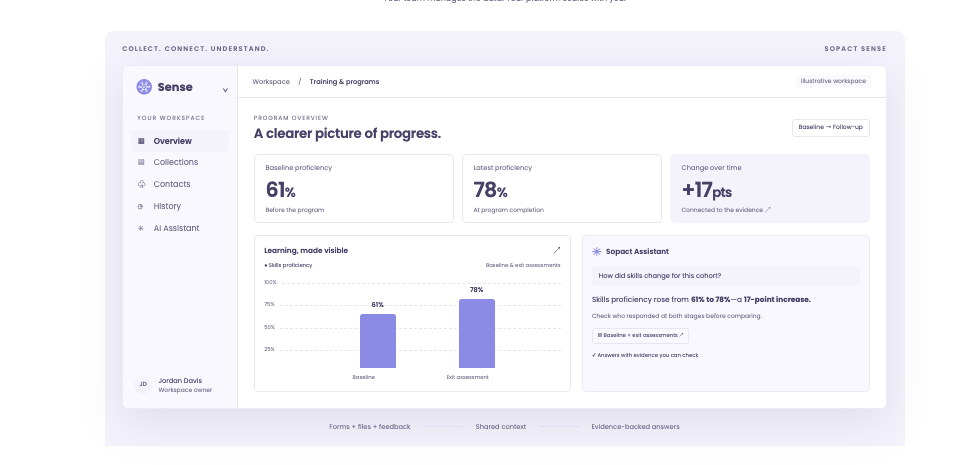
DIRECT COMPARISON
| Decision | What other options offer | Where to evaluate Sopact |
|---|---|---|
| Internal ownership | Alchemer documents no-code feedback Workflow. | Compare who maintains the entire program collection-and-analysis cycle after setup; no-code alone is not the distinction. |
| Mixed-source context | Pulse analyzes unstructured feedback; Iris spans customer listening channels. | Evaluate how program reports and interview transcripts connect with participant history and collection stages. |
| Qualitative and quantitative | Alchemer provides survey analysis and AI-driven text analysis. | Examine both kinds of evidence in the same program question, with definitions and human review. |
| Longitudinal decisions | Feedback trends can show changes in an experience. | For participant change, verify matched records, dates, missing follow-up and changed question definitions. |
| Cross-program reporting | Confirm which products, integrations and controls the proposed Alchemer setup includes. | Evaluate shared definitions and access across programs without assuming every input or permission boundary is automatic. |
Claims are bounded to the documented features. Sources and practical limitations are linked in the reviews below. No hands-on parity test is claimed.
THE OTHER OPTIONS
A shorter shortlist is useful only if it keeps the functions you rely on.
Why consider it: Survey, Workflow and Pulse cover collection, follow-up automation and text analysis. Alchemer also positions Iris as an AI-native customer-feedback platform.
Check before choosing: Confirm Iris availability: its current product page invites waitlist signups. Verify the proposed product combination, source coverage and administration responsibilities. Do not compare only the survey editor with another vendor’s full offering.
Read the vendor’s documentationWhy consider it: Supports cross-survey trends, contact custom data, conversational analysis and themes in written responses.
Check before choosing: AI availability depends on the account and survey. Multi-survey analysis has its own exclusions; these do not establish platform-wide gaps.
Read the vendor’s documentationWhy consider it: Research and experience tools; imported-data projects support analysis of external data.
Check before choosing: Match the proposed products and administration responsibilities to the work you actually need.
Read the vendor’s documentationWhy consider it: Survey and research workflows with AI-assisted tasks.
Check before choosing: Confirm the study methods, audience access and analysis features needed for your research.
Read the vendor’s documentationA CLOSER LOOK
Alchemer was formerly SurveyGizmo. Evaluate the current offering rather than an old feature list: Survey supports collection, Workflow addresses feedback follow-up and Pulse handles text analysis. Its 2026 Iris announcement adds another reason to compare current configurations. For Sopact, the decision is whether connected program evidence is your central requirement.
BEFORE YOU SWITCH
Use an approved sample. Let the person who will own the workflow run this test.
BUYING QUESTIONS
Consider SurveyMonkey for survey operations, Qualtrics or QuestionPro for research requirements, and Sopact for recurring program collection with mixed-source context. Keep Alchemer as the baseline, including the products you would actually deploy.
No. Alchemer already describes Iris as AI-native. Compare the practical fit: your evidence sources, continuing program history, governance and the work your own team can maintain.
Sopact supports analysis of collected transcripts and supported files alongside form data. Confirm formats and how those sources connect to the program. This is not a promise of automatic interview recording, transcription or inbox ingestion.
BRING YOUR REAL WORKFLOW
Bring a form, a supporting file and the decision your team needs to make. See how the collection and analysis fit together.
Prepared by Sopact, a vendor included in this guide. Selection follows the workflow each article addresses. Product statements draw on the linked public documentation; recommendations are editorial judgments, not independent testing. Verify the proposed product, configuration, source handling and controls before purchasing.
Sources reviewed October 21, 2026. Documentation can change. Customer accounts are attributed; illustrations are labeled. The guide does not establish guaranteed accuracy, security certification or a universal implementation timeline.