Sopact is a technology based social enterprise committed to helping organizations measure impact by directly involving their stakeholders.
Useful links
Copyright 2015-2025 © sopact. All rights reserved.

New webinar on 3rd March 2026 | 9:00 am PT
In this webinar, discover how Sopact Sense revolutionizes data collection and analysis.
KoboToolbox collects 20M surveys a month. The Free Data Trap begins at the export. Honest comparison of SurveyCTO, ODK, and Sopact Sense — for when program intelligence is the real bottleneck.
By Unmesh Sheth, Founder & CEO, Sopact
The quarterly report is due Friday. Your community health program has used KoboToolbox for three years. Free, reliable, offline-capable, multilingual — everything you needed to get data from the field to the server without a software budget. You have collected over 40,000 survey submissions. The data is clean. The forms worked. KoboToolbox did what it promised.
But the report is due Friday, and the analyst opened the CSV export Monday morning. The cleaning script ran two hours. The household follow-up records don't match the baseline on thirty-one participants because the unique ID question was left blank on the second wave. The 800 open-text responses — community members describing barriers to healthcare access in their own words — have never been systematically read. They sit in column F, 800 rows of text that might contain the most important insight in the dataset, waiting for a qualitative analysis project that nobody has time to start. The program manager wants outcomes. The data shows activities. The report will describe what was collected, not what changed — because the collection solved the cost problem but not the intelligence problem.
This is the Free Data Trap — the belief that solving the cost of data collection solves the measurement problem. KoboToolbox removed the financial barrier to field data collection for 32,000+ organizations worldwide. Free community plan, unlimited projects, offline capability, multilingual forms, 5,000 submissions per month without a dollar spent. Those are real and meaningful contributions to the sector. The trap appears at the analysis boundary: the data is free to collect, but the intelligence required to use it costs analyst time, export cycles, and manual coding hours that never appear on any KoboToolbox invoice. Organizations mistake the absence of a software cost for the presence of a measurement solution. The 20 million surveys collected monthly on KoboToolbox represent 20 million data events waiting for analysis infrastructure that free data collection was never designed to provide.
KoboToolbox and Sopact Sense share offline data collection and multilingual form support — the surface-level overlap. The architecture beneath is different. Before evaluating alternatives, the bottleneck must be precisely located: is the constraint field data collection, or is it what comes after?
The platform's reach is not accidental. KoboToolbox is used by the United Nations across multiple agencies, the World Food Programme, the International Rescue Committee, the International Federation of Red Cross and Red Crescent, Save the Children, and Médecins Sans Frontières. These organizations chose KoboToolbox because it solves a genuine, hard problem: getting reliable, structured data from practitioners in challenging field environments without requiring a software budget.
The free tier is genuinely free. The nonprofit Community Plan includes 5,000 submissions per month, unlimited projects, and access to all core form-building features at no cost. For 95% of KoboToolbox's nonprofit users, according to the organization itself, the free plan covers their data collection needs. This is not a freemium limitation strategy — it is a mission-driven pricing philosophy from a nonprofit organization sustained by partnerships and grants, not shareholder returns. The professional plan at $129/month for nonprofits and the teams plan for high-volume organizations provide upgrade paths without predatory tier structures.
The visual form builder lowers the technical barrier compared to SurveyCTO's XLSForm-only approach. Both platforms support XLSForm for complex instrument design, but KoboToolbox's graphical form builder allows practitioners without spreadsheet coding expertise to create surveys with skip logic, validation rules, and multiple question types without writing a single line of code. This matters operationally: when the M&E coordinator who built the XLSForms leaves the organization, KoboToolbox's visual builder gives non-technical program staff a path to maintaining their own instruments.
Offline capability across Android, iOS, and web browsers means field teams can collect data in the same environments as SurveyCTO — rural areas, humanitarian crises, post-disaster contexts — without connectivity requirements. Sync is automatic when connectivity is available, with local storage protecting against data loss when it is not.
Multi-language support covers hundreds of languages — forms can be translated and displayed in any language at the question level, with the enumerator seeing one language and the respondent interface displaying another if needed. For programs operating across linguistic communities, this removes a significant design constraint.
The ODK ecosystem compatibility means KoboToolbox forms are XLSForm-standard and portable — organizations can migrate between ODK-compatible platforms without redesigning instruments. This reduces lock-in and enables collaboration with external partners who use other ODK tools.
Who KoboToolbox is for, stated honestly: Field practitioners, M&E teams at humanitarian organizations, small to mid-size NGOs operating in challenging environments, research teams that need offline data collection at zero or near-zero cost. Organizations where the primary bottleneck is access to reliable, multilingual, offline-capable data collection tools — and where data analysis happens downstream in Excel, SPSS, or R.
The Free Data Trap has a specific activation pattern. It does not appear on day one of KoboToolbox use — it appears after the data has been collected. Year one: the organization uses KoboToolbox to collect its first structured dataset. The free collection is transformative relative to paper forms. Year two: the dataset grows. The reporting cycle becomes routine. Year three: a funder asks a question the data cannot answer without a significant analytical project. The data is there. The intelligence is not.
Basic analytics and reporting are the most consistently cited limitation across every review platform. SaaSworthy summarizes: "Common limitations mentioned include basic analytics and reporting features, which often require exporting data to external tools for deeper analysis." KoboToolbox provides summary statistics, basic charts, and table views of submitted data. For programs needing comparison across cohorts, longitudinal pre-post analysis, or thematic synthesis from open-text responses, the analysis must happen in Excel, SPSS, Power BI, or a custom tool after export.
Case management enables longitudinal tracking — but requires technical setup. KoboToolbox's dynamic data attachments feature allows linking projects using shared identifiers, enabling data from one survey to pre-populate into a follow-up survey for the same participant. This is genuine longitudinal capability. It requires: deliberate instrument design with a shared participant identifier, correct configuration of the dynamic data attachment, and technical knowledge of how XLSForm references work across projects. When the setup is correct, it functions. When it is not — when the identifier field was skipped, the attachment was misconfigured, or a participant changed devices — the longitudinal link breaks and manual reconciliation is required. This is a manageable research workflow problem; it is not a simple program management capability.
Qualitative data from open-text fields arrives in the export as text strings. KoboToolbox has introduced audio transcription and machine translation features for spoken responses — genuine product development. For typed open-text fields (the most common qualitative collection format in program evaluation), there is no built-in theme extraction or analysis layer. Reading 800 responses manually takes days. Extracting themes systematically requires NVivo, MAXQDA, or a manual coding spreadsheet external to KoboToolbox. The qualitative evidence sits in column F of the export, available but not analyzed.
Reporting latency compounds with program scale. For a small NGO running one program with one survey wave per cycle, the Free Data Trap is a manageable inconvenience — export to Excel, clean the data, write the narrative. For an organization running four programs simultaneously, collecting intake, check-in, and exit surveys across each, the export-clean-analyze cycle becomes the bottleneck that determines when the board gets useful information. The data collection is free. The analysis pipeline is not.
For nonprofit impact measurement, program evaluation, and longitudinal survey buyers whose organization has grown into the Free Data Trap, the question is no longer which data collection tool to use — it is what needs to come after data collection for the data to generate program intelligence.
Sopact Sense begins where KoboToolbox ends. The shared surface — offline capability and multilingual forms — is real, but the architecture beneath is designed for a different job.
Offline and multilingual: where they look the same and where they differ. Both platforms work offline and support multi-language instruments. KoboToolbox's offline capability is primarily designed for enumerator-mediated field surveys — practitioners collecting data on behalf of participants. Sopact Sense's offline capability is designed for participant-direct program surveys — participants completing instruments on their own devices with occasional connectivity gaps. Multi-language in KoboToolbox is enumerator- and field-facing; in Sopact Sense it is participant-facing, with participants selecting their language at the start of the survey. For field enumerator-mediated surveys in genuinely remote humanitarian contexts, KoboToolbox remains the appropriate tool. For participant-direct program surveys with language diversity, Sopact Sense handles the same capability.
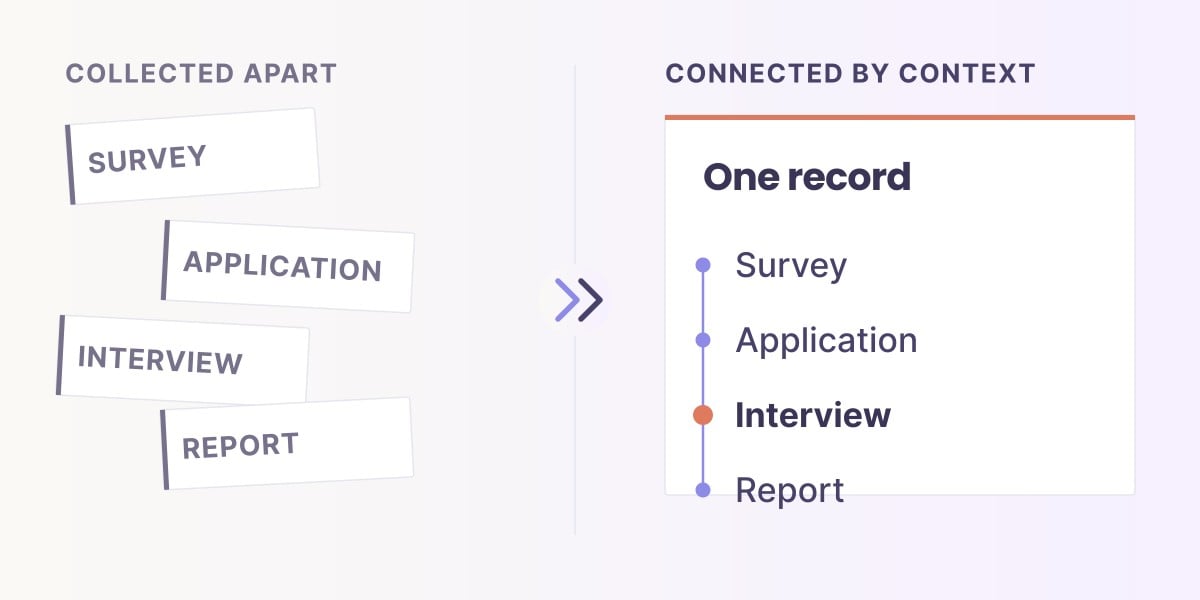
The persistent Contact ID replaces the Free Data Trap's reconciliation burden. In Sopact Sense, every participant receives a unique Contact ID at program intake. Every subsequent survey — check-in, exit, follow-up — distributes a unique link that embeds that Contact ID. Pre-post comparison happens automatically. The 30-participant reconciliation failure that appeared when the unique ID field was skipped in KoboToolbox does not happen in Sopact Sense because the identity is built into the distribution architecture, not dependent on a participant filling in a field correctly.
Intelligent Suite closes the qualitative gap. When participants answer open-text questions in Sopact Sense, the Intelligent Suite extracts themes across all responses simultaneously — 800 community health barrier narratives analyzed in minutes, results linked to the same Contact ID as quantitative metrics. The thematic analysis that would have required a NVivo project and four weeks of coding happens before the program manager's coffee is cold. The qualitative evidence that explains why outcomes happened or didn't becomes program intelligence rather than an export column nobody has time to read.
Logic model alignment from day one. KoboToolbox starts with a blank form. Sopact Sense starts with a theory of change. Survey questions are designed to measure specific outputs and outcomes in the logic model — each question maps to a program milestone rather than to a researcher's instrument preference. The analysis structure exists in the data collection design, not in the post-export code that must reverse-engineer what the questions were supposed to measure.
Real-time program intelligence. As data arrives in Sopact Sense, the program manager can see which participants are progressing, which are at risk, what qualitative themes are emerging in the current cohort, and how outcomes compare to targets — without waiting for the export cycle. The Free Data Trap's reporting latency disappears not because the analysis is faster but because the intelligence infrastructure is built into the collection architecture.
For survey for nonprofits and nonprofit storytelling buyers who have outgrown KoboToolbox's collection-only model, Sopact Sense closes the gap between data collected and intelligence generated.
The platforms most frequently evaluated alongside KoboToolbox divide cleanly into the same two architectural categories as the SurveyCTO comparison: ODK-ecosystem field collection tools that share the Free Data Trap, and program intelligence platforms that address what comes after collection.
SurveyCTO. KoboToolbox's primary peer within the ODK ecosystem, at a significant price difference (~$198+/month vs. free). SurveyCTO's advantages over KoboToolbox: superior offline reliability in extreme conditions, audio audit for enumerator quality control, GPS fencing for interview location verification, and 24/7 professional support. For humanitarian organizations and research institutions where enumerator fraud detection and extreme-offline reliability are requirements, SurveyCTO's premium is justified. For organizations where those specific capabilities are not required, KoboToolbox provides comparable collection at zero cost. Both share the Free Data Trap — the analysis happens downstream in Stata, R, or Excel. See SurveyCTO alternatives for the comparison between these two platforms.
ODK (Open Data Kit). The open-source foundation both KoboToolbox and SurveyCTO build on. Self-hosted, free, maximum technical control. Right for large research institutions and governments with IT infrastructure and the technical team to maintain it. The Free Data Trap is identical — data exits to statistical analysis software. Significantly higher technical overhead than KoboToolbox to set up and operate.
REDCap. The clinical research standard for longitudinal data management. Has genuine persistent participant identity management. Right for IRB-compliant clinical research and academic medical contexts. Not designed for the field enumerator workflow or the program management speed most NGOs require. The Free Data Trap does not apply — REDCap is typically paid infrastructure — but analysis in statistical software is still required for most advanced analyses.
Sopact Sense. Not a replacement for KoboToolbox in enumerator-mediated humanitarian field surveys in extreme-offline contexts. The right alternative when the Free Data Trap has activated: when the data is being collected but program intelligence is not being generated at the speed or depth the program requires. When open-text qualitative data is going unanalyzed. When longitudinal participant tracking requires manual reconciliation every cycle. When real-time program intelligence matters more than field enumerator management.
The honest hybrid. Several organizations running both field-based humanitarian surveys and ongoing participant program tracking find the right answer is both. KoboToolbox handles field data collection for population-based surveys where free, offline, and enumerator-mediated are all requirements. Sopact Sense handles participant-direct program surveys, longitudinal outcome tracking, and real-time intelligence. KoboToolbox data can be imported into Sopact Sense for intelligence analysis — the Free Data Trap is crossed once, and subsequent program phases run in Sopact Sense's intelligence-continuous architecture.
For comparison across adjacent survey tools, see best SurveyMonkey alternatives and best Qualtrics alternatives for how the same post-collection intelligence gap manifests across different survey architectures.
KoboToolbox remains the right choice when:
Your data collection is enumerator-mediated field surveys — practitioners collecting data on behalf of communities in offline environments. If your primary bottleneck is access to free, reliable, multilingual, offline-capable field data collection, KoboToolbox solves it better than any paid alternative at the same price point, because the price point is zero.
Your organization is in the early stages of moving from paper forms to digital data collection. The transformation from paper to KoboToolbox is real and meaningful — the first year of structured digital data collection produces organizational learning that has value independent of how sophisticated the analysis layer is. The Free Data Trap has not activated yet.
Your program requires ODK ecosystem compatibility for collaboration with partner organizations using SurveyCTO, ODK, or other XLSForm-compatible tools. KoboToolbox's ODK compatibility makes it the standard integration layer across the humanitarian data collection ecosystem.
Your team includes M&E practitioners with Excel, SPSS, or R skills who handle analysis downstream, and the Free Data Trap is a manageable part of the workflow rather than an organizational bottleneck.
The Free Data Trap has activated when: the analysis that should follow data collection consistently arrives too late to inform program decisions, when qualitative open-text responses go unread because the manual coding capacity does not exist, when longitudinal participant matching fails on a percentage of records every cycle because participants skipped the identifier field, or when a funder or board asks an outcome question that the KoboToolbox data cannot answer without a weeks-long reconciliation and analysis project.
KoboToolbox pricing in 2026: Free nonprofit Community Plan includes 5,000 submissions/month, 1GB storage, unlimited projects. Starter plan $21/month. Professional plan for nonprofits $129/month (includes 30,000 submissions/month, unlimited storage, advanced support). Teams plan for high-volume organizations. Enterprise plan for large multilateral agencies. For comparison, Sopact Sense publishes flat tiers with full AI analysis, longitudinal tracking, and qualitative intelligence at every level — no submission counting, no storage limits, no per-response billing.
Migration from KoboToolbox to Sopact Sense follows the same cycle-boundary pattern as every other transition in this series: design the next cohort's intake in Sopact Sense, distribute unique Contact ID-linked survey links, and let the identity layer build from first collection. Historical KoboToolbox exports can be imported for trend comparison. The Free Data Trap stops growing on the first cohort that runs in Sopact Sense's architecture. Setup takes one day, self-service, no IT involvement — a notably lower technical barrier than KoboToolbox's own XLSForm-based complex form design.
For organizations evaluating KoboToolbox vs. SurveyCTO (within the ODK ecosystem): the decision is primarily about budget and field quality control requirements. KoboToolbox is free and adequate for most contexts. SurveyCTO provides audio audit, GPS fencing, and extreme-offline reliability at ~$198+/month. Both share the Free Data Trap. See SurveyCTO alternatives for the detailed SurveyCTO comparison.
What to bring to a Sopact Sense demo: Your current KoboToolbox survey sequence — which forms you run, in what order, with what participant population. The open-text column in your last export that nobody has read. The participant matching failure rate from your last longitudinal analysis cycle. The funder question that required a two-week analytical project to answer incompletely. The demo designs the connected participant record for your specific program and shows what the qualitative analysis from your open-text fields produces in minutes.
Best KoboToolbox alternative depends on the bottleneck. For program intelligence — real-time qualitative analysis, persistent participant identity, logic-model outcome tracking without statistical software expertise: Sopact Sense closes the Free Data Trap that KoboToolbox's collection-only architecture cannot. For field data collection with superior supervisor monitoring: SurveyCTO at $198+/month. For self-hosted maximum control: ODK. For IRB-compliant clinical research: REDCap. KoboToolbox remains the best choice when free, offline, multilingual, enumerator-mediated field data collection is the primary requirement and the Free Data Trap has not yet activated.
The Free Data Trap is the belief that solving the cost of data collection solves the measurement problem. KoboToolbox removed the financial barrier to field data collection for 32,000+ organizations. What remained was the analytical barrier: data is free to collect, but program intelligence costs analyst time, export cycles, and manual qualitative coding hours that never appear on a KoboToolbox invoice. The trap activates when organizations have abundant, clean, free-to-collect data and no scalable path to program intelligence — and mistake the absence of a software cost for the presence of a measurement solution.
KoboToolbox is genuinely free for nonprofits through the Community Plan, which includes 5,000 survey submissions per month, unlimited projects, and all core form-building features. This covers 95% of KoboToolbox's nonprofit users according to the organization. Paid upgrades are available: Professional nonprofit at $129/month for 30,000 submissions and unlimited storage, Teams plan for high-volume organizations, and Enterprise for multilateral agencies. KoboToolbox is a nonprofit organization sustained by partnerships, grants, and service revenue — the free tier is mission-driven, not a freemium limitation.
KoboToolbox supports longitudinal data collection through dynamic data attachments — linking projects with shared participant identifiers allows data from one survey to pre-populate into a follow-up survey. This is genuine longitudinal capability. It requires: deliberate instrument design with a shared participant identifier, correct dynamic data attachment configuration, and participants filling in the identifier field consistently across waves. When setup is correct, it functions. When the identifier field is skipped or the configuration is incorrect, the longitudinal link breaks and manual reconciliation is required. Sopact Sense handles longitudinal continuity through persistent Contact IDs embedded in unique survey distribution links — no identifier field required, no configuration that can break.
KoboToolbox has introduced audio transcription and machine translation features for spoken responses. For typed open-text fields — the most common qualitative data format in program evaluation — there is no built-in theme extraction or analysis. Open-text responses export as text strings in a CSV. Systematic analysis requires NVivo, MAXQDA, or a manual coding framework external to KoboToolbox. Sopact Sense's Intelligent Suite analyzes open-ended responses automatically across all data collection events, extracting themes from 800 responses in minutes and linking qualitative evidence to quantitative metrics under the same Contact ID.
KoboToolbox pricing for nonprofits: Community Plan free (5,000 submissions/month, 1GB storage, unlimited projects). Starter $21/month. Professional nonprofit $129/month (30,000 submissions, unlimited storage, advanced support). Teams plan for high-volume data collection. Enterprise plan for multilateral agencies and large organizations. For comparison, Sopact Sense publishes flat tiers with full AI analysis and longitudinal tracking at every level — no submission counting, no storage limits at paid tiers, no per-response billing.
KoboToolbox and SurveyCTO are both XLSForm-compatible ODK ecosystem platforms. KoboToolbox is free for humanitarian organizations; SurveyCTO starts at ~$198/month. SurveyCTO advantages: audio audit for enumerator quality control, GPS fencing for interview location verification, superior offline reliability in extreme conditions, 24/7 professional support. KoboToolbox advantages: zero cost, visual form builder reducing technical dependency, broader user community, adequate offline capability for most contexts. Both share the Free Data Trap — analysis happens downstream in statistical software. See best SurveyCTO alternatives for the detailed comparison.
KoboToolbox is used by over 32,000 nonprofit organizations worldwide, collecting 20 million surveys per month. Users include multiple United Nations agencies, the World Food Programme, International Rescue Committee, International Federation of Red Cross and Red Crescent, Save the Children, and Médecins Sans Frontières. KoboToolbox was created in 2005 at the Harvard Humanitarian Initiative and is now maintained by Kobo, a nonprofit organization. Primary use cases: humanitarian needs assessments, health surveys, field research, human rights monitoring, program evaluations, and any context requiring reliable offline multilingual data collection at low or zero cost.
Four structural limitations define KoboToolbox's ceiling for program intelligence use cases: the Free Data Trap (data collection is free but analysis requires analyst time, export cycles, and external tools that are not free); basic analytics requiring export to Excel or statistical software for anything beyond summary statistics; qualitative isolation (open-text responses require NVivo or manual coding for systematic analysis — not available inside KoboToolbox); and longitudinal fragility (dynamic data attachments work when correctly configured and participants fill identifier fields consistently — breaks when either condition fails).
Yes, and this is often the honest answer for organizations requiring both capabilities. KoboToolbox handles free field data collection for population-based surveys where offline, multilingual, enumerator-mediated collection at zero cost is the requirement. Sopact Sense handles participant-direct program surveys, longitudinal outcome tracking, qualitative intelligence, and real-time program intelligence. KoboToolbox data can be imported into Sopact Sense for longitudinal analysis and program intelligence after each field collection wave. This hybrid approach uses each platform for the job it was designed for.
Sopact Sense is not a replacement for KoboToolbox in enumerator-mediated humanitarian field surveys where free, offline, multilingual collection is the primary requirement. It is the intelligence platform for program contexts where the Free Data Trap has activated — where data is being collected but program intelligence is not being generated at the speed or depth the program requires. Sopact Sense can also fully replace KoboToolbox for participant-direct program surveys where field enumerator management is not required, providing offline capability, multilingual support, persistent participant identity, and real-time qualitative analysis in one platform.