

If you run programmes across several sites with a small team, Open Play Foundation’s problem is probably yours too.
Open Play Foundation NPC was founded in January 2023 as a collaboration between Remgro and Stellenbosch Football Club. In three years it has built four sports facilities in the under-resourced communities around Stellenbosch: Kayamandi, Cloetesville and Kylemore. The flagship is an R11 million project at Kayamandi Primary that pairs a mini-soccer pitch with a water harvesting system, a purification plant and wastewater irrigation for a vegetable garden.
Building is only half of it. The Kayamandi Community Coaches Programme employs local residents as coaches on those facilities, funded through the Greater Stellenbosch Trust’s Citizen Connect social employment initiative. Between them they run everything from mini-cricket and netball to chess, boxing and drum majorettes.
Open Play has never been short of measurement ambition. Working with Ranyaka Community Transformation, a partner on the Kayamandi project, they ran a 96-indicator community assessment across four outcome areas, scored by the Kayamandi community itself. It produced a genuine baseline: 37% on health, education and activity, 40% on economic opportunity, 44% on environment, 60% on social cohesion. That instrument still does the job it was built for, which is to say where a community stands and whether it is moving over years.
What no community baseline is designed to do is tell you what happened at one court last week.
That second question is operational, and it runs on a completely different clock. It is also the question that decides whether a facility actually gets used. And it is the one almost every small foundation struggles with, because answering it weekly across multiple sites is a full-time data job, and a small team running four facilities does not have a spare analyst sitting around.
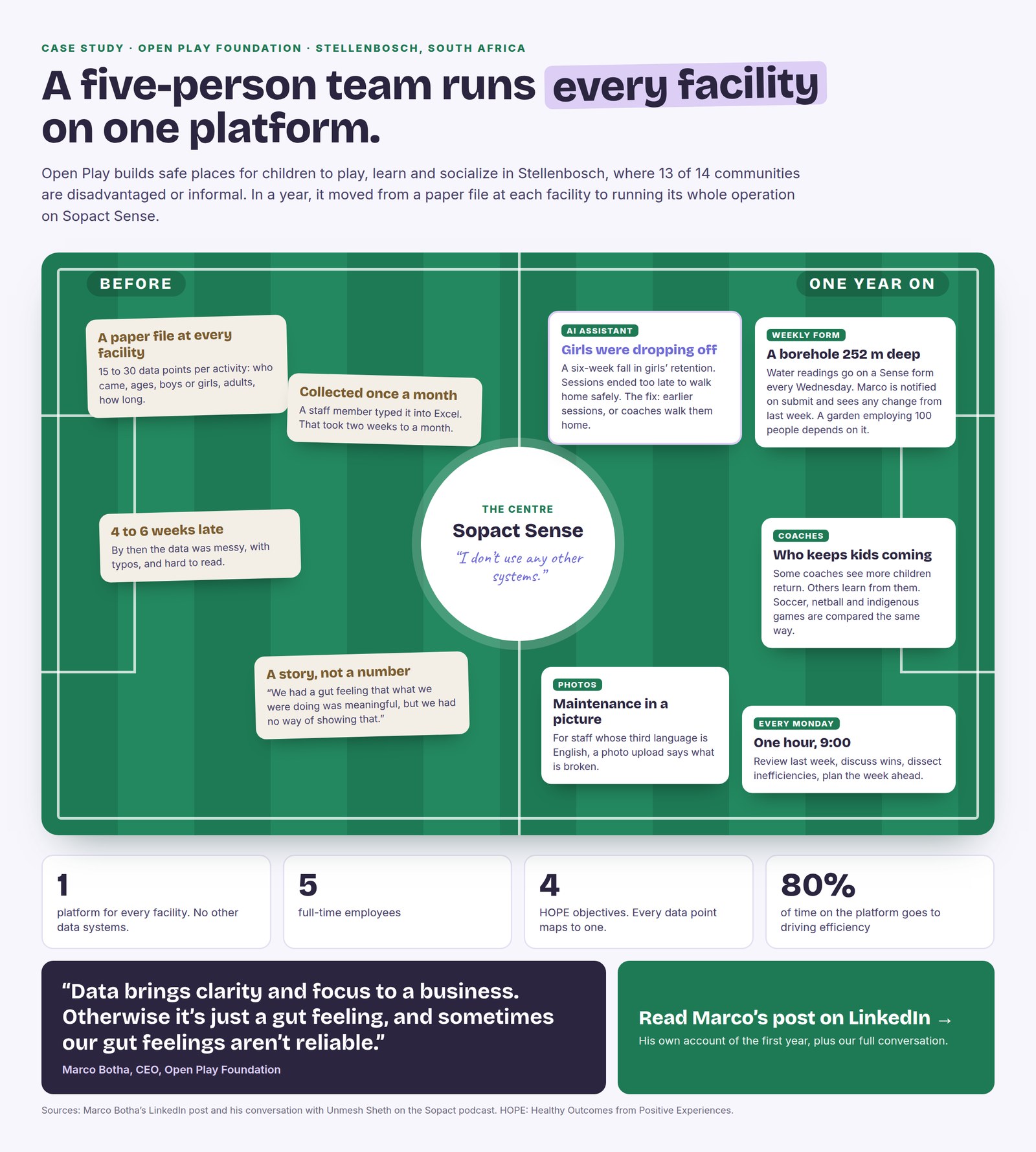
So the weekly reality lived where it lives in most organisations this size. In a template, filled in by hand, sent up, and read much later.
For an organisation whose sixth stated value is joint custodianship, that lag was the distance between the promise and the proof.
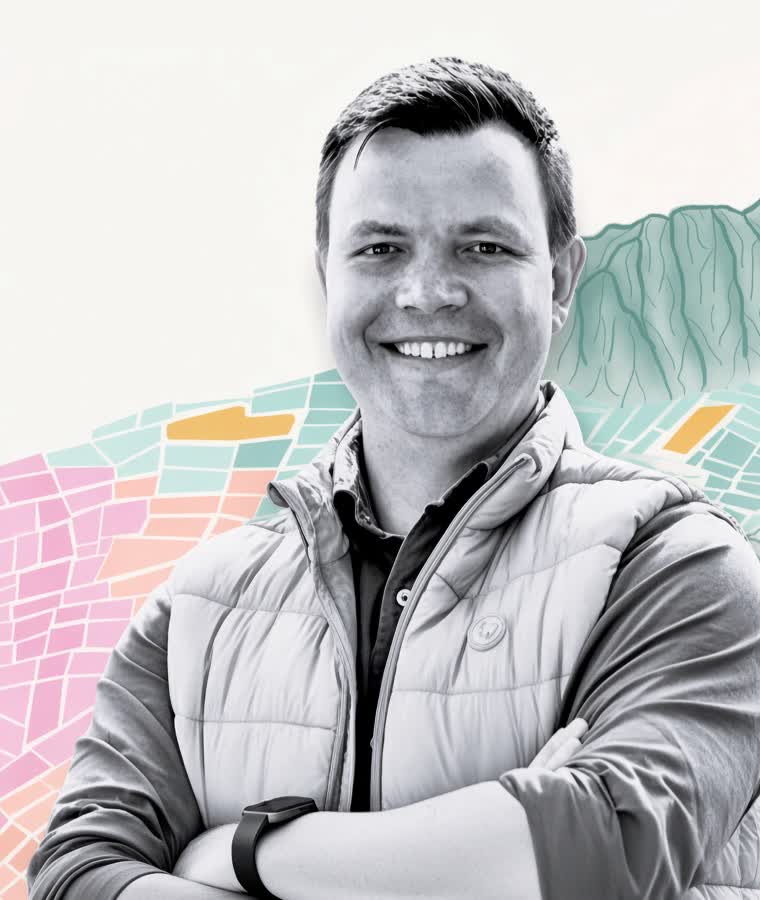
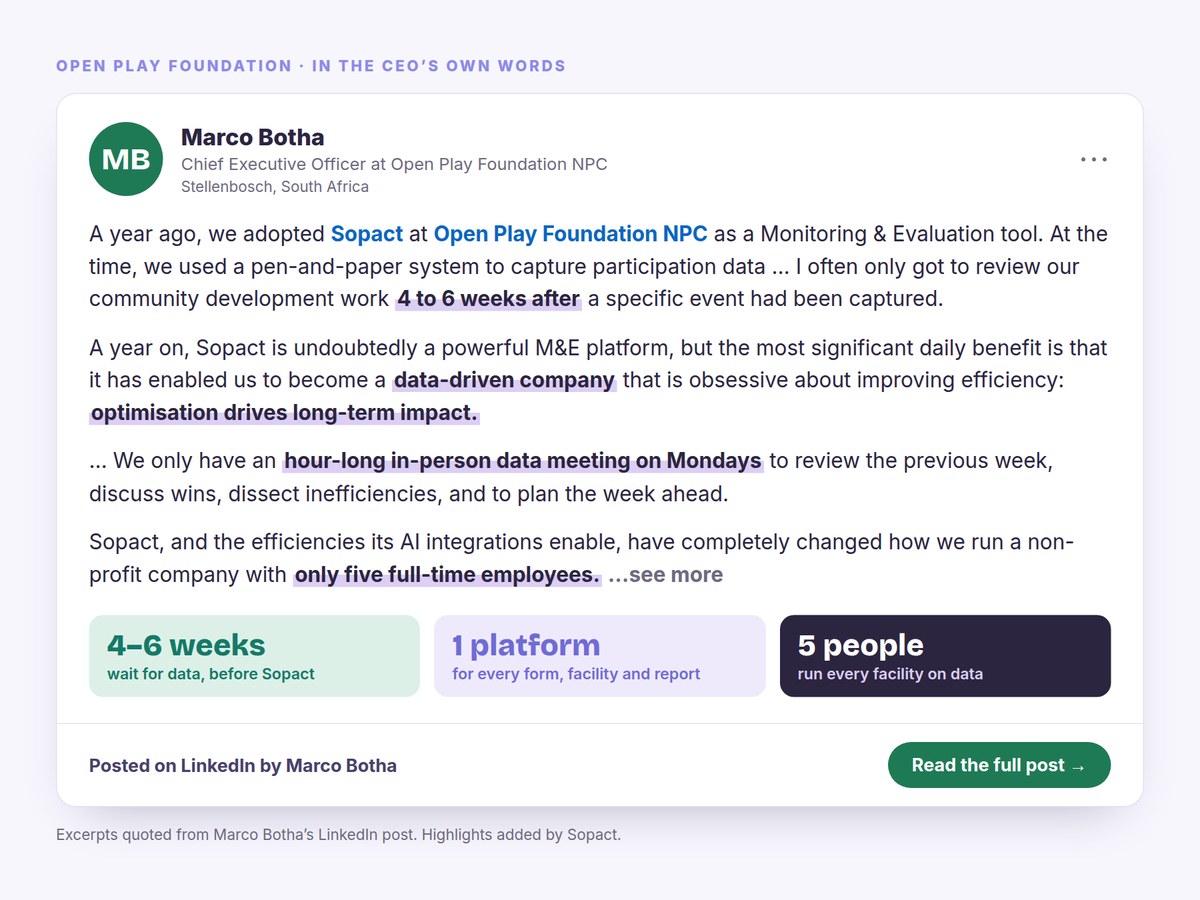
Marco Botha is not a data scientist. He spent eight years at Media24 as a sports writer and editor, ghostwrote Faf du Plessis’s autobiography, and took a Harvard master’s in management in 2023 to run this organisation. He knows exactly what a good report reads like. That was the problem. He could see the gap between the report he wanted and the one his data could produce.
He did not start with an implementation plan. He started with one programme.
It just took 2 prompts and my report was ready.
Then he built another, and another.
Open Play carries an unusual amount of water infrastructure for a sports foundation. The GreenSource project runs a harvesting system, a purification plant and wastewater irrigation for a vegetable garden that feeds a food-security programme. For an organisation with that much plumbing under its care, a leak is never a footnote. It is money, and it is a programme.
That is exactly the kind of problem the old reporting cycle would not have caught in time.
We found a water leak in the field immediately through this data. It would have been a huge loss for us had we not been using Sopact.
Nobody had built a loop to find water leaks. It surfaced because the data was being read on arrival by someone who knows the sites, rather than averaged into a quarterly summary by someone who does not.
Marco recently pulled ten programmes into a single funder report himself, broken down by facility, activity, coach and gender parity.
The coach breakdown carries more weight than it looks. Open Play’s coaches are local residents employed through a social employment initiative, so coach-level session data is not only programme data. It is evidence for the employment programme that pays them.
Read one of Marco’s facilities reports and the method shows up before the numbers do.
He reports by facility, by name. Ikaya, Aitsa Klipkraal, Kayamandi GreenSource, Fiekie’s Courts of Hope. Funders fund facilities, so that is the unit he reports in, each with its own session count and hours.
He filters against his own interest. The report carries an explicit note that participation totals exclude assemblies, major ceremonies, visitor-driven sessions, adult sessions and marked outliers. Those rows would make his numbers bigger. He takes them out, because a ceremony is not a coaching session and he wants the figure to mean one thing.
He watches collection compliance, not just results. Knowing which sites are logging consistently is what makes the totals trustworthy in the first place, and it is visible to him without asking anyone.
He publishes his own discrepancies. Where a survey interface count and the database reporting table disagree, the report names the gap, states which source it followed and flags it as unreconciled. A once-a-year PDF would have quietly picked one.
He standardises messy labels. Activity names, partner organisations and coach labels recorded inconsistently across four sites get merged so the facilities can actually be compared.
He treats the report as a version, not a monument. It states its coverage window to the day and expects to be superseded. The totals behind this page have already moved since he wrote it.
Open Play’s promise sits in its sixth value: “We don’t exit projects at the handover but remain involved as joint custodians to ensure facilities are being used optimally as instruments of change.”
Any organisation that builds something and walks away can point at the thing it built. Staying is harder, because staying requires evidence, week after week, that the thing is being used and is working. That is the job Sopact does here.
Open Play’s four sites are Kayamandi Primary, a school of 1,500 learners; Pinkie’s Promise court at Ikaya Primary, the largest public primary school in Kayamandi with more than 2,000 students; Fiekie’s Courts of HOPE at Pieter Langeveldt Primary in Cloetesville; and a youth centre at Aitsa Klipkraal in Kylemore. Both named courts are tributes: to Pinkie Yolisa, Ikaya’s head of sport, and to Shafiek “Fiekie” Jacobs, the principal at Pieter Langeveldt.
The work is backed by Remgro, Capitec, PwC Stellenbosch, Stellenbosch Football Club, Global United Football Club, the Genesis Group, the Dutch Ministry of Foreign Affairs, the Greater Stellenbosch Trust and more than twenty other partners.
The Open Play Foundation NPC enables the children of Stellenbosch to discover their potential by revitalising public spaces into safe and accessible recreational platforms where the transformative power of sport, culture, and education can be harnessed through community partnerships.
Open Play Foundation NPC is a registered non-profit. If you would like to back the next court, visit openplayfoundation.com.