


What is impact measurement and management (IMM)?
Impact measurement and management (IMM) is the practice impact funds, foundations and CSR teams use to agree what change each investee or grantee should produce, measure it on shared definitions, and use the results in decisions from diligence to exit.
The word that separates IMM from reporting is "management". A fund that collects quarterly numbers and files them has measured; a fund that notices a gap, asks the partner about it, and changes its support or its next agreement has managed.
THE SHORT VERSION
- IMM starts at onboarding, when the fund and each funded partner write down what gets reported and what each number means.
- Every report is checked against that agreement, and only numbers that share a definition are added into a portfolio total.
- Gaps become questions to the partner, and the answers change support, terms or the next agreement; that follow-through is the management.
What is the difference between measuring and managing impact?
Measuring produces the evidence; managing is what the fund does with it, such as following up with a partner, changing support, adjusting terms or reporting a miss honestly. Most IMM programs are strong on the first half and thin on the second.
The reason is usually timing. If partner reports arrive in different formats and are reconciled once a year for the annual report, the numbers are ready only after the decisions they could have informed. IMM works when each report is checked on arrival, so a gap in the first quarter is a conversation, not a surprise in the fourth.
How does IMM work across the portfolio lifecycle?
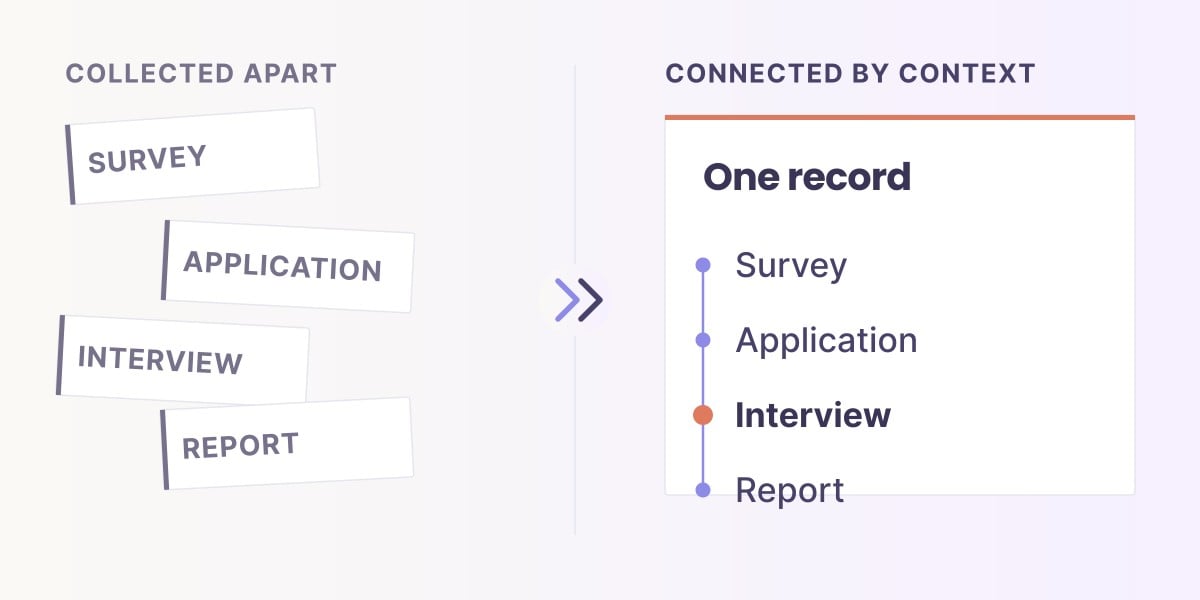
The same partner record should carry the impact thesis from diligence, the agreement from onboarding, every checked report and the follow-up questions, so each stage builds on the last instead of starting again.
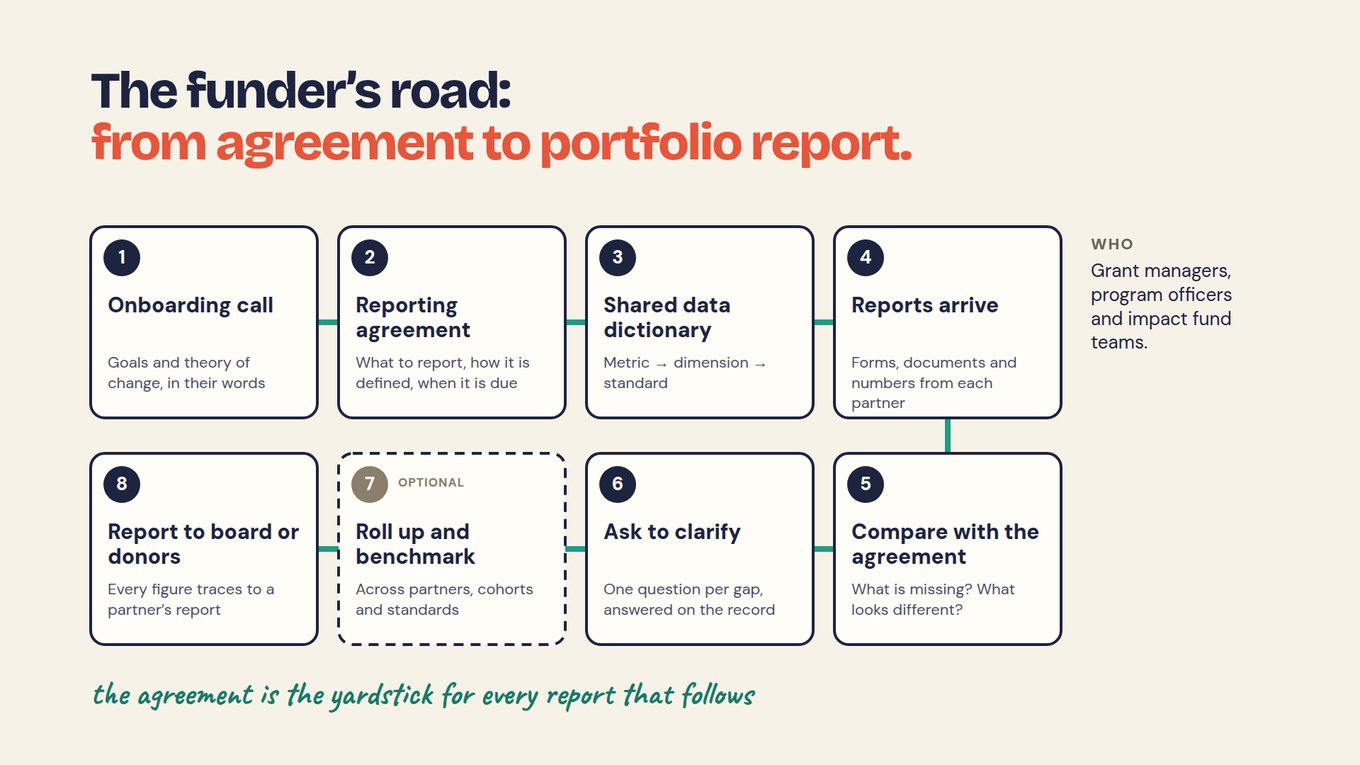
For a grant manager or impact fund team, the working sequence is an onboarding call, a reporting agreement, a shared data dictionary, reports that are compared with the agreement, one clarifying question per gap, an optional roll-up and benchmark, and a report to the board, LPs or donors.
Scroll horizontally to see all columns →
| Stage | What the fund keeps | Decision it supports |
|---|---|---|
| Diligence | Impact thesis, stakeholder need, risks, candidate outcomes | Is the impact claim material and testable? |
| Onboarding | Reporting agreement and dictionary rows, with due dates | What will both sides report, and what does each number mean? |
| Each reporting period | Reports marked matches, different, missing or not split | Which partner needs a question or support now? |
| Portfolio review | Totals of matching numbers, held numbers, optional benchmarks | What patterns and risks appear across partners? |
| Reporting and exit | Board or LP report with a source for each figure, misses included | What can the fund credibly claim, and what changes next time? |
The onboarding row does the most work. Turn the onboarding call into a reporting agreement shows how a recorded call becomes the draft agreement both sides sign.
How do the Five Dimensions of Impact and IRIS+ fit into IMM?
The Five Dimensions are a guide to the questions each metric should answer, and IRIS+ is an optional catalogue of standard metric definitions; neither produces evidence until each metric has its own row in a shared data dictionary.
The Impact Frontiers dimensions ask what outcome occurs, who experiences it, how much change there is, what the enterprise contributes and what the risk is that impact differs from expectations. IRIS+ supplies metric codes that help when funders compare across portfolios. An SDG mapping names a goal but does not make two partners' numbers comparable.
In practice, a dictionary row turns the frameworks into something a partner can count. In the fictional workforce fund used below, the row for "Total clients enrolled" reads: unique trainees in the reporting period, not sessions; dimensions How much and Who (by gender, age, disability); standard IRIS+ PI4060 "Client Individuals: Total"; roll-up across partners. A shared data dictionary walks through writing one.
The video below, The Five Dimensions of Impact (IMP Framework Explained), takes the dimensions one at a time, with the question each asks and the evidence it takes to answer. Pause after each one and check which of your current metrics answers it.
How do you roll up impact results across a portfolio?
Add up only the numbers that share a definition, show anything counted differently as held, with a one-line reason, and never fold a held number into the total. A total is only honest if every part means the same thing.
Take a fictional regional workforce fund with four job-training partners, A to D. Their agreement counts placement in a job within 90 days of exit. Partners A, B and D report 42, 31 and 27, so the portfolio total is 100. Partner C reports 55 placements, but within six months, so its number waits until C confirms the 90-day count.
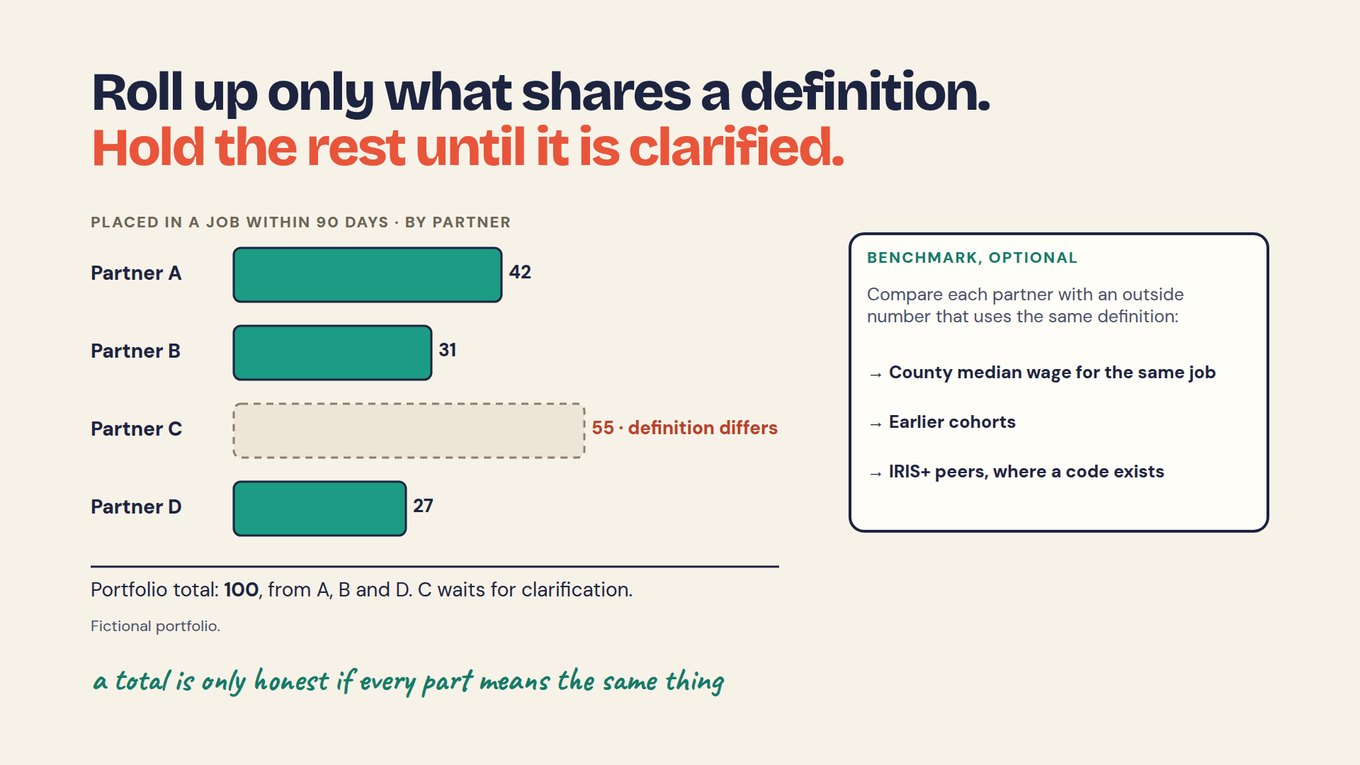
How the held number appears in the report matters as much as the total. Compare two ways of writing the same line:
HIDES THE PROBLEM
"155 people placed in a job." The six-month count is mixed into a 90-day total.
SHOWS IT
"100 people placed within 90 days, from A, B and D. Partner C's 55 used a six-month rule; its 90-day count is requested."
Benchmarks are optional and only fair on the same definition, such as the county median wage for the same job, an earlier cohort from the same partner, or IRIS+ peers where a code exists. Occupational wage data comes from sources such as the Bureau of Labor Statistics. A comparison starts a conversation with a partner; it is not a ranking.
What should a fund do when a partner's numbers don't match?
Treat each gap as a question, not a verdict: send one clear question per gap, record the answer on the partner's record, and change the agreement or the support if the same gap keeps coming back.
Partner C's report shows the pattern. Enrolled (80 unique people) matches the agreement. Placement uses six months instead of 90 days, 12-month retention is missing, and starting wage is one average, not split by track. That becomes three questions: can you count placements within 90 days, as agreed; when will 12-month retention be available; and can you split starting wage by track?
Seen from Partner C's side, the six-month figure is not carelessness; C fills four reporting templates, and one of its funders asked for six months. The fund's job is to make its own definition clear and workable. Check each partner report against the agreement covers the row-by-row check.
Definitions written early are what let this scale. AHA Ventures, the investment arm of the American Heart Association, is growing its portfolio from 19 to more than 40 companies, and its head of impact drafts each company's logic model and data dictionary during the onboarding call, with Sopact Sense. Auroville International USA channels more than $1M a year to about 80 project partners, who report every quarter against shared terms such as a "clean-water beneficiary".
How should a fund evaluate IMM software?
Test any platform on one real partner, from agreement to portfolio total, and ask it to show the record behind every figure; feature lists matter less than whether a held number stays held. Deal-flow systems keep transactions and portals collect templates; the question is how they connect.
Scroll horizontally to see all columns →
| Test | Ask the vendor to show | A good answer |
|---|---|---|
| One record | One partner's agreement, reports and follow-ups together | A persistent ID per partner, from the first form |
| Check | A report compared with the agreement | Each metric marked, with one question per gap |
| Roll-up | A total with one partner on a different definition | That partner held and named, not added |
| Trace | One figure in the board report | It opens to the partner record behind it |
| Scoped AI | What the assistant may read | Only sources you selected; missing numbers flagged |
In Sopact Sense today, each partner or company keeps one ID; folders let each team's AI Assistant see only its folder while the portfolio owner sees aggregated results; the Assistant stays locked until you declare its sources; and every line of an answer links to a record. It does not replace cap-table, accounting or fund-administration systems.
The two-minute video shows portfolio reports built from several sources. Hold it to the tests above.
PROMPT · PASTE INTO CLAUDE, CHATGPT OR YOUR AI TOOL
Here is our agreed definition for [METRIC] and each partner's reported number with the definition it used: [PASTE].

1. Add up only the partners whose definition matches ours. Show the sum as an equation.
2. List every partner left out, with one line on why.
3. Draft one polite question to each partner left out.

Rules: use only the numbers I pasted. Do not estimate, convert or round. If a partner's number or definition is not given, write "not in our data".
What can IMM not tell you?
A portfolio total shows what was reported on a shared definition; it does not show that the fund, or the program, caused it. Enterprise contribution (what the program adds for people) and investor contribution (what the fund's capital and support add) are separate claims, and both need comparison evidence to go beyond plausibility.
Placement and wage numbers are often self-reported, and people who cannot be reached are rarely a random slice, so show the denominator and the non-response beside each rate. A partner with a lower rate may serve people furthest from work. Check every AI draft against the partner record, and let a named person decide what a result means.
How do you start IMM across a portfolio?
Pick one metric that every partner already reports and run one full cycle on it, from definition to a checked total.
- Choose the metric, such as placement in a job, and write one plain definition with its window, such as 90 days after exit.
- Send it to every partner as a dictionary row and ask each to confirm or say how it counts today.
- When reports arrive, mark each partner's number as matches, different, missing or not split.
- Send one question per gap and record each answer on the partner's record.
- Add the matches, show held numbers on their own lines, and give every figure a source.
- Before the next cycle, fix the definition wherever two partners read it differently.
After one cycle you hold a total you can defend, a short list of held numbers with open questions, and a dictionary row every partner has confirmed.
Frequently asked questions
What does IMM stand for?
IMM stands for impact measurement and management. Measurement produces the evidence: agreed metrics, reported on shared definitions and checked against the agreement. Management uses that evidence in decisions, such as follow-up with a partner, a change in support, new terms or an honest note in the report. Funds, foundations and CSR teams use the term for the whole cycle from diligence to exit.
What are the Five Dimensions of Impact?
They are five questions from Impact Frontiers: what outcome occurs, who experiences it, how much change occurs, what the enterprise contributes compared with what would have happened anyway, and what risk exists that impact differs from expectations. Use them as a guide when writing each metric's dictionary row, so the metric says who is counted and how much, not only what.
What is investor contribution in IMM?
Investor contribution is the difference an investor makes through capital, engagement, signaling or other support. It is separate from the enterprise's contribution to outcomes for people. A fund can describe its engagement with each company, but claiming that its capital caused a result needs evidence of what would have happened without it, which most portfolios do not have.
What is impact risk?
Impact risk is the chance that impact turns out different from what was expected: evidence is incomplete, an assumption fails, results do not last, some people are left out, or negative effects appear. In practice, a missing metric, a changed definition or falling response rates are early warnings, so record them on the partner's record instead of waiting for the annual report.
How do IRIS+ and the SDGs fit into IMM?
Both give a common language. IRIS+ offers standard metric codes, such as PI4060 for total clients, that help funders compare across portfolios where a code fits. SDG mapping names the goal a metric relates to. Neither replaces a dictionary row with a plain definition, a window, the categories to split by and the roll-up rule every partner confirms.
Can IMM software replace a deal-flow or fund administration system?
Usually not, and it should not need to. Deal-flow, cap-table and fund-administration systems handle transactions and finance. IMM software should connect to them through a stable ID per company or partner and handle the agreement, definitions, checked reports and portfolio total, with every figure traceable to its record. Keep each system for the job it does best.
