

IMM framework, Five Dimensions, and AI platform. From due diligence through quarterly monitoring to LP reports — without resetting context each cycle.
Impact measurement and management is the ongoing practice of identifying, measuring, interpreting, and using impact evidence throughout investment or portfolio decisions. For impact funds and foundations, IMM begins in diligence, becomes an agreed impact plan during onboarding, continues through monitoring and engagement, and informs portfolio management and LP, donor, board, or public reporting.
Watch: Impact Measurement & Management In the Age #ai #impactinvesting #aianalysis.
Watch · 2 min
Portfolio reporting from every source
Every source in, every investor's report out. CRM, diligence, investee surveys, documents and email — one connected record, personalized reporting per recipient.
Key takeaways
A fund may review one set of impact claims during diligence, agree different indicators during onboarding, collect quarterly figures in spreadsheets, and rebuild the context again for LP reporting. The portfolio team cannot see whether the original thesis still holds or why a number changed.
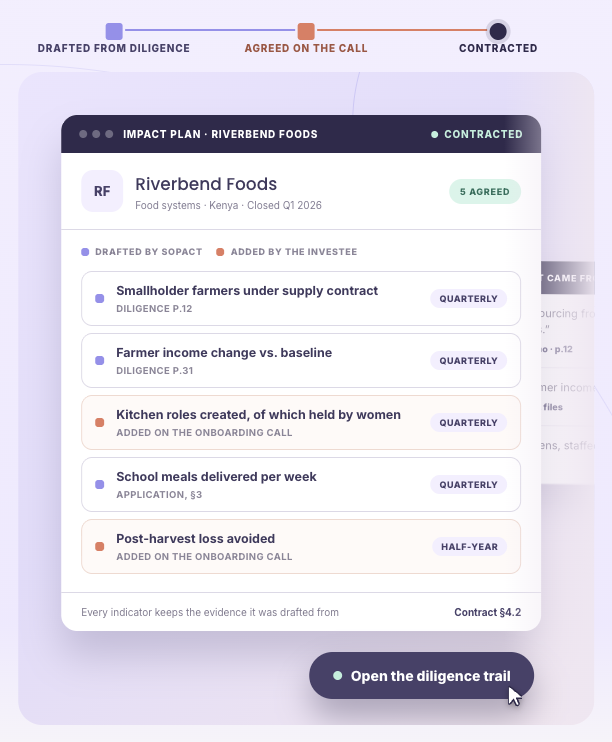
A practical IMM system preserves the chain: what was claimed, what evidence supported it, what was agreed, what was collected, what stakeholders said, which risks changed, and how the portfolio decision followed.
Sopact connects diligence documents, agreed outcomes, indicators, stakeholder evidence, quarterly results, risks, and source records on a persistent investee or grantee record. Portfolio views aggregate comparable evidence while preserving the context and citations behind each result.
Sopact does not replace cap-table, accounting, deal-flow, or fund-administration systems. It can work alongside them as the governed impact evidence and reporting workflow.
Use one recent investment or grant from diligence through a reporting period. Include a custom metric, a standard metric, stakeholder evidence, a changed assumption, an investee document, and the portfolio question an IC or LP will ask.
Impact and investment teams should be able to revise an agreed measure, review missing evidence, compare the portfolio, and prepare an audience view without a consultant each cycle.
How the options differ
The application, diligence, investment thesis, agreed plan, quarterly evidence, engagement notes, and exit history should remain connected.
How the options differ
The platform should read the full authorized set of metrics, reports, notes, and documents across the portfolio at the required cadence.
How the options differ
The team needs to see how the impact thesis, measures, targets, actuals, stakeholder evidence, and risks changed from diligence through exit.
How the options differ
Interviews, open-ended responses, site notes, and investee narratives explain who experienced change, why, and what may be unintended.
How the options differ
Memos, applications, impact studies, contracts, logframes, and investee reports hold important assumptions and evidence.
How the options differ
An assistant should answer across investees while respecting approved definitions, permissions, reporting periods, and evidence boundaries.
How the options differ
Every headline result needs a definition, unit, period, calculation, contributing investees, adjustments, limitations, and source trail.
How the options differ
The Five Dimensions of Impact—what, who, how much, contribution, and risk—help teams ask a complete set of questions, though the five words on their own do not say what each dimension is asking of an investee. IRIS+ and SDG mappings support comparability. A theory of change or custom investment thesis explains why the fund expects change. The operating step is to translate those frameworks into outcome and indicator definitions, units, segments, owners, collection cadence, calculations, sources, and reporting views.
Watch (8:45): a walk through each dimension in turn, and the reason the Impact Management Project settled on a common set of questions rather than a single impact score.
The same governed record should support each stage rather than creating a separate reporting project.
| Stage | Evidence to retain | Decision supported |
|---|---|---|
| Diligence | Impact thesis, stakeholder need, supporting studies, risks, candidate outcomes and indicators | Is the impact claim material, plausible, aligned, and testable? |
| Onboarding | Agreed impact plan, definitions, baselines, targets, owners, cadence, sources, and standards mappings | What will the investee and fund measure, and how will both interpret it? |
| Monitoring | Quarterly measures, stakeholder evidence, documents, missingness, changes, and risks | Is performance on track, and where should the fund or investee respond? |
| Portfolio review | Comparable roll-ups with investee context, exceptions, contribution, and uncertainty | What patterns, risks, and support needs appear across the portfolio? |
| Reporting and exit | Audience-specific results, source trail, limitations, learning, and durability | What can the fund credibly report, and what should change in future decisions? |
Yes. Keep systems that manage pipeline, cap tables, finance, documents, or fund administration. Connect the stable investee and investment identifiers, agreed measures, authorized reports, and evidence required for IMM.
Use the Academy chapters on turning requirements into evidence, building a data dictionary, and tracing every result to evidence.
IMM is the ongoing practice of defining, measuring, interpreting, and using impact evidence throughout investment, grant, or portfolio decisions.
IMM stands for impact measurement and management. Measurement produces evidence; management uses that evidence in decisions and improvement.
The Five Dimensions ask what outcome occurs, who experiences it, how much change occurs, how much the organization contributes, and what risk may prevent or distort the impact.
Investor contribution is the difference an investor makes through capital, engagement, signaling, market building, or other support. It is distinct from the enterprise's contribution to stakeholder outcomes.
Impact risk is the possibility that impact differs from expectations because evidence is incomplete, assumptions fail, results do not last, stakeholders are excluded, or negative effects occur.
They support common language and reporting alignment. Funds still need clear definitions, units, owners, cadence, calculations, sources, and investee context for each selected metric.
Stakeholder evidence should inform diligence, outcome selection, risk review, interpretation, unintended-effect checks, and reporting. It should remain connected to segments and source passages.
Usually not. IMM software should connect to those systems and govern the impact evidence, definitions, portfolio analysis, source trail, and reporting workflow.


