


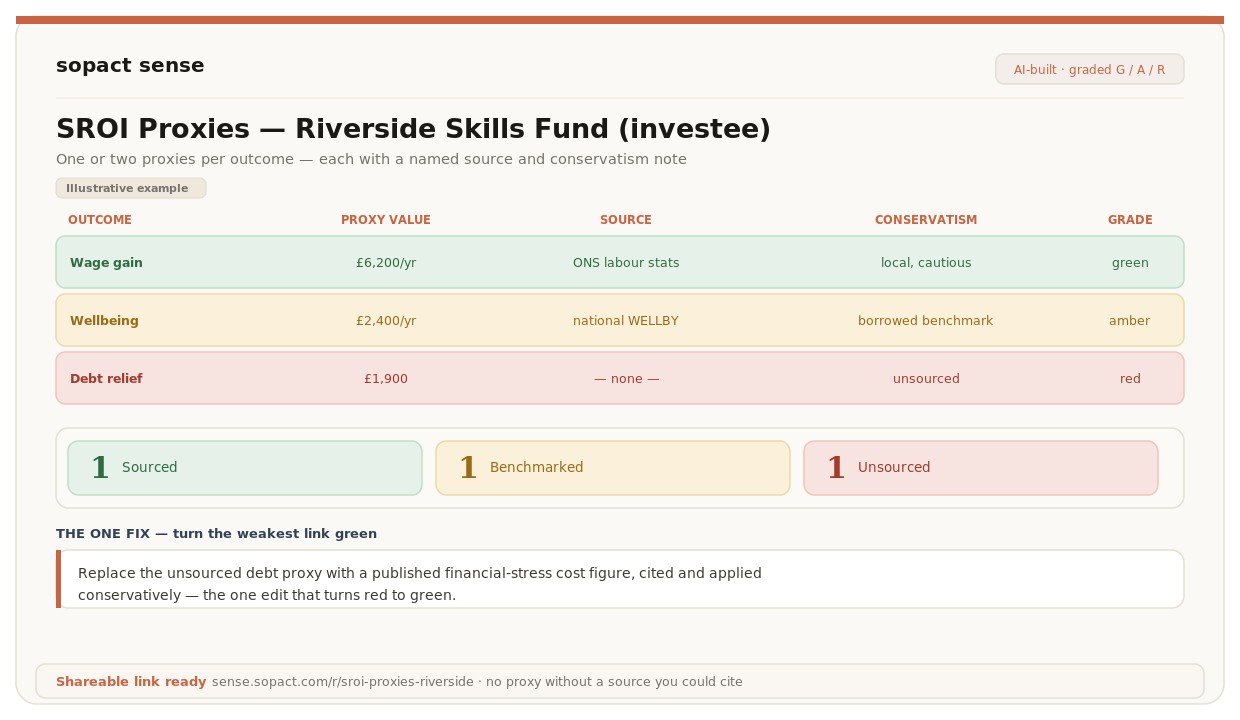
Use this only when valuation serves your decision. The numerical examples in these specialist readings are separate fictional exercises, not additional findings about the Foundation training team.
Define the outcome before looking for a number
A financial proxy is a monetary approximation of an outcome’s value. Begin with what changed for whom, how it was measured and over what period. “Got a job,” “increased earnings” and “improved wellbeing” are related but different outcomes. One convenient wage figure does not represent all three.
Ask affected stakeholders what matters about the change. Social Value International’s valuation guidance emphasizes their preferences when understanding the relative importance of outcomes. A method that values a service provider’s cost change may answer a different question from one that values a participant’s experience.
Write a short specification: “We want to value [defined change] for [stakeholder group], measured in [unit] over [period], for [decision].” If that sentence is unclear, searching a proxy database is premature.
Where can you look for valuation evidence?
Start with the original source or methodology behind a candidate. Useful places to investigate include official statistics and unit-cost publications, peer-reviewed valuation studies, and established valuation resources with accessible methods. A secondary list can help you discover a source, but it should not replace reading it.
The UK Treasury’s Green Book discusses market and non-market valuation approaches, including revealed preference, stated preference and wellbeing valuation. Its wellbeing guidance explains when evidence may support monetization. These are UK appraisal references, not a universal list of SROI proxies or a reason to transplant UK values into another setting.
For any database or published value, check its current methodology, version and permitted use. A screenshot of a number without its conditions is not enough. Save the source location and relevant passage so another reviewer can reproduce the choice.
Use a proxy-selection record
| Field | What to check |
|---|---|
| Outcome and stakeholder | Exact change valued and whose perspective it represents. |
| Source and method | Original publication, relevant passage, study method and limitations. |
| Unit and period | Per person, event, hour or year; duration and observation window. |
| Context | Population, geography, price year and currency. |
| Adjustments | Original value, any transformation and the reason for it. |
| Overlap and exclusions | What the value includes and might duplicate elsewhere. |
| Decision and review | Why selected, alternatives, reviewer and version. |
Give each approved candidate a source ID and version. Keep the original published value separate from any converted or adjusted value you use. That makes the change visible instead of leaving the reviewer to reconstruct it from a spreadsheet formula.
Worked example: compare candidates for an earnings outcome
The earlier valuation example established employment status, not an earnings gain. For this exercise only, suppose a separate fictional follow-up study now has approved before-and-after earnings records for a defined subgroup and observation period. This additional evidence is invented for teaching; it is not a new finding about a different lesson’s cohort.
Compare the following candidate approaches before inserting a monetary amount:
| Candidate | What it could support | Decision for this exercise |
|---|---|---|
| Reviewed earnings-change records | Observed monetary change for the measured subgroup and period. | Investigate as the direct financial outcome measure; contribution still unresolved. |
| Typical full-time annual wage | A labor-market benchmark with its own population and period. | Do not substitute for the subgroup’s actual earnings change. |
| Wellbeing valuation associated with employment | A different dimension of the employment experience under a specified method. | Assess separately; do not assume it is interchangeable or additive. |
The selection note could say: “Use the reviewed earnings-change measure for the observed subgroup and period. Do not extrapolate it to everyone with a job-status record. Retain the earnings definition, source references and coverage. Examine contribution separately. Do not add a wellbeing valuation unless it represents a distinct outcome and overlap has been assessed.”
The decision is not that one source is always best. It is that the chosen evidence answers this particular outcome question more directly than the alternatives. A different outcome could require a different method.
Check units, prices and geography
A value per person-year is not interchangeable with a value per event or a one-time change. Before multiplying, confirm the outcome quantity and duration use the same unit. A full-year value should not be applied to a shorter observation period without a justified method.
Record the price year and currency. If conversion or inflation adjustment is needed, document the source, date, method and reason. A currency conversion alone does not make an outcome valuation transferable across countries. Differences in services, incomes, institutions and the meaning of the outcome can matter.
A local source can improve relevance, but location alone is not a quality test. A weak local estimate is not automatically preferable to a rigorous broader study. Explain the tradeoff between method quality and contextual fit, and test a reasonable alternative where uncertainty remains.
Do not replace a missing outcome with a related cost
If the outcome is reduced financial stress, a debt balance and a financial-stress valuation answer different questions. A lower debt balance may help explain the change, but it is not automatically the monetary value of reduced stress.
Similarly, treatment cost, avoided service use and improved health are not synonyms. If your analysis concerns a provider’s resource use, establish that the service-use change occurred and that the selected cost measure fits. Do not label an estimated resource benefit as money actually saved in a budget unless the evidence supports that claim.
When no candidate fits, return to the outcome definition or investigate an appropriate valuation study. Do not reduce a loosely related number by 20% and call the mismatch resolved. The percentage would add another unsupported assumption.
Check what the proxy already includes
A candidate may already reflect aspects of the change counted elsewhere in the map. Before adding values, read the methodology’s treatment of income, wellbeing, health and other related effects. If two rows overlap, record how you will avoid double counting.
Also distinguish the value of an outcome from the share attributable to the activity. Selecting a good proxy does not resolve deadweight, others’ contribution or displacement. Those assumptions remain separate parts of the value map.
Use a “conservatism note” to explain a justified cautious choice, not to defend an arbitrary low figure. A lower number can still misrepresent the outcome, hide material harms or create an inconsistent comparison.
Write the selection note and test an alternative
Keep the approved proxy, rejected alternatives and reasons together. Your note should let a new reviewer understand the decision without repeating the whole search.
- What outcome and stakeholder does the value represent?
- Why does this source fit the measure and period?
- What conversion or adjustment was made, and why?
- What is excluded or potentially overlapping?
- Which plausible alternative will you test in sensitivity analysis?
- Who approved the choice, and when should it be reviewed?
For example, if two defensible valuation choices produce different conclusions, do not hide the less favorable result. Explain the difference and what additional evidence would help resolve it. A sensitivity range describes tested assumptions; it is not automatically a statistical confidence interval.
In a configured Sopact workflow, keep this selection note with the outcome evidence and source documents. Test that your team can retrieve the source and distinguish an approved value from a draft suggestion. The assistant can support review; it does not certify a proxy merely by assigning a green label.
Add this to your plan
Record what you decided in this chapter in the same working evidence plan you started in Foundations, so definitions, sources and checks stay in one place.