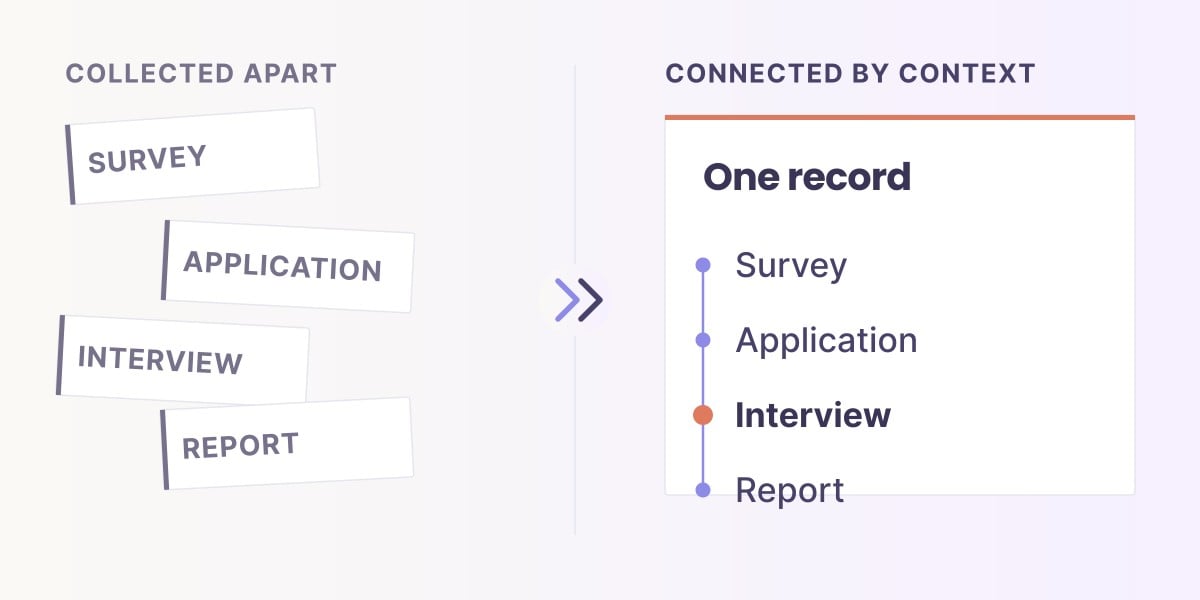
What is partner intelligence?
Partner intelligence is the use of connected information to understand partner performance, relationship health and the next action a partnership needs. It brings together what partners deliver, what they report, what people experience and the evidence behind a decision. The scope varies: a channel team may examine sales and enablement, while an operations team reviews delivery, service quality and unresolved commitments.
A useful view answers three questions: What happened? What might explain it? What should we do next? Partner feedback helps with the explanation, but it is not the only evidence. Delivery records, agreed standards, support cases and documents can reveal issues that a survey misses. Equally, an on-time delivery total may hide repeated confusion about instructions.
This guide focuses on recurring evidence across operational and service partners. It is for teams that receive updates from several organizations or sites and need a dependable review process without rebuilding their analysis every reporting period.
Start with the decision the partnership needs
Before adding a scorecard or another survey, choose the decision the information should support. Are you trying to resolve delivery exceptions, improve onboarding, understand partner experience or decide which relationships need additional support? These questions need different evidence and different review schedules.
Scroll horizontally to see all columns →
| Decision | Useful evidence | A limit to remember |
|---|---|---|
| Where should we investigate delivery problems? | Due dates, receipts, exception notes and agreed tolerances | A late receipt may reflect a recording delay rather than a late delivery. |
| Which partners need onboarding support? | Completion records, unanswered questions and partner comments | Training completion does not establish that someone can use the process. |
| What makes working together difficult? | Short check-ins, support cases and interviews | The people who respond may have different experiences from those who do not. |
| Can we report a consistent network result? | Shared definitions, period coverage and source records | Similar labels do not guarantee comparable measures. |
Write down who can act on the finding. If nobody can change an approval delay, clarify a requirement or provide support, collecting more detail about it will not by itself improve the relationship. Agree how findings will return to partners, too.
Connect the right records without flattening the network
One organization can have several sites, contracts and contacts. Keep those relationships explicit. A partner organization is not interchangeable with a delivery location, and a contact changing jobs should not erase the organization's earlier evidence.
For example, Partner P-12 may support Sites A and B under Agreement G-4. A monthly return describes the organization; a receipt belongs to a particular site and delivery; a comment comes from a named role or an anonymous respondent. Each needs the appropriate context. Putting everything into one undifferentiated row makes later comparisons harder.
- Organization context: a stable partner reference, relationship type and responsible owner.
- Operational context: the relevant site, agreement, activity or delivery reference.
- Time: the reporting period and the date an event occurred, which may differ from submission time.
- Evidence: the original response or document, source and review status.
- Follow-up: the issue, action owner, due date and later result.
Collect stable registration details once and update them when necessary. Information such as contact role or operating location can change, so preserve the context needed to interpret earlier records. Do not collect personal identifiers merely to make a dashboard look complete; organization-level reporting and anonymous relationship feedback may be sufficient.
Let local collection vary around a small shared core
Different partners may use different forms, languages or operational systems. Requiring every partner to adopt an identical questionnaire can add work without improving the decisions you need to make. Start by identifying the few fields required for a shared comparison.
A shared core might include partner reference, site, period, number of deliveries due, number received on time and the definition of “on time.” Local forms can add questions about equipment, scheduling or local service conditions. The core is an agreement about meaning; it is not a demand to collect every possible field everywhere.
Record the following in a data dictionary before aggregating:
- What each measure means, including its unit and eligible population.
- Which source supplies it and who reviews corrections.
- How local labels map to the shared definition.
- How missing, unknown and not-applicable values are treated.
- Which changes require a new version or break in the trend.
Suppose one site records calendar days and another working days. Renaming both fields “turnaround time” does not resolve the difference. Convert them only when the underlying dates and agreed rule allow it; otherwise report them separately. The same principle applies when one partner counts people and another counts visits.
Read delivery evidence and partner experience together
Use a short check-in when you need to understand the working relationship. Ask about a specific period or event so the answer has context. Useful questions include:
- How clear were the requirements for this reporting period?
- Which step caused the most avoidable work, if any?
- What information or support did you need but not receive?
- What worked well and should continue?
- What would you like the responsible team to follow up on?
Provide a suitable response scale where comparison is useful and an optional comment where explanation matters. Do not make every comment mandatory. Tell contributors who will see the answer and whether it may be used in a performance review. A confidential relationship check-in and an identified service request serve different purposes.
Compare the feedback with operational evidence without assuming one proves the other. A partner may report a slow approval process while meeting every deadline through extra work. Another may miss a deadline because your team changed a specification. Both deserve investigation; neither is captured fairly by a single activity count.
For more question design guidance, use the stakeholder survey question guide. Choose only the questions relevant to the people contributing.
A worked partner review: keep the denominators visible
Consider this fictional monthly review. Partner A has 80 deliveries due and 72 on time. Partner B has 20 due and 14 on time. A's on-time rate is 90%; B's is 70%. Across both partners, 86 of 100 deliveries were on time, or 86%. Averaging the two percentages would give 80%, which answers a different question: the average partner rate with each partner weighted equally.
Keep both views if both help, and label them. Delivery-weighted performance describes the combined operation. Equal partner weighting can help review relationships without allowing a high-volume partner to dominate the result.
Now add the feedback. Thirty representatives were invited, 18 responded and six mentioned unclear approval instructions. That is six of 18 respondents, not six of all partner organizations. Some organizations may have more than one representative. Before presenting an organization-level figure, establish which organizations were covered and how multiple perspectives will be summarized.
The comments suggest an issue to investigate. They do not prove that unclear instructions caused every late delivery. Check the relevant cases, dates and decision records. The review might lead to a clearer approval guide, a named escalation contact and a follow-up check next month.
Report missing evidence alongside the result. If one site's receipts have not arrived, the combined delivery rate may be incomplete even though all partner surveys are in. A survey-completion percentage cannot stand in for coverage of the operational data.
Use AI to assist review, with evidence people can inspect
AI can help organize comments, extract information from documents and draft a summary for review. The useful output includes the source passage, the relevant partner and period, and an indication of what is missing or uncertain. A confident summary without those details can send the team toward the wrong action.
Test ambiguous and contradictory evidence. “We received it late” might refer to instructions, a shipment or a payment. A revised report may supersede one figure while leaving the rest unchanged. A scanned document may contain an extraction error. The reviewer needs a way to inspect the source and correct the interpretation.
Do not treat a repeated AI answer as proof that it is correct. Check a sample against the original evidence, confirm calculations separately and record the version used for important reports. Permission to view one partner's record must not automatically mean permission to view another's confidential documents.
A practical first use is to prepare an exception list for a human review meeting. Keep the final decision, its owner and the evidence used separate from an AI-suggested theme or priority.
How to evaluate partner intelligence software
Begin with your existing systems. A CRM or partner relationship management platform may already hold relevant information and provide reporting. Salesforce, for example, documents partner reporting and dashboards. Evaluate the missing workflow and maintenance burden before adding another platform. Source: Salesforce partner reporting documentation.
For a recurring collection and analysis workflow, test one complete period rather than a polished dashboard alone. Include two partners, multiple sites, a renamed contact, a corrected figure, a missing return and a document that disagrees with a form response.
Scroll horizontally to see all columns →
| Test | What a useful demonstration shows |
|---|---|
| Local forms and shared measures | Different collection formats map to agreed definitions, with exceptions visible. |
| Record relationships | Organization, site and period remain distinct; corrections do not silently overwrite history. |
| Analysis | A result exposes its denominator, filters, exclusions and supporting evidence. |
| Access | Contributors and reviewers see the information appropriate to their responsibilities. |
| Action | A reviewed issue reaches its owner and has an agreed follow-up record. |
| Team ownership | The operational team can maintain routine definitions and collection changes after setup. |
Sopact's relevant starting point is collecting recurring partner evidence, analyzing it with context and keeping definitions and access under the team's control. Confirm the exact collection modes, imports and action-management connections your implementation needs. Do not assume that a proposed workflow is a native feature simply because it appears in a diagram.
Include implementation and ongoing review time in the buying decision: preparing source data, agreeing measures, configuring access, training contributors, reviewing AI output and maintaining integrations. A lower subscription does not necessarily mean a lower total operating cost, but that needs to be demonstrated for your own process.
Start with one recurring partner review
Choose a review the team already needs to run. Agree the decision, the shared core and the people who will contribute. Collect one period, inspect the exceptions and return a concise summary to the partners involved. Then revise the process using what made collection or interpretation difficult.
Food4Education's published story offers a relevant example: the starting point was aggregating supply-chain data, with a broader connected operational view as a development goal. It illustrates a practical foundation rather than a claim that every downstream outcome has already been measured. Read the Food4Education story.
For the planning exercises, follow the Partner & Supplier Academy course. For wider reporting, use the stakeholder feedback guide to plan what contributors should hear back.
Frequently asked questions
Is partner intelligence the same as partner relationship management?
Partner relationship management covers the processes and systems used to run partnerships. Partner intelligence is the understanding developed from relevant evidence. A PRM system may supply much of that evidence, while other collection and analysis tools can fill specific gaps.
Do we need one survey for all partners?
No. Use a small shared core where comparison is necessary and allow local questions where the work differs. Define the meaning, unit, period and missing-data rules before aggregating responses.
Can partner feedback predict a relationship problem?
Feedback can reveal concerns worth investigating. It does not guarantee a prediction. Review comments alongside operational records and follow-up evidence before concluding that a partnership is at risk.
How often should we review partner evidence?
Match the schedule to the decision. An urgent delivery exception may need immediate attention, while a relationship review may be quarterly. Avoid collecting repeated surveys when nobody has time or authority to respond.
Should we give every partner a health score?
Only if the score supports a clear decision and its inputs are defensible. Keep the underlying measures visible. An overall score can hide a serious exception or make unlike relationships appear comparable.