


What is stakeholder engagement?
Stakeholder engagement is the work of involving people who affect or are affected by an organization's decisions. It includes understanding their needs, providing relevant information, seeking input where it can influence the work and explaining the response.
Stakeholders can include customers, employees, members, suppliers, delivery partners, participants and communities. They do not all need the same relationship or the same questions. Useful engagement begins with a specific decision and a clear understanding of whose experience matters.
A meeting or survey can be part of engagement, but the activity alone does not show what was learned. Equally, an information update can be valuable without collecting another response. The right approach depends on the purpose and the opportunity people actually have to contribute.
Why stakeholder engagement matters
People close to the work often see constraints that a central team misses. A member knows which services are useful. A supplier knows which instructions create avoidable delay. An employee may explain why a new process is difficult to use during a busy shift.
Engagement gives that knowledge a route into decisions. It can help identify problems earlier, test assumptions and make implementation more practical. Those are potential benefits, not guaranteed outcomes from sending a survey. The organization needs authority, capacity and a willingness to review what it hears.
Engagement also creates obligations of clarity. Explain why input is requested, who will see it and what can change. If the decision is already made, say so and focus on helping people understand or implement it rather than implying a choice that no longer exists.
Examples across different relationships
Scroll horizontally to see all columns →
| Relationship | Engagement question | Useful next step |
|---|---|---|
| Membership network | Which parts of the annual return create duplicate work? | Test a smaller shared core with different chapter types. |
| Customer experience | What happens between a support request and a useful resolution? | Review feedback alongside service records and assign an improvement owner. |
| Employee experience | What makes the new process difficult during daily work? | Offer appropriate confidential input and review differences across teams. |
| Partners and suppliers | Which requirements or handoffs cause recurring confusion? | Clarify definitions and check the next reporting or delivery cycle. |
| Training program | What support would help learners apply the skill? | Test practical support and follow up at a suitable time. |
| Community service | Who cannot access the service through the current route? | Investigate barriers with affected people and test another route. |
These examples involve different data and privacy needs. A confidential employee survey should not automatically become an identified person-level record. A supplier delivery exception may need a named organization and contact so the team can act. Choose the record structure to fit the purpose.
Be clear about the kind of involvement
Not every activity gives participants the same influence. Distinguish an update from a consultation, practical co-design or a shared decision. State what the organization will do with the contribution before asking for it.
For example, an update about a new deadline may need clear instructions and a route for questions. A consultation on a proposed form needs time to consider responses before finalizing it. Joint design requires participants to help develop or test options, not merely react to a finished proposal.
A more intensive method is not automatically better. Use a proportionate approach that fits the decision and people's time. What matters is whether the promise is honest and the activity can fulfill it.
A practical process for engaging stakeholders
- Define the decision. Identify what is open, what is fixed and who can act on the findings.
- Identify relevant groups. Include those affected and those missing from current evidence.
- Understand participation needs. Check timing, access, language, confidentiality and whether existing contacts represent the required experience.
- Choose the input and method. Ask questions that support the decision, using a survey, conversation, practical test or existing evidence as appropriate.
- Review findings and gaps. Examine numbers, comments and contradictory evidence with the relevant context.
- Decide and respond. Record what changed, why and who owns any follow-up.
- Check what happened next. Review the action and whether the process needs adjustment.
For the organizational priorities, use the engagement strategy guide. For activities and responsibilities, use the engagement plan and its editable template.
Collect evidence without imposing one survey on everyone
Different groups experience different parts of the work. Role-specific questions often produce more useful answers than one broad questionnaire sent to everyone. Use a small shared core where comparison is necessary and local questions where the needs differ.
In a multi-site organization, agree definitions before aggregating results. A “completed case,” “active member” or “on-time delivery” should mean the same thing across the records being combined. Document the period, unit, eligibility and missing-data rules. If meanings differ, explain the limits or show separate results.
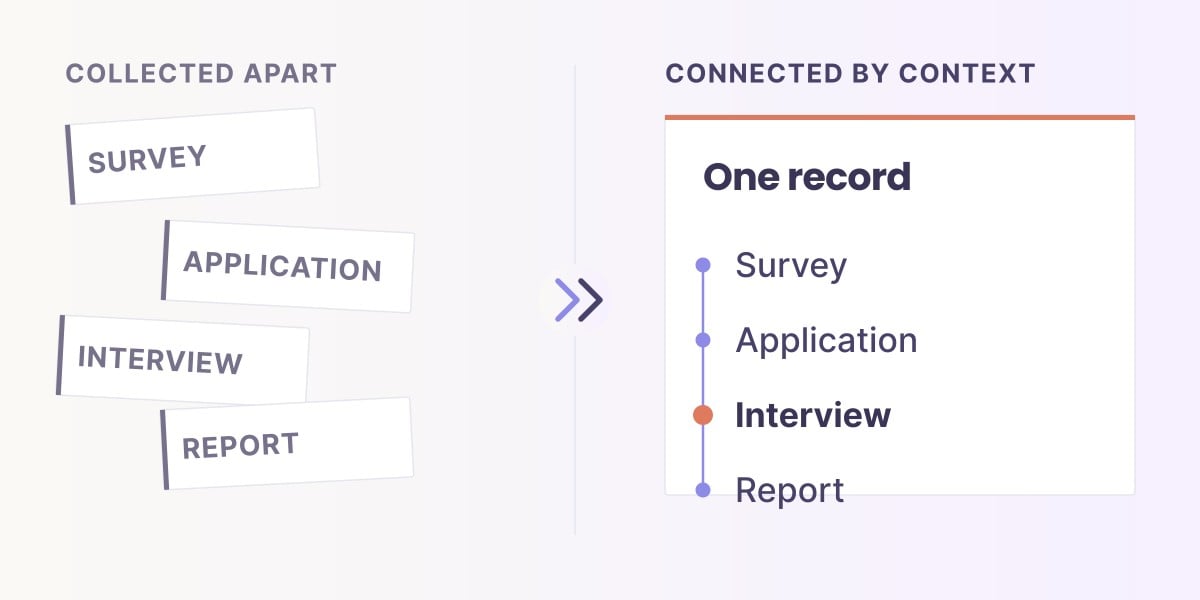
Reuse stable context rather than asking for it repeatedly. Keep changing information current and preserve earlier context when it affects comparisons. Anonymous group feedback can still support useful decisions without linking every contribution to a named person.
Combine closed questions and open responses when both help. A rating can show a pattern among respondents; a comment can explain an experience. Neither is automatically more valuable. See the stakeholder question guide for examples by role.
How to measure stakeholder engagement
Use several measures that reflect the purpose. Meeting counts and response rates are useful operational information, but they do not establish understanding, influence or trust on their own.
Scroll horizontally to see all columns →
| Measure | What to examine | Limit |
|---|---|---|
| Reach and coverage | Which eligible groups were invited and which contributed | A high total can hide missing groups. |
| Participation experience | Whether people understood the purpose and could contribute appropriately | Only respondents' experience may be available. |
| Evidence use | Which decisions considered the findings and how | Not every suggestion must be adopted for the input to be considered. |
| Response | Whether contributors received the promised explanation | Sending a message does not establish that it was understood. |
| Follow-through | Whether agreed actions were completed and checked | A completed task does not necessarily resolve the underlying concern. |
If you measure trust, use questions that actually address trust and interpret them in context. Automated sentiment from comments is not an interchangeable trust measure. A critical contribution may reflect strong engagement and a desire to improve the work.
Worked example: avoid a misleading average
A fictional network invites 200 members to review a service change. There are 150 members in larger branches and 50 in smaller branches. It receives 90 responses from larger branches and ten from smaller branches.
The overall response rate is 100 of 200, or 50%. Coverage differs: 60% for larger-branch members and 20% for smaller-branch members. An overall positive rating therefore needs that context before the team treats it as a balanced picture.
Among the 100 respondents, 70 say the new process is clear. That is 70% of respondents, not 70% of all members. Twelve of 40 written comments mention difficulty finding instructions; that is 30% of commenters. Do not mix the rating and comment denominators.
The next action could be a clearer instruction page and a targeted attempt to hear from smaller branches through a suitable route. The report back should explain both the improvement and the remaining evidence gap. A later check can assess whether contributors can find and use the revised instructions.
Common challenges and how to respond
Survey fatigue. Review repeated requests and ask whether recent evidence can answer the question. Make the purpose clear and return useful findings. Sending more reminders is not the only option.
Quieter groups remain absent. Investigate access and representation. A form cannot analyze the views of people who were never reached. Keep the gap visible rather than equating silence with satisfaction.
Conflicting views. Preserve the disagreement and examine context. Groups may face different conditions or prioritize different outcomes. A single average or majority vote may not resolve the decision fairly.
No response after collection. Assign a review owner and a decision owner before launching the activity. Set a realistic date for reporting back, including unresolved items.
Too many separate files. Keep group, period, source and definitions with the evidence. Start with a manageable structure and connect the workflow when recurring volume makes manual reconciliation difficult.
How software and AI can support the work
Software can help collect information, retain context, organize comments and make evidence available to reviewers. Existing CRM or engagement systems may already support some of this. Evaluate the actual gap and maintenance effort rather than assuming that all traditional tools only count meetings.
Sopact's relevant role is a recurring collection, analysis and governance workflow that operational teams can manage. Test whether reviewers can inspect the original evidence, understand coverage, maintain shared definitions and control access. Confirm the exact integrations and follow-up arrangements needed for your implementation.
AI can assist with themes and draft summaries, but review ambiguous comments, omitted perspectives and claims that go beyond the evidence. It does not guarantee fairness, detect every relationship problem or decide what the organization should do.
The Association for Project Management treats engagement as systematic work involving identification, analysis, planning and implementation. Keep that wider process in view when choosing tools. Source: APM stakeholder engagement guidance.
For practical planning, continue with the Membership & Networks course. Choose one real collection and review process, then build from what your team and contributors find useful.
Frequently asked questions
What does stakeholder engagement mean in practice?
It means involving relevant people appropriately, understanding their input and explaining the response. The activity should fit the decision and the influence participants can actually have.
What is the difference between engagement and consultation?
Consultation seeks input on a question or proposal. Engagement is the broader work of maintaining appropriate involvement and communication, which can include consultation, updates and joint work.
Is stakeholder engagement only relevant to nonprofits?
No. Businesses engage customers, employees, suppliers, partners and other affected groups. The purpose and data needs vary, but clear participation and responsible follow-through apply across sectors.
Do we need to identify every survey respondent?
No. Use identification only where it serves the purpose and is appropriate. Anonymous or group-level feedback can support decisions, while individual service follow-up may require a suitable contact route.
How do we show that engagement was useful?
Show who contributed, what was learned, how decisions considered the input, what was communicated back and whether actions were checked. Include important missing perspectives and limits.
