


Related solution
Applications & Grants
Connect application evidence, human review and the next program stage.
Explore the solution →

USE CASE / SOFTWARE GUIDE
Government grant management software helps public agencies and grant recipients organize applications, awards, reporting, monitoring and closeout. Good software supports accountable administration and makes the evidence behind a grant useful throughout delivery, so staff can understand progress and respond to emerging needs.
A grant can be administratively current while its program evidence remains difficult to interpret. Applications, site-visit notes, recipient reports and community feedback may live in separate systems. Staff then spend review time assembling the history rather than understanding whether delivery is progressing and what support would help.
AI can reduce repeated reading and make incoming evidence available sooner. Sopact’s role is connected application and program intelligence: bringing forms, files and feedback into context for continuing questions through AI Assistance. That role should be scoped alongside the agency’s award, accounting and formal reporting responsibilities.
Prepare application material for accountable human review.
Read recipient progress with the original grant purpose.
Use current evidence in support and reporting decisions.
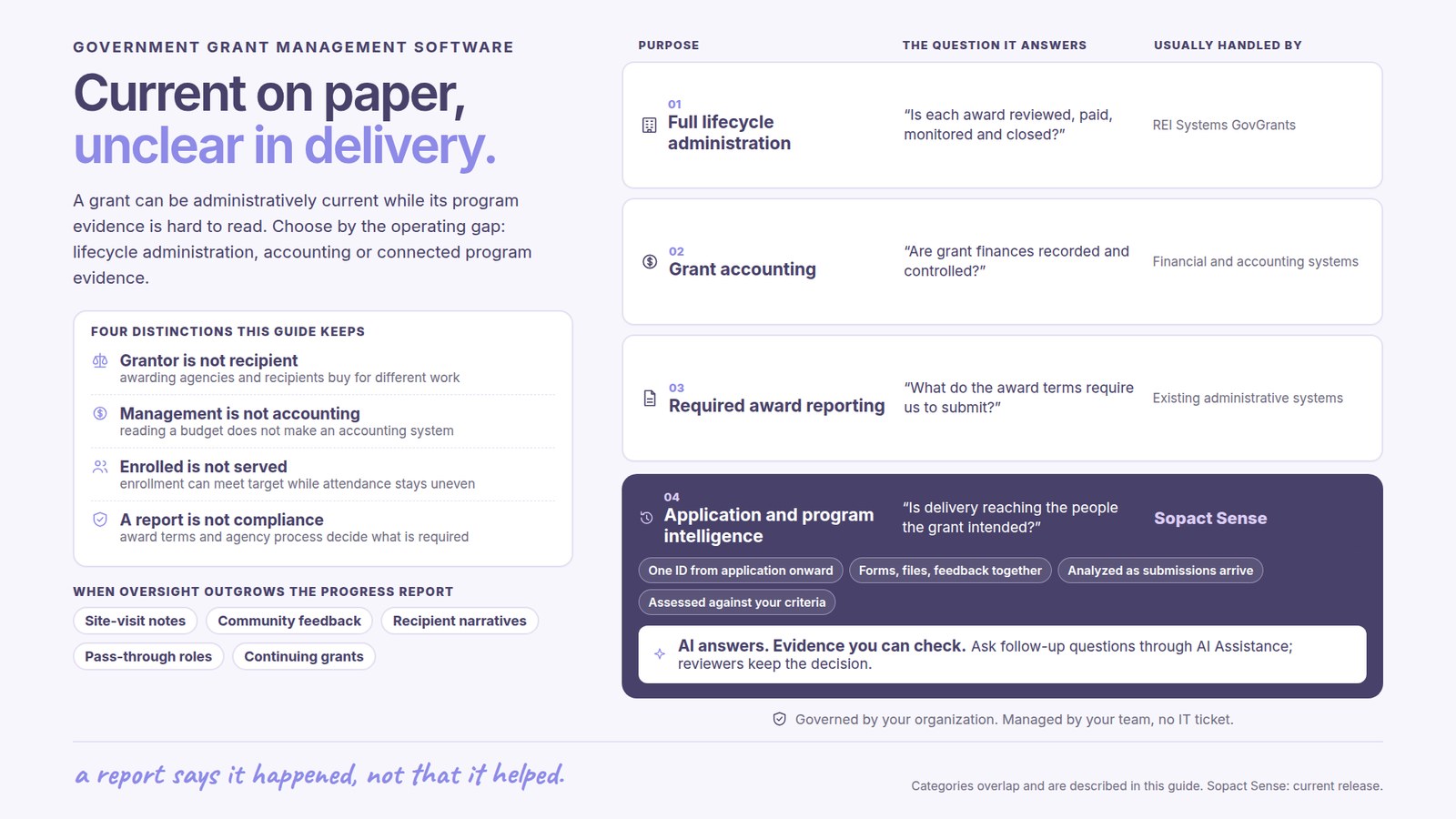
An awarding agency manages the opportunity, review, award and oversight process. A recipient manages its commitments, delivery and reporting back to the funder. A pass-through organization can have responsibilities on both sides. Those differences affect the software purchase.
Grants.gov describes the federal grant lifecycle across pre-award, award and post-award phases. The latter includes implementation, reporting and closeout. A useful selection process recognizes the full responsibility rather than treating grant management as application scoring alone.
Financial administration, required submissions and program learning are connected but distinct. If the primary need is grant accounting, evaluate the financial functions directly. An evidence-analysis platform does not become an accounting system because it can read a budget document.
REI Systems’ GovGrants factsheet documents application review, awards, monitoring, progress reporting, payments, closeout and analytics, with connections to government and financial systems. It illustrates why established public-sector grant platforms cannot be reduced to application portals.
Sopact addresses a different, sometimes complementary need: preparing and understanding evidence across the grant and program relationship. The organization may retain its existing administrative system while improving collection, analysis and the context available to program staff.
The choice should follow the operating gap. A wider platform migration and a focused program-intelligence workflow are different projects, with different scope and dependencies.
Application review involves more than producing a short summary. Reviewers need the relevant support for the published criteria, unresolved questions and a consistent basis for discussion. They remain responsible for the funding decision.
Sopact makes analysis available as submitted data arrives in the agreed workflow. Reviewers can inspect the material and use AI Assistance to prepare questions, including matters that require an interview or clarification.
For continuing grants, the evidence remains useful after selection. The application’s purpose and starting conditions can inform onboarding, recipient conversations and progress review. Staff avoid beginning every later stage with a disconnected version of the same history.
A report may show that an activity happened without explaining whether it served the intended participants. Site observations, recipient narratives and community feedback can help staff understand the difference.
For an illustrative local training grant, enrollment could meet the target while attendance is uneven because sessions conflict with working hours. A useful review connects those facts and opens a discussion about delivery. It does not interpret enrollment alone as proof of the intended outcome.
Sopact’s AI-native approach keeps incoming analysis available for those recurring questions, with the source material retained for review. The value is practical oversight and support while delivery continues, as well as a more coherent account when reporting is due.
A common data dictionary helps different recipients use compatible meanings for a shared measure. Define the unit, population, period, calculation and source appropriate to the grant. Unique participants, service visits and completed activities should not be added as if they described the same thing.
Preserve award-specific requirements and program-specific outcomes. A cross-program view can show comparable activity and common concerns without inventing a single success score for unrelated services.
Grants.gov’s post-award guidance describes monitoring progress and expenditures through programmatic and financial reporting. The actual award terms and agency process determine the required reporting; a software-generated account is not a guarantee of compliance.
Sopact’s typical setup estimate is two days to two weeks for an agreed collection and analysis scope. That estimate should not be read as a promise to complete government procurement, security review, financial integration or a full grant-system migration in that period.
Personalization and continuing support help program staff retain ownership of the questions and definitions they use. Agree the evidence sources, review responsibilities and relationship to existing systems so the new workflow reduces recurring preparation.
The application-review customer resource below illustrates a human committee workflow outside government. It is relevant to evidence preparation, not proof of a government deployment or authorization.
It supports public grant applications, awards, monitoring, reporting and closeout for grantors or recipients, depending on the workflow.
No. Accounting manages financial records and related controls. Grant management also covers applications, obligations, program evidence and oversight.
No. Its relevant role is collection and connected evidence analysis. Administrative systems can remain where they fulfill required award, payment and reporting functions.
No. It can prepare evidence and questions for reviewers, who retain responsibility for decisions under the agency’s process.
No. Sopact’s typical two-day–two-week estimate concerns an agreed setup scope. Procurement, authorization, complex integration and migration have separate dependencies.
Continue with a purpose
Related solution
Connect application evidence, human review and the next program stage.
Explore the solution →Continue learning
Explore how program criteria guide evidence review.
Start learning →
Customer story
A five-day launch and custom-rubric assessments prepared for a human committee.
Read the story →Explore how Sopact can connect application material, recipient reports and feedback with your program team’s ongoing decisions.
See it with your workflow →