


Related solution
Applications & Grants
Connect application evidence, human review and the next program stage.
Explore the solution →

USE CASE / SOFTWARE GUIDE
Grant software alternatives are platforms that can replace or extend how an organization receives applications, reviews evidence, administers awards and understands funded work. A good alternative removes the specific work slowing the team down while preserving the grant history, responsibilities and reporting the organization still needs.
The reason to reconsider a system is often practical: reviewers spend weeks reading attachments, program teams rebuild the context after selection, or each report requires another spreadsheet and narrative-analysis exercise. Moving those tasks to a new interface does not necessarily reduce the effort. The buying decision starts with identifying which part of the work needs to change.
AI now supports review and analysis in several established grant platforms. Sopact’s AI-native approach connects incoming forms, files and feedback with program context, making analysis available through AI Assistance during review and subsequent delivery. Its fit is strongest where understanding funded work matters as much as administering the award.
Make submitted evidence useful before committee review.
Carry relevant knowledge into funded work and follow-up.
Read results with the definitions and sources behind them.
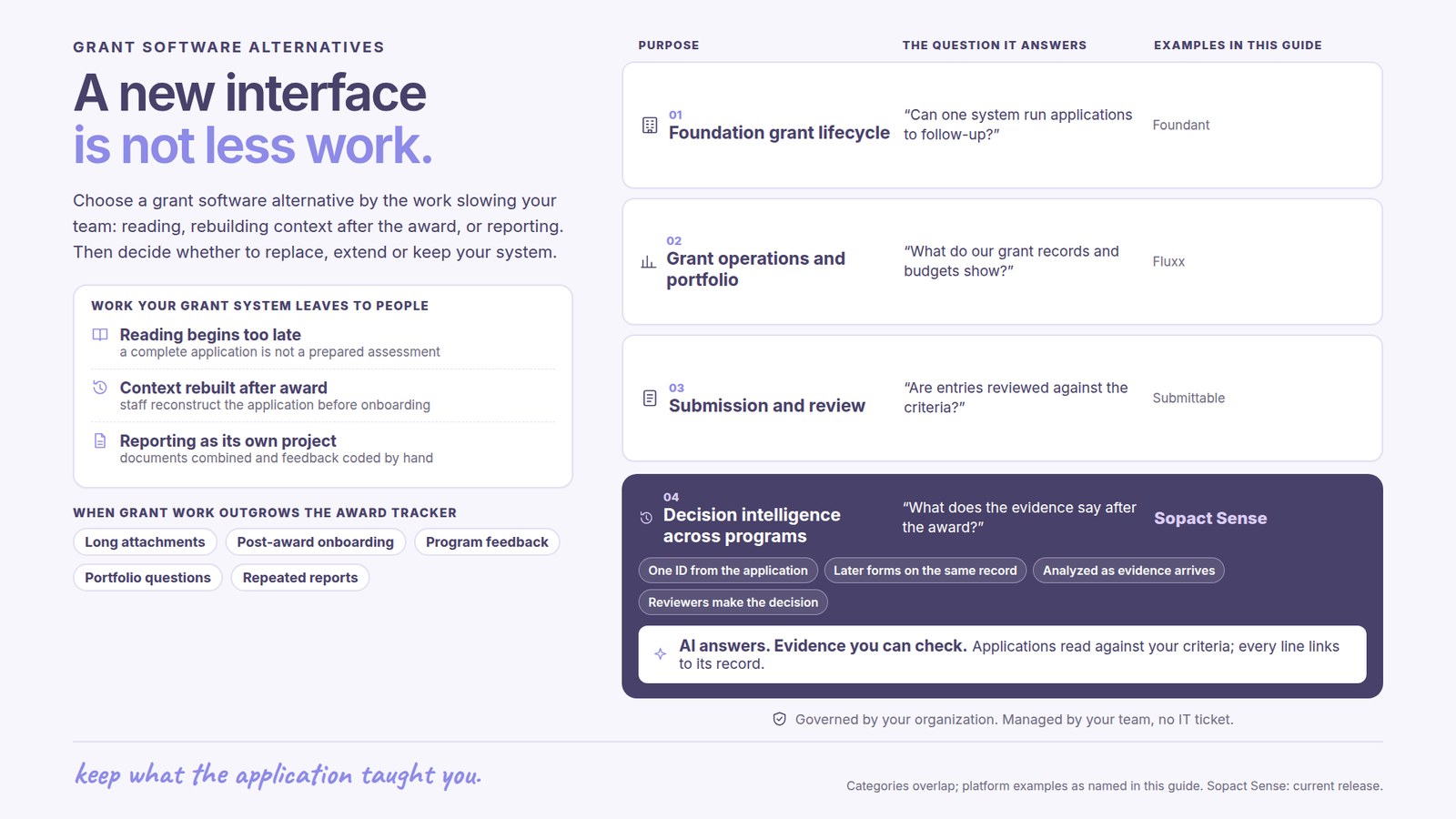
A complete application is not a prepared assessment. Reviewers still need to understand supporting material, relate it to the criteria and decide what needs clarification. The opportunity is earlier access to useful analysis, with the committee retaining judgment.
The application explains the proposed work, starting conditions and support needs. When program staff receive only an award record, they must reconstruct that context before onboarding or progress discussions.
A grant tracker can show deadlines and submitted reports while staff still combine documents, code feedback and interpret outcomes manually. If this is the problem, replacing payment or award administration may be unnecessary.
Foundant’s Grant Lifecycle Manager covers applications, review, decisions, payments and follow-up. Its current product description includes AI application summaries. It is a relevant choice for a foundation seeking a dedicated grant lifecycle system, including the work after selection.
Fluxx combines grant administration with Finn and Grantelligence. Finn answers questions across grant records, budgets and documents; Grantelligence supports portfolio dashboards. A buyer looking for AI around an existing grant portfolio should evaluate these capabilities directly.
Submittable’s automated review offering includes AI-assisted assessment against criteria. It belongs in the shortlist when intake and review coordination are central. The depth of later program analysis is a separate purchasing question.
Sopact connects applications with subsequent forms, files, interviews and feedback. Analysis becomes available as new evidence arrives and can support continuing questions through AI Assistance. The value is a shorter path from program evidence to a useful decision, personalized to the organization’s work.
An application summary, a criteria-based assessment, a portfolio question and analysis of new participant feedback solve different problems. A platform can offer several of them. The meaningful distinction is which sources are included, when the analysis is available and whether it remains useful for later work.
For a grant supporting training, the proposal might establish the intended participants and delivery model. Later assessments, mentor notes and interviews explain progress. Sopact keeps that evidence in context so the team can examine a new question without rebuilding the program account.
For a scholarship or one-time award, that continuing journey may be unnecessary. The important benefit can be prepared evidence for selection and clear human review. Buying a broader program workflow only makes sense when the organization will use it.
During intake, incoming analysis helps reviewers understand the material and identify questions for an interview or clarification. It does not make the final decision or remove deliberation. After selection, relevant context can help staff personalize onboarding and support.
During delivery, program feedback can reveal a difficulty that an award-status dashboard would not explain. For example, a funded training program may reach its enrollment target while participants report that the timetable prevents attendance. Connecting those sources lets staff discuss an adjustment while the program is running.
At portfolio level, shared definitions make compatible measures easier to interpret together. Program-specific evidence remains available to explain differences. Sopact’s grant-management guide develops this continuing use of evidence.
Replacement makes sense when the operating system itself no longer fits the organization’s responsibilities. Extension can make sense when administration works but collection or analysis across programs remains difficult. Retaining and improving the current system may be sufficient when existing capabilities have not yet been used effectively.
A sound transition preserves the meaning of historical applications, decisions and reports. It also keeps ownership clear between grant operations, program staff and finance. The objective is fewer handoffs and less repeated preparation, rather than two systems containing conflicting versions of the same award.
Sopact can be scoped for a defined collection and analysis need alongside another system. Available exports, integrations and responsibility for each source shape that arrangement. The best grant-management software guide provides a broader shortlist by purpose.
Sopact’s typical setup estimate is two days to two weeks for an agreed scope. That is different from the time required to migrate an entire grant operation or reach a committee decision. A meaningful estimate includes the sources, criteria and ongoing questions the program needs.
Once the configured workflow is operating, analysis is available as data arrives. Reviewers can use the prepared evidence, ask further questions and apply human judgment. The benefit is less waiting for a separate reading and coding exercise, not a promise that every review cycle ends instantly.
Personalization, self-governance and continuing Sopact support are part of the value: the team can maintain its program knowledge as the work changes. Choose the platform that reduces the recurring burden you actually face, with enough operational depth for the responsibilities it will own.
They are platforms that replace or extend grant intake, review, administration or analysis. The right choice depends on which responsibility needs to improve.
No. Grant-writing and discovery tools help applicants find opportunities or prepare proposals. Grant management can cover funder intake, decisions, awards, follow-up and reporting.
Yes. Current offerings include Foundant application summaries, Submittable review assistance and Fluxx portfolio questions and analytics. Compare their scope with the work your team needs.
When the organization needs incoming evidence from forms, files and feedback to support review, continuing program questions and portfolio learning, with personalization and team ownership.
No. A defined collection or analysis workflow may sit alongside an existing system when administration still works. The data exchange and responsibilities belong in the agreed scope.
Continue with a purpose
Related solution
Connect application evidence, human review and the next program stage.
Explore the solution →Continue learning
Explore how program criteria guide evidence review.
Start learning →
Customer story
A five-day launch and custom-rubric assessments prepared for a human committee.
Read the story →Explore how Sopact can connect application evidence with the program and portfolio questions your team needs to answer.
See it with your workflow →