


Related solution
Applications & Grants
Connect application evidence, human review and the next program stage.
Explore the solution →

USE CASE / SOFTWARE GUIDE
Grant management software for universities helps research offices and program teams manage funding applications, reviews, awards and reporting. Good software supports the institution’s actual funding responsibilities while making proposal evidence and later progress useful to the people deciding how to allocate and support resources.
Universities make several different purchases under this label. Sponsored-research teams need proposal routing, sponsor submissions and award administration. Internal seed-funding and innovation teams need a fair review process and a way to follow funded work. Treating both as the same problem can leave one team with excessive administration and another without essential controls.
AI makes application narratives and progress reports easier to analyze before a committee or program meeting. Sopact focuses on that connected evidence: analysis becomes available as material arrives and remains usable through AI Assistance during review and subsequent program support. It should be evaluated alongside the university’s required research-administration and financial systems.
Read proposals against the program’s criteria.
Keep intended milestones and earlier evidence available.
Connect updates with decisions about mentoring and further support.
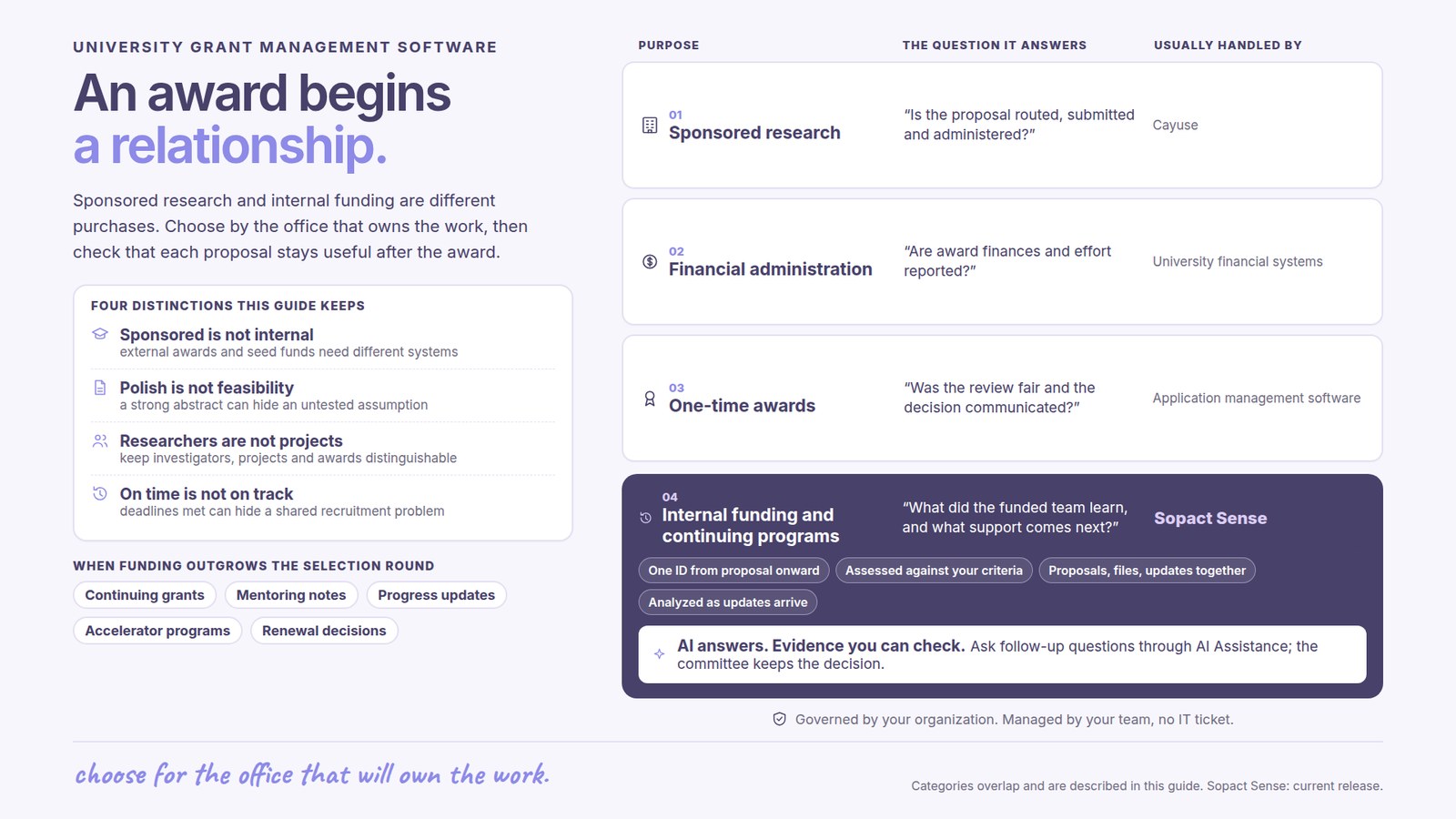
Sponsored-research administration involves the institutional process around external awards. Proposal approval, sponsor-specific submission, agreements, financial management and effort reporting can be central requirements. Cayuse’s award-management suite documents these distinct functions across pre-award and post-award work.
Internal funding has a different immediate decision: which research, student or innovation proposals should the institution support? Review criteria, committee judgment and follow-up may matter more than a federal submission workflow. A university can need both types of system.
Start with the responsible office and the funding process. Software that helps a committee understand applications does not automatically replace the system responsible for sponsored-award accounting or required submissions. This distinction keeps the shortlist relevant.
A proposal contains more than a summary of an idea. Reviewers need to understand its purpose, supporting evidence, feasibility, intended beneficiaries and unresolved questions against the competition’s criteria. A polished abstract can still leave those questions unanswered.
Sopact analyzes submitted material within the agreed review workflow, making evidence available for human assessment. The benefit is less initial reading and reconciliation before reviewers discuss the proposals that need judgment. Interviews and clarification remain part of the decision where the committee requires them.
For a seed-funding competition, a reviewer may need to distinguish a strong research question from an untested delivery assumption. Showing the relevant source material helps the committee discuss that distinction. AI-generated assessments should remain reviewable rather than becoming an unexplained final ranking.
An award begins a relationship. The application explains what the team proposed and why the institution supported it. Progress updates, mentoring notes and later outcomes should add to that understanding instead of starting a separate reporting exercise.
For an innovation program, staff may want to know whether a venture tested its assumptions, how mentoring affected its next step and what obstacle requires support. Those questions differ from whether a form was submitted on time. The underlying evidence can inform both the next conversation and a portfolio review.
Keep investigators, project teams and awards distinguishable. One researcher may participate in several projects, and one project may have several contributors. The buyer benefit is an interpretable history rather than a single undifferentiated activity total.
Sopact connects application evidence with incoming project updates and relevant program context. Analysis is available as data arrives in the configured workflow, so a program lead can ask a new question through AI Assistance without first assembling every report.
Consider a fictional seed program where projects meet reporting deadlines but several teams describe difficulty recruiting study participants. A status dashboard may show everything as current. Reading the narratives together exposes a shared delivery constraint that may deserve coordinated help.
The useful result is a support decision: discuss recruitment assistance, revise an unrealistic milestone or examine whether the difficulty is local to one project. A summary of each report is helpful preparation; connected analysis helps the institution learn across the funded work.
Carnegie Mellon Project Olympus’s published story describes an application workflow launched in five days, with custom-rubric analysis prepared for a human committee. The program had a short launch and decision window.
That evidence supports a specific point: a university program can improve application preparation and review without treating it as a months-long system rollout. It does not establish that an entire sponsored-research office, finance environment or compliance process was replaced.
Sopact’s broader setup estimate is two days to two weeks for an agreed scope. The initial workflow, historical material, integrations and institution-specific requirements determine what can be delivered in that period. Final selection and award approval remain with the university.
Research administration, internal competitions and program learning have overlapping evidence but different obligations. Identify which system owns each responsibility so faculty and staff do not receive duplicate requests or conflicting instructions.
For a continuing grant or accelerator program, the value of Sopact is the evidence retained after selection: onboarding, mentoring, progress and later questions remain connected. For a one-time award, focus on review quality and communication without adding unnecessary follow-up.
Personalization and continuing team support should help the program adapt its questions while preserving earlier meaning. For the broader selection category, see application management software.
It supports university funding work such as applications, reviews, awards and reporting. Sponsored research and internal funding require different scopes.
Its role here is application and program intelligence. Sponsor submission, financial administration and other institutional responsibilities must be addressed separately.
Yes. In continuing programs, the application can inform onboarding, mentoring and progress review instead of being archived separately.
Sopact’s typical estimate is two days to two weeks for an agreed scope. That is not a promise to migrate all university research systems in that period.
Human reviewers and the institution retain the decision. AI prepares evidence and assessments for review and follow-up.
Continue with a purpose
Related solution
Connect application evidence, human review and the next program stage.
Explore the solution →Continue learning
Explore how program criteria guide evidence review.
Start learning →
Customer story
A five-day launch and custom-rubric assessments prepared for a human committee.
Read the story →Explore how Sopact can bring applications, review and ongoing project evidence into a workflow your program team owns.
See it with your workflow →