What is outcome tracking in grant management?
Grant outcome tracking follows the changes a grant was made to produce, such as people placed in jobs that last, using the definitions and dates written into the grant agreement, and checks every grantee report against them. It sits beside the financial and compliance side of grant management, not inside it.
Most grants systems are good at the award, the payments and whether a report arrived. The weak point is what happens next: a report lands as a PDF or a spreadsheet, its numbers are copied into a portfolio sheet, and nobody checks whether "placed" means the same thing in every row.
THE SHORT VERSION
- Write the outcomes into the grant agreement with a definition, a period and a due date for each, so there is something to track against.
- Check each grantee report metric by metric as it arrives, and turn every gap into one plain question sent within days.
- Roll up only the numbers that share a definition, and show the held ones beside the total with a one-line reason.
How is outcome tracking different from tracking spending and activities?
Spending tracks the money, activity tracking counts what was delivered, and outcome tracking asks what changed for the people the grant was meant to reach. A grant can spend to budget while delivery lags, or deliver every session without the change it was funded for, so keep the three apart.
| Layer | Question | Example |
|---|---|---|
| Money | Was it committed, paid and spent as agreed? | Budget lines, disbursements |
| Delivery | Were the activities and outputs completed? | Enrolled, completed training |
| Outcomes | What changed, for whom, over what period? | Placed within 90 days, retained at 12 months |
Impact Frontiers' Five Dimensions of Impact separate the outcome, who experiences it, how much change, contribution and risk. That framing helps decide what evidence an outcome needs before anyone calls it impact.
What should a grant agreement say about outcomes?
For each outcome, the agreement should name the metric, how it is counted, for whom, when it is due and where the evidence comes from, in words both sides would read the same way. The best moment to write this is the onboarding call, from the grantee's own theory of change.
The running example on this page is fictional: a regional workforce fund that makes grants to four job-training partners, A to D. Its agreement covers five metrics: participants enrolled, completed training, placed in a job, retained, and starting wage.
| Term | Agreed wording | Question to settle |
|---|---|---|
| Who counts | Unique people, not visits | Who is excluded, and why? |
| Placement | In a job within 90 days of exit | What counts as a job? |
| Retention | Same job at 12 months, annual | How is it confirmed? |
| Wage | Hourly starting wage, by track | Is a track field collected at intake? |
| Rhythm | Enrolled quarterly; the rest annual | Which report carries which metric? |
| Ownership | Grantee collects; fund reviews | Who resolves a disagreement? |
Agree a small set the grantee can actually collect. If a change takes longer than the grant period, say what can be observed during the grant and whether a later follow-up is feasible; closeout and long-term learning do not have to share a date.
How do you check a grantee report against the agreement?
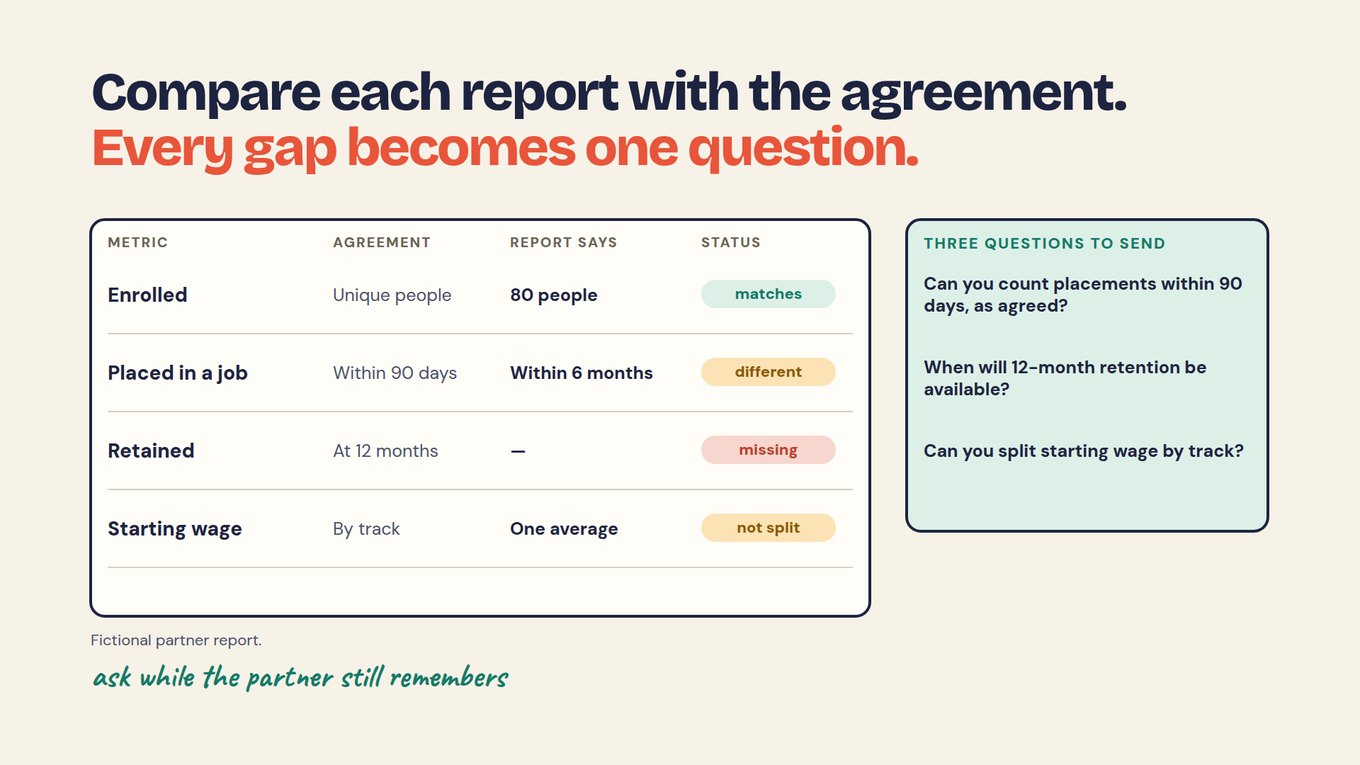
Start the review when the report arrives, read it against the agreement's list of metrics, and give each metric a status: matches, different definition, missing or not split. Only a match goes into the portfolio as it is; everything else waits for an answer.
Take Partner C in the workforce example. Its enrolment figure, 80 unique people, is ready to use; the other three are not. Placements are counted at six months rather than 90 days, 12-month retention is absent, and starting wage arrives as a single average rather than one figure per track.
Decide in advance how your team handles the cases that do not fit neatly:
| Situation | What to do |
|---|---|
| Report not received | Follow up; never record zero delivery |
| Two figures disagree | Keep both and ask which is right |
| Below target | Check timing and explanation before deciding on support |
| Definition changed | Note which periods can still be compared |
| Metric not yet due | Log it as "not due", not "missing" |
What should you send back to the grantee?
One message per grantee, within days of the report, with one plain question per gap that names the agreed definition and asks for something the grantee can pull from its own records. For Partner C, that is three questions: can you count placements within 90 days, as agreed; when will 12-month retention be available; can you split starting wage by track?
Keep the tone clarifying. A grantee that reports to several funders is usually filling in several templates, and a six-month window is more likely another funder's definition than a mistake. A short thank-you, the three questions and a date for the answer is enough.
Record each gap, question and answer in a gap log beside the agreement, one row per metric. The chapter Check each partner report against the agreement gives the four-column template and a prompt for the first pass.
How do you roll up outcomes across a grant portfolio?
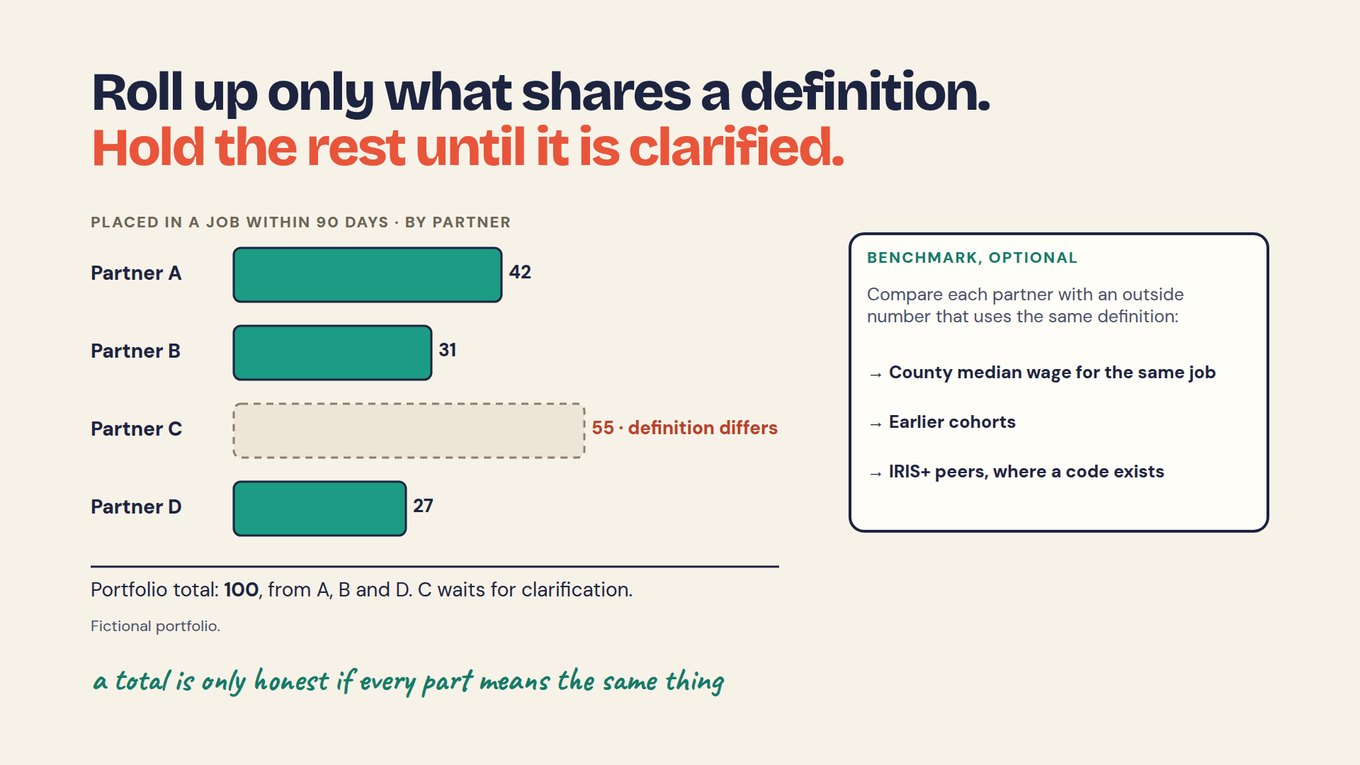
Add only the numbers that share a definition, and put each held number beside the total with a one-line reason, so the portfolio figure is honest and no grantee's work disappears. A total is only as good as the least comparable number inside it.
For placements within 90 days, Partners A, B and D reported 42, 31 and 27, so the portfolio total is 100. Partner C's 55 is held, because it counts six months; when C answers, its 90-day count joins the total, and that count cannot exceed 55.
Two more habits keep a roll-up honest. Do not add cumulative quarterly totals together as if each quarter were a new group of people, and show the denominator beside every rate instead of averaging partners' percentages. A board report can then state the total, what is held and why, in one line each.
What happens when a grant's targets or definitions change?
Keep the original and the amended agreement side by side, with the reason, who approved it and the date it takes effect, and judge each period against the terms that applied at the time. A revised target should never make an earlier period look as if it met a target that did not yet exist.
If a definition changes, such as moving placement from 90 days to six months, change it for every grantee from a stated period and keep earlier periods on the old wording. For closeout, the Grants.gov post-award overview covers implementation, reporting and closeout for US federal awards; other funders follow their own rules.
Where do grants software and AI help with outcome tracking?
Software helps most when every report lands on the right grantee's record, the agreed definitions sit next to it, and any number in a summary can be opened back to its source. You may be able to get there with your current system: some grants platforms, such as Fluxx, describe outcome and portfolio reporting features in their product pages.
In Sopact Sense, each grantee has one persistent ID and every report and follow-up lands on that record. An Intelligence Cell can read each report on arrival with a prompt you configure, each grantee's data can sit in its own folder, and every line of an AI Assistant answer links to a record you can open.
The video below walks through an AI workflow that reads applications and program evidence. Watch for the moment a summary is traced back to its source document, the step to test in any tool.
Any AI tool can do the first pass if you give it the agreement and forbid guessing; keep participant names out of what you paste.
PROMPT · PASTE INTO CLAUDE, CHATGPT OR YOUR AI TOOL
You are helping a grant manager review one grantee's report.

Grant agreement terms (metric, definition, period, breakdown, due date):
[PASTE AGREEMENT TERMS]
Previous period's accepted figures, if any:
[PASTE OR WRITE "none"]
Grantee report:
[ATTACH OR PASTE]

1. For each agreed metric due this period, quote what the report says and where. Status: matches, different definition, missing, not split or not due.
2. Flag any figure that conflicts with another figure in the report or with last period, without choosing between them.
3. Draft a short, friendly message to the grantee with one question per gap.

Rules:
- Do not calculate, convert or estimate any value. If a number is not in the report, write "not in our data".
- A similar metric is not a match; say how the definition differs.
- I will review every row before anything is sent.
What can grant outcome tracking prove?
It shows whether grantees reported what was agreed and what changed for the people they reached; it does not show that the grant caused the change. Outputs such as people trained are not outcomes such as jobs held at 12 months, and a before-and-after change needs a comparison, such as earlier cohorts on the same definition, before it supports a causal claim.
Follow-ups are self-reported and some people never answer, so report how many responded beside the outcome and treat the rest as unknown, never as failures. A status of "matches" means a number is defined as agreed, not that it is correct; people review every AI-drafted row against the report before a question goes out.
Start with one active grant this reporting cycle
Pick one grant whose agreement and latest report you have, and take one outcome all the way from agreement to portfolio line before changing any system. The test shows where your current setup holds and where it breaks.
- Open the agreement and write the outcome's definition, period, breakdown and due date in one row.
- Read the latest report against that row and give it a status.
- If there is a gap, send one plain question within a week and log the answer.
- Place the number in the portfolio total or on a held line with a one-line reason.
- Trace the portfolio figure back to the report page or record it came from.
- Note one change for the next agreement, such as a clearer definition or a field collected at intake.
After the first cycle you have one outcome tracked end to end, a gap log with its first answers, and a clear view of which steps your grants system handles and which happen in email.
The video below makes the same case for starting small: most grant platforms are not broken, only slow to set up for outcomes. Watch for how one agreement and a few metrics come before any platform change.
Frequently asked questions
How is grant outcome tracking different from grant reporting?
Grant reporting is the grantee's side: preparing and sending the update each period. Outcome tracking is the grant manager's side: holding each report against the outcomes in the agreement, following up on gaps and building a portfolio view. The two meet in the agreement, so its definitions and due dates need to be clear before the first report.
What if a grantee reports on a different definition?
Hold that number out of the portfolio total and ask for the agreed count, naming the definition in your question. Do not convert it yourself or add it anyway. If the grantee's definition seems better, discuss changing the agreement for every grantee from a stated period, rather than accepting a different measure for one grant only.
What if only some participants respond to follow-up?
Report the number who responded beside the outcome among them, and keep the rest as unknown. A rate among respondents is not a rate for the whole cohort, and people who did not answer should not be counted as either succeeding or failing. Ask the grantee what it knows about who was missed.
Does outcome tracking prove the grant caused the change?
No. It shows what changed among the people reached and whether it was reported as agreed. Attributing the change to the grant needs a comparison, such as earlier cohorts or outside data using the same definition, and an account of who did not respond. Report the change and its limits together.
What happens when a grant target changes?
Keep the original and the amended agreement, the reason, who approved the change and the date it applies from. Judge each period against the target that applied at the time, and say in the report which target a result is compared with. A team change log makes this quick to show a board.
Do we need separate software for outcome tracking?
Not always. Test your current grants system against one real grant first: can it hold the agreed definitions, record a held number with its reason, and trace a portfolio figure back to the report it came from? If those steps happen in email and spreadsheets, a connected collection and analysis tool may help alongside it.