


What is foundation board reporting?
Foundation board reporting is preparing what trustees need to oversee the foundation's grants, review progress against what partners agreed to report, and make decisions, in a pack short enough to read and exact enough to check. The pack is also called a board docket.
A good pack separates an update from a decision. Its results section is a portfolio report: partners' checked numbers added up where they share a definition, what is held back and why, and a few partner stories.
THE SHORT VERSION
- Open with the board's question and the decisions requested, so trustees know which numbers matter before they read any.
- Report totals only for numbers that share the agreed definition, with denominators, and put every held or missing number on page one with its reason.
- Use one partner story per theme, cleared for the board, and send the board's questions back into next year's reporting agreement.
What does a foundation board need from a report?
A board needs to know what it is being asked to decide, what it should discuss and what it is only monitoring, because each is a different reading task. Sort every agenda item into one of the three before anyone collects another slide.
| Item | Trustee's question | What to show |
|---|---|---|
| Decision | Should we approve this change to a grant or strategy? | The request first, then options, evidence, trade-offs and a staff recommendation |
| Discussion | What do partners' experiences mean for the next cycle? | The question, framed openly, with what the evidence does and does not settle |
| Monitoring | Are delivery, finances and actions on track? | Agreed measures against plan, and what changed since the last meeting |
BoardSource's meeting guidance recommends reserving meeting time for critical issues and decisions, with materials sent ahead. A consent agenda is no place to bury a difficult result.
The video below starts from the question most boards eventually ask, “What did this grant actually produce?”, and why answering it can take weeks of manual assembly. Watch for where that time goes.
What should a foundation board report include?
Use the same eight sections in the same order every meeting, so trustees learn where to look, and move detail to an appendix. Not every section is needed every time.
On a narrow screen, scroll the table horizontally to read all columns.
| Section | What to include | Reader's question |
|---|---|---|
| Executive summary | The board's question, decisions requested, unresolved concerns | What needs my attention? |
| Strategy and portfolio progress | Progress against the theory of change and agreed metrics | Are we moving in the intended direction? |
| Grant portfolio | Commitments, disbursements, reports due, amendments | What have we committed, and what changed? |
| Financial review | Finance-approved statements and budget variances | What does our position mean for the plan? |
| Results and learning | Roll-up with denominators, held numbers, partner stories | What changed, and how well do we know it? |
| Risks and exceptions | Evidence gaps, issues, owner, next review date | Where is action needed? |
| Decision briefs | Request, options, evidence, trade-offs, recommendation | What exactly are we deciding? |
| Action log and appendix | Past decisions, open actions, partner tables, sources | What happened since last time? |
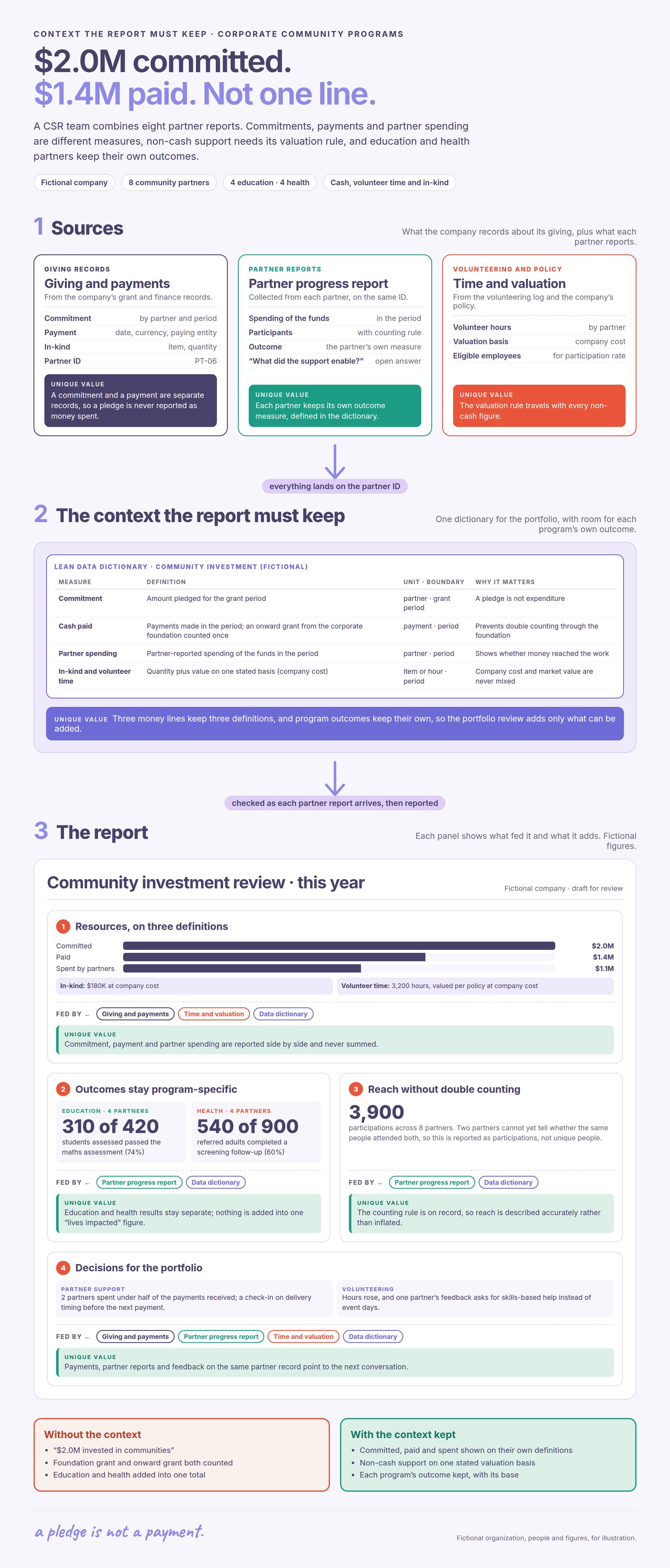
Keep commitments, payments and expenditure apart: a grant approved, cash disbursed and spending reported are three different events. Finance confirms those figures, and BoardSource recommends financial statements get separate consideration, off the consent agenda.
Here is a portfolio review that keeps those three events apart: a corporate foundation’s community grants across eight partners, with each theme’s outcomes on its own line.
Where do the results in a board report come from?
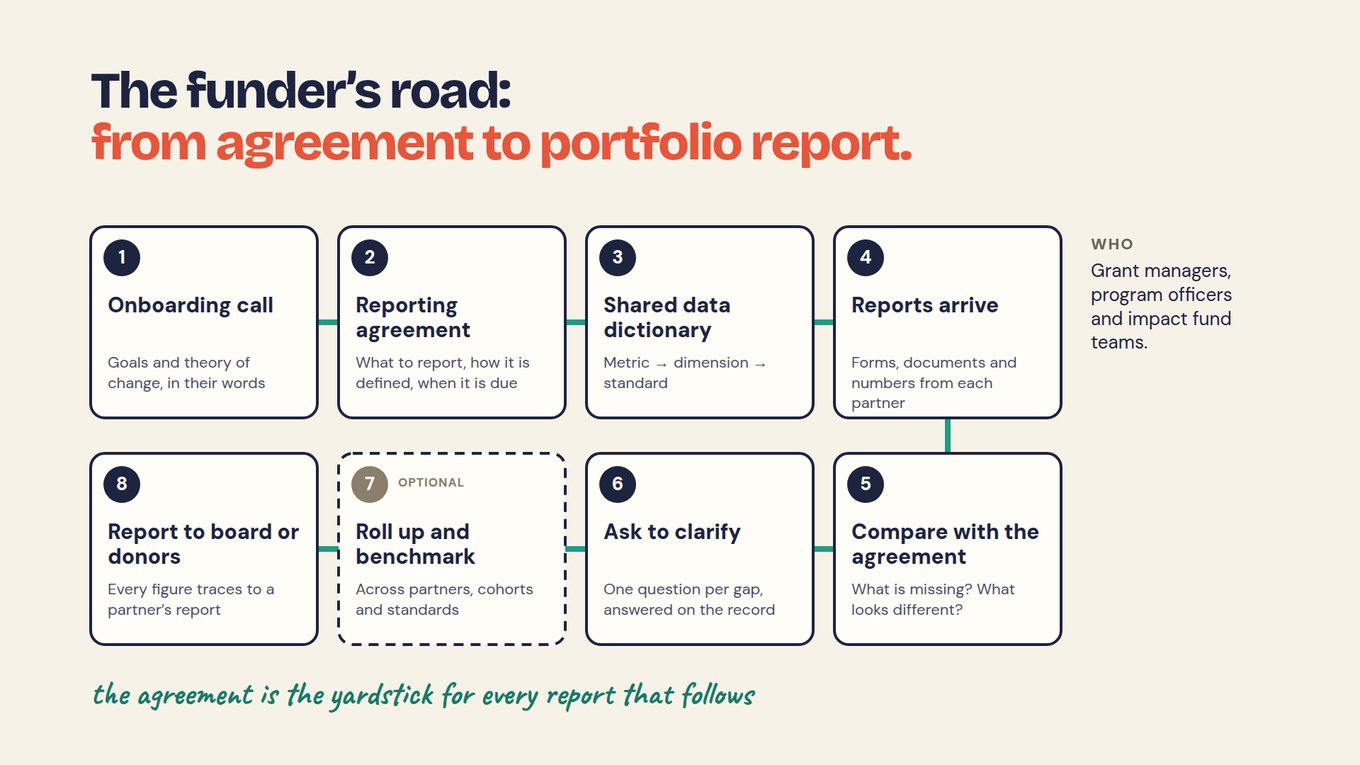
They come from the reporting agreement each partner signed up to, checked report by report, so every figure on page one traces to a partner's report. The board report is the last stop on the funder's road, not a fresh data hunt.
Auroville International USA shows the shape at scale. It channels donor money to about 80 project partners, more than $1M a year; partners apply, are approved and report every quarter, and the funder report is built from those quarterly reports. It defines terms such as a "complete quarterly report" and a "clean-water beneficiary" across five water projects, so the same words count the same thing in every report.
That definition work happens long before the meeting, in the shared data dictionary. Without it, a board report can only repeat what partners sent, in whatever units they chose.
How do you report portfolio results a board can check?
Give the total only for partners that used the agreed definition, put the denominator beside it, and name each held number with its reason on the same page. A quiet exception loses trust the first time someone asks how a number was counted.
Take a fictional regional workforce fund with four job-training partners, the running example of the course. The board's question is whether trainees get jobs within 90 days of exit and keep them. Partners A, B and D reported 42, 31 and 27 placements on the agreed 90-day definition; Partner C reported 55, counted within six months.
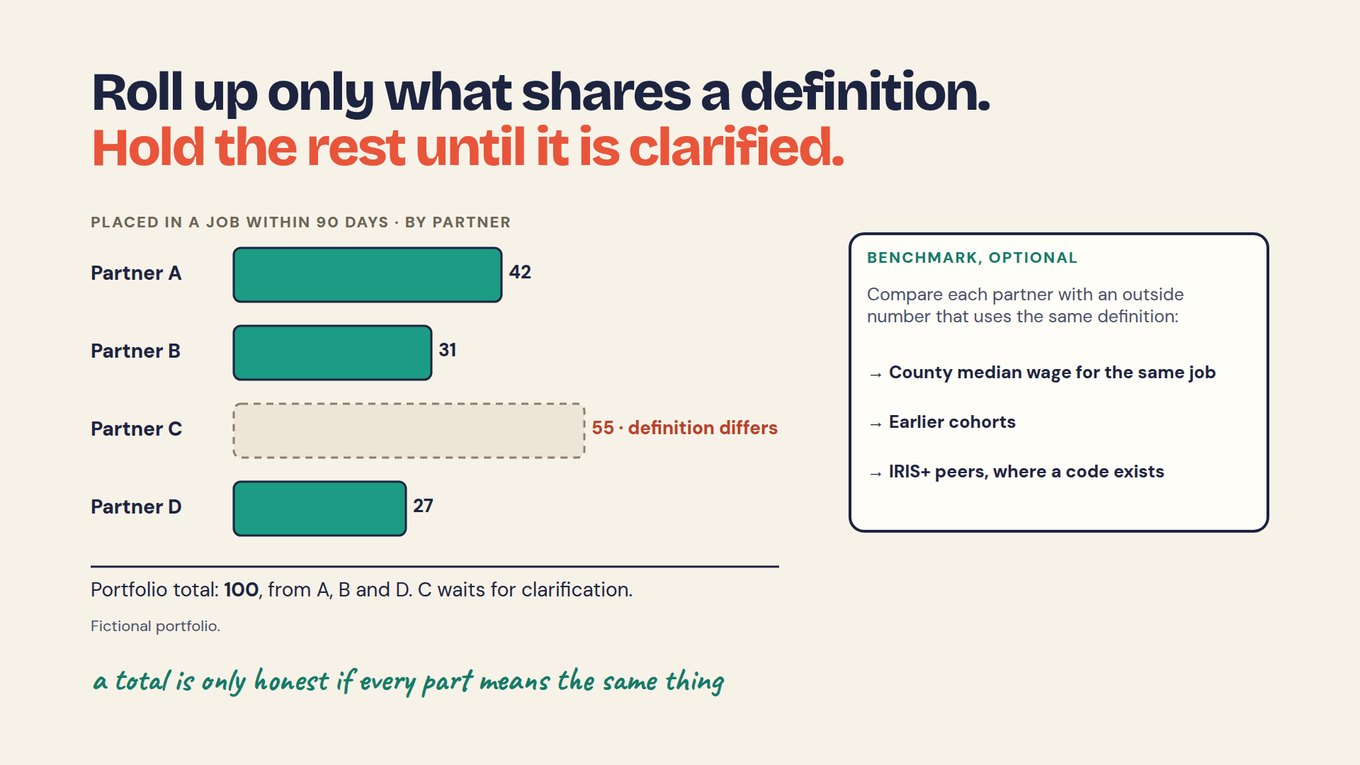
On page one that becomes: "100 trainees placed in a job within 90 days of exit, out of those who completed training at Partners A, B and D. Partner C reported 55 placements within six months; we have asked for its 90-day count. C's retention at 12 months is not yet available." Three sentences, and nothing a trustee can catch out.
"155 placed" would mix two measures; "100 placed" with C silently dropped would hide a partner's work. The chapter Roll up and benchmark portfolio results covers held numbers and breakdowns by who was served.
How many partner stories belong in a board report?
One story per theme is usually enough: a partner's own words, used with the permission the partner collected for this audience, placed next to the number it explains. Stories explain a number; they never stand in for one.
For the workforce fund, the placement theme might carry one trainee's words from Partner A's report. The retention theme carries no story yet, because the 12-month data is not in. Never invent or tidy a quote, and when in doubt, leave the participant unnamed.
Trustees have a taste, like any funder. A board that reads page one closely and distrusts a miss hidden in an average wants change per person plus one voice, in two pages. Capture each funder's taste, and your own shows how to write that down.
How do you turn a reporting gap into a board decision?
When a gap repeats, write it up as a decision brief: the request, evidence, options, trade-offs, what is uncertain and when the board will see the result. The board still exercises judgment.
DECISION BRIEF · WORKFORCE FUND (FICTIONAL)
Request. Write the 90-day placement rule into next year's reporting template, and add training track to every partner's intake form.
Evidence. Partner C counted placements within six months and reported one average starting wage instead of wage by track; the questions sent are in the gap log.
Options. Change template and intake now; change the template only; or keep the agreement and follow up partner by partner.
Trade-offs. Partners update forms before the new period; staff brief all four partners.
Uncertainty and review. Whether C can recount past placements is not yet known; the program officer reports back next quarter.
How do you prepare a board report with AI and still trust it?
Give the AI only checked inputs, forbid it to calculate, and tick every figure against its partner report before the pack goes out. A tool handed raw partner spreadsheets will add up anything, including Partner C's 55.
- Agree the board's question and the decisions requested.
- Set the cutoff and list which partner reports are in and which are missing.
- Check each report against the agreement and log every difference.
- Draft from the checked roll-up, gap log, cleared quotes and taste notes.
- Ask program and finance owners to confirm every shared figure.
- Keep a dated copy of the issued pack, and log later corrections.
PROMPT · PASTE INTO CLAUDE, CHATGPT OR YOUR AI TOOL
Draft the results section of our board report.
Inputs: the checked roll-up with denominators [paste], the gap log with held and missing numbers [paste], partner quotes cleared for the board [paste], our board's taste notes [paste].
Order: the board's question; headline results; held and missing; one story per theme; what we will change.
Rules:
- Do not calculate, round or combine any number. Use each exactly as given.
- Never add a held number to a total. List it under "held and missing" with its reason.
- Quote only the words provided.
- After each number, name its source in brackets.
- If an input is missing, write "not in our data" instead of filling the gap.
In Sopact Sense, each partner keeps one ID and its own folder, the AI Assistant stays locked until you choose which surveys it may use, every line of an answer links to a record you can open, and an Intelligence Row gives a per-partner summary. A shared place for definitions and taste is coming soon.
The video introduces impact measurement and management with AI from the funder's side. Watch for how measurement feeds portfolio decisions, the same job a board report's results section does.
What should a foundation board report not claim?
It reports what partners observed and what the portfolio can add up; it does not prove the foundation's money caused the change. Four partners serving different people in different places is not a controlled study.
"100 placed within 90 days" is an outcome, not an output like enrollment, but it is not evidence that the grants produced those jobs. Where trustees ask about cause, say what further evidence would be needed. Follow-up answers are self-reported, so say who did not respond.
A missing report is not proof of poor delivery, and a submitted report is not proof its claims are right. AI can draft and flag, but a named person checks each line against the record, and the board decides.
Start with one board question at your next meeting
Pick the one question the next meeting must answer, and build its results section end to end before you redesign the whole pack.
- Write the question in one sentence, with the decision it feeds.
- Choose one metric that answers it, and list each partner's number with its status from the check.
- Write the results paragraph: total with denominator, then each held number with its reason and the question sent.
- Pick one partner story for the theme, cleared for the board.
- Draft with the prompt, then tick every figure against its partner report.
- After the meeting, add the board's questions to its taste notes and the gap log to next year's agreement.
After the first cycle you have a page one trustees can check, a short note on how your board reads, and a list of changes for next year's reporting agreement.
Frequently asked questions
What should a foundation board report include?
An executive summary with the board's question and decisions requested, portfolio progress, the grant portfolio, a finance-approved review, results and learning, risks, decision briefs, and an action log with an appendix. The results section shows totals with denominators, held numbers with reasons and a few partner stories. Adapt the order to your board's remit.
What is a board docket?
A board docket is the packet of agenda items and supporting material prepared for a board meeting, also called a board pack or board book. For a grantmaking foundation it usually includes grant recommendations, financial statements, portfolio results and decision briefs. Send it early enough for trustees to read page one closely and raise questions before the meeting.
How often should a foundation prepare board reports?
Follow the board's own meeting schedule, and set partner reporting cutoffs and review time backward from the date the pack is sent. If partners report quarterly, bring results at the same rhythm, and put annual measures such as 12-month retention on the calendar with a due date, so their absence is not read as a miss.
How should missing grantee reports be shown?
Say how many partner reports are included, which are missing and which measures that affects. Keep a missing report distinct from a zero or a poor result, and never let a total drawn from three partners read as a result for four. Name the owner of each follow-up and the date the missing report is due.
Can AI write a foundation board report?
AI can draft the results section from checked inputs: the roll-up with denominators, the gap log, cleared partner quotes and your board's taste notes. It should not calculate, combine or fill gaps, and missing items should be flagged as not in the data. A person then checks every figure against its partner report, and the board still makes the decisions.
Is a foundation board report the same as an annual impact report?
No. The board report supports internal oversight and decisions, so it carries decision briefs, finances and open questions. An annual impact report speaks to a wider audience. Both can reuse the same checked evidence and definitions, so a number means the same thing in each, but their purpose, detail and access differ.
