When should you consider a Good Grants alternative?
Consider a Good Grants alternative when your judging round runs well but the leaderboard at the end cannot show why each application ranks where it does, or when what the panel learned at selection does not carry into follow-up after the award. Test first whether your current configuration can close that gap. Good Grants covers more than judging, and keeping it may be the right answer.
The pattern is familiar. Reviewers score their assignments, the platform totals the results, and the panel spends its meeting on the ranking: why the fourth application sits above the fifth, whether one reviewer marked harder, what an applicant actually wrote about delivery. The scores are all there; the reasons live in reviewers’ heads or nowhere, and after the award they have to be rebuilt when the first report arrives. Sopact publishes this guide, and its purpose is a fair evaluation, including when staying makes sense.
What Good Grants covers, before and after the award
The official Good Grants feature overview describes pre-award, award and post-award work, including applications, review, agreements, grant reports and disbursement tracking, along with organization views, scoring matrices and optional AI tools. It would be inaccurate to describe it as a tool whose records end when winners are announced.
The same documentation describes an AI field for summaries and reporting preparation. Try it on your own submissions before treating manual reading as a product limitation. These sources were checked in September 2026; confirm what is available in the configuration you would use, since a documented feature is where a demonstration starts, not proof that two implementations work equally well.
A leaderboard shows the order, not the reasons
A ranking is a sum of judgments, and the sum hides what a panel most needs: which criterion drove a score, which passage the reviewer was reading, and whether two reviewers who disagreed were looking at the same evidence. It is a useful input to a decision, but it cannot show that the criteria were sound or that reviewers read them the same way.
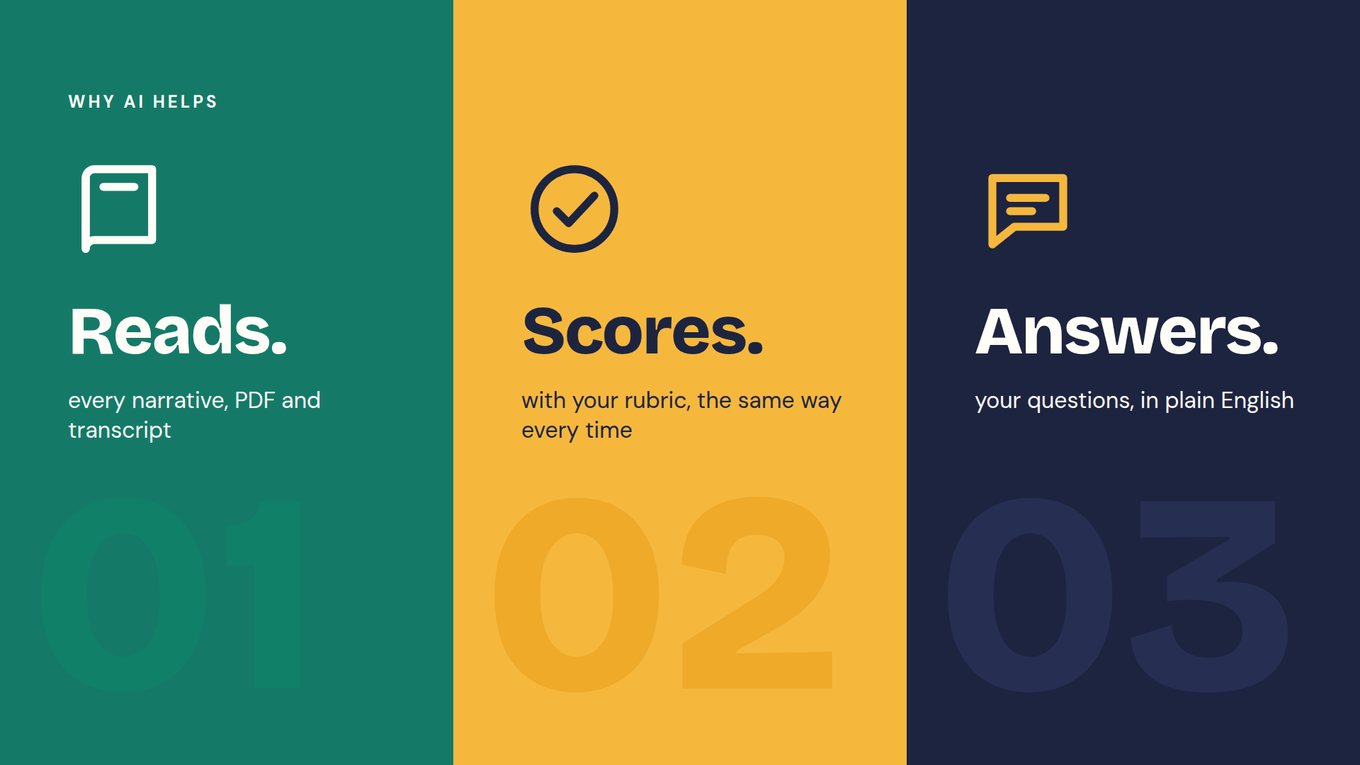
The deck behind Sopact’s video Rethinking Grant Management with AI puts what AI adds to review in three verbs, and scoring is only the middle one. A judging platform already handles scoring through its reviewers. The question for an alternative is whether the reading before it and the answering after it can be done consistently enough that each score arrives with its evidence attached.
Test this in both products with two applications that make similar claims with different support, scored against a rubric with score-level descriptions. A trustworthy assessment, from a person or from AI, follows the evidence rather than polish or length, and points to the passage behind each criterion score. Once a score can be opened, reviewer disagreement becomes a conversation about evidence rather than about whose total sits closest to the average.
WATCH · A RANKING THAT CARRIES ITS EVIDENCE
From intake to a top-ten report the panel can question
This walkthrough shows the alternative to a bare leaderboard in under five minutes. Unmesh Sheth, Sopact’s founder, starts with intake design, because what applicants are asked decides what reviewers can later judge; then 80 applications arrive and an Intelligence Cell analyzes each one as it lands; then he asks which ten are the best and gets back a full report the team can share. Watch the last step closely: the shortlist is built from analysis already stored for each application, which gives a panel something specific to push back on.
Jump to: 1:14 — Designing an intake that listens · 2:13 — 80 applications, read on arrival · 3:25 — “Tell me which 10 are the best”
Use this in your evaluation: Take the top ten from your last round and, for each, write down the passage that earned its place. Wherever nobody can find one, the leaderboard was carrying a judgment the record never kept.
Design the intake so there is evidence to judge
The walkthrough makes a point that matters more than any scoring feature: an application form resembles a survey but works as a data-collection design, and Unmesh describes the shift as moving toward listening. Profile questions such as location and primary language have their uses, yet they tell a reviewer nothing about fit; open questions and a short proposal do. If a criterion asks reviewers to judge feasibility and the form never asked how the applicant will deliver, nobody can score it from evidence.
Map each criterion to the question or document that will evidence it before the round opens, and keep eligibility separate from merit. Good Grants explains the distinction between moderation and tagging in its help documentation; in any platform, decide which gaps need clarification and who resolves them, so missing evidence never quietly becomes a low score. In Sopact, each applicant gets one persistent ID from application to reporting; an Intelligence Cell, configured with a prompt based on your criteria, reads each answer, essay or document as it arrives and returns a draft with its passage; an Intelligence Row summarizes each applicant; and the AI Assistant, or Claude and ChatGPT through MCP, answers questions about the pool with sources.
One rubric, read the same way by every reviewer
Consistency across reviewers is where a ranking built from split assignments is weakest. A panel that splits the pool will read a criterion like community need in several ways by the second week. A draft assessment that applies the same prompt to every application, and shows its passage, gives each reviewer a common starting point to agree or disagree with. It does not make the rubric fair: a criterion that rewards polish will reward polish consistently.
The Institute of the Americas is designing its CaliBaja North American Leadership Academy around this problem. The planned ten-month program for emerging leaders aged 26 to 40 from the public, private and civil-society sectors of the Mexico–US CaliBaja region will use one application pathway in English and Spanish, one set of criteria and one rubric shared by reviewers in both countries, with source material kept beside each evaluation. In the Institute’s words: “One bilingual application pathway can give emerging leaders across Mexico and the United States a fairer, more consistent starting point.” The Academy is not yet open for applications, so this is a design, not a result. Read the Institute of the Americas story →
Whatever the platform, protect the rubric’s history: if a criterion changes mid-round, keep the previous version and apply the change to every affected submission through an agreed process, not only to later applicants.
Compare Good Grants and Sopact by responsibility
| Responsibility | Good Grants evaluation | Sopact evaluation |
|---|---|---|
| Applications and review rounds | Demonstrate your forms, review modes, assignments and decision process. | Test the intake and review stages you need, including exceptions and human approvals. |
| Evidence behind scores | Inspect the available AI output, source context and reviewer checks. | Inspect draft assessments against your criteria, with supporting passages and missing information marked. |
| Reviewer disagreement | Show how moderation is recorded and how a changed score keeps its reason. | Show a reviewer override next to the draft it replaced, with the reason kept. |
| Post-award work | Show grant reporting and the organization view for your configuration. | Connect the selected applicant, program and later observations on one ID while keeping each record distinct. |
| Routine changes | Have program staff change a field, review rule or reporting request. | Have staff revise a question or prompt and review the effect on records already read. |
| Funding administration | Show the award, agreement and disbursement tracking the program requires. | Verify finance handoffs separately; an evidence workflow does not execute payments. |
Tracking a disbursement and executing a payment are different responsibilities, so ask each vendor to show the behavior you require rather than relying on a broad “payments” label.
Design the follow-up after the award
The evidence gathered at selection is the baseline for everything after it, which is the reason to keep each reviewer’s reading on the record rather than beside the leaderboard. A fellowship, a community grant and a one-time prize need different follow-up, so decide what the team needs to learn before designing any survey.
Fictional example: a development fellowship wants to know whether participants use what they learned. The application describes prior experience and the gaps the applicant wants to close; onboarding confirms goals; later check-ins ask about practice and barriers. Because the application answers stay on the same ID, each check-in is read against what that person said they needed. Keep separate records for each application, award and observation so a repeat applicant has a history without submissions being merged, and across local programs share fields only where comparison is meaningful.
The limits belong here. People make the awards, and no AI assessment should be used until someone has checked it against the application it cites. A check-in a participant never returned stays missing; it cannot be inferred from the application. And a positive check-in is an observation, not proof the fellowship caused the change; that claim needs an evaluation design.
Test on a completed round of your smallest program
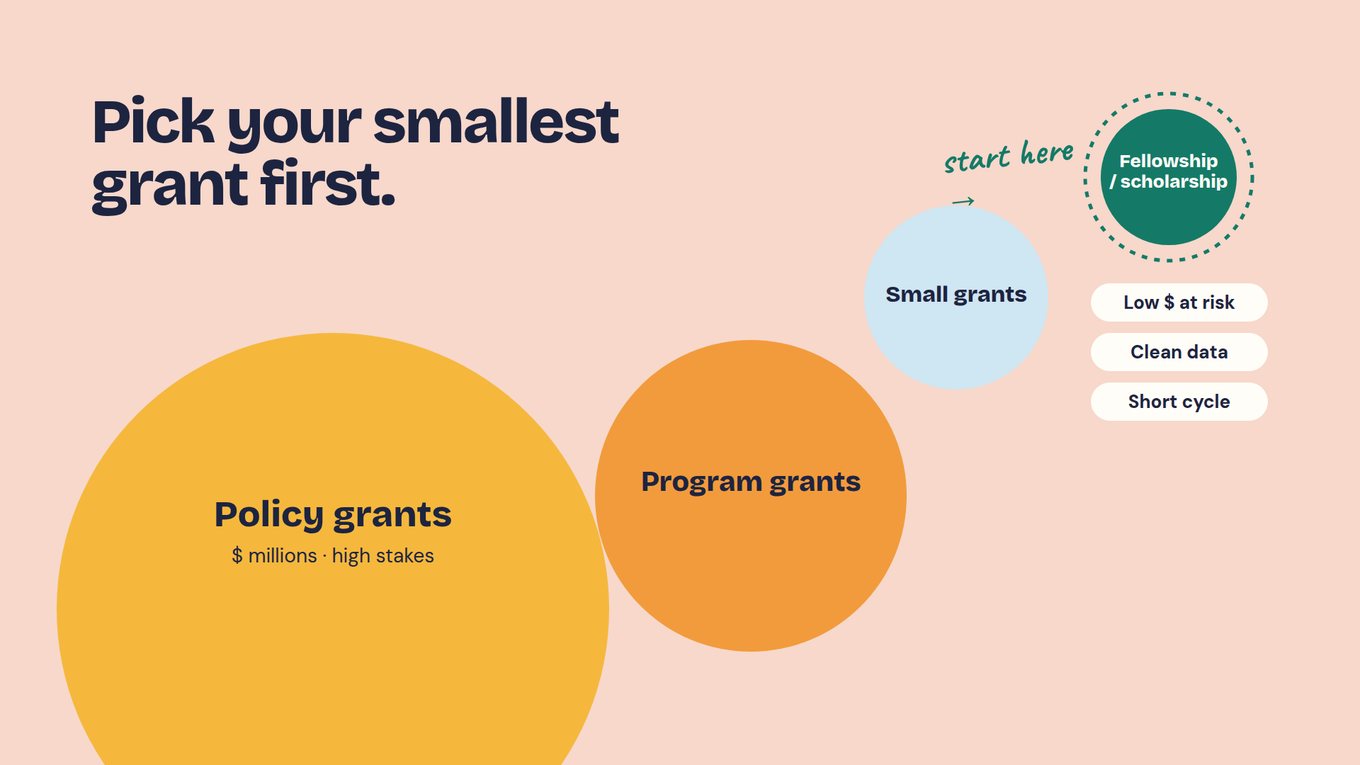
The lowest-risk evaluation reruns a round you have already decided. Choose your smallest program, a fellowship, a prize or a small-grants round, rather than the flagship: less money rides on each decision, the data tends to be cleaner and the cycle is short enough to learn from. A program outside your main platform works too; one foundation Sopact is talking to runs three fellowship programs outside its main platform.
Rerun a completed round
Use authorized submissions, the original rubric and the decisions already made. Include an incomplete application, a pair where reviewers disagreed and a repeat applicant, and compare the draft assessments with the independent scores criterion by criterion. A different shortlist is a reason to check which reading the evidence supports, not a claim of improvement.
Carry one selected applicant forward
Move a representative awardee into onboarding and a sample report, and check what carries forward, what must be confirmed again and what stays restricted to reviewers.
Measure the whole workflow
Record preparation, reviewer checking, clarification, corrections, reporting and maintenance, not only the time to produce a score. Unmesh closes the walkthrough with how customers describe the change: what used to take months now happens as daily business. That is the claim to test on your own round.
When keeping Good Grants is the right call
Keep Good Grants when its configured review, award and reporting workflow meets your requirements, staff can maintain it and the panel can already see the reasoning behind each score. Consider Sopact when a rerun of a completed round shows a better fit for evidence-backed review and for carrying context into follow-up, and when the boundaries with finance and other operations are clear. Before switching a live program, rehearse the move: confirm that exports keep attachments, review comments, scores, decisions and access rules, map identifiers and relationships, check complete sample histories and agree rollback and applicant-support responsibilities. For wider categories, compare submission software and application management software; to plan what your demonstration should prove, use the Academy lessons on batch application analysis, proposal scoring and reviewing outcome reports.
Frequently asked questions
Does Good Grants support post-award reporting?
Yes. Its feature documentation describes agreements, grant reports and disbursement tracking alongside applications and review. The useful test is whether the context from selection, meaning the evidence behind each score and the reviewer’s reasoning, carries into the reports that follow. Demonstrate your own follow-up and analysis requirements in the proposed configuration, using a real awardee record from a completed round.
Does Good Grants have AI tools?
Its documentation describes optional AI tools, including an AI field for summaries and reporting preparation. Test that field on your own submissions: what it reads, whether each output shows its source, how reviewers check and correct it, and who maintains the settings. Apply the same checks to Sopact’s Intelligence Cell, so the comparison rests on evidence rather than on which product mentions AI more.
Why is a leaderboard not enough for a funding decision?
A leaderboard totals reviewers’ scores, which gives the order but not the reasons. On its own it does not show which criterion drove a score, whether two reviewers read the same evidence or whether a low mark reflects weak evidence or missing evidence. Panels need those reasons to resolve disagreement and explain decisions later. Ask any platform to open a score, show the passage behind it and keep the reason for a changed score.
Does Sopact make the selection decision?
No. The Intelligence Cell proposes a criterion-by-criterion reading of each application with the supporting passage, and the AI Assistant can produce a ranking or summary when asked, as the top-ten report in the video shows. Reviewers check those drafts, record overrides with their reasons and resolve uncertainty. The final decision and its rationale stay with the people accountable for the program.
Can we pilot Sopact while keeping Good Grants?
Yes. The lowest-risk test reruns a completed round from a small program using authorized records, while the live program stays in Good Grants. If both systems continue afterward, agree who owns each record, how data moves between them, how access and corrections work and how applicants are supported, so the second system does not create a new reconciliation job for staff.