play icon for videos
← Academy
Social impact careers · Data skills

Social Impact Careers: How to Move Beyond Reporting

Build your career around helping an organization learn from evidence, make sound decisions and follow through on what it changes.

If you work in social impact data, build your career around helping an organization learn and act on evidence. Producing accurate reports remains part of the job. Your wider contribution is to explain what the organization is learning, which decisions the evidence supports, and what needs to change. As AI takes on more of the preparation work, I would invest in that responsibility. This applies to analysts, evaluators, impact measurement and management practitioners, and consultants—although their authority and methods differ.

Watch the full career coaching lesson with Unmesh Sheth, founder of Sopact · 12:34. Watch on YouTube.

Download the presentation used in the video. The examples illustrate the skills behind this career shift.

What should your social impact career be built around?

My advice is to become someone a team trusts to explain what it knows, what it does not know, and what that means for its choices. That is a broader responsibility than delivering a dashboard or completing a funder report.

A report records results. Learning changes the team's understanding of those results. A decision commits someone to a course of action. Following up shows whether that action helped. Your career can develop by taking responsibility for more of this work, with clear boundaries around who makes the final decision.

These are connected responsibilities, not a ladder of job titles. An early-career analyst can identify a misleading comparison that changes a recommendation. A senior measurement lead can produce extensive reporting that nobody uses. Seniority alone does not establish the value of the work.

ResponsibilityQuestion it answersUseful contribution
ReportingWhat happened?An accurate account of results, with definitions and limitations.
LearningWhat do we understand differently?An explanation checked against evidence, including what remains unknown.
Decisions and actionWhat should change, and who can act?Options and tradeoffs, an agreed choice and someone responsible for it.
ReviewWhat happened after the change?A check on the consequences and what the team should reconsider.

Reporting also serves accountability, transparency and compliance. Keep doing it well. The career question is whether your contribution ends when the report is sent.

What does AI change about that work?

AI can assist with preparing material: drafting a framework, organizing text, writing a query and preparing an explanation. The amount it can safely handle depends on the task, the information supplied and how the result is checked. My career recommendation is to use those capabilities to make room for investigation and judgment.

If you use AI only to produce more reports, you may increase output without improving a single decision. The more valuable opportunity is to notice a problem sooner, examine more than one explanation and help the team respond while the evidence is still useful.

That does not make every practitioner a manager. The practitioner establishes what the evidence supports and explains the options. The person responsible for the program, funding or investment decides within their authority. People affected by that decision need a meaningful voice in it.

This direction predates generative AI. Utilization-Focused Evaluation explicitly centers the people who will use findings and how those findings will be used. In impact investing, Principle 8 of the Operating Principles for Impact Management connects reviewing results with improving decisions and management processes. AI offers new ways to support that work; it does not replace its purpose.

Which responsibilities should you learn to take on?

Understand the program well enough to question the result

Learn how the work happens before deciding what its data means. Who is the program reaching? What do participants experience? Where do staff make difficult choices? Which results take time to emerge? A change in a chart may reflect a change in delivery, a change in who participated or a change in how someone entered the records.

This is where program experience becomes valuable in a data career. Someone who understands the service can spot an explanation that looks plausible in a report but makes no sense in practice. Build enough analytical skill to examine that concern, and enough subject knowledge to know when to raise it.

Improve how the organization learns from people

Move closer to data collection. Help decide what needs to be learned, when people can reasonably answer and how their responses will connect over time. A good collection process captures useful experience without repeatedly asking people for information the organization already holds.

Attendance, case notes, surveys and follow-up each reveal something different. Learn how to bring them together without losing the person, the context or the timing. This responsibility involves listening and coordination as much as software. If you only receive a spreadsheet after collection has ended, many of the most important problems may already be difficult to fix.
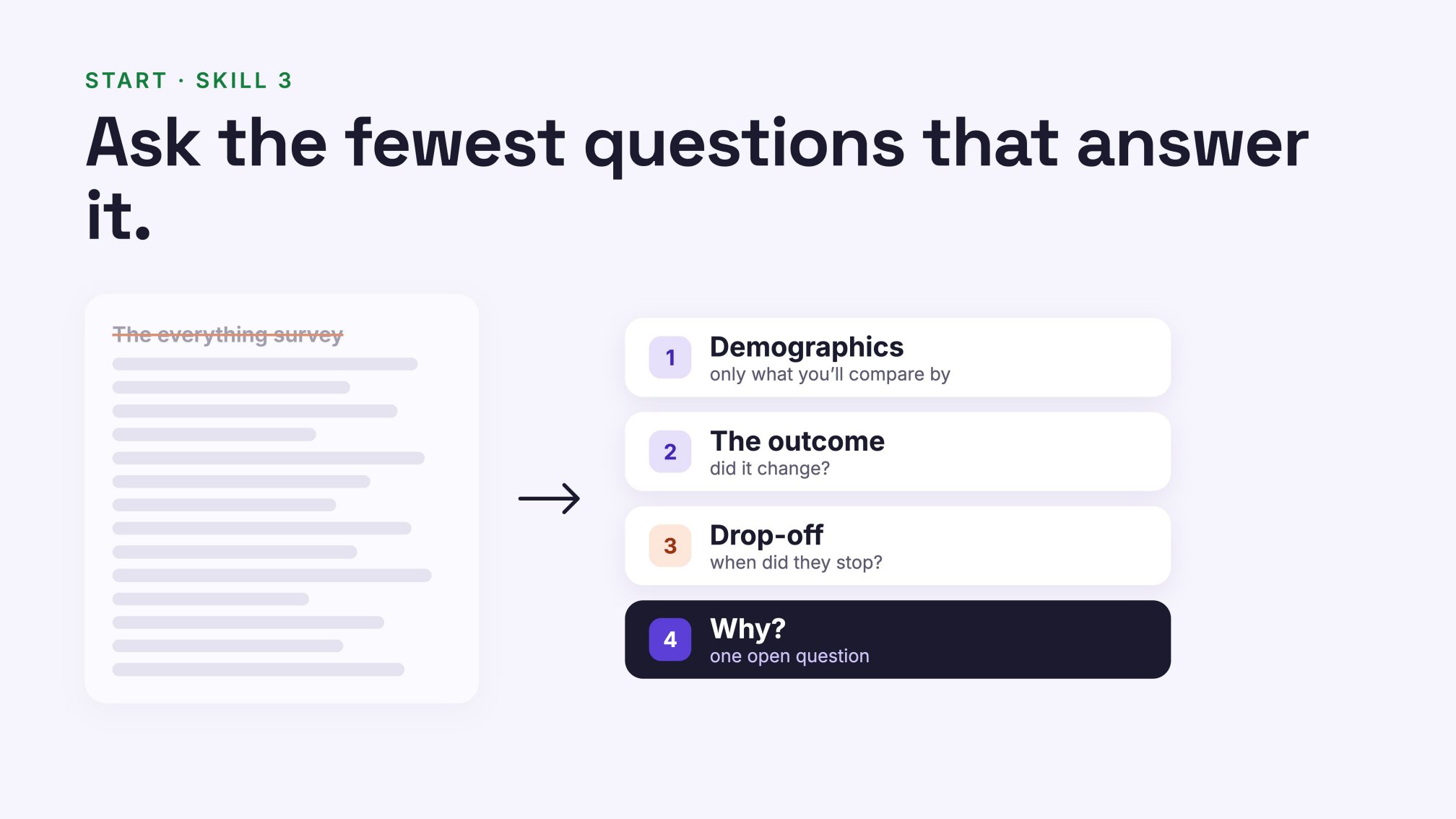
Presentation example: collect relevant background, outcomes, participation and reasons.
An example from the original presentation · slide 7 of 12.

Judge whether the evidence is strong enough for the proposed action

Learn to distinguish a pattern worth investigating from a conclusion strong enough to act on. Ask whether the comparison is fair, whose experience is missing and what other explanation could fit. Understand what the method can establish before recommending what to do.

The strength of evidence needed also depends on the decision. Trying a reversible change to a session reminder is different from ending a service or claiming that a program caused an improvement. Learn when routine analysis is sufficient and when you need an evaluator, statistician or other specialist.

Finding a data mismatch is useful because of its consequence. You may prevent a team from scaling a program based on an overstated result, or from cutting a service because follow-up records are incomplete. That is the career value to explain, beyond “I cleaned the dataset.”

Help people work through a decision

Practice discussing findings with the people who will use them. Explain the options, the evidence for each, the uncertainty and the practical tradeoffs. Invite people to challenge the interpretation. Be able to say that the available evidence does not justify a decision yet.

A useful recommendation also needs an owner, resources and a realistic time to act. If those are absent, a better chart will not solve the problem. Learn how to identify these barriers without presenting yourself as the person entitled to make everyone else's decisions.

Follow up on what the organization changed

Stay involved long enough to find out whether the recommendation was used and what happened afterward. Sometimes the team learns that the original explanation was wrong. Sometimes an improvement for one group creates a difficulty for another. Those findings should shape the next decision.

For a career portfolio, this creates a stronger account of your work: the problem you investigated, the evidence you checked, the choice it informed and the result of reviewing that choice. Report the limits honestly. You do not need to claim sole credit for an outcome to demonstrate your contribution.

What should you stop treating as your main professional value?

Spend less of your development time on repeated production work that your tools can already handle reliably. Put more time into the reasoning and relationships that make the output useful.

  • Framework formatting: use AI to help prepare a theory of change or logframe draft. Learn to question its assumptions, include the perspectives of people affected and judge what evidence is missing. Knowing how to draw the boxes is a small part of the responsibility.
  • Dashboard production: automate recurring preparation where it works. Learn which comparisons are meaningful, which changes require attention and how to explain a result that challenges the team's expectations.
  • Learning every analysis package: choose technical study around the work you want to do. SQL, R, Power BI or Tableau can be essential in a particular role. They are not a complete career plan on their own.
  • Collecting more information: learn to defend why a question is needed and remove collection that adds burden without helping anyone learn or act.
  • Presenting a confident answer: become comfortable identifying uncertainty, checking an AI-generated explanation and changing your advice when the evidence changes.

You still need enough technical and methodological understanding to check the work. Delegating a calculation does not remove responsibility for its meaning. Choose your depth: a specialist evaluator, a database analyst and a program learning lead will need different training.

How does this apply to different social impact roles?

The shared direction is better use of evidence. The responsibility you take on should fit your role.

  • Program and nonprofit analysts: build dependable records and help staff investigate changes in participation, experience and outcomes while they can still respond.
  • M&E and learning practitioners: connect required monitoring with the questions program teams need answered. Plan opportunities to interpret findings and revise delivery, alongside reporting obligations.
  • Impact evaluators: establish what can credibly be concluded, for whom and under which conditions. Help intended users understand those conclusions while preserving the independence the assignment requires.
  • Impact measurement and management teams: bring evidence into program, grant or investment reviews. Examine differences between expected and actual results, including negative effects and risks that aggregate totals can conceal.
  • Social impact consultants: agree on how the client will use the work, what capability you will leave behind and who will maintain it. Include interpretation and follow-up in the scope where appropriate.

For an investment-focused path, Impact Frontiers' curriculum connects impact management with investment decisions and impact-financial integration. It is one example of learning that needs to fit the decisions your role supports. For organizations choosing external support, our social impact consulting guide covers services, selection and handoff.

What does this difference look like in real work?

Consider this illustrative situation: a youth program sees lower participation at one location. The reporting task is to calculate attendance correctly and explain the change. The broader learning responsibility is to establish whether the program has a participation problem, a recording problem or both.

The practitioner checks the records with staff, asks participants about their experience and compares plausible explanations. Suppose that investigation supports a scheduling problem. The practitioner explains the evidence and its limits, then works with the program lead to consider an alternative time. The lead decides whether to try it and takes responsibility for delivery.

The practitioner then checks whether participation improves and whether the new time makes access harder for anyone else. If the result does not support the explanation, the team revises its understanding. The professional contribution extends from an accurate count to a better-informed choice and a review of its consequences.

Presentation example: investigate what happened and what the team should consider changing.
An example from the original presentation · slide 10 of 12.

The same principle applies to a funder comparing partners. A lower reported outcome may reflect different populations or definitions. The practitioner helps establish whether a comparison is defensible before it influences funding. “We cannot make that comparison yet” can be a valuable finding.

What must your employer or client change?

You cannot create a learning organization solely by improving your own skills. Your role needs access to the people who collect information, the people it represents and the people who make decisions. You also need time to investigate findings and permission to surface uncomfortable results.

When considering a role or consulting assignment, ask what happens after a report is delivered. Who discusses it? Can findings change a program or budget? Are practitioners involved before the questions are finalized? Is there capacity to act, or will the same person simply be asked to produce more reports?

A team may still need separate collection, analysis and evaluation specialists. The important change is that they work together early enough to correct problems. If every question travels through a long chain of handoffs, AI at the final reporting stage will not repair what was never collected.

I would also ask employers to broaden how they assess these roles: include the quality of evidence, risks identified, clarity of recommendations and usefulness to decision makers. Avoid judging an analyst solely by whether outcomes improved; implementation, resources and external conditions are not all under their control. A defensible decision to wait, retain a service or gather more evidence may be the right result.

How can you make this career move without starting over?

Use one existing piece of work to demonstrate a wider contribution. If you already produce reports, choose one recurring finding that deserves investigation. If you work in programs, identify a question your experience suggests the current records cannot answer. If you consult, agree on one use of the findings and include time to support it.

Build a short account of that work: what the team needed to understand, what you checked, what changed in its understanding and which decision followed. Include the evidence that challenged your initial view. If the work has not yet led to action, say why and explain the next step.

Use that example to choose your next learning investment. A weakness in study design calls for methods training. Difficulty interviewing participants calls for qualitative research practice. A database constraint may call for SQL. Difficulty getting findings used may call for facilitation, program knowledge or a clearer agreement with leadership. The next course should address a real gap in the responsibility you want to take on.

Where does an AI-native data platform fit?

A platform can support this way of working when collection, records and analysis remain connected. It can reduce the repeated preparation needed to revisit a question as new information arrives. It cannot establish the organization's learning priorities or take responsibility for its decisions.

Sopact's approach brings data collection and AI-assisted analysis into a connected workflow. For the practitioner, the relevant skill is designing that workflow: what should be collected, how records connect, who can access them and how an answer can be checked. The platform supports the work; people remain responsible for the interpretation and response.

Questions about social impact careers and AI

Is reporting becoming irrelevant?

No. Reliable reporting supports accountability and provides a record of what happened. The career opportunity is to help people use that information as well. This may mean investigating an unexpected result, making uncertainty visible or helping a team review a choice. Automation should preserve reporting quality while creating capacity for those responsibilities.

Do I need a different job title?

Not necessarily. Start with the scope of your current role and the authority you have. An analyst can contribute to a decision without owning it. Ask for involvement in interpreting findings and reviewing their use. If a prospective role offers only production work, consider whether that matches the experience you want to build.

Can I work in social impact without becoming a programmer?

Yes, some roles emphasize program knowledge, research, measurement design or helping teams use evidence. Others require substantial programming or statistical expertise. Read the responsibilities of the roles you want and learn accordingly. You still need to understand definitions, comparisons and limitations when a platform or AI performs the analysis.

What should an experienced practitioner learn about AI?

Learn to choose appropriate tasks, provide the relevant context and verify the output. Practice identifying omissions and unsupported explanations, not just writing prompts. Understand your organization's rules for using participant information. Then examine whether the time saved is helping you investigate important questions or simply increasing the amount of material produced.

How should a consultant demonstrate value?

Show how your work helped a client understand a problem, assess its options or build a reliable way to learn. Explain your contribution, the client's responsibilities and the limits of the evidence. Agree on suitable follow-up rather than promising an outcome you cannot control. A useful handoff includes the ability to maintain and question the work.

Does evidence always tell the organization what to do?

No. Evidence informs a choice, but decisions also involve priorities, resources, obligations and the perspectives of people affected. Your contribution is to make the evidence and tradeoffs clear, including uncertainty. Do not disguise a value judgment as a calculation or treat an AI recommendation as the authority to act.

Put this guide into practice.

Bring a reporting process your team wants to improve, the evidence behind it and the decisions it needs to support. Explore how to keep collection and learning connected.

Explore connected data collection
Prepare Data Governance Before Using AI
Prepare your data governance
nonprofit-data-governance-before-ai
Feedback
Foundation
Prepare an evidence register and a tested governance baseline before applying AI to program data.
How to Turn Findings into Action and Check What Changes
The Loop — the method in one read
the-loop
Loop
The method
0
One continuous method for reliable, traceable AI reporting across case, application, grant, and program workflows: collect clean, analyze on arrival, and improve in time.
For growing data collection, connected analysis and recurring reporting
What Is Case Intelligence?
what-is-case-intelligence
Case
Foundation
1
One current, traceable record for each person—connecting intake, services, notes, surveys, documents, outcomes, decisions, and follow-up.
Workforce and training · Youth and mentoring · Case management · Scholarships · Accelerators · Education · Nonprofit programs
What is grant intelligence?
What Is Grant Intelligence?
what-is-grant-intelligence
Grant
Foundation
1
One connected evidence record from application and committee review through the awarded grant, grantee reporting, renewal, and board accountability.
Foundations and grantmakers · Public grant programs · Scholarships and fellowships · Accelerators
Connected Data Intelligence
Understand the approach
connected-data-intelligence
Feedback
Foundation
1
Connect recurring collection, relevant history, AI analysis, and governance in a workflow your team can maintain.
Growing organizations managing recurring data collection without a dedicated data team.
Measurement and Reporting: From Agreement to Evidence-Based Report
Measurement and reporting: from agreement to report
embedded-impact-measurement
Reporting
Start here
1
Turn the onboarding call into a reporting agreement, share one data dictionary, and write reports funders can compare and check.
For funders and the organizations they fund
Connect company context before collecting another return
Connect context
track-investees-impact-agreement-variance
Portfolio
Portfolio intelligence tools
1
Build a repeatable collect, review and improve cycle
Methodology — continuous, not annual
loop-methodology
Loop
The method
1
The continuous collect–analyze–improve cycle, adopted as an experiment: start with the step that already pays and add one data-collection step at a time.
Teams tired of rebuilding spreadsheets and forms who want a measurement system that compounds instead of resetting.
Agree the theory of change and core metrics on the onboarding call
Agree measures
onboard-portfolio-lock-impact-agreement-track-results
Portfolio
Portfolio intelligence tools
2
Test whether an AI-assisted result is repeatable and correct
Reliability — test repeatability and accuracy
loop-reliability
Loop
The method
2
Test repeatability and accuracy using versioned data, defined calculations, known-answer checks and human review of qualitative interpretation.
Teams that need to check recurring AI-assisted analysis before using it in decisions or reports.
Design an application process around the decision, not the form
Design an Application Process
how-to-design-an-application-process
Grant
Foundation
2
How to Structure Stakeholder Data: Four Common Patterns
Choose your record structure
which-shape-is-your-data
Feedback
Foundation
2
Map the people, observations and relationships your workflow needs before collecting data.
Turn the onboarding call into a reporting agreement
onboarding-call-to-reporting-agreement
Reporting
Agree together
2
How to build a theory of change, then show it as a logic model, logframe or results framework
how-to-build-a-theory-of-change
Reporting
Agree together
3
How to Build a Logic Model: Steps, Example and AI Prompt
Build a Logic Model You Can Use
how-to-build-a-logic-model
Reporting
Align
3
How do you onboard a grant or RFP program?
Onboard a Grant or RFP Program
how-to-onboard-a-grant-rfp-program
Grant
Foundation
3
Turn your theory of change into a data-collection plan
Turn a Theory of Change into a Data-Collection Workflow
theory-of-change-to-data-collection-workflow
Case
Foundation
3
Run quarterly collection around each company's dictionary
Collect quarterly
collect-investee-reporting-without-burden
Portfolio
Portfolio intelligence tools
3
Keep a clear trail from a finding to its evidence
Traceability & Transparency
loop-traceability
Loop
The method
3
Every figure links back to the exact response, note, or document it came from — a full audit trail from headline result to raw evidence.
Teams whose numbers get scrutinized — by funders, boards, auditors, or standards — and who need to answer where did this come from on the spot.
Build Context: What Your AI Needs to Know
Build context
build-organization-evidence-model
Feedback
Foundation
3
How to Change Survey Questions Without Losing Comparability
Change questions with a clear history
change-questions-without-breaking-the-record
Feedback
Control
3
Create a question-change log and decide how old and new versions should appear in reports.
Programme & MEL leads · Teams whose questionnaire has ossified · Anyone evaluating a platform where configuration is a purchased service
Five Dimensions of Impact: How to Review Your Evidence
Use the Five Dimensions to Test the Evidence
five-dimensions-of-impact
Reporting
Align
4
How do you design a grant rubric and eligibility rules?
Design Your Rubric & Eligibility Rules
grant-rubric-eligibility-rules
Grant
Foundation
4
Review impact and financial evidence before it reaches the dashboard
Review and approve
read-investee-reports-multi-signal
Portfolio
Portfolio intelligence tools
4
Adapt the learning cycle to your workflow
Flexibility — one method, four workflows
loop-flexibility
Loop
The method
4
The same collect–analyze–improve cycle, shaped to four kinds of impact work — case, grant, portfolio, and feedback — each shown end to end.
Anyone deciding where the Loop fits their work, who wants to see the full path from messy input to a report they can defend.
How to Collect Feedback Offline and Track the Same People Over Time
Collect offline and reconcile the batch
collect-feedback-offline
Feedback
Connect
4
Build a field protocol and reconcile a test batch across devices, visits and delayed uploads.
Field & multi-site programs · Low-connectivity contexts · Teams collecting in person
How Do You Design an Intake Form for a Baseline?
Design an Intake Form That Captures a Usable Baseline
intake-form-usable-baseline
Case
Nonprofit Track
5
Turn a proposed outcome into a reporting definition
Outcomes vs Outputs
frame-outcomes-over-outputs
Grant
Foundation
5
Plan and review your first workflow pilot
loop-guarantee
Loop
The method
5
How to Analyze Documents as Evidence: Sources, Context and Review
Read documents as traceable evidence
read-documents-as-evidence
Feedback
Connect
5
Create a document register and reviewed findings with source locations, context and explicit exceptions.
Check each partner report against the agreement
check-partner-reports-against-agreement
Reporting
Funder road
5
Combine compatible metrics and explain every portfolio total
Build rollups
portfolio-impact-rollups
Portfolio
Portfolio intelligence tools
5
How to Clean Open-Ended Survey Responses Without Losing Meaning
Clean responses and define the denominator
clean-open-ended-survey-responses
Feedback
Clean
6
Create a cleaning log, response-status table and reproducible report statement.
How to Review Participant Support Needs Mid-Program
Spot At-Risk Participants Mid-Program
spot-at-risk-participants-mid-program
Case
Nonprofit Track
6
How to Write a Nonprofit Grant Application: Template and Example
Grant Application for Nonprofits
grant-application-for-nonprofit-organizations
Grant
Foundation
6
Personalize quarterly donor and annual LP reports
Report with evidence
portfolio-lp-board-impact-report
Portfolio
Portfolio intelligence tools
6
How to Build a Funder Context Profile: Research to Reporting
Build a Sourced Funder Context Profile
build-funder-context-profile
Reporting
Align
6
Roll up and benchmark portfolio results
roll-up-and-benchmark-portfolio-results
Reporting
Funder road
6
How Do You Measure Change at Exit?
Measure Change at Exit (Not Just Completion)
measure-change-at-exit
Case
Nonprofit Track
7
How do you collect applications clean at the source?
Collect Applications Clean at the Source
collect-applications-clean-at-source
Grant
Collect
7
Turn portfolio findings into action and test the next cycle
Act and improve
portfolio-risk-monitoring-alerts
Portfolio
Portfolio intelligence tools
7
How to Analyze Multilingual Feedback Without Losing Meaning
Analyze and review multilingual feedback
analyze-multilingual-feedback
Feedback
Clean
7
Build a language review sheet and test software on original responses, translations, codes and reporting bases.
Multi-country programs · Multilingual survey data · Global networks & chapters
How to Define Impact Metrics Your Team and Funder Can Use
Define Measures the Organization and Funder Can Both Use
define-impact-metrics-funders-want
Reporting
Align
7
Write the portfolio report for your board or donors
write-the-portfolio-report
Reporting
Funder road
7
Survey Attrition: How to Track Missing Waves in Longitudinal Studies
Track missing waves and matched outcomes
survey-attrition-longitudinal-studies
Feedback
Read
8
Build a wave-status register, compare response groups and report paired change with coverage and limitations.
How to Use Mentor Notes to Review Participant Support
Use mentor notes for support review
mentor-notes-early-warning
Case
Nonprofit Track
8
How do you reduce applicant burden?
Reduce Applicant Burden
reduce-applicant-burden-auto-clarification
Grant
Collect
8
Impact Metric Definitions: A Practical Worksheet and Example
Give Every Number One Definition
one-definition-for-every-number
Reporting
Define
8
Map every funder's ask to one evidence base
turn-reporting-requirements-into-evidence
Reporting
Funded partner road
8
How to Connect Quantitative and Qualitative Survey Data
Connect scores and comments
connect-quantitative-qualitative-survey-data
Feedback
Read
9
Build a linked analysis view and joint display, with clear groups, reporting bases and evidence limits.
How to Calculate SROI as New Evidence Arrives
Calculate SROI — Live, Sourced, and Honest
calculate-sroi-live
Case
Nonprofit Track
9
How to Collect Grantee Reports with Less Burden
Collect Grantee Reports Without Burden
collect-grantee-reporting-without-burden
Grant
Collect
9
Capture each funder's taste, and your own
capture-funder-taste
Reporting
Funded partner road
9
How to Analyze Pre, Mid and Post Survey Data
Analyze pre, mid and post surveys
analyze-pre-mid-post-survey-data
Feedback
Read
10
Build a matched pre/mid/post analysis, interpret score movement and retain clear rules for missing waves.
How to Report a Job-Training Program to Grant Funders
Turn a Cohort into a Funder Impact Report
job-training-grant-impact-report
Case
Nonprofit Track
10
How to Follow Up on Missing Grantee Data
Chase Missing Grantee Data
chase-missing-grantee-data
Grant
Collect
10
How to Collect Clean Data Inside Your Workflow
Collect Clean Evidence Inside the Workflow
collect-clean-data-at-the-source
Reporting
Embed
10
Write each funder's report with AI, then check it
assistant-writes-the-funder-report
Reporting
Funded partner road
10
Draft from approved sources, check the claims, and save an accountable report version. Bring the brief from the previous lesson.
Program managers, grant leads and reporting teams
How to Analyze Longitudinal Survey Data
Analyze longitudinal survey data
analyze-longitudinal-survey-data
Feedback
Read
11
Build a continuing analysis record with clear time scales, observed trajectories and limits.
How to Turn a Job Description into a Requirements Checklist
Clarify employer requirements
job-description-requirements-checklist
Case
Social Enterprise Track
11
How to Reduce Bias in Grant Application Review
Review Without Reviewer Bias
review-applications-without-reviewer-bias
Grant
Analyze
11
How to Keep Impact Reporting Numbers Consistent
Get Stable Results From Governed Data
same-numbers-every-time
Reporting
Read
11
Compare your results with outside data: live queries and public datasets
compare-with-outside-data
Reporting
Toolkit
11
How to Analyze Grant Applications: Batch Review & Comparison
Analyze a Whole Round
how-to-analyze-a-batch-of-grant-applications
Grant
Analyze
12
How to Measure Outcome Duration and Drop-Off
Measure outcome duration and drop-off
measure-outcome-duration-drop-off
Feedback
Read
12
Build a dated outcome claim, distinguish missingness from outcome loss and test forecast assumptions.
How to Score Candidate–Role Matches with a Clear Rubric
Review candidate–role evidence
score-candidate-role-matches-without-bias
Case
Social Enterprise Track
12
Make every number in your report match its source
where-every-number-came-from
Reporting
Toolkit
12
How to Report Job Placements to Impact Investors
Turn a Cohort into a Social-Enterprise Investor Report
job-placement-investor-impact-report
Case
Social Enterprise Track
13
How do you track reviewer conflicts of interest?
Track Reviewer Conflicts of Interest
track-conflicts-of-interest-audit
Grant
Analyze
13
How to Write a Donor Report: Format, Evidence and Example
Design a Report for a Real Funding Decision
donor-report-funders-trust
Reporting
Decide
13
Build a report brief and claim-and-evidence table before drafting. Explain delivery, outcomes, spending, limitations and next actions.
Program managers, grant leads and reporting teams
How to put a credible dollar value on your results
credible-dollar-value-on-impact
Reporting
Toolkit
13
Prepare a valuation brief. Decide what the evidence supports, what needs more work, and when an outcome account is enough.
Program, evaluation and investment teams considering social-value estimates
AI Data Access Controls: What Your Assistant May See
Control what the assistant can access
what-the-assistant-may-see
Feedback
Prove
13
Define task-specific access, test synthetic records and verify report-sharing boundaries.
How to calculate the SROI ratio, step by step: value map, financial proxies and adjustments
how-to-calculate-the-sroi-ratio
Reporting
Toolkit
14
Build a reproducible SROI calculation, test its assumptions and explain the result in a reviewed report.
Evaluation and reporting teams reviewing an SROI calculation
How to Write an Evidence-Based Impact Narrative for a Funder Report
Write a cited impact narrative
impact-narrative-funder-report-cited
Feedback
Prove
14
Build and check a report paragraph using a claim-and-source table, appropriate quotations and clear limitations.
How Do You Read a Grantee Report?
Read a Grantee Report
read-grantee-report-multi-signal
Grant
Analyze
14
How Do You Compute Grantee Variance?
Compute Grantee Variance
how-to-compute-grantee-variance
Grant
Analyze
15
Keep a person’s history connected across programs and staff changes
Follow one person over time
one-person-followed-for-years
Feedback
Shapes
15
Build a participant record that preserves episodes, dates, versions and missingness across repeated collection.
How Do You Build an SROI Value Map?
Build an SROI Value Map
how-to-build-an-sroi-value-map
Reporting
Optional method
16
Build a first value map, keep missing evidence visible, and give each unresolved outcome a next action.
Evaluation, program and investment teams preparing an SROI analysis
How do you track budget, invoices and actual spend for a grant?
Track Budget vs Actual Spend
how-to-track-budget-invoices-actual-spend
Grant
Analyze
16
Multi-Rater Feedback: Connect Perspectives and Protect Context
Connect several perspectives on one person
several-people-describing-one-person
Feedback
Shapes
16
Design subject-rater relationships, reporting rules and a tested multi-perspective feedback record.
How Do You Pick a Financial Proxy for SROI?
Pick a Defensible Financial Proxy
how-to-pick-a-financial-proxy-for-sroi
Reporting
Optional method
17
Compare candidate valuation sources and document why one fits your outcome, stakeholder and reporting period.
Evaluation and reporting teams selecting financial proxies
How Do You Analyze Grantee Reporting Longitudinally?
Analyze Grantee Reporting Over Time
analyze-grantee-reporting-longitudinal
Grant
Analyze
17
Cross-Program Reporting: Combine Results Without Losing Meaning
Combine evidence across programs
many-programs-one-picture
Feedback
Shapes
17
Build a defensible cross-program result with comparable measures, correct denominators and documented exclusions.
How to read Form 990 for a grant review
Read a 990 for Compliance
how-to-read-a-990-for-compliance
Grant
Analyze
18
Pick One Question. Keep Every System You Have.
Run a member-network survey
member-network-survey
Feedback
Shapes
18
Design and test a member reporting cycle with continuing records, coverage checks and authorized results.
Ask your whole grant round anything (Assistant + MCP)
Ask Your Whole Grant Round Anything
ask-your-grant-round-anything
Grant
Analyze
19
How do you build a grant audit trail?
Build a Grant Audit Trail
grant-audit-compliance-trail
Grant
Communicate
20
How do you produce grant compliance and regulatory reports?
Produce Compliance Reports
grant-compliance-regulatory-reports
Grant
Communicate
21
How Do You Roll Grantees Into a Board Report?
Roll Grantees Into a Board Report
roll-grantees-funder-board-report
Grant
Communicate
22
How Do You Build Grant Dashboards and Maps?
Grant Dashboards & Maps
grant-dashboards-geographic-mapping
Grant
Communicate
23