play icon for videos

Training Evaluation Software · Built for the AI Era · Sopact

Training evaluation software that reads open-ended feedback on arrival and links Kirkpatrick Level 1 reaction to Level 4 results on one learner record, so L&D teams measure training effectiveness and business impact rather than smile-sheet scores.

Updated
June 2, 2026
360 feedback training evaluation
Use Case
Training Evaluation Software · Built for the AI Era · Sopact
Use Case · Training Evaluation · Built for the AI era

Beyond the smile sheet.
Training outcome intelligence has begun.

The training evaluation software most L&D teams run was built to collect a reaction score — send the survey, average the stars, file the deck. Collection is solved. The new bottleneck is the workflow that reads every open-ended comment on arrival, and links what a learner felt on day one to what they did sixty days later.

The learner is the unit of work, and the learner record has to be intelligent. When the pre-assessment, the reaction survey, the manager’s observation, and the business result all live on one record — one ID, one story — training effectiveness shows up as one query, not a year-end reconstruction. That is the difference between a survey tool and training outcome intelligence.

Direct answer

What is training evaluation software?

Training evaluation software is a platform that measures whether a training program worked — capturing reaction, learning, behavior change, and business results on one learner record from pre-training through follow-up. It replaces the common stack of a smile-sheet survey, a separate quiz tool, and a year-end spreadsheet with one connected record, and the best tools read the open-ended feedback on arrival rather than leaving it unread.

It is also searched as training evaluation tools, a training measurement system, or a tool to measure training effectiveness. The distinction that matters in 2026 is whether the software only collects a reaction score or also links Kirkpatrick Level 1 to Level 4.

Used by:

  • Corporate L&D and talent-development teams
  • Workforce, apprenticeship, and reskilling programs
  • Nonprofit and grant-funded training programs
  • Compliance and safety training functions
  • Anyone reporting training impact beyond completion rates

Not the same as an LMS (delivers and tracks course completion) or a survey tool (collects reaction sheets). Training evaluation software is organized around the evaluation itself — reaction through results — and the best tools sit on top of the LMS and survey tool as the measurement layer. New to the topic? Start with training evaluation and the Kirkpatrick model.

The shift

The era of the smile sheet is over.

For two decades, training evaluation meant the reaction survey: hand out the form, average the satisfaction score, and move on. That was the right tool for the question of the 2000s — did learners like it. Collection is now solved. Every survey tool runs a clean Level 1 reaction sheet. The work moved. The hard part is no longer collecting the score — it is reading the open-ended comment, linking what a learner felt to what they later did, and carrying one learner from pre-assessment to business result.

AI without a workflow is a clever intern with no desk. The L&D teams winning with AI are the ones whose evaluation data has a place to land — one learner, one ID, reaction through results — so the open-ended feedback is read on arrival instead of pasted into an appendix nobody opens.

The smile-sheet era The outcome-intelligence era
Average the reaction score, file the deckRead what changed and link reaction to results
A separate survey per course, never linked to the learnerOne learner ID from pre-assessment to follow-up
Open-ended comments pasted into an unread appendixEvery comment read on arrival and coded into themes
Level 1 collected; Level 3 and 4 asserted, not measuredBaseline and 60-day follow-up on one record, scored together
The effectiveness report is a year-end slide buildEffectiveness is one query off the same records, comment attached
Collection is solved. The new bottleneck is the workflow that reads every open-ended comment on arrival — and links what a learner felt to what they did.
From the field

Marco Botha didn’t want another reaction report. He wanted to know what was hiding in his data.

Open Play Foundation had been running training and development programs for years. The pre-assessments, attendance logs, and feedback surveys lived in different systems, the way they do at almost every L&D function. The survey tool recorded the reaction score. It was never built to read what changed in a participant. Until those records lived on one learner, Marco couldn’t see what was happening across the cohort — only what each spreadsheet told him.

“Those statistics that we’re now running on Sopact immediately showed me there’s something significantly wrong … things like that, we would never have been able to do in the past.” Marco Botha, CEO, Open Play Foundation

Same logic for a corporate or workforce training team: when the pre-assessment, the reaction survey, the manager’s 60-day observation, and the business metric all live on one learner record, the reading nobody could do before shows up on Tuesday, not at year-end. The pattern buried across files — the cohort whose confidence rose but whose behavior never changed — becomes a single query.

The spine

Five stages, one learner record. The spine a survey tool was never built to hold.

Every learner passes through the same five stages from pre-assessment to business result. Training outcome intelligence builds the spine once; every program plugs into it. This is what a tool bought to average a reaction score can’t do.

Stage 1

Collect

Pre-assessment, reaction survey, and open-ended feedback arrive on one form — and one persistent learner ID, not a separate survey per course.

Stage 2

Framework

Kirkpatrick’s four levels (or Phillips ROI) encoded as the framework every learner record is evaluated against. The stakeholder’s questions, built in.

Stage 3

Data dictionary

Every item, scale, and competency in one dictionary, configured in plain English — so pre and post are identical on the items that measure change.

Stage 4

Transformation

Built-in skills read each open-ended comment on arrival and code it into themes with attribution — the L3/L4 evidence a survey tool leaves unread.

Stage 5

Definitive reports

The effectiveness report — reaction through results, with ROI — as one query, each number citing its comment. Exports drop into Looker Studio, Power BI, or Tableau.

The levels

Five levels of training evaluation. Most software stops at Level 1.

The Kirkpatrick model defines four levels, and Phillips adds a fifth for ROI. Reaction is easy and universally collected. Behavior and results are where evaluation actually proves value — and where most tools, and most reports, quietly give up.

Level 1 · Reaction

Did they value it?

The smile sheet: satisfaction, relevance, confidence. Universally collected, easy to game, and on its own a weak predictor of anything that follows. The open-ended comment here is the part worth reading.

Level 2 · Learning

Did knowledge increase?

Pre/post assessment of knowledge, skill, or confidence. Requires the same learner ID and identical items at both points — the moment most stacks fragment into two unlinked surveys.

Level 3 · Behavior

Did behavior change on the job?

Measured weeks later, often by the learner and their manager. The first level that proves transfer — and the first one a reaction tool cannot reach, because it needs a follow-up wave on the same record.

Level 4 · Results

Did a business metric move?

Did the outcome the training targeted — safety incidents, sales, retention, quality — actually shift. Requires linking the learner record to a business metric, not just a survey.

Level 5 · ROI (Phillips)

Was it worth the spend?

Phillips’ addition: convert the Level 4 result to money, isolate the training’s contribution, and compare to cost. Covered in depth on the training ROI guide.

The gap

Levels 3 and 4 are where tools quit

Almost everyone collects Level 1. The drop-off to Level 3 is the whole problem — and it is a record problem: no persistent learner ID, no follow-up wave, no one reading the narrative. That is the gap Sopact is built to close.

Before Sopact vs. after Sopact, by level

LevelBefore (survey tool + spreadsheets)After (one learner record)
L1 ReactionAverage score; comments pasted into an appendix.Comments read on arrival and coded into themes the same day.
L2 LearningPre and post are two unlinked surveys; matching is manual.Pre/post on one learner ID; the delta is automatic.
L3 BehaviorRarely measured; asserted from the reaction score.60-day follow-up on the same record; manager + learner narrative read.
L4 ResultsClaimed in the year-end deck without evidence.Learner record linked to the business metric; the claim is sourced.
L5 ROIA spreadsheet built once, never reproducible.ROI as one query off the same records, each number cited.

In every level the reaction score still gets collected. What moves is the evidence of transfer — out of the year-end deck and onto the learner record, read as it arrives.

One learner, five moments

The same learner ID, from pre-assessment to business result.

Most L&D stacks lose continuity at every tool boundary — the pre-assessment is in one place, the reaction survey in another, the follow-up in a third. Training outcome intelligence keeps learner #14837 the same learner at every moment: pre, post, reaction, 60-day behavior, business result.

Pre
Baseline

Pre-assessment of knowledge and confidence on learner #14837. The reference point every later measure compares against.

Day 0
Reaction

Reaction survey and open-ended feedback land on the same record. AI codes the comment into themes on arrival.

Post
Learning

Identical post-assessment attaches to #14837. The pre/post delta is automatic — no manual matching.

Day 60
Behavior

Learner and manager report on-the-job change. A unique link fills the one missing field — no duplicate record.

Quarter
Results

The targeted business metric, linked to the same learner ID. The effectiveness report writes itself; nothing was reassembled.

Vendor comparison

Sopact vs. the training evaluation tools L&D teams already know.

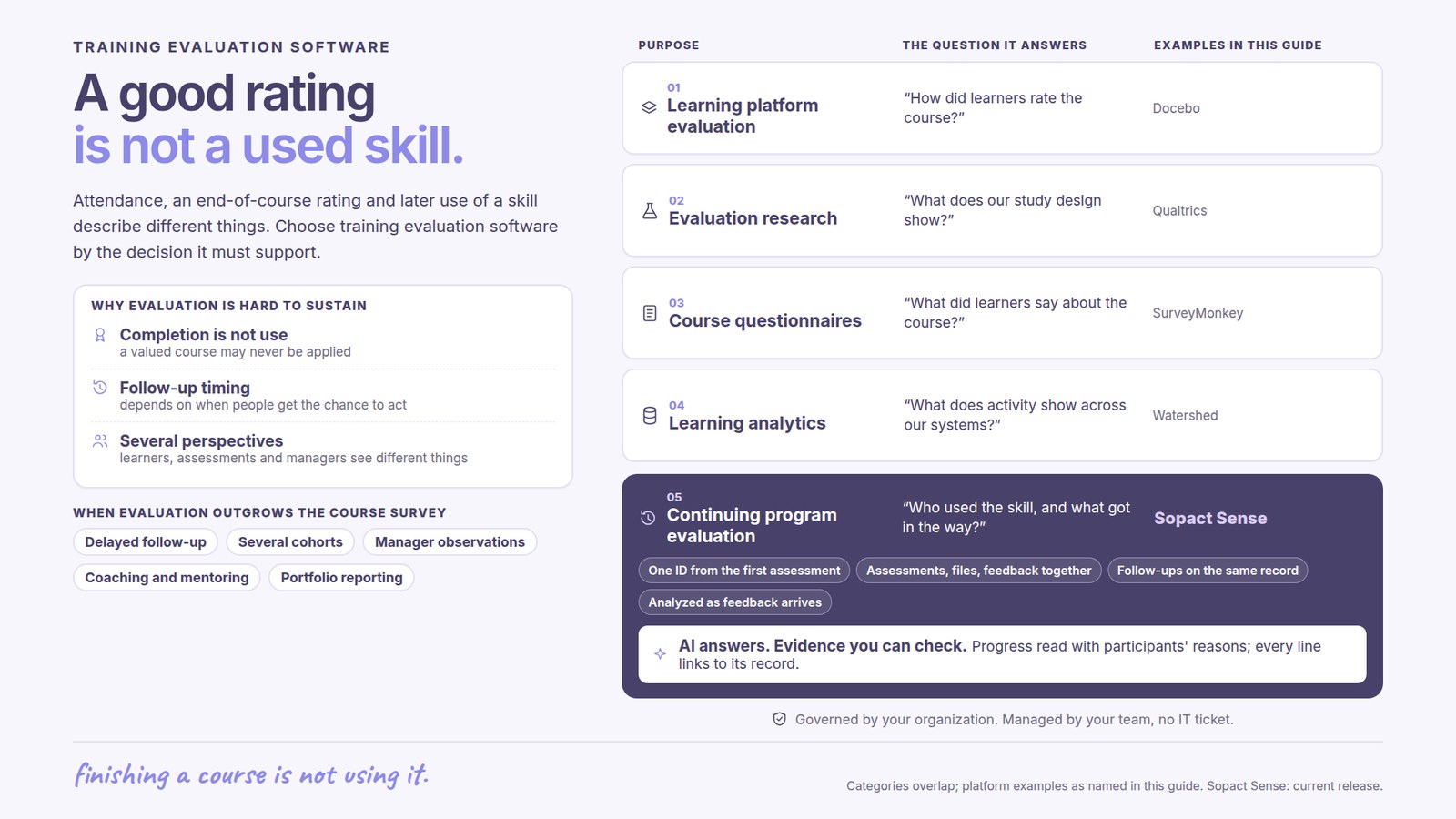
These are real, capable tools — SurveyMonkey and Qualtrics are strong survey platforms; Explorance Metrics That Matter and Kodo Survey are dedicated L&D measurement tools; Watershed is a learning-record store that connects xAPI data to business metrics. The rows below aren’t about whether they collect a reaction score. Every one does. They ask the question a CLO or a funder asks: does the tool read the open-ended feedback, link Level 1 to Level 4 on one learner, and hand you the effectiveness report as one query.

Capability Sopact SurveyMonkey Qualtrics Explorance (MTM) Kodo Survey Watershed
Time to first cycle liveDaysDaysWeeks2–4 moWeeks2–4 mo
AI reads open-ended feedback on arrivalYes · nativeNoAdd-onNoNoNo
Theme coding & citation trailYes · nativeNoAdd-onLimitedNoNo
One learner ID across waves (pre→follow-up)Yes · nativeNoCustomYesYesYes
Kirkpatrick L1–L4 linked on one recordYes · nativeNoCustom buildYesYesPartial
Behavior (L3) follow-up built inYesNoCustomYesYesPartial
Effectiveness report as one queryYes · nativeNoCustomYesPartialYes
Configuration in natural languageYes · nativePartialAdminConsultantPartialAdmin
White-label learner-facing formsYesPartialYesPartialPartialLimited
Built for small teams (no admin on staff)YesYesHeavy liftHeavy liftYesHeavy lift
Longitudinal outcome trackingYes · nativeNoCustomYesPartialYes

Honest reading: SurveyMonkey and Qualtrics win on survey breadth and ubiquity; Explorance, Kodo, and Watershed are purpose-built for L&D measurement and strong on the levels. Where none was designed to compete is reading the open-ended feedback on arrival and coding it with a citation trail — turning the qualitative L3/L4 evidence into data, live in days. Vendor capabilities change; confirm current details with each before deciding.

Where it fits

Built for training that has to prove results — and honest about where it isn’t.

There’s no seat math and no tier puzzle. The real question is fit. Sopact is most powerful as training evaluation software when three things are true — and most honest about the two places it won’t pretend to be the system of record.

Where Sopact is strongest

01 · Measured beyond reaction

Behavior and results, not just stars

If your stakeholders ask whether behavior changed and a business metric moved — Kirkpatrick Level 3 and 4 — not only whether learners enjoyed it, that is the exact question Sopact is built to answer.

02 · You follow learners over time

Pre to 60-day, one ID

The longitudinal arc is where Sopact is strongest — the same learner from pre-assessment to follow-up on one record. A one-touch reaction survey idles the engine; a multi-wave evaluation fires it.

03 · Your evidence is narrative

Open-ended feedback, comments

When the proof of transfer lives in open-ended feedback and manager observations, Sopact codes it on arrival — every theme traces to the source. Not “learners felt confident” but “38 of 120 comments cite applying the skill, e.g. learner #2841: I ran my first review using the framework.”

Where we’re honest about the edges

The boundary · Delivery

We measure training — we don’t deliver it

Sopact is not an LMS. If you need to host courses, track completions, or serve SCORM content, keep your LMS — Sopact is the evaluation layer that sits on top of it.

The boundary · System of record

We layer on top — we don’t replace

If you need Sopact to be the HRIS or the LMS, that’s the wrong shape. Sopact is the outcome-intelligence layer that reads across them on one learner ID.

And it goes live in days, not quarters.

The whole spine — data dictionary, built-in skills, white-label forms, Kirkpatrick framework with attribution, and definitive reporting (reaction through ROI) — is configured in plain English, not by a consultant on retainer. That is why the first pre-to-results cycle is live in days while a legacy measurement build runs a quarter or more.

DaysTo first live pre-to-results cycle
L1→L4Linked on one learner record
4–6 wkAnnual reporting overhead removed
2–3×Integrator-to-license cost we don’t charge
Report shapes

Four reports an L&D team actually needs.

The annual effectiveness deck gets the attention. But the day-to-day reports that change how a program runs are simpler — and rarely built, because the evidence is stuck in survey exports. Training outcome intelligence ships all four.

01 · Missing

What we should have collected and didn’t

Learners with a pre-assessment but no post. Cohorts with no 60-day follow-up logged. Surfaces the gap before the QBR does.

02 · Unusual

Cohorts that don’t look like the rest

A cohort whose confidence rose but whose behavior didn’t. A comment flagging a broken module nobody escalated. The program owner sees what to look at before the next cohort.

03 · Comprehensive

The full effectiveness report on demand

Reaction, learning gain, behavior change, business result, and coded comment themes — the Kirkpatrick report as one query, in whatever format the stakeholder wants.

04 · Aggregate

The leadership-ready view

Year-over-year effectiveness, cross-program comparison, ROI by program. The story for the leadership review — not the raw survey export.

Buyer fit

Sized for the L&D function you actually run.

Sopact is used by single-program training teams and by enterprise L&D functions. The system is the same; the complexity dial moves.

Small

Single-program teams

One training program that needs to move past the smile sheet — a workforce or nonprofit program, or a corporate team with one flagship course, currently on a survey tool plus spreadsheets.

Tags: single-program, no analyst on staff, survey-to-system migration, first L3 measurement.

Medium

Multi-program L&D (a few to dozens)

An L&D team running several programs that has to report effectiveness and ROI to leadership with consistent Kirkpatrick levels across them.

Tags: multi-program, multi-stakeholder, longitudinal tracking, LMS integration.

Large

Enterprise & multi-region (40+)

An enterprise L&D function rolling up effectiveness across regions and business units, that needs one learner ID and BI integration across the stack.

Tags: multi-region, rollup, white-label, API/BI, HRIS & LMS integration.

Where it fits less well

If you need an LMS to host and deliver courses, or a pure survey tool for one-off polls, Sopact is not that tool — and we’ll say so on the first call. Sopact is the evaluation-and-outcome layer for training that has to prove transfer, sitting alongside those systems rather than replacing them.

FAQ

What L&D teams ask before they pick training evaluation software.

Questions on training evaluation software — also searched as training evaluation tools or a tool to measure training effectiveness — from the Kirkpatrick levels and security to how it compares to the tools teams already run.

What is training evaluation software?

Training evaluation software is a platform that measures whether a training program worked — capturing reaction, learning, behavior change, and business results on one learner record from pre-training through follow-up. It replaces the common stack of a smile-sheet survey, a separate quiz tool, and a year-end spreadsheet with one connected record, and the best tools read the open-ended feedback on arrival rather than leaving it unread. It is also searched as training evaluation tools, a training measurement system, or a tool to measure training effectiveness.

How do you measure training effectiveness?

Measure across the four Kirkpatrick levels: Level 1 reaction (did learners value it), Level 2 learning (did knowledge or skill increase, via pre/post assessment), Level 3 behavior (did on-the-job behavior change, measured weeks later), and Level 4 results (did a business metric move). The discipline that makes it work is one persistent learner ID from pre-training to follow-up, and pairing every score with the open-ended comment that explains it. Software that only collects Level 1 cannot evidence effectiveness; software that links Level 1 to Level 4 can.

What features should training evaluation software have?

The essentials are: one persistent learner ID across waves; pre/post assessment that links a baseline to a follow-up; capture of structured scores and open-ended feedback together; reading of that open-ended feedback into themes on arrival; Kirkpatrick (or Phillips ROI) levels built in as the framework; and reporting that produces the effectiveness story as one query. The modern differentiator is whether the tool reads the qualitative feedback or only stores it for someone to read later.

How is training evaluation software different from an LMS or a survey tool?

An LMS (learning management system) delivers and tracks course completion; a survey tool (SurveyMonkey, Qualtrics) collects reaction sheets. Neither was built to link a baseline to a follow-up on one learner and read the open-ended feedback that explains behavior change. Training evaluation software is organized around the evaluation itself — reaction through results — and the best tools sit on top of the LMS and survey tool as the measurement layer, sharing one learner ID.

How does Sopact compare to SurveyMonkey, Qualtrics, Explorance, Kodo Survey, and Watershed?

SurveyMonkey and Qualtrics are strong survey tools; Explorance Metrics That Matter and Kodo Survey are dedicated L&D measurement tools; Watershed is a learning-record store that connects xAPI data to business metrics. They are capable, established systems. Where none was designed to compete is reading the open-ended feedback on arrival and coding it into themes with a citation trail, linking Level 1 to Level 4 on one record, and being live in days rather than a configuration project. Confirm current vendor capabilities before deciding.

How is Sopact priced for training evaluation?

Sopact is priced by use-case complexity, not seats or responses. A single training program measured at all four levels costs less than an enterprise L&D function running dozens of programs across regions. Pricing reflects the number of programs sharing one learner, longitudinal depth, custom rubrics, white-label depth, and integration with the LMS or HRIS. There are no Starter / Pro / Enterprise tiers.

Can training evaluation software measure behavior change and ROI?

It should — that is the hard part most tools skip. Behavior change (Kirkpatrick Level 3) requires a follow-up wave weeks after training on the same learner ID, and ROI (Phillips Level 5) requires linking that behavior to a business metric and isolating the training’s contribution. Software that keeps one learner record from pre-training through a 60-day follow-up, and reads the manager and learner narrative, is what makes Level 3 and Level 4 measurable rather than asserted. See the training ROI guide.

What is the best tool to measure training effectiveness?

There is no single best tool — it depends on whether you need to collect reaction or to prove results. A team that only needs smile sheets is fine with a survey tool; a team measured on behavior change and business impact needs software that maintains one learner ID across waves, links a baseline to follow-up, and reads the open-ended feedback. Match the tool to the Kirkpatrick level your stakeholders actually ask about — most struggle at Level 3 and Level 4, which is exactly where a reading layer helps most.

Does training evaluation software work for nonprofit and workforce programs?

Yes. Workforce, apprenticeship, and grant-funded training programs have the same need as corporate L&D — prove that the training changed something — often with a funder asking the questions instead of a CLO. The same spine (one learner ID, pre/post, follow-up, read narrative) produces the funder report and the leadership report from one record. See training evaluation for the methodology.

Does it integrate with our LMS?

Yes. Sopact sits on top of the LMS as the evaluation layer, sharing one learner ID, and exposes API and BI integration so results flow to and from the systems you already run — the LMS, the HRIS, your BI tool. Clean exports drop into Looker Studio, Power BI, or Tableau, so the measurement layer reads across your stack rather than replacing it.

How is this different from just using SurveyMonkey or Google Forms?

Survey tools collect the reaction sheet well and stop there: each survey is its own dataset, pre and post are unlinked, and the open-ended comments sit unread. Training evaluation software keeps one learner ID across waves, links the baseline to the follow-up automatically, reads the comments into themes, and produces the Kirkpatrick report as one query — the work that otherwise becomes a manual spreadsheet rebuild every cycle.

Related guides

Continue across the training-evaluation cluster.

Pillar · Method

Training evaluation

The methodology hub — 7 methods to measure training, start to finish.

Framework

Kirkpatrick model

The four levels in depth — reaction, learning, behavior, results.

Method

Training ROI

Phillips’ Level 5 — converting results to money and isolating training’s contribution.

Method

Training assessment

Pre/post knowledge and skill measurement — Kirkpatrick Level 2.

Method

Survey questions

The questions that capture reaction and behavior worth reading.

Product

Sopact Sense

The outcome-intelligence engine your training data is configured on top of.

Stop reporting reaction. Start proving results.

No demo theater. No discovery phase. Tell us what you train, who you measure, and which level your stakeholders ask about — reaction, behavior, ROI. We’ll show you what the first 30 days look like on Sopact.