Training Evaluation Survey Questions: 25+ Decision-Anchored Examples for Real Outcome Measurement
The funder report is due Friday. Your post-training survey shows an average satisfaction score of 4.3 out of 5. Your learning quiz shows 87% passed. Your 90-day follow-up email went to 140 participants and received 23 responses — and you cannot tell which 23, because the follow-up form has no connection to the post-survey, which has no connection to the pre-survey, which used a different ID than the enrollment record. The funder is not asking about satisfaction. The funder is asking whether participants applied the new skills on the job, whether that application held three months later, and whether the cohort with prior experience outperformed the cohort without. Not one of the 47 questions on your post-survey can answer that — not because the questions are badly written, but because every one of them is an Orphan Question.
Last updated: April 2026
The Orphan Question is a training evaluation survey question that sits without three connections: the decision it feeds, a paired open-ended counterpart that explains it, and a persistent learner ID that links it to the same participant's answers across time. Most published question banks — including the "25 best post-training survey questions" lists that dominate search results — are compilations of orphaned questions. They are not invalid. They are not badly written. They simply cannot, as a data architecture, produce the evidence funders and boards now require. This page is a question bank of a different kind: every question below earns its place because it can be traced to a decision, paired with a counterpart, and linked to a learner ID inside Sopact Sense. The bank is organized by the decision each question helps you make — not by survey section.
Use Case · Training Evaluation
Training evaluation survey questions that answer the funder's question
A 25-question bank for reaction, learning, behavior, and results — decision-anchored, matched for pre/post, and linked to the same learner from enrollment through 90-day follow-up.
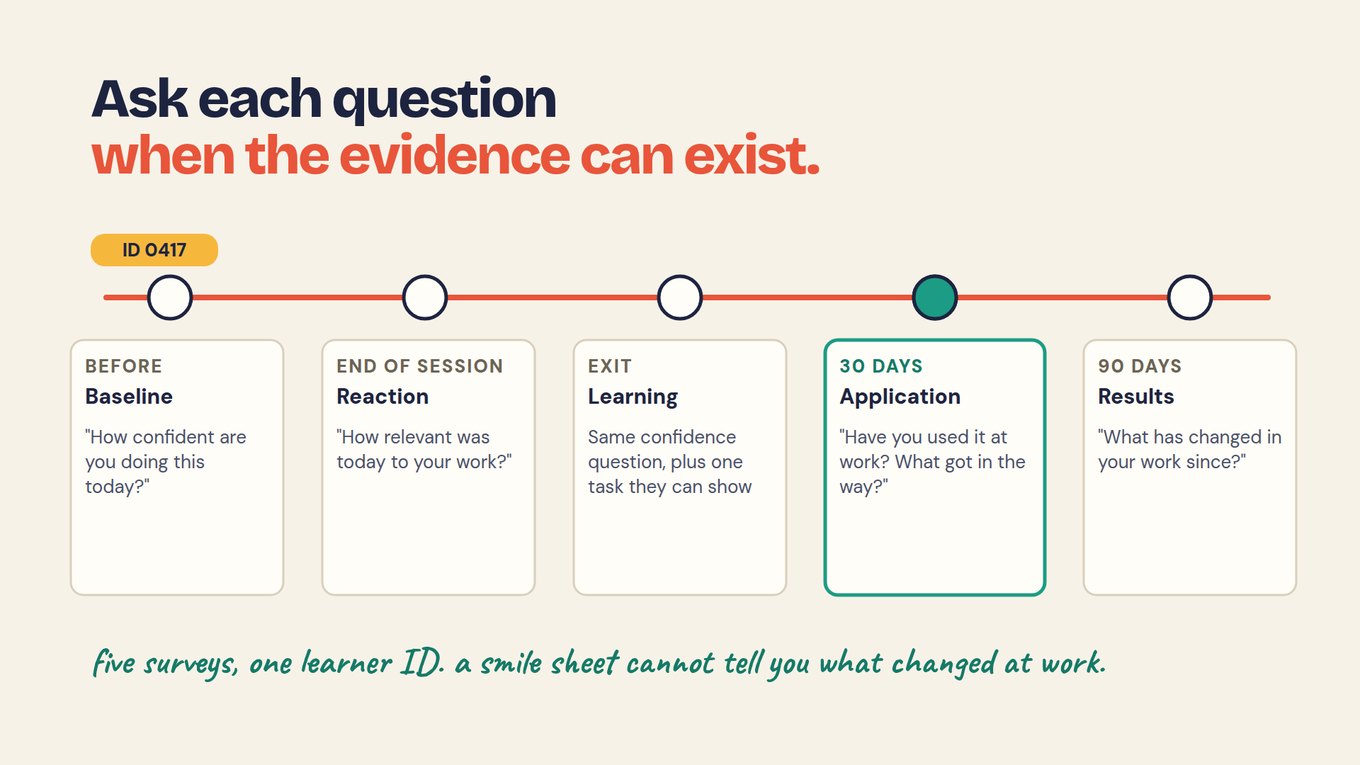
The persistent learner ID thread · one record across four waves
Ownable concept
The Orphan Question
A training evaluation survey question that sits without three connections: the decision it feeds, a paired open-ended counterpart that explains it, and a persistent learner ID that links it to the same participant's answers across time. Most published question banks are compilations of orphaned questions — no matter how well each individual question is written.
25
Decision-anchored questions across all four Kirkpatrick levels
4
Waves linked by a persistent learner ID — pre, post, 30/60d, 90d+
80%
Analyst time typically spent reconciling fragmented training data
4 min
Funder-ready report when the question and data architecture hold
How to write training evaluation survey questions that don't orphan themselves
Six architectural decisions that determine whether your question bank produces funder-grade evidence or three weeks of analyst cleanup. All six belong at the design stage — none can be added later.
A 1–5 confidence rating captures magnitude. The open-ended "what drove your rating" captures the reasoning. Placed immediately after the scale item — never at the end of the survey where dropout peaks and response quality collapses.
Solo ratings produce numbers no one can interpret once the cohort closes.
02
Lock scales
Lock scales and wording across every wave
Identical wording, identical scale, identical response options — pre, post, 30-day, 60-day, 90-day. A 1–5 pre and a 1–7 post is not a comparison; it is an artifact of instrument drift. Lock the instrument at version 1.0 before Wave 1.
A mid-program scale change destroys comparability for that cohort's entire history.
03
Decision-anchor
Anchor every question to a specific program decision
If you cannot name the decision a question feeds — facilitator review, curriculum cut, barrier intervention, funder-report line — remove it. Surveys that collect data "in case we need it" produce the 47-question instruments no one will analyze.
Decisionless questions are the single largest source of survey fatigue.
04
Persistent ID
Assign a persistent learner ID before Wave 1
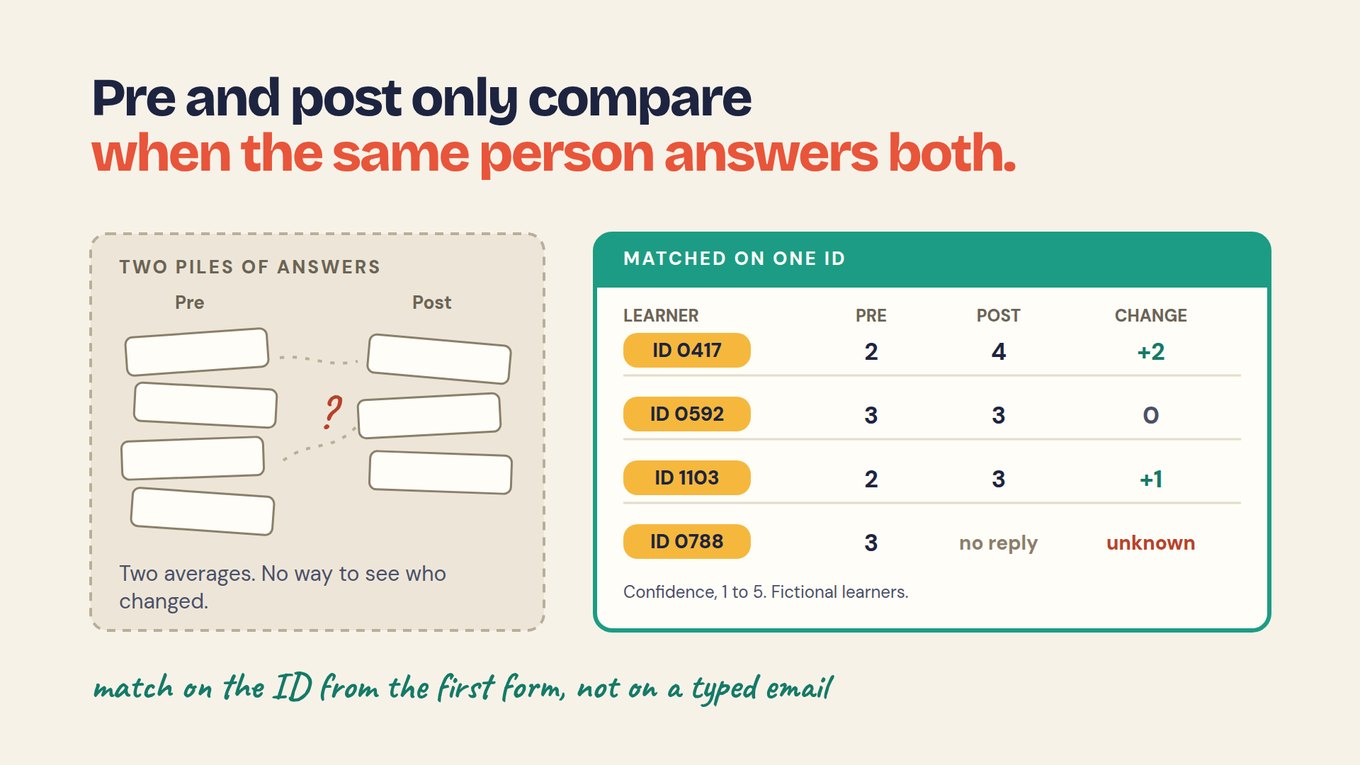
Email, name, and participant-remembered access codes all fail between waves. Systems assign IDs at enrollment and embed them in every personalized survey link. This is the only structural fix for the Identity Break that ends pre/post matching three weeks into cleanup.
No cleanup process replaces an ID that was never assigned at the start.
05
Disaggregate
Design disaggregation fields at collection, not retroactively
Gender, cohort, site, prior experience, program track — funder reports will request every one of these segments. They must exist as structured fields on the intake form, not as free-text buried in open-ends that need coding months later.
Demographic fields not collected at intake cannot be added to historical cohort data.
06
Plan follow-up
Plan 30, 60, 90-day follow-up waves from day one
Behavior-transfer items (Level 3) and results items (Level 4) require follow-up waves. Adding them as afterthoughts six weeks after program completion produces weak response rates and no baseline to match against. Commitment is asked for at enrollment.
Follow-up bolted on late produces 15% response rates and unusable data.
Every principle above is an architecture decision. None are fixable after data collection starts — which is why Sopact Sense enforces them at design, not at analysis.
Training evaluation survey questions are the specific items administered to participants before, during, and after a training program to measure reaction, learning, behavior change, and organizational results. A well-designed bank covers all four Kirkpatrick tiers — not just reaction. The difference between a training feedback survey and a training evaluation is whether the data can answer questions about behavior change on the job, which requires matched pre and post responses from the same learner. Sopact Sense assigns a persistent learner ID at enrollment so every answer across every wave links to the same record without manual matching.
What is a training feedback survey?
A training feedback survey is a short instrument — typically five to ten questions — administered immediately after a session to capture reaction: how satisfied participants were, how useful they found the content, and what they would change. It covers Kirkpatrick Level 1 only. Feedback surveys are useful for rapid facilitator improvement but cannot prove learning, behavior change, or organizational results. A program that runs feedback surveys and nothing else is running reaction measurement, not evaluation — which is the distinction most funder agreements now explicitly call out.
What is a post training survey?
A post training survey is the instrument administered at program completion to measure what participants learned, how confident they feel applying it, and their satisfaction with the delivery. Designed well, it covers Kirkpatrick Levels 1 and 2 — reaction and learning. The structural requirement for a post-survey to produce matched-pair evidence is that every response must link back to a pre-training baseline through a persistent learner ID — not by name, not by email, not by remembered access code. This is where the Identity Break fails most programs, covered in depth on the pre and post surveys page.
Pre training survey questions examples
A pre-training survey establishes baseline knowledge, confidence, and demographic context before any instruction begins. Ten examples that map directly to post-survey counterparts:
Before this program, how would you rate your ability to [specific skill taught]? (1–10)
Describe one specific task in your current role where you would use [skill area] if you were confident in it. (open-end)
What has prevented you from building [skill] before now? (open-end)
How many years have you worked in [relevant domain]? (numeric)
Which of the following best describes your primary goal for this program? [list matched to learning objectives]
On a 1–5 scale, how confident are you in [each of the 3–5 core learning objectives]? (matched to post)
Have you received formal instruction in [skill] before? (yes / no, with open-end)
What are you hoping will be different in your work after this program? (open-end)
What is the single biggest barrier between you and competency in [skill] today? (open-end)
Would you be willing to participate in a 30-day, 60-day, and 90-day follow-up survey? (yes / no — sets expectation at Wave 1)
Every pre-survey item has a post-survey counterpart that uses identical wording and scale. Scale changes between waves invalidate the comparison entirely — covered in survey metrics and KPIs.
Step 1: Design matched pre/post pairs — the question-by-question architecture
The Orphan Question emerges most often at the design stage, when a program manager builds a post-survey from a published question-bank template without building the matching pre-survey first. Matched pairs mean every outcome question appears in both waves with identical wording, identical scale, and identical response options. If the pre asks "how confident are you in [skill] on a 1–5 scale," the post asks exactly the same — not 1–7, not 1–10, not "how much more confident." Pair design also means every rating item is followed immediately by a paired open-end: the 1–5 item captures magnitude, the open-end captures reasoning. Analysts cannot interpret a confidence drop from 4 to 3 without the sentence the participant wrote next to it.
Three archetypes
Whichever shape of training program you run — the question architecture is the same
Workforce programs, capacity-building cohorts, and credential programs each need different content. They all need the same three-wave question architecture to produce evidence.
A nonprofit runs a 12-week workforce cohort for 60 participants. Funder requires pre-to-post evidence disaggregated by gender and site, plus 90-day post-exit employment data. The question bank is identical for every cohort. The architecture is what determines whether funder reports take three days or four minutes.
01
Pre-survey
Baseline confidence, barrier ID, site and gender anchors
Three tools, three ID systems, three weeks of matching
Google Forms for intake — no ID beyond row number
SurveyMonkey for post — separate login, separate export
MailChimp bulk email for 90-day — responses untagged to participant
Analyst reconciles on name + email in a spreadsheet
30–40% of records fail matching on first pass
With Sopact Sense
One platform, one learner ID, zero matching
Persistent learner ID assigned at enrollment
Every wave delivered through a personalized link tied to that ID
Open-ended responses themed as they arrive
Disaggregation by gender and site is a filter, not a project
Funder report generates in minutes, not days
A capacity-building nonprofit runs a six-month cohort teaching 40 partner organizations a new practice. The learner is both an individual and an institutional representative. Funder asks whether the practice was adopted at the organizational level — not just whether the individual learned it. The question bank adds organizational-adoption items at 90 days and 6 months.
01
Pre-survey
Current organizational practice, individual baseline
02
Post-survey
Learning confirmation, intent to adopt at org level
Learner ID + partner organization ID, both persistent
Every learner tagged to their partner organization at enrollment
Organizational adoption is a 6-month rubric-based survey
Open-ends themed for barrier and enabling-condition patterns
"Which orgs adopted?" is a report filter, not a research project
A credential program runs quarterly cohorts of 120 participants verifying a specific skill against an external rubric. The credential only holds value if post-program rubric scores can be traced to the same participant's learning trajectory. Rubric scoring is the Level 2 anchor; employment outcome at 90 days is the Level 4 proof.
Step 2: The four measurement tiers — 25 decision-anchored questions
Every question below is tied to a decision the program team makes. The rationale in italics is the decision, not a methodology note.
Reaction — Kirkpatrick Level 1 (5 questions)
How would you rate the overall usefulness of this training? (1–10) — facilitator performance review and curriculum retention
What was the most useful part of this training? (open-end) — next-cohort curriculum prioritization
What was the least useful part of this training? (open-end) — next-cohort content cuts
Would you recommend this training to a colleague? (yes / no / maybe) — enrollment marketing claims with evidence
What one change would make the most difference in this program? (open-end) — next-cohort program design input
Learning — Kirkpatrick Level 2 (6 questions)
On a 1–5 scale, how confident are you that you can [specific skill taught] today? (matched to pre) — baseline-to-endline confidence delta per learner
Describe a specific situation at work where you would apply [skill]. (open-end) — behavior-readiness signal before Level 3 measurement
[Knowledge-check item with a verifiable correct answer] — learning outcome measurement
Which of these scenarios best illustrates [concept taught]? (scenario MCQ) — applied knowledge vs. rote recall distinction
What concept from this program was the hardest to grasp? (open-end) — curriculum scaffolding decisions
Rate your understanding of each of the core learning objectives. (1–5 each, one per objective) — objective-level completion reporting
Behavior — Kirkpatrick Level 3 (7 questions — delivered at 30, 60, and 90 days)
In the last [30 / 60 / 90] days, how many times have you used [skill] on the job? (numeric) — transfer frequency evidence for funder reports
Describe the most recent time you applied [skill] at work. (open-end) — narrative evidence of transfer
On a 1–5 scale, how confident are you in [skill] right now? (matched to pre and post) — sustained-confidence curve across four waves
What has helped you apply the training at work? (open-end) — enabling-condition identification
What has prevented you from applying the training at work? (open-end) — barrier identification for program redesign
Has your manager or a peer observed you using [skill]? (yes / no / unsure) — observation-channel triangulation
If yes, what feedback did they give? (open-end) — external validation evidence
Results — Kirkpatrick Level 4 (7 questions — delivered at 90 days and again at 6 or 12 months)
Has your role or responsibilities changed since completing the program? (yes / no, with open-end) — role progression outcome
Describe one work outcome you can attribute in part to this training. (open-end) — attributable outcome evidence for funders
On a 1–5 scale, how much has your confidence in [skill] changed since enrollment? (matched to pre) — long-term confidence retention
Have you trained or mentored someone else on [skill] since completing the program? (yes / no, with open-end) — multiplier effect evidence
In the last 90 days, has your team or organization adopted a practice you introduced from this training? (yes / no, with open-end) — organizational transfer evidence
What additional support would help you continue applying [skill]? (open-end) — alumni-program design input
Would you be willing to participate in a 20-minute interview about your experience? (yes / no) — qualitative case-study pipeline
That is a 25-question decision-anchored bank — covering reaction, learning, behavior, and results — that maps to every Kirkpatrick level without a single orphaned question.
Step 3: How the instruments live in Sopact Sense
A question bank becomes an instrument when it is built inside a data collection platform that carries a persistent learner ID, links pre/post responses automatically, and runs qualitative analysis on the open-ends as they arrive. Exporting a 25-question bank into Google Forms or SurveyMonkey produces clean data at collection — and no ability to link to the pre-survey without manual matching three months later. In Sopact Sense, the pre-survey, post-survey, and 30/60/90-day follow-up instruments are designed from the same question library, tied to the same participant record at enrollment, and analyzed without a cleanup step. The qualitative responses are themed as they arrive, not three weeks after the funder deadline has passed.
Risk map · Compare
Four risks that orphan a training evaluation — and what replaces each
Each risk below survives any question-bank template. Replacement is an architecture decision, not a survey-design choice.
Risk 01
The Smile Sheet
Reaction data passed off as evaluation. Satisfaction at 4.3/5 and the funder still has no answer to the question they asked.
Level 1 is the floor, not the ceiling.
Risk 02
The Unmatched Pair
Pre and post both exist. The ID chain between them does not. 30–40% of records fail manual matching by name and email.
No cleanup recovers an ID that was never assigned.
Risk 03
The Orphan Open-End
Open-ended responses sit in a CSV column no one codes. The "why" behind every number is collected and then discarded.
Qualitative data that is not themed is effectively not collected.
Risk 04
The Shifting Scale
Pre-survey used 1–5. Post-survey used 1–7. The delta is an artifact of instrument drift — not a measurement of change.
Locked scales are a prerequisite, not a refinement.
Capability comparison
Where generic survey tools stop — and where a training-intelligence architecture picks up
Capability
Traditional stack
With Sopact Sense
Section 01 · Question design
Matched pre/post wording
Identical items across waves
Manual discipline
Maintained by analyst memory or a versioned doc — breaks under turnover
Locked at the instrument level
Waves share the same question bank — version control is structural, not procedural
Paired open-end per rating
Magnitude plus reasoning
Possible, rarely enforced
Placement drifts to end of survey where dropout peaks
Paired at design, fixed in place
Every rating item has its paired open-end immediately below — order cannot drift
Decision anchoring per question
Each question feeds a named decision
Not structured
Results in long instruments with decisionless items
Metadata per question
Decision tag stored with the question — unused tags flagged for removal
Section 02 · Identity architecture
Persistent learner ID
Assigned before Wave 1
Not assigned
Matching relies on name, email, or participant-remembered codes — all fail between waves
Assigned at enrollment
Embedded in every personalized wave link — inherited by every subsequent instrument
Cross-wave linking
Pre → post → 30/60/90-day → 6-month
Manual VLOOKUP / spreadsheet merge
2–3 weeks per cohort; 30–40% of records fail matching on first pass
Automatic on collection
Pre/post comparison is a filter, not a reconciliation project
Disaggregation at collection
Gender, site, cohort, prior experience
Retrofitted from exports
Fields not captured at intake are permanently unavailable for historical cohorts
Structured at intake form
Every funder segment is a filter — "did it work for women at site B" answers in seconds
Section 03 · Analysis readiness
Qualitative coding at scale
Themes across 100s of open-ends
Manual, 2–4 weeks per cohort
Typically skipped; quotes cherry-picked for reports
Themed as responses arrive
Open-ends coded into structured fields next to the source answer — reproducible across cohorts
Real-time dashboards
Live view across cohorts and waves
Quarterly export cycle
Findings arrive after decisions about the current cohort are already made
Updated as data arrives
Mid-program adjustment based on live barrier and enabler themes
Funder report generation
Kirkpatrick L1–L4 by cohort
3 days of analyst time per cohort
Consultant engagement $8k–$18k per evaluation cycle
4 minutes to a shareable report
Auditable — every aggregate metric traces back to participants and quotes
Every row above is a structural requirement — and every one is an architecture decision made before Wave 1 opens.
A 25-question bank is worth what you can do with it. In Sopact Sense, every answer lands on a persistent learner record — ready for the funder question you haven't been asked yet.
Step 4: Common pitfalls in training evaluation survey questions
Response-shift bias is the phenomenon where participants' self-assessed baseline changes after training: the 4/5 confidence score they gave at pre-survey is revised, retrospectively, as a 2/5 once they understand how much more there is to know. The fix is a retrospective pre-test item delivered alongside the post-survey: "Looking back now, how would you rate your confidence in [skill] before the program began?" Pair this with the original pre-survey rating to measure both actual change and perceived change.
Ceiling effects occur when the scale tops out for most respondents on the post-survey — most answers cluster at 4 or 5 on a 1–5 scale — and real variation between participants disappears. The fix is a wider scale on outcome-critical items (1–10 rather than 1–5) and at least one behavior-frequency item ("how many times this week…") that cannot hit a ceiling.
Social desirability is the tendency of participants to answer the way they believe the program wants them to, inflating satisfaction and self-reported learning. The fix is triangulation: pair every self-reported confidence item with an open-ended "describe a specific situation" item, and where possible pair both with an external observation channel — a manager or mentor completing a parallel rubric, covered in depth on the training assessment page.
Small-N problems show up in programs with 20 or fewer participants per cohort, where statistical comparison between subgroups is unreliable. The fix is not more participants per cohort — it is longitudinal pooling: running the identical matched-pair instrument across four or more cohorts and comparing year-over-year at the individual learner level. That requires the instrument wording, scale, and schema to stay locked across cohorts — which is a data architecture decision, not a question design choice. Covered more fully on the longitudinal design page.
Step 5: From survey answers to outcome evidence
The step from "we collected 340 post-survey responses" to "we have outcome evidence a funder can audit" is where most training programs stall. Survey answers become evidence when three conditions hold at the data architecture level: every response links to a persistent learner ID, every open-ended response is coded into structured themes before the next cohort begins, and every outcome metric traces back to the specific participants and quotes behind it. Programs running on SurveyMonkey or Google Forms cannot meet any of these three conditions without weeks of analyst time per cohort — which is the same Kirkpatrick Ceiling covered on the training evaluation methods page, approached from the question-design side. A 25-question decision-anchored bank produces evidence the day the last response arrives, not six weeks later. The question architecture and the data architecture cannot be separated.
Masterclass
Training Evaluation Strategy — why most programs collect the right data and can't connect it
What is the difference between a training feedback survey and a training evaluation?
A training feedback survey captures reaction — satisfaction, perceived usefulness, facilitator quality — at one point in time immediately after a session. A training evaluation measures whether learning occurred, whether behavior changed on the job, and whether organizational results improved, across matched pre and post waves tied to persistent learner IDs. Feedback covers Level 1. Evaluation covers Levels 1 through 4.
What should you ask in a pre-training survey?
A pre-training survey should ask baseline versions of every outcome-critical question that will appear on the post-survey, at least one open-ended item per skill area capturing current practice, and the demographic anchors required for disaggregation. It should not contain any question whose answer will not be re-asked at post. Every pre-item exists to enable a matched-pair comparison — the structural requirement for change measurement.
What are the four levels of training evaluation?
The four levels of training evaluation, per Kirkpatrick, are Reaction (did participants like it), Learning (did they acquire knowledge and skills), Behavior (did they apply the learning on the job), and Results (did it produce organizational outcomes). Programs that stop at Level 1 or 2 are running satisfaction and test-score measurement — not evaluation. Levels 3 and 4 require matched measurement across a persistent learner ID, covered in depth on the Kirkpatrick model page.
How do you measure the effectiveness of training?
You measure training effectiveness through a matched-pair design — identical questions at pre and post, plus 30/60/90-day follow-up on behavior items — tied to a persistent learner ID so every response links to the same participant record automatically. Effectiveness is the change on outcome-critical items between waves, filtered by demographic and cohort segments, with open-ended responses coded for barrier and enabling-condition themes. See the training effectiveness page for the full measurement architecture.
What is a good response rate for a post-training survey?
A post-training survey delivered immediately at program completion typically achieves 70 to 95 percent response rates. Follow-up surveys drop at predictable intervals — 30 to 50 percent at 30 days, 20 to 40 percent at 60 days, 15 to 35 percent at 90 days — when delivered through generic email blasts. Personalized links tied to the participant's record, the pattern Sopact Sense uses, typically triple the 90-day response rate because the recipient recognizes the context.
What is The Orphan Question?
The Orphan Question is a training evaluation survey question that sits without three connections: the decision it feeds, a paired open-ended counterpart that explains it, and a persistent learner ID that links it to the same participant's other answers across time. A survey full of orphaned questions produces data that cannot answer the questions funders actually ask — no matter how well-written each individual question is.
How many questions should a post-training survey have?
A post-training survey delivered at session end should stay under 12 questions and under six minutes of completion time. Completion rates drop sharply past minute six, and the questions completed in a hurry produce unreliable data. A 25-question bank should split across pre, post, and 30/60/90-day follow-up waves — not collapse into one long instrument at the end.
Can you use the same survey for every training program?
No. Outcome questions must reference the specific skill taught — "how confident are you in [specific skill]" rather than "how confident are you in general." The reaction questions, the scale structure, the follow-up cadence, and the disaggregation fields can be templated across programs. The skill-specific items cannot.
How do you evaluate a training program with small cohorts?
For cohorts under 20 participants, single-cohort statistical comparison is unreliable. The pattern that works is longitudinal pooling: running the identical matched-pair instrument across four or more cohorts and comparing year-over-year at the individual learner level. That requires the instrument wording, scale, and schema to stay locked across cohorts — an architecture decision made at the platform level, not a question design choice.
How much does training evaluation software cost?
Generic survey tools range from free (Google Forms) to roughly thirty to fifty dollars per user per month (SurveyMonkey, Qualtrics) — and produce unlinked submissions that require manual matching. Purpose-built training-intelligence platforms that provide persistent learner IDs, automatic cross-wave matching, and AI-driven qualitative analysis — like Sopact Sense — typically start around one thousand dollars per month for programs running one to three active cohorts, and scale with program complexity rather than seat count.
What is the retrospective pre-test?
A retrospective pre-test is a post-survey item that asks participants to rate their pre-program state after training, alongside their current state: "Looking back now, how confident were you in [skill] before enrollment?" It corrects for response-shift bias, where participants' self-assessed baseline changes after they understand the domain. Use it in addition to, not instead of, the actual pre-survey — both measurements carry different signals.
The three-step workflow
Design, collect, and analyze one training evaluation inside one platform
A 25-question bank is the starting line. Moving from bank to evidence takes three architectural pillars — all three built into Sopact Sense.
01
Pillar 01
Design the instruments once, correctly
Build pre, post, and follow-up surveys from the same question library. Pair every rating with an open-end. Lock scales across waves. Tag every question to the decision it feeds.
Matched pre/post wording enforced at the instrument level
Paired open-ends placed inline, not at survey end
Decision tags stored as metadata on each question
02
Pillar 02
Collect across waves with one persistent ID
Assign the learner ID at enrollment. Embed it in every wave link. No VLOOKUP, no name-matching, no 30–40% record loss between pre and post.
Persistent learner ID inherited by every subsequent survey
Personalized links tied to the participant record
Disaggregation fields structured at intake
03
Pillar 03
Analyze themes, deltas, and segments in minutes
Open-ends themed as responses arrive. Confidence deltas calculated across waves automatically. Funder reports generated against the live data, not against a six-week-old CSV.
Open-ended themes coded into structured fields
Pre/post/follow-up deltas as filters, not projects
Funder-ready reports with auditable metric trace-back
The question bank is the starting line — not the finish line. See how Sopact Sense runs all three pillars on one learner record.