


What is training evaluation?
Training evaluation is the systematic process of determining whether a training program reached the right participants, improved their knowledge or skills, and contributed to the outcomes the program exists to create. For a workforce or nonprofit training program, that means looking beyond attendance and satisfaction to employment, retention, earnings, job quality, or another clearly defined participant result.
Video: how training program data connects across the participant journey, from application through certification and job placement.
Also see: the Kirkpatrick model demonstration
Video: how the Kirkpatrick model connects reaction, learning, behavior, and results across the training lifecycle.
Training evaluation should be designed before the first participant enrolls. The CDC recommends defining the evaluation purpose, questions, methods, timing, and intended users early—not adding a survey after delivery. That matters because the strongest workforce outcomes often appear months after training ends.
Key takeaways
- Attendance, completion and certificates describe delivery; satisfaction describes participant experience. None alone establishes that participants found or kept work.
- Employment, internships, promotions, retention, and wage gains must remain separate outcomes, each with its own definition and time period.
- A placement rate is only credible when the denominator and the number of participants with unknown status are reported with it.
- “Employed after training” and “employed because of training” are different claims; the second requires evidence about contribution or attribution.
- Quantitative results explain what changed; interviews and open-ended responses help investigate possible reasons for differences.
The central distinction: participation is not employment
A program can deliver every planned session, achieve high attendance, and receive excellent participant feedback without knowing whether anyone entered employment. Those results answer whether the training was delivered and how participants experienced it. They do not answer whether the program achieved its workforce purpose.
- 1. EnrolledStarting employment status, goals, barriers, and eligibility
- 2. ParticipatedAttendance, training received, completion, and dosage
- 3. Became readySkills, credentials, confidence, applications, and interviews
- 4. Entered workInternship, apprenticeship, self-employment, or paid job—kept distinct
- 5. ProgressedRetention, hours, earnings, job quality, and advancement over time
The chain is useful because every stage can fail for a different reason. Someone may complete training but lack transportation. Another participant may gain the target skill but face a childcare constraint. A third may receive an offer but decline because the wage or schedule is not viable. One overall satisfaction score cannot reveal those differences.
What should a workforce training program evaluate?
A useful evaluation combines implementation evidence, learning evidence, employment outcomes, and participant context. The exact measures depend on the program, but the distinctions below should remain stable.
Scroll horizontally to see all columns →
| Evaluation question | Evidence to collect | When to collect it |
|---|---|---|
| Did the intended participants enroll? | Eligibility, baseline employment status, goals, prior experience, and barriers | At enrollment |
| Did they receive the training? | Attendance, dosage, completion, services received, and reasons for non-completion | During delivery |
| Did knowledge or skill improve? | Pre/post assessment on the same rubric, demonstration, credential, or portfolio evidence | Before and at completion |
| Did readiness improve? | Resume quality, interview readiness, applications, interviews, referrals, and participant confidence | During and shortly after training |
| Did participants enter employment? | Employment status, start date, employer, role, hours, wage, and relationship to training | At defined follow-up points |
| Did employment last and improve? | Retention, earnings, promotion, benefits, schedule stability, and job quality | For example, 90, 180, and 365 days |
| Why did results differ? | Open-ended follow-up, interviews, case notes, employer feedback, and documented barriers | Throughout the participant journey |
Public workforce reporting illustrates why definitions and timing matter. If your program is subject to specific reporting requirements, use the applicable definitions and current guidance. A locally chosen placement measure should not be presented as an official measure merely because the labels are similar. See the Department of Labor performance-indicator reference.
How do you calculate a defensible employment outcome?
Start by defining the employment event. Specify whether it includes paid jobs only or also internships, apprenticeships, self-employment, promotions, or continued education. Then specify the follow-up checkpoint and who belongs in the denominator.
Example: “Employment within 180 days” could mean the number of eligible participants who entered paid, unsubsidized employment within 180 days of completing the program, divided by all eligible completers. That definition is very different from dividing only by participants who answered the follow-up survey.
Report the denominator, not only the rate
60 of 100 enrolled participants completed training.
Of the 60 completers, 42 were confirmed employed, 10 confirmed not employed and eight had unknown status. Among the 40 non-completers, 28 were confirmed not employed and 12 had unknown status. These figures describe this fictional example, not an actual program.
A transparent report can show 42% of everyone enrolled, 70% of completers, and the 20% unknown follow-up rate. Reporting only “70% placement” would hide both non-completion and missing follow-up.
This denominator discipline prevents attrition from making a program appear more successful than the evidence supports. It also creates an operational signal: a high unknown rate may indicate that follow-up needs to be built into case management, partner reporting, or participant communication instead of left to a one-time survey.
Employment after training is not automatically employment because of training
Training evaluation must separate an observed outcome from a causal claim. If a participant found work after completing a program, the employment is observable. Whether training caused that employment is a harder question because labor-market conditions, prior experience, employer demand, referrals, transportation, childcare, and other services may also have contributed.
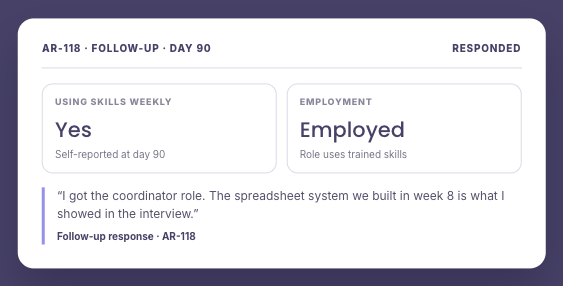
A program can strengthen its contribution claim by recording the participant’s baseline, the services actually received, skill change, application and interview milestones, the timing of employment, and the participant’s and employer’s explanation of what helped. When feasible, it can also compare cohorts, use a not-yet-served group, or examine whether greater participation is associated with stronger outcomes. The conclusion should match the design: “participants reported that interview practice helped them obtain offers” is different from “the training caused 42 jobs.”
Start with a training needs assessment and baseline
A useful evaluation starts before training is delivered. A training needs assessment should identify the gap the program is expected to address and determine whether training is an appropriate response. Barriers involving tools, transport, childcare, employer opportunity or management support may require practical changes alongside learning support.
Assess the need at three levels: the organization’s objective, the tasks or roles affected, and each learner’s current capability and circumstances. Combine a clear rating or observable baseline with one neutral, open-ended question asking what makes participation or performance difficult.
Keep the baseline on the same learner record used for enrollment, attendance, learning checks, completion, employment, retention, and follow-up. Reuse a needs assessment as a baseline only if its measure, timing and population fit the later comparison. Otherwise collect a suitable baseline separately. Keep context connected without assuming every source is an equivalent measure.
Training evaluation models: which one should you use?
Models organize evaluation questions; they do not replace good outcome definitions or connected participant data. Choose the model that fits the decision you need to make.
Scroll horizontally to see all columns →
| Model | What it helps answer | Best use |
|---|---|---|
| Theory of Change or logic model | How training activities are expected to lead to skills, employment, and longer-term change | Designing the program and deciding what must be measured |
| Kirkpatrick | How participants reacted, learned, applied learning, and produced results | Organizing evidence across the training lifecycle |
| CIPP | Whether the context, inputs, process, and products of the program are appropriate | Improving program design and implementation |
| Brinkerhoff Success Case Method | Why the strongest and weakest outcomes occurred | Combining outcome patterns with in-depth participant evidence |
| Phillips ROI | Whether monetized benefits exceed program costs after adjustments | Economic evaluation when outcome and cost evidence are strong enough |
The Kirkpatrick model remains useful, but it should not force a workforce program to translate every result into corporate performance language. For a job-training program, Level 4 may be employment, retention, earnings, or job quality. The program’s theory of change explains why those results should follow from the intervention; Kirkpatrick helps organize the evidence collected along the way.
Training evaluation methods: use more than a post-course survey
Participant records and administrative data
Enrollment, attendance, case management, credential, job placement, and wage records establish what happened and when. They are strongest when each source connects to the same participant ID and retains its source and timestamp.
Pre/post assessments and demonstrations
Use the same construct and scoring rubric before and after training. The CDC notes that a post-test alone can show end proficiency but cannot show whether learning changed because participants may have started with the knowledge or skill.
Surveys and short follow-ups
Surveys can measure relevance, confidence, application, barriers, employment status, and participant-reported contribution. Keep them short, time them to the decision, and consider whether a reliable, authorized administrative source can answer the question without asking participants again.
Interviews, open-ended responses, and case notes
Qualitative evidence helps investigate why participants with similar training experiences may have reached different outcomes. It can surface transportation, caregiving, health, documentation, discrimination, wage, schedule, or employer-fit issues that a placement count cannot diagnose.
Employer or partner verification
Employer confirmation, partner records, and wage data can strengthen employment and retention evidence. The verification method and any remaining gaps should travel with the reported number.
A practical example: The Lantern Network
The Lantern Network describes mentorship, career-readiness support and internship opportunities. That range of activities makes it useful to distinguish participation, readiness and later employment in an evaluation.
Internships, jobs and promotions represent different stages. Keep them separate in the underlying data even when a public narrative groups them as career progress. The example illustrates an evaluation-design question, not an independent verification of program impact.
Lantern’s published measurement approach identifies the right next layer: full-time employment in a participant’s field, time to placement, salary ranges, career advancement, and follow-up at six months, one year, and three years. A connected participant record can bring those measures together without losing the mentorship, skill-development, network, and lived-experience evidence that explains the outcome.
How to build a useful training evaluation
1. Start with the decision
Name who will use the findings and what they will decide. A program manager improving participant support needs different evidence from a funder deciding whether to renew a grant.
2. Define the final outcome before choosing questions
Write the employment, retention, earnings, or job-quality definition, including the time window and denominator. Then work backward to the skills and intermediate milestones that make the outcome plausible.
3. Establish the baseline
Record employment status, prior experience, goals, and barriers at enrollment. Without a baseline, the program may know where participants ended but not what changed.
4. Keep one participant identity across time
Connect enrollment, attendance, assessments, interviews, job placement, and follow-up to one persistent ID. Names and email addresses change; the participant record should not.
5. Collect evidence during the workflow
Capture attendance during delivery, learning at completion, placement when staff verify it, and barriers when participants report them. Evidence collected near the event is easier to validate and more useful for intervention.
6. Follow up at meaningful checkpoints
Choose checkpoints that match the program and funder requirements. Report who was reached, who was not reached, and how the missing status affects interpretation.
7. Review outcomes with context
Disaggregate results by relevant participant characteristics and service patterns, but protect privacy and avoid tiny groups. Read interviews and open-ended evidence alongside the numbers to understand barriers, unintended outcomes, and where the program should adapt.
What commonly goes wrong?
The post-course satisfaction score becomes the outcome
Satisfaction can identify problems with delivery, but it does not establish learning or employment. Keep it as implementation evidence.
Different outcomes are bundled into one success rate
An internship, a paid job, a promotion, and continued education should have separate fields and definitions. They can be summarized later without destroying the original distinctions.
Only respondents appear in the denominator
Show all eligible participants, known outcomes, and unknown outcomes. A declining response rate is part of the result, not a footnote to hide.
Attribution is asserted rather than examined
Trace the pathway from service received to skill change, milestones, employment, and participant explanation. State other contributing factors and limitations.
The report arrives too late to help participants
A six-month analysis project may satisfy a reporting deadline but miss the chance to help a participant facing an immediate barrier. Review evidence on a cadence that allows staff to act.
Related training evaluation guides
- Training evaluation survey questions
- How to measure training effectiveness
- Kirkpatrick model for training evaluation
- Training ROI
- Build a data dictionary for consistent outcomes
Compare outcomes across sites with shared definitions
Different locations can retain questions relevant to their services while contributing a small shared set of outcomes. Agree on the employment event, follow-up window, population and source standard in a data dictionary. Do not combine internships, paid jobs and promotions simply because they appear in one success field.
Keep stable registration context separate from recurring updates and record changes when they occur. Individual follow-up needs an appropriate linking method, but some program questions can be answered with aggregate or anonymous evidence. Limit access to identifiable records and review small-group reporting.
Use the findings in a report
Show the population, period, known and unknown outcomes, evidence sources and limits of the claim. Connect each finding to an owner and next action. Use the impact report guide and report examples to prepare the output.
Frequently asked questions
What is training evaluation?
Training evaluation is the systematic process of determining whether a program reached the intended participants, improved knowledge or skills, and contributed to its intended outcomes. For workforce programs, evaluation should extend beyond attendance and satisfaction to employment, retention, earnings, job quality, and participant context.
How do you evaluate a workforce training program?
Define the intended employment outcome and denominator, establish each participant’s baseline, connect participation and learning evidence to one persistent record, follow up at meaningful checkpoints, and analyze employment, retention, and qualitative context together.
What are the four levels of the Kirkpatrick model?
The four levels are Reaction, Learning, Behavior, and Results. They examine how participants experienced training, what they learned, whether they applied it, and whether an intended result followed. Workforce programs can define results as employment, retention, earnings, or job quality.
What are the main training evaluation methods?
Common methods include participant and administrative records, pre/post assessments, demonstrations, surveys, interviews, focus groups, observations, case notes, employer verification, and follow-up employment or wage data. The best combination depends on the evaluation question and available evidence.
How should a job-placement rate be calculated?
Define the employment event, follow-up period, eligible population, and denominator before calculation. Report the number employed, the number confirmed not employed, and the number with unknown status. Do not silently exclude participants who could not be reached.
Can a program claim that training caused employment?
Not from a before-and-after count alone. A causal claim requires an appropriate evaluation design. Without that design, report observed employment and describe the program’s contribution using service, skill, milestone, timing, comparison, and qualitative evidence while stating other factors and limitations.
What is the difference between a training output and an outcome?
An output records what the program delivered, such as sessions, participants, hours, or certificates. An outcome records a change for participants, such as improved skill, an interview, employment, job retention, higher earnings, or better job quality.
Does Sopact replace a learning management system?
No. A learning management system delivers content and tracks course activity. Sopact connects training, participant, qualitative, and follow-up evidence so a workforce or nonprofit program can understand outcomes across the participant journey.
