play icon for videos

Social work case management software

Social work case management software that treats case notes as outcome evidence. Built for clinical and community social workers running longitudinal client work.

US
Pioneering the best AI-native application & portfolio intelligence platform
Updated
May 8, 2026
360 feedback training evaluation
Use Case
Social work case management software · Notes as evidence

Social work case management software should treat case notes as outcome evidence, not as documents tacked on to a record.

Most case files in social work practice live in two places: structured fields in the case management system, and the qualitative case notes that carry the actual story. The strong systems read them as one record. Most platforms read only the first.

This guide is for clinical and community social workers, social work managers, and program directors at agencies running social work practice. It explains how case notes can count as evidence in outcome reporting, what HIPAA-grade audit logs need to look like for AI queries against case notes, and how to evaluate the move off a tool that treats your notes as documents. Worked example from a stabilization-grant social work practice. No prior background needed.

In this guide
  • Why case notes carry the analytical weight
  • Six design principles
  • When the case note review breaks
  • A worked social work example
  • HIPAA, audit, and AI questions
  • Frequently asked questions
A social work caseload, tracked three ways
Notes in a folder

"Strong client engagement this quarter. Most cases on track."

Written. No structure. Two clinical reviewers read the same caseload differently.
Notes plus a tracker

Active 87 · Stabilized 62 · Exited 14

Counted. The notes are still in a separate folder. Outcome reporting joins them by hand.
Notes as evidence

Stabilized 62: "Sleep stabilizing, medication adherent, attending the parenting group consistently for six weeks." Same client, structured field plus narrative, in one queryable record.

Anchored. The clinical narrative and the structured outcome answer the same question.
The anatomy of case management software

Six parts. Most platforms have four. The two that get skipped are where outcome evidence lives.

A case management system has six parts. The first four are familiar: a stakeholder, the cycles you follow them through, the structured fields you capture, the case notes you write. The last two are where mature platforms separate from beginner platforms: an analytical layer that reads both structured fields and case notes as evidence, and a pulse cadence that holds the same person across cycles instead of resetting at each one.

Part 1

Stakeholder

The person the program serves, held under a single ID across every cycle the program runs.

A family receiving a stabilization grant in March is the same family answering a follow-up survey in October.

Part 2

Cycles

The points at which the case is touched: intake, mid-program check-in, exit, follow-up. Each cycle is a data collection moment.

Intake names the goal. Mid-program tests whether the goal still holds. Exit closes the cycle. Follow-up confirms whether the change held.

Part 3

Structured fields

The values the form captures: grant amount, service category, exit status, demographic categories, referral source.

Grant amount $1,200. Service category Eviction prevention. Exit status Stable.

Part 4

Case notes

The qualitative record of what happened: what the case worker observed, what the client said, what was tried, what worked.

"She kept the apartment, finished the certification, and started the new job in March." That is outcome evidence, not commentary.

Part 5 · The first gap

Analytical layer

The component that reads structured fields and case notes together as outcome evidence. Without it, case notes stay as documents and quarterly reports get assembled by hand.

"Of the 912 evictions prevented, how many clients reported a stable housing situation at follow-up?" The answer needs both layers.

Part 6 · The second gap

Pulse cadence

The repeating cycle that holds the same stakeholder across intake, mid-program, exit, and follow-up under one ID. The thing that turns a case file into longitudinal evidence.

Same family, same ID, four cycles, one outcome trail. The funder report writes itself from the rollup.

The strong case management platforms have all six. The weak ones have parts 1 through 4 and a separate spreadsheet for part 5. The cycle layer (part 6) is the part that decides whether the team can answer the funder question or has to spend a week reconciling spreadsheets each quarter.

Definitions · Five questions, one vocabulary

What case management software actually does, in plain language.

Five questions cover the vocabulary most teams use without quite agreeing on what each term means. Read these once, then use the rest of the page as the playbook.

What is case management software?

Case management software is a system that holds the records of the people a program serves and the cycles of service those people receive. The unit of analysis is the client over time: who they are, what services they received, what changed, what is still in progress.

Strong case management software has six parts. A persistent stakeholder ID. A cycle structure (intake, mid-program, exit, follow-up). Structured fields. Case notes. An analytical layer that reads both structured fields and case notes as evidence. A pulse cadence that holds the same person across cycles. Most platforms have the first four. The last two are where outcome reporting either works or breaks.

What is intake in case management?

Intake is the first cycle. It captures who the person is, what they are asking for, and what the program expects to change for them. Strong intake names the hypothesis: "This family is at risk of eviction in 30 days, and this grant plus referrals should keep them housed for at least six months."

The hypothesis is what the rest of the case file gets compared to. Without a named hypothesis at intake, exit becomes a status check rather than an outcome verification.

What are case notes and why do they matter?

Case notes are the qualitative record of what happened in the relationship: what the case worker observed, what the client said, what was tried, what worked, what did not. They are the part of the case file that holds the texture funders ask about and that the structured fields cannot capture.

The architectural question is whether the platform treats case notes as documents or as evidence. As documents, they live as attachments and the analytical layer cannot read them, so quarterly reports get assembled by hand. As evidence, they sit alongside structured fields in the same workflow and the analytical layer reads both.

What is a service plan?

A service plan is the agreed sequence of services a client will receive: the grant, the referral, the workshop, the follow-up call. It connects intake (what the program expects to change) to exit (whether the change held).

Service plans become useful when they are tied to outcome categories rather than service categories alone. "Eviction prevention" is an outcome. "Cash assistance" is a service. The platform should track both.

How is case management software different from a CRM?

A CRM tracks deals and contacts through a sales pipeline. The unit is the opportunity, the time horizon is the close cycle, and most of the value is in moving deals to the next stage. Bending a CRM into case management requires expensive consultant configuration to add cycle structure and qualitative narrative the schema was not designed for.

Case management software starts with the client over time, not the deal. The cycles are intake, mid-program, exit, follow-up. The qualitative case notes are first-class data, not free-text fields tacked on at the end. The reporting question is "did this person's situation change," not "did this deal close."

Which kind of case management is this page about?

Four kinds of case management exist. This page is about three of them.

This page Nonprofit and direct services

Stabilization grants, food assistance, employment support, behavioral health. Mixed structured services data and substantial qualitative case notes.

This page Human services agencies

Public-sector or contracted human services delivery. Same workflow as nonprofits, often with stricter audit and reporting requirements.

This page Social work case management

Clinical or community social work practice. Case notes carry most of the analytical weight; the strong systems treat them as evidence.

Different category Legal or AML case management

Law firms, compliance teams. Same word, different domain. Tools like Clio and Casepeer serve this space and are not the subject of this page.

Six design principles

Principles a case management workflow has to honor before any platform decision matters.

Platforms differ. Workflow principles do not. A team that wires the principles correctly will get useful outcome reporting from a careful spreadsheet. A team that skips them will get assembly-by-hand reports from any platform, including the expensive ones.

Principle 01

Intake is a hypothesis

Name what you expect to change for this person, beyond what happened to them. The hypothesis is what the rest of the case file gets compared to.

Without it, exit is a status check. With it, exit is an outcome verification.

Principle 02

One person, many cycles

A persistent stakeholder ID across intake, mid-program, exit, and follow-up. The same family answering the follow-up survey is findable as the same family that arrived at intake.

Without it, longitudinal outcomes are reconstructed from scratch every quarter.

Principle 03

Notes are evidence

Case notes are qualitative outcome data, not commentary attached to the real record. The platform must let you query them the way you query structured fields.

Without it, the funder report is a Word doc assembled by hand each quarter.

Principle 04

Mixed signal, single answer

Quantitative rollups grounded in qualitative context. The number and the story arrive in the same answer, not in two separate reports the audience has to reconcile.

"912 evictions prevented" plus "She kept the apartment, finished the certification" lives together.

Principle 05

Cadence beats snapshot

A pulse on a defined cycle (monthly check-in, quarterly outcome review, six-month follow-up) beats a once-a-year deep dive on every stakeholder. Risk surfaces in the cycle it happened, not at the annual review.

A repeating short cycle is more honest than a long, sparse one.

Principle 06

Funder-ready by default

The same data that runs the program writes the report. If the team copies numbers into a Word doc each quarter, the analytical layer is on the wrong side of the workflow.

Reporting is not a separate motion. It is the rollup of the work the team is already doing.

Method-choice matrix · Six scenarios

When does a case management platform earn the spend, and when does a spreadsheet still hold up?

Six common scenarios. For each one, what a structured case management platform actually solves, what a longitudinal pulse layer adds on top, and the threshold at which the spend pays for itself. The honest answer for some scenarios is "your spreadsheet works."

Scenario
Case management platform handles
Longitudinal pulse adds
Threshold to consider
Single-encounter services
Spreadsheet works
Counts visits, basic demographics, output totals.
Limited value at this layer. The encounter is too brief to benefit from longitudinal context.
Below 50 active records per month, a careful spreadsheet plus a shared drive is honestly fine.
Multi-encounter case management
Platform earns the spend
Intake, service plan, ongoing case notes, exit. The structured backbone of the case file.
Same person across cycles instead of fresh records each time. Funder report rolls up directly.
When case workers manage 30+ active cases each, or the program runs more than three months per case.
Cohort outcome tracking
Pulse is the differentiator
Cohort enrollment, attendance, completion. The structured side of the cohort.
Mid-program check-ins, exit, six-month follow-up. The thing that turns "cohort completed" into "cohort changed."
Any program where the funder asks for outcomes after exit, beyond outputs at exit.
Stakeholder voice across program
Notes-as-evidence is the differentiator
Stores qualitative responses as documents or text fields.
Reads case notes and open-text responses as analytical evidence in the same rollup as structured fields.
When the team currently spends a week each quarter copying stories into a Word doc.
Multi-program client (wraparound)
Single-ID is the differentiator
Each program holds its own case record. The same person appears multiple times.
A single stakeholder ID across programs. The wraparound view of the same person across housing, employment, and behavioral health is queryable directly.
Any organization running three or more programs against the same client population.
Annual funder reporting
Quant-qual rollup is the differentiator
Counts and category breakdowns. The numerical side of the report.
The narrative arrives with the numbers. The board reads outcomes and stories in the same report, not in two separate documents.
If the program manager spends more than two days reconciling the funder report each quarter, the analytical layer is missing.
Worked example · Stabilization-grant program

A direct-services nonprofit moves from cases-counted to lives-followed.

A composite example based on common direct-services patterns. The program runs stabilization grants across four outcome categories: eviction prevention, transportation access, employment access, and food security. The team handles roughly 11,000 cases per year. The board wants to see the change, beyond the count.

Context

The program currently runs on a structured case management platform that captures intake forms cleanly and stores case notes as document attachments. Quarterly the program manager spends about a week reconciling spreadsheet exports against the case-note documents to write the funder report. The board questions the team cannot answer cleanly are: how many of the 912 evictions prevented are still housed at six months, and what changed for the families that did not stay housed.

Step 01

Reframe intake as a hypothesis

Before

Intake captures the household composition, the eviction notice, the requested amount. The case file does not name what the program expects to change.

After

Intake adds two fields: outcome category and expected change. "This family is at risk of eviction in 30 days. The grant plus a referral to the local employment workshop should keep them housed for at least six months."

Step 02

Hold one stakeholder ID across cycles

Before

A family appears at intake in March, attends the workshop in April under a different record, answers a follow-up survey in October under a third record. Three records, one family. Reconciliation happens by hand.

After

Single stakeholder ID. Intake, workshop attendance, exit, follow-up survey all link to the same family. The longitudinal view is queryable directly.

Step 03

Treat case notes as evidence

Before

Case worker writes "She kept the apartment, finished the certification, started the new job in March." The note lives as a document attached to the case. The reporting tool reads the structured fields only.

After

The same note lives next to the structured fields in the same workflow. The analytical layer queries both. "How many evictions prevented led to a stable housing outcome at follow-up" returns numbers grounded in the actual case-note evidence.

Step 04

Roll up to the funder report

Before

Quarterly, the program manager exports a spreadsheet, opens 30 case-note documents, copies representative quotes into a Word doc, reconciles totals. A week of work each quarter.

After

The board report rolls up directly from the underlying case file. Numbers and representative case-note quotes appear in the same answer. The week of reconciliation becomes an hour of review.

One family, four cycles, one ID

A pulse timeline for a single eviction-prevention case across nine months.

Cycle 01 · Intake March

Hypothesis named. Eviction in 30 days. Grant requested $1,200. Expected change: housed for at least six months. Referral to certification workshop attached.

Cycle 02 · Mid-program May

Check-in. Apartment retained. Workshop in progress. Case note records the parent of the family is two weeks from completion. No new risk surfaced.

Cycle 03 · Exit June

Exit recorded. Apartment retained. Certification completed. Job offer accepted. Case note records the start date as March of the following year, deferred for childcare reasons.

Cycle 04 · Follow-up December

Follow-up survey. Apartment retained. Job started on schedule in March of the following year. Family reports stable housing and improved financial situation. The funder question is now answerable in numbers and in voice.

Program contexts

Three program contexts where the cycles-and-notes architecture pays off.

Case management software is not a single product category. Different programs put weight on different parts of the workflow. Three patterns cover most of the case management work nonprofits and human services agencies do, and each one stresses a different part of the architecture.

Context 01 Direct services · Stabilization grants

Eviction prevention, food security, transportation access

Short cycle, structured intake, qualitative case notes that carry the outcome story. The pressure points are the funder report and the question of whether the change held at follow-up. Bonterra Apricot, ETO, and CharityTracker are the dominant incumbents.

Where pulse adds the most Six-month follow-up survey under the same stakeholder ID as intake Case-note quotes paired with the structured outcome category in the funder report Risk surfaced at the cycle it happened, not at the annual review
Context 02 Workforce training · Cohort programs

Skill-building, certification, employment-access programs

Cohort intake, attendance, completion, and the question of whether the certification translated to a job. The structured side is well served by training-program tools. The pulse layer is where the post-completion outcome lives.

Where pulse adds the most Three-month and six-month employment follow-up at the cohort level Wage-change data tied to the participant's intake and exit records Funder reporting that shows completion plus actual job placement, not completion alone
Context 03 Multi-program wraparound

Reentry, family services, behavioral health stacks

The same person receives services across housing, employment, and health programs. Each program runs its own case file. Without a single stakeholder ID, the wraparound view is a manual reconciliation. The pulse layer is the only thing that turns it into queryable evidence.

Where pulse adds the most Single ID across housing, employment, and behavioral health programs Cross-program outcome rollups for board and funder reporting Case-note threads that follow the same person across years and programs
Vendor landscape · A note, not a leaderboard

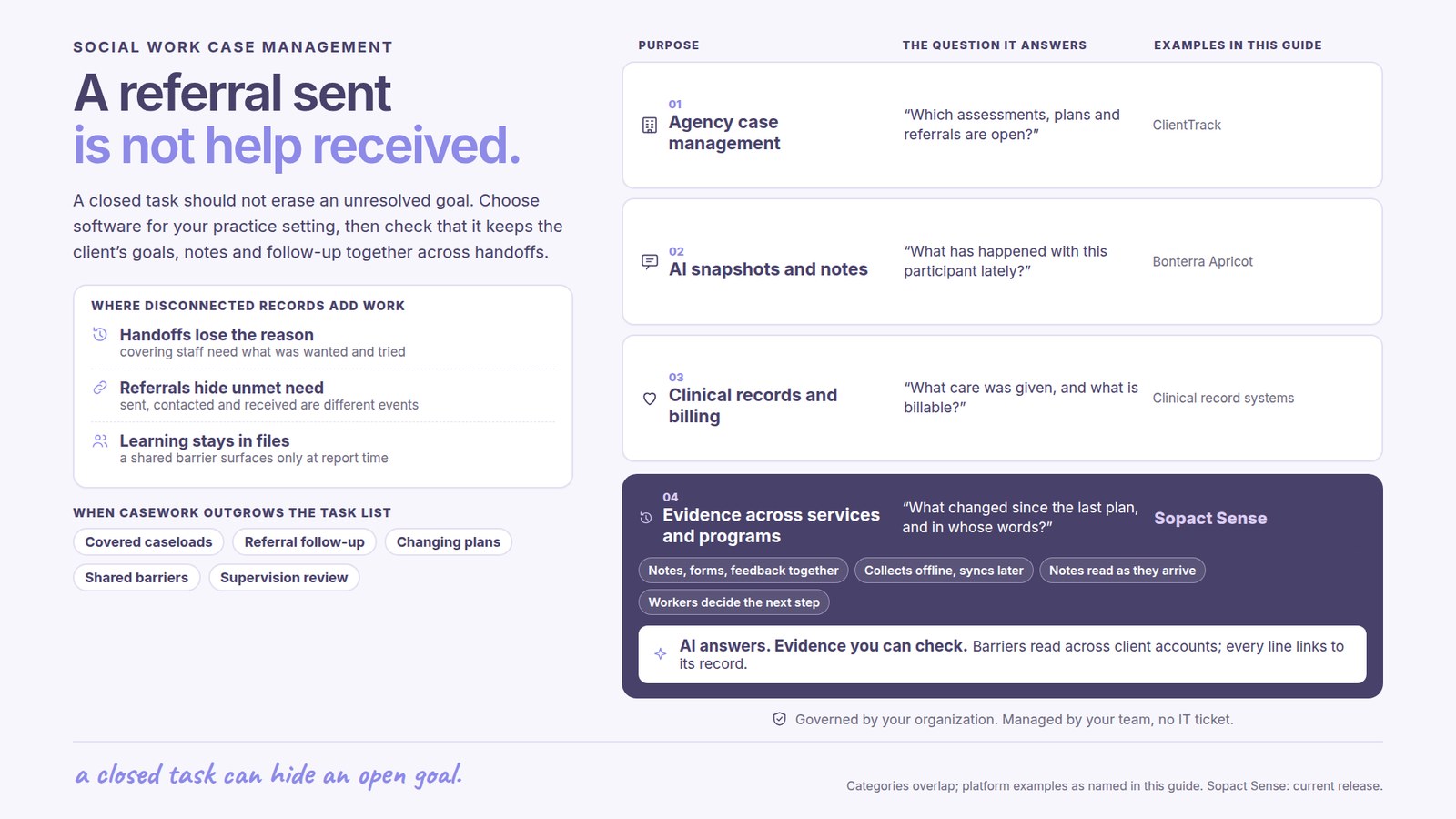
The dominant case management platforms cover four of the six parts well. The team feels the missing two as quarterly reconciliation work.

Most nonprofit and human services teams arrive at this page already using one of the platforms below. None of them are wrong choices for the structured intake and services-tracking layer. The reason teams switch is structural: the analytical layer that reads case notes as evidence, and the pulse cadence that holds the same person across cycles, are not yet load-bearing in any of these incumbents.

Bonterra Apricot Bonterra ETO Salesforce Nonprofit Cloud CharityTracker Casebook NewOrg PlanStreet Foothold AWARDS
What the incumbents do well

Structured intake, services tracking, audit logs.

The dominant platforms are mature on customizable intake forms, drag-and-drop form builders, services delivered, attendance, exit status, and structured dashboards. Audit logs are real and HIPAA controls are real. For a team coming off a spreadsheet, any of them is a real upgrade on the structured side.

Bonterra reviews specifically praise the comprehensiveness of client profiles and the accuracy of the structured reports. Buyers who are happy with the structured side and never ask the analytical question are well served.

Where teams switch

The analytical layer and the pulse cadence.

The two parts of the architecture the dominant incumbents do not yet treat as first-class are the analytical layer (case notes treated as evidence rather than documents) and the pulse cadence (the same stakeholder held across cycles under one ID).

Teams who switch usually do so because the program manager has been spending a week each quarter reconciling case-note documents against spreadsheet exports to write the funder report. The structured platform was not the problem; the analytical layer above it was the problem. Sopact Sense is built around those two layers and treats the structured side as a given, which is the inverse of how the incumbents grew up.

Frequently asked questions

Plain answers to fifteen questions case management buyers ask.

Each answer is also in the page schema (FAQPage in JSON-LD), so search engines and AI overviews can read them directly.

Q.01

What is case management software?

Case management software is a system that holds the records of the people a program serves and the cycles of service those people receive. It captures intake forms, case notes, service touches, and exit information for each client, then rolls those records up into reports for program managers and funders. Modern case management software adds longitudinal context: the same person followed across intake, mid-program, exit, and follow-up, with case notes treated as outcome evidence rather than commentary.

Q.02

What is the best case management software for nonprofits?

The best case management software for a given nonprofit depends on three things: the cycles the program actually runs, whether case notes need to count as outcome evidence, and how the report finally gets to the funder. Heavyweight incumbents like Bonterra Apricot and Salesforce Nonprofit Cloud handle structured intake well but treat case notes as documents rather than evidence. Newer platforms add a longitudinal pulse layer that holds the same stakeholder across cycles and lets case notes feed the outcome rollup directly.

Q.03

What is human services case management software?

Human services case management software is a class of case management platform built for organizations that deliver direct services such as housing assistance, food security, employment support, behavioral health, and stabilization grants. It differs from legal or healthcare case management software in that the case file mixes structured services data (grant amount, exit status, referral type) with substantial qualitative narrative (intake stories, case notes, exit interviews). The strong systems treat both as analytical data, not as storage alone.

Q.04

What is social work case management software?

Social work case management software is a tool that supports social workers in tracking clients across the service relationship: intake assessment, service plan, ongoing case notes, and exit. It differs from generic CRM in that the unit of analysis is the client over time rather than the deal stage, and most of the value lives in the qualitative case notes. The best systems let case notes count as outcome evidence rather than treating them as separate documents.

Q.05

What is nonprofit case management?

Nonprofit case management is the practice of tracking the people a program serves through the cycles of service they receive, then turning that record into outcome evidence funders can read. It includes intake, ongoing service delivery, case notes, exit, and increasingly a follow-up pulse to confirm whether the change held. Nonprofit case management is the core workflow under direct services, stabilization grants, workforce development, behavioral health, and most other people-facing program work.

Q.06

Why do most case management platforms make funder reporting hard?

Most case management platforms were built for the structured part of service delivery: form fields, attendance, services delivered. The funder report needs the qualitative part too: what changed for the person, in their words, with the case worker's observation. When case notes live as documents and the reporting tool only reads structured fields, the team copies stories into a Word doc by hand each quarter. That is the gap a longitudinal pulse layer is designed to close.

Q.07

What does longitudinal mean in case management?

Longitudinal means following the same person across multiple points in time, rather than aggregating different people at different points. In case management, longitudinal tracking is the difference between a 1,200-cases-this-year report and a 1,200-people-each-followed-for-eighteen-months report. The first answers volume; the second answers whether the program changed something. Funders increasingly want the second.

Q.08

How is case management software different from a CRM?

A CRM tracks deals and contacts through a sales pipeline; the unit is the opportunity. Case management software tracks people through a service relationship; the unit is the client over time. CRMs are optimized for converting leads to revenue. Case management is optimized for following clients through stabilization, growth, and exit. Bending a generic CRM into case management usually requires expensive consultant configuration and still struggles with longitudinal outcome tracking.

Q.09

Can AI read case notes as outcome evidence?

Yes, when the analytical layer is deterministic. Generic AI wrappers will summarize case notes inconsistently across runs, which is unsafe for funder reporting. A deterministic layer takes the case notes, converts the analytical question to a structured query, runs it against the actual data, and returns the same answer every time. The case notes count as outcome evidence in the same rollup as the structured fields.

Q.10

What about HIPAA and client confidentiality?

Case management software handling protected health information needs HIPAA controls, audit logs, role-based access, and a defensible answer for how case notes are accessed and queried. Confidentiality questions also extend to the analytical layer: who can run an AI query against the case notes, what the query history looks like, and how the output is logged. Programs that need this should ask about the audit trail before they ask about the report builder.

Q.11

How long does it take to switch case management platforms?

Switching case management platforms usually takes six to twelve weeks for a mid-tier nonprofit and longer for an organization running multiple programs across the same case file. The structured data (intake forms, services delivered, exit status) is straightforward to migrate. The case notes are harder because they tend to live in inconsistent formats across years. A switch worth doing is one where the new platform makes the case notes more useful, not only more migrated.

Q.12

Do small nonprofits really need case management software?

If the program runs more than fifty active cases at any given time, or if the funder asks for outcome data the team currently writes by hand, yes. Below that threshold a careful spreadsheet plus shared drive can work. The trigger to upgrade is usually the funder report: when the program manager spends a week each quarter reconciling case notes against numbers, the spreadsheet has stopped paying for itself.

Q.13

Can Google Forms or Airtable replace case management software?

For the intake layer, yes, often. Google Forms collects the data and Airtable stores it. The gap shows up at the cycles after intake: case notes have nowhere structured to live, the same person across cycles is reconstructed by hand, and funder reporting requires a separate analytical pass each quarter. Many programs start there and graduate to a platform when the longitudinal layer becomes load-bearing.

Q.14

What is Bonterra Apricot and how is it different?

Bonterra Apricot, formerly Social Solutions Apricot, is the dominant incumbent in nonprofit case management software. It is mature on the structured intake and services tracking layer, with customizable forms and dashboards. The differences buyers report after switching are usually around the analytical layer (case notes treated as documents rather than evidence), the longitudinal layer (cycles after intake reconstructed manually), and pricing (post-acquisition price increases without proportionate feature investment). Newer platforms compete on those three points.

Q.15

How does Sopact handle case management?

Sopact Sense holds the case file as a single longitudinal record: one stakeholder ID across intake, mid-program, exit, and follow-up. Structured fields and case notes live in the same workflow, and the analytical layer reads both. Funder reports roll up from the underlying data rather than being assembled by hand each quarter. The pulse cadence is set by the program; the rubric for what counts as an outcome is set by the team.

Take the next step

If your case files hold the answers but the report still gets written by hand, you have an analytical-layer problem, not a platform problem.

A 30-minute conversation is the fastest way to figure out whether the gap is in your intake structure, your case-note workflow, or the rollup that goes to funders. We can walk you through how a longitudinal pulse layer would sit on top of what you already have, including a Bonterra Apricot or Salesforce NPSP installation that does not need to be replaced.

Who this is for Program directors, ED-level leaders, and outcome teams at nonprofits, foundations, and human services agencies running 200 or more active cases.
What we do not do We do not replace your intake form builder if it works. We do not require a year of services consulting before a real outcome report comes out.
What you walk out with A read on whether case notes are the bottleneck, a sketch of the pulse cadence that fits your program, and a clear sense of what a switch costs versus what it saves.