How can case management software help you prove outcomes to funders?
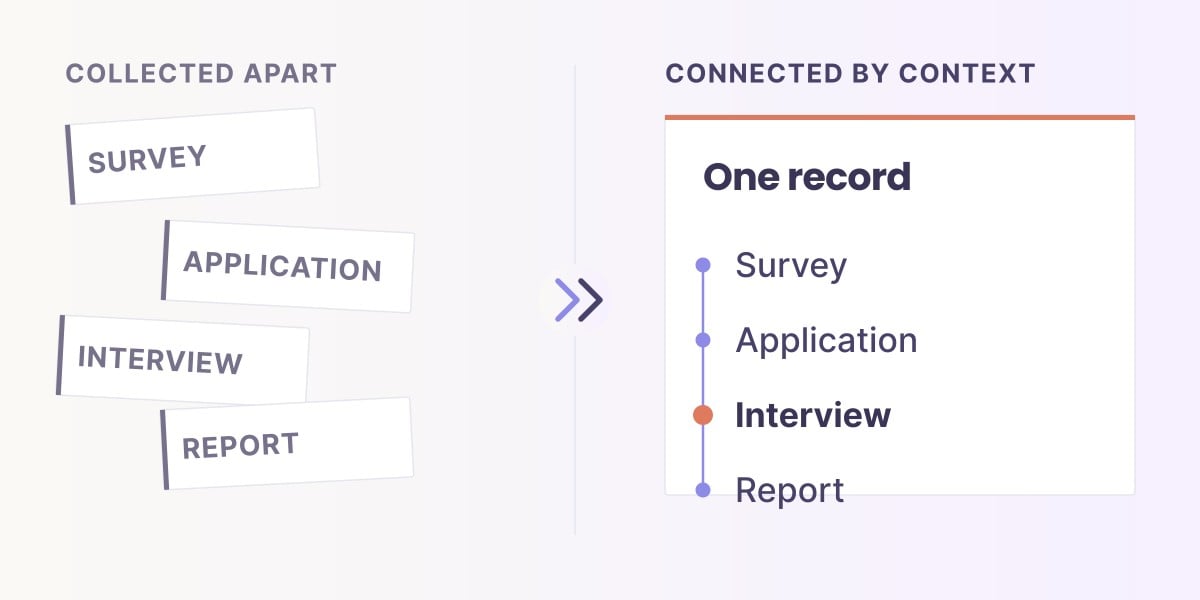
Case management software helps you prove outcomes to funders when it keeps each participant’s intake, services and follow-ups on one record and counts every outcome exactly as your funder agreement defines it, so the funder can check the number instead of taking it on trust. Storing case notes is the starting point, not the proof.
Proof, for a funder, is narrower than most teams expect. It means the number you send uses the agreed definition, time window and breakdown, covers a stated group of people, and can be traced back to the records behind it.
THE SHORT VERSION
- Your funder will lay your report beside the agreement and mark each metric as matching, different, missing or not split.
- Most gaps come from a changed time window, a missing follow-up or a total where a breakdown was agreed, and all three can be caught before you send.
- Judge case management software on whether it produces the agreed count from one record per person and shows the records behind it.
When does proving outcomes to a funder start?
It starts at the grant agreement, when you and the funder settle which outcomes you will report and how each is counted, long before the first report is due. A definition agreed on the onboarding call is one you can build into your forms; one discovered in the funder’s reply is a rework.
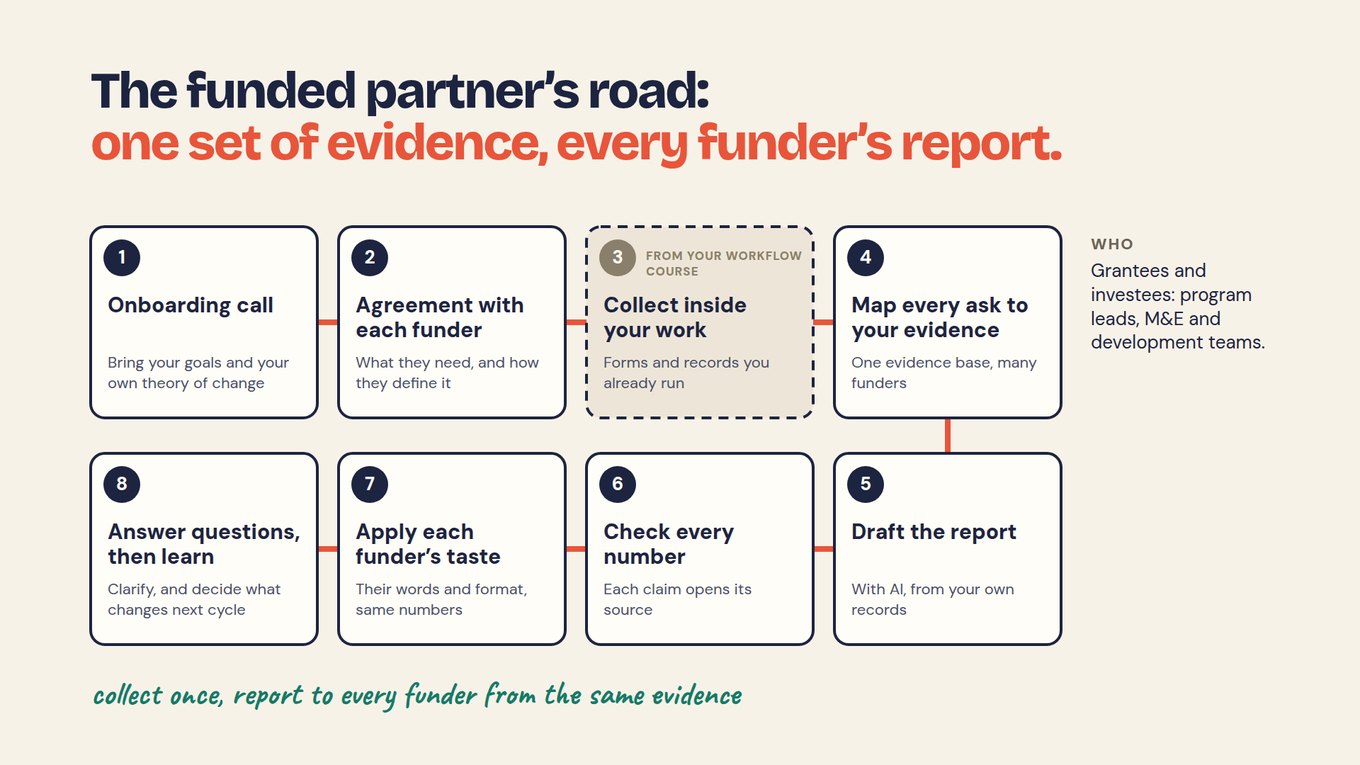
The course draws the funded partner’s side as eight steps. Proof depends on step 2, where each funder’s definitions are agreed, and on step 6, where every number is checked against its source before the report leaves.
What will a funder check in your outcome report?
A careful funder puts your report next to the agreement, metric by metric, and gives each one a status: matches, different definition, missing, or not split. Only a match goes into their portfolio total as it stands; everything else becomes a question back to you.
Here is how that looks from the other side of the table. Partner C is a fictional job-training program funded by a fictional regional workforce fund, whose agreement counts enrolment as unique people, placement within 90 days of exit, retention in the same job at 12 months, and hourly starting wage by track.
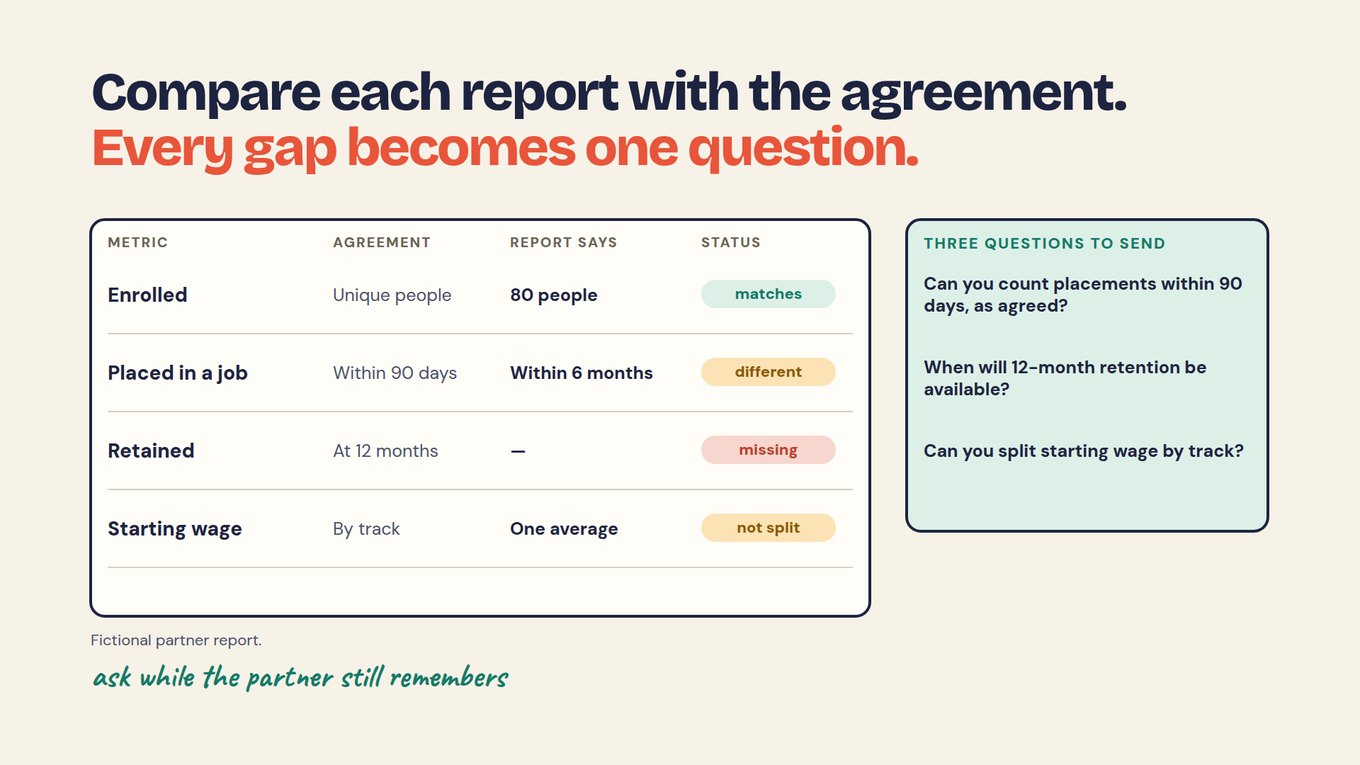
None of the three gaps says Partner C did poorly. It may have placed more people than any other partner; the fund cannot tell, so it held C’s placement count of 55 out of its total until the 90-day number arrived.
| Status | What it looked like for Partner C | How to prevent it |
|---|---|---|
| Different definition | Placement counted within 6 months, not 90 days | Compute the agreed window from exit and placement dates; label any other funder’s window |
| Missing | No 12-month retention figure | Write “not yet available” and the date it will be |
| Not split | One average starting wage | Group the same records by track before sending |
The six-month figure was not wrong; it came from another funder’s template. Map every funder’s ask to one evidence base keeps each funder’s definition on its own row; Check each partner report against the agreement shows the funder’s side.
What counts as an outcome rather than an output?
Outputs count what your program did; outcomes show what changed for the people it served, measured with a definition and a time window. Funders fund activity, but they judge you on outcomes.
In the workforce example, enrolments and completed trainings are outputs. Placement within 90 days, retention at 12 months and starting wage are outcomes, and each needs a follow-up that reaches the same person after exit. That is why the participant record matters more than the report template.
What does one participant record need to hold?
One record per person, created at the first form, with every later service, survey and follow-up attached to the same ID. Without it, a report can count one person twice, attach the wrong follow-up, or mistake attendance for change.
| Part of the record | Example | Funder question it answers |
|---|---|---|
| Person and enrolment | ID, program, start date, consent | Who is in this reporting group? |
| Starting point | Intake answers and date | Where did each person begin? |
| Services | Training sessions, mentoring, referrals | What did each person receive? |
| Exit and follow-up | Exit date, placement date, 12-month check | What changed, and within the agreed window? |
| Their own words | Open answers, with permission to quote | Why did it change, or not? |
The video below makes the case in one line: AI can make a small team faster, but it cannot recover evidence that a CRM, case system, spreadsheet or survey tool never kept connected. Watch for where that connection has to start: at the first form.
How do you make an outcome number a funder can reproduce?
Send every outcome with its definition, the group it covers, the number whose result is unknown, and the date the data was pulled. With those four, the funder can rebuild your figure; without them, it is an assertion.
For Partner C’s placement count, the recipe reads: people who exited in the period, of whom those with a placement date within 90 days of exit, with the rest shown as not placed or unknown. Nothing new has to be collected, because exit and placement dates already sit on one ID per person.
Asking the same question next month may return a different number if late follow-ups arrive. That is fine as long as you can say which cut-off each report used, and keep a change log when a definition moves.
What should you test in case management software for funder reporting?
Give every vendor the same small test set and ask your own team, not the vendor, to run eight checks on it. Include a duplicate person, a missing follow-up, a participant in two programs, a corrected answer and a critical comment.
| Check | Task to perform | A workable result |
|---|---|---|
| Team control | Change one outcome definition | Your team makes the change and sees which records it affects |
| Connected records | Follow one person across two enrolments and a staff handoff | Services and follow-ups stay on the right person |
| Coverage | Report who was eligible, reached and missing | Missing people are shown, not dropped |
| Time | Count placements within 90 days of exit | The window is computed from dates on the record |
| Open answers | Review positive, negative and mixed comments | Each theme opens the answers behind it |
| Documents | Check a statement drawn from an uploaded file | The source passage is visible |
| Two funders | Produce two funders’ views from the same records | Different definitions are labelled; no one is counted twice |
| Reproduction | Rebuild a sent number after a correction | A reviewer can explain the old and new figure |
Count the whole reporting cycle, not the demo: setup, imports, matching people, reviewer time and revisions. A process that needs a specialist for every change is hard for a small team to keep up.
How do case management tools compare for outcome reporting?
Several established case management products track outcomes and produce reports, so compare how each fits your definitions, data and staffing rather than whether it can report at all.
| Option | Published capability | What to test |
|---|---|---|
| Bonterra Apricot | Case management with program outcomes, analytics and reporting | How staff maintain measures and revise a recurring funder report |
| Casebook | Participant goal and outcome tracking with reporting | Whether its goal types fit your agreed outcomes |
| CaseWorthy | Case and program management with outcome reporting | How the configured workflow handles your funders’ definitions |
| Sopact Sense | One ID from the first form; AI analysis with answers that trace to records | Whether your team produces each funder’s count without re-matching files |
Sources: Apricot, Casebook outcome tracking and CaseWorthy platform. Capabilities vary by configuration, so ask each vendor to run your checks; this is a fit assessment, not a ranking.
Sopact changes the work between collection and the report. An Intelligence Row summarizes each participant’s record, the AI Assistant answers plain-language questions with every line linked to a record you can open, and folders keep each team's AI Assistant to its own folder's data while the owner sees aggregated results.
How do you write outcomes into the funder’s report?
Lead with each agreed outcome in the funder’s words, give the number with its definition and coverage, and put any label or “not yet available” line directly beside it. One participant’s voice, used with permission, can explain the number but not replace it.
AI drafts this well once records and definitions are right. As Marco Botha, CEO of Open Play Foundation, put it: “It just took 2 prompts and my report was ready.” The chapter Write each funder’s report with AI, then check it covers the check that follows every draft.
PROMPT · PASTE INTO CLAUDE, CHATGPT OR YOUR AI TOOL
Act as the program officer at our funder, reading our outcome report before we send it.

Inputs: our grant agreement's outcome metrics with definitions [PASTE]; our draft outcome report [PASTE].

For each agreed outcome, in agreement order:
1. Quote what our report says, with its location.
2. Give one status: matches, different definition, missing, or not split.
3. For anything but "matches", write the question you, the funder, would send us, and the one line we could add to answer it now.

Rules: do not calculate, convert or estimate any value. If a number is not in the draft, write "not in our data". Do not treat a similar metric as a match. Return a table: Outcome | Report says | Status | Funder's question | Line to add.
The video below explains why reports built on clean data still go unread. Watch for the context a funder needs around an outcome number before they will act on it.
What can an outcome report not prove?
An outcome report shows what changed for the people you followed; on its own it does not show that your program caused the change. A placement rate can rise with the local job market, and a causal claim needs a comparison group chosen before collection.
Follow-ups lose people, and those who answer may differ from those who do not, so report the unknowns beside every rate. AI drafts and themes are suggestions until a named person checks them against the record. For the difference between claiming and contributing, see attribution vs contribution.
Start with one outcome your funder agreed
Pick the outcome your largest funder cares most about and run the funder’s check on it yourself before the next report.
- Copy that outcome’s definition, window and breakdown from the agreement, word for word.
- Confirm that intake, exit and follow-up for each person sit on one ID; list anyone who does not match.
- Compute the count exactly as defined, and write down the group, the unknowns and the cut-off date.
- Compare it with what you sent last time and mark it matches, different, missing or not split.
- Add the one-line label or “not yet available” line the report needs, then have a colleague rebuild the number from your notes.
After the first cycle you have one outcome a funder can check end to end, and a pattern to repeat for the next.
Frequently asked questions
Does case management software prove that a program caused an outcome?
No. It can keep the evidence connected and count outcomes consistently, but whether the program caused a change depends on the evaluation design, such as a comparison group planned before collection. Report observed outcomes with their coverage and definitions, and keep any claim about cause separate and supported by that design.
What if our funder defines an outcome differently from us?
Report their number, counted their way, and add one line saying how it differs from your own definition. Do not change your records or your dictionary to match; if Funder B wants six-month placement and your agreement with another funder says 90 days, both counts come from the same exit and placement dates, each labelled.
Can we keep our existing case management system?
Often, yes. Test how records export or connect, how people are matched and who maintains the link. The deciding question is whether you can produce each funder’s agreed count from one record per person without rebuilding the match by hand every cycle.
How should we handle missing follow-up?
Show the eligible group, those who answered and those whose result is unknown, as separate numbers. Never count an unknown as a success or a failure to fill the report. If an outcome cannot exist yet, such as 12-month retention before a year has passed, say when it will be available.
Should a funder receive identifiable participant records?
Only where there is a clear purpose and permission. A funder can usually check an outcome from the definition, the counts, the cut-off date and de-identified examples, while your authorized staff keep access to the underlying records. Keep names and contact details out of anything you paste into an AI tool.