play icon for videos

Client Intake Software · The Form Is the First Read · Sopact

Client intake software where the form is the first read. Open-text intake is themed on arrival, validated screens self-score, the record becomes the spine.

Updated
May 29, 2026
360 feedback training evaluation
Use Case
Client Intake Software · Smart Intake That Reads Itself · Sopact
The thesis · intake forms → intake intelligence

Beyond intake forms.
Smart intake that reads itself.

The intake software your agency uses was designed when the bottleneck was data entry — get the responses out of paper, into a structured form, into the case management system overnight. That bottleneck moved.

Data entry is solved. The new bottleneck is the workflow that drafts the data dictionary from your existing form, reads every response on arrival, and assigns a persistent client ID at first contact — so eligibility surfaces immediately, risks route to the supervisor queue, and the same client record carries forward through every program.

That is the difference between intake forms — a way to collect responses for later review — and intake intelligence: a smart form that reads itself, drafts its own data dictionary, and joins the response to the same persistent client record that will hold every later interaction.

AI without a workflow is a clever intern with no desk. The teams winning at intake are the ones whose first-contact data has a place to land — one record, one ID, one story.

01 · FORM
Smart intake
Conditional logic · eligibility branching · offline-safe
02 · DICTIONARY
Drafted from your form
Fields, codes, demographics — signed once, reused forever
03 · READ
AI on arrival
Open-text scored, themes tagged, eligibility decided
04 · ROUTE
Risks surface
Safeguarding flags route to supervisor queue immediately
05 · ID
Persistent client ID
Same ID across every program for the lifetime of the relationship
Definition · for the AI-overview reader
Direct answer

What is client intake software?

Client intake software is the platform that collects the first interaction with a new client — eligibility screen, demographics, baseline assessment, consent, and the assignment of a persistent client ID. Modern client intake software does more than collect: it drafts the data dictionary from your existing form, reads each response on arrival, and routes risks to the supervisor before the worker even closes the tab.

Used by:

  • Nonprofit and human services intake teams running eligibility screening
  • Social work agencies handling referral intake (CPS, APS, family services)
  • Housing intake teams managing coordinated-entry assessment
  • Workforce and reentry programs running enrollment intake
  • Behavioral health intake clinicians running validated baseline screens
  • Multi-program agencies with one client moving across intakes
Adjacent terms

Social work intake software, human services intake software, nonprofit client intake software, case intake and disposition tracking, eligibility screening software — different terms point to the same software category from different domains.

Not the same as

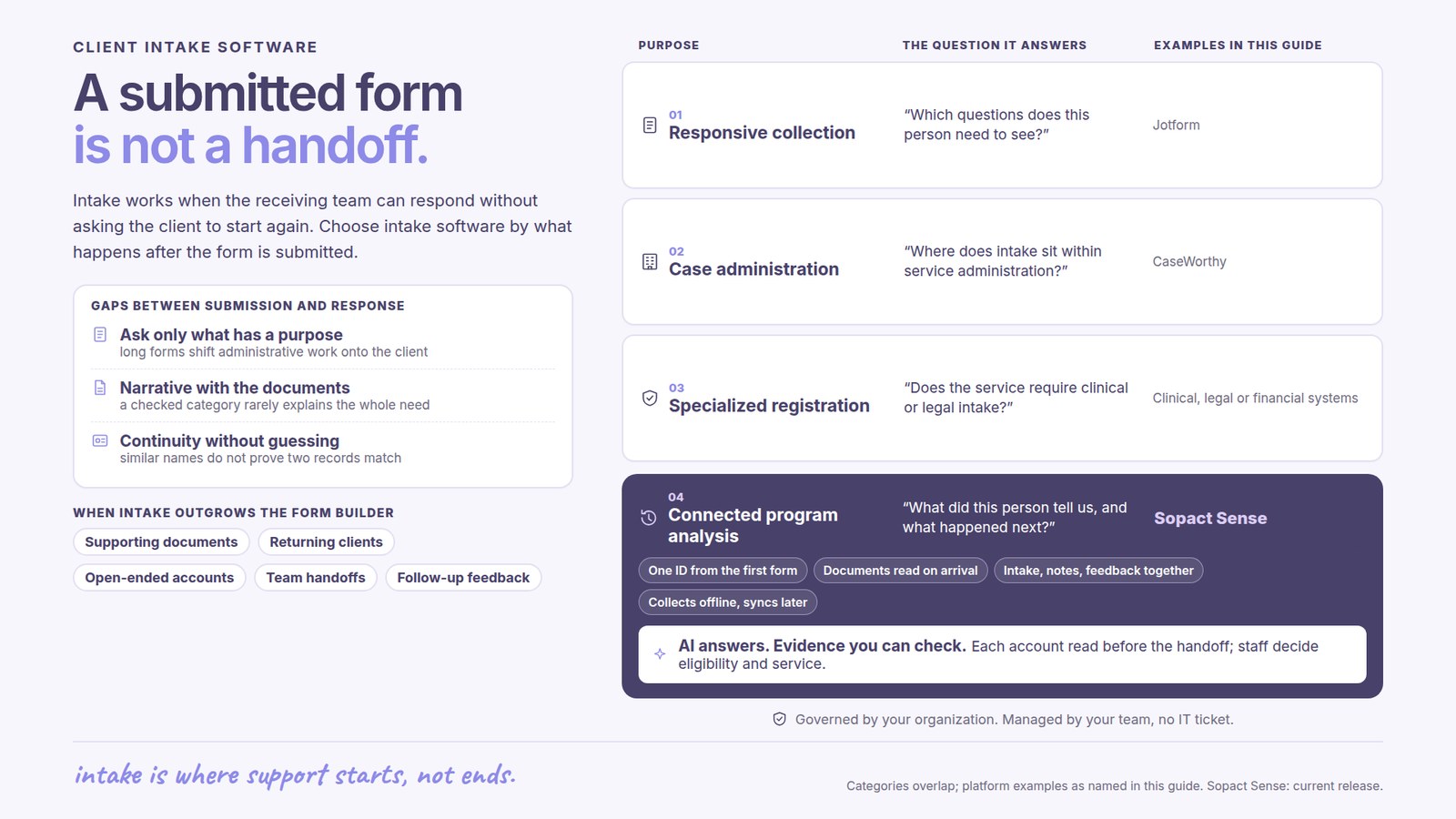
A survey tool (SurveyMonkey, Qualtrics, JotForm) collects responses for later analysis. Client intake software collects responses that become the foundation of a persistent client record — with eligibility, risk routing, and service planning happening on arrival.

The shift · why intake forms are breaking

The era of intake forms
as data entry is over.

The intake form your agency uses was designed when the bottleneck was data entry. Get the responses out of paper, into a structured form, into the case-management system overnight. The form was a funnel into the database.

Data entry is solved. The new bottleneck is the workflow that drafts the data dictionary from the form itself, reads every response on arrival, and assigns a persistent client ID that survives every later program and cycle. The form is no longer a funnel. It is the beginning of an intelligent client record.

The era that ended

Intake Forms

What replaces it

Intake Intelligence

Form designed in JotForm or Microsoft Forms, responses exported nightly, manually keyed into the case-management system.
Form designed in language. Responses flow directly into the client record. No keying step.
Open-text responses (“what brings you here today?”) sit in a CSV column nobody reads until the cohort report.
Open-text responses read on arrival. Themes tagged, eligibility decided, risks routed in real time.
Client identity matched by name and birthdate at year-end. Re-applicants from earlier cycles often missed.
Persistent client ID assigned at first contact. Re-applicants in year three arrive with their full history.
Eligibility decision is a worker review task after the form lands. Backlog grows.
Eligibility surfaces at submission. Worker reviews edge cases, not every case.
Risk signals (safeguarding language, escalation) sit in the form until someone reads it.
Risk signals route to supervisor queue immediately. Citation trail attached.

The intake form that drafts its own data dictionary saves a quarter of integrator work. The form is the beginning of the client record, not a separate funnel into it.

From the field · Open Play Foundation

An impossible reading, caught in minutes.

For years, Open Play’s data sat in paper logs and spreadsheets. The foundation needed real-time evidence — not a quarter-end export — and nothing in the old setup could flag an operational problem while it was still fixable.

After heavy rain, Open Play’s water purification system reported it had run out of rainwater — which Marco knew was impossible. Because the figures were live, he cross-checked in minutes and surfaced a probable reservoir leak. Same logic for intake: when every response is read on arrival and routed to the right queue, the impossible reading — the safeguarding flag missed, the eligibility decision delayed, the re-applicant unrecognized — shows up immediately, not at the year-end audit.

“Those statistics that we’re now running on Sopact immediately showed me there’s something significantly wrong … things like that, we would never have been able to do in the past.”

Marco Botha, CEO, Open Play Foundation
The method spine · five stages of intake intelligence

The five-stage spine,
applied to first contact.

Every effective intake workflow moves through the same five stages — from the moment the client clicks submit to the moment a persistent client ID is assigned and the case worker takes over.

1

Form Data

Smart form responses, eligibility fields, validated screens.

2

Framework

Eligibility criteria, intake rubric, demographic schema.

3

Data Dictionary

Drafted from the form itself. Signed once, reused forever.

4

Read & Route

AI on arrival, eligibility decided, risks routed.

5

ID Assigned

Persistent client ID · client record opened.

The rule

The form is the beginning of the client record, not a separate funnel into it. Same data dictionary. Same ID. Same record.

Buyer fit · six intake shapes

Six intake shapes.
One smart-form engine.

The eligibility criteria change, the validated screen changes, the consent language changes. The smart-form engine underneath does not.

01Nonprofit human services intakeeligibility → enroll → serve
02Social work referral intakereferral → screen → assign
03Housing coordinated entryCES → VI-SPDAT → queue
04Workforce / reentry enrollmentinterest → eligibility → cohort
05Behavioral health intakescreen → treatment plan
06Multi-program agency intakeone intake, many programs
Pre-side · what the form collects

What you collect

Post-side · what reads on arrival

What the system decides

Nonprofit human services intake. Household composition, income, eligibility documents, dietary needs, language.
CSBG/LIHEAP/food-eligibility decided · demographic codes assigned · client ID created.
Social work referral. Referral source, presenting concerns, safety language, family composition.
Risk routing · specialty match · supervisor queue if safeguarding flagged · case worker assigned.
Housing coordinated entry. Housing history, barriers, VI-SPDAT score, immediate needs.
CES priority assigned · navigator matched · emergency-shelter routing if VI-SPDAT > threshold.
Workforce / reentry. Skills inventory, credential history, court-referral context.
Cohort match · eligibility decided · pre-screen results joined to baseline.
Behavioral health. Validated screen (PHQ-9, GAD-7), social history, immediate risk.
Treatment plan template populated · risk routed · clinical-team assigned.
Multi-program agency. One intake for a family touching food, workforce, housing.
One client ID created across all three programs · cross-program record opened.
From submit to assigned worker

Five moments. From client’s
submit to worker’s queue.

A smart intake form moves through five moments from the client clicking submit to the case worker receiving the assignment — usually in under five minutes.

01Submit
Form arrives
  • Conditional logic
  • Eligibility branching
  • Offline-safe sync
  • Demographic capture
02Read
AI on arrival
  • Open-text scored
  • Themes tagged
  • Eligibility decided
  • Citations attached
03Route
Smart routing
  • Safeguarding to supervisor
  • Match by specialty
  • Match by capacity
  • Workload balanced
04ID
Persistent client ID
  • Same ID across programs
  • Re-applicant detected
  • Prior history attached
  • Consent recorded
05Assign
Worker receives
  • Full intake context
  • Risk flags pre-attached
  • Service plan started
  • 5 minutes from submit
5 min

From client submit to worker queue. Eligibility decided, risks routed, persistent client ID assigned, full context attached — before the worker opens the file.

Compared to legacy intake-form vendors

How Sopact compares to
JotForm, SurveyMonkey, Apricot, Penelope.

Most intake evaluations include a survey tool, a CRM-with-form, and a case-management platform. Each was built for a different downstream use.

Capability
Sopact
JotForm
SurveyMonkey
Bonterra Apricot
Penelope
AI reads open-text on arrival
Yes · native
No
Limited
No
No
Eligibility decision on arrival
Yes
Workflow rules
No
Workflow rules
Workflow rules
Data dictionary drafted from form
Yes
No
No
No
No
Persistent client ID across programs
Yes
No
No
Per program
Per program
Risk routing to supervisor queue
Yes
Limited
No
Workflow rules
Workflow rules
Conditional logic & branching
Yes
Yes
Yes
Yes
Yes
Offline form capture & sync
Yes
Limited
Limited
Limited
Limited
Encryption, RBAC, audit logging
Yes
Yes
Yes
Yes
Yes
Re-applicant detection across cycles
Yes
No
No
Name match
Name match
Time to first intake live
Days
Hours
Hours
3–6 months
3–6 months
How to read this table

JotForm and SurveyMonkey are fast at collecting; they aren’t intake software. Apricot and Penelope are case management with intake modules; they take months. Sopact is intake software that becomes a client record.

Pricing · by complexity, not by form-submission count

Sopact prices by the complexity
of what you actually run.

No per-seat tax. No per-submission meter. The line items are the things that drive work.

What every deployment includes
1

Custom data dictionary

Drafted from your existing intake form in one working session. Your eligibility codes, your demographic categories.

2

Built-in Sopact skills for intake

Intake Reader, Eligibility Screener, Risk-Signal Detector, Re-applicant Matcher, Demographic Coder — turned on by default.

3

Form, banner, and report design

Logo, color palette, intake form styled to your brand. Client-facing pages match your identity.

4

Mixed-method auto-indicators

Closed-ended fields and open-text responses scored together. Indicators populate automatically with citation trails.

5

Definitive reporting

Intake throughput · eligibility distribution · risk-signal trends · re-applicant rate — each generated from one place.

What scales the complexity
Programs

Number of programs sharing one client

One program is simplest. Multi-program intake adds cross-program ID matching.

Conditional depth

Simple eligibility is light. Multi-branch logic across 100+ fields adds depth.

Languages

English-only is simplest. Multi-language intake with validated screens in each adds configuration.

Custom skills

Built-in skills cover common patterns. Your agency’s domain rubrics compose with the built-ins.

White-label depth

One brand is simplest. Multi-brand intake portals add configuration.

API integration

Reading reports in Sopact is included. Piping to CRM, HMIS, or BI adds integration.

Days
Time to first smart intake live
5 min
From client submit to worker queue with full context
1 ID
Persistent client ID across every program and cycle
100%
Open-text responses read on arrival
Pricing in one line

A small agency with one intake form pays less than a multi-site federation with intake in three languages across six programs. Talk to us with your intake form; we will quote against it directly.

Security · controls we provide, named honestly

Encryption, RBAC, audit logs.
Enterprise-grade AI under SLA.

Intake data is the most sensitive moment in a client’s record — eligibility, demographics, immediate risk. Here’s what Sopact provides.

Encryption

At rest and in transit

AES-256 at rest, TLS 1.3 in transit, encrypted backups, scheduled key rotation.

Access & audit

Role-based, fully logged

Role-based access at the field level, SSO, MFA, complete audit trail.

AI under SLA

No training-data retention

Enterprise-grade SLAs with no training-data retention.

On HIPAA, FERPA, and regulated regimes

Sopact is not currently HIPAA-certified or covered by a Business Associate Agreement (BAA). Agencies subject to HIPAA, FERPA, 42 CFR Part 2, or state confidentiality rules should evaluate these controls against their own compliance program.

Stage 05 · four intake-report shapes

Four report shapes,
drawn from intake.

Reports are questions. Intake produces four distinct shapes.

Missing

Incomplete intake submissions

The form started but not finished, the eligibility document not uploaded, the consent not signed. Surface continuously.

Unusual

Intake distribution drift

Eligibility approval rate dropping, demographic distribution shifting, risk-signal frequency rising.

Comprehensive

One client’s intake history

Every intake the client has completed, with eligibility decisions, demographic codes, and consent records.

Aggregate

Intake cohort patterns

Eligibility approval rates, demographic distribution, source-of-referral trends, time-to-route stats.

What makes it unique · four properties

Four properties JotForm
or SurveyMonkey cannot offer.

Strip away the marketing and four properties separate intake intelligence from everything before it.

1

Data dictionary drafted from the form

The form’s structure becomes the dictionary’s structure. One working session, no integrator week.

2

Persistent client ID at first contact

Same ID across every program for the lifetime of the relationship. Re-applicants in year three arrive with their full history.

3

Definitive AI — same submission, same decision

For eligibility decisions an auditor will scrutinize, variance is disqualifying. Same input, same answer.

4

Enterprise-grade security controls

Encryption, role-based access, no training-data retention, complete audit trail.

Buyer fit · by intake volume

From small single-form agencies
to multi-language, multi-program intakes.

The architecture is the same; the configuration scales with intake breadth.

Small · one program

One intake form, English

A 12-person agency with one intake form. Live in a week. No integrator, no IT staff.

food assistancehousingworkforce
Medium · multi-program

One intake, many programs

Multi-program agency where one intake feeds three programs. Persistent client ID across programs, demographic codes reconciled.

community actionhuman servicesUnited Way
Large · multi-site, multi-language

County-system intake

Multi-site federation with intake in 3+ languages, multiple eligibility schemas, integration to HMIS or county BI.

multi-languageHMIS / CoCmulti-site
Common questions · asked before the demo

Asked, answered, on the page.

Ten questions that come up in nearly every client-intake evaluation.

Q1What is client intake software?
Client intake software is the platform that collects the first interaction with a new client — eligibility screen, demographics, baseline assessment, consent, and the assignment of a persistent client ID. Modern client intake software does more than collect: it drafts the data dictionary from your existing form, reads each response on arrival, and routes risks to the supervisor before the worker even closes the tab.
Q2What is the best client intake software for nonprofits?
For nonprofits, the best client intake software (1) supports conditional logic and eligibility branching from day one, (2) drafts the data dictionary from your existing intake form, (3) assigns a persistent client ID at first contact, and (4) reads open-text responses on arrival. Legacy options like Bonterra Apricot and JotForm collect responses well; AI-native platforms like Sopact read them on arrival.
Q3How is Sopact priced for client intake?
Sopact pricing is based on the complexity of the use case, not seat counts or intake volume. Every deployment includes the smart intake form, AI on arrival, persistent client ID assignment, and definitive reporting.
Q4Is there free client intake software?
Free intake software exists — Google Forms, JotForm free tier — but the cost moves to manual data entry from the form into the case management system, no persistent client ID across cycles, and no AI reading of the open-text responses.
Q5How does AI improve client intake?
AI reads every open-text intake response on arrival and tags themes against eligibility criteria, risk codes, and demographic categories. Eligibility decisions surface immediately; risk signals route to the supervisor queue at submission; the same input always produces the same answer.
Q6What security controls does Sopact provide for client intake data?
Sopact provides AES-256 encryption at rest, TLS 1.3 in transit, role-based access at the field level, SSO with MFA, and a complete audit trail. AI calls run under enterprise-grade SLAs with no training-data retention. Sopact is not currently HIPAA-certified or covered by a BAA.
Q7Can client intake software work offline for field intake?
Yes. Modern client intake software supports offline form capture that syncs back to the persistent client record when the field worker is back online. Sopact supports this pattern for outreach, encampment intake, and home-visit intake.
Q8What’s the difference between client intake software and a survey tool?
A survey tool (SurveyMonkey, Qualtrics, JotForm) collects responses for analysis later. Client intake software collects responses that immediately become the foundation of a persistent client record — with eligibility decisions, risk routing, and downstream service planning happening on arrival.
Q9How does the data dictionary get drafted from the form?
Sopact reads your existing intake form — the fields, the conditional logic, the validation rules — and drafts a data dictionary entry for every field: definition, source, calculation, and owner. One working session instead of three weeks of integrator analysis.
Q10What questions should I ask before buying intake software?
Six questions: (1) Does the form draft its own data dictionary? (2) Is the open-text response read on arrival? (3) Is a persistent client ID assigned at first contact? (4) Does the same client ID survive across all my programs? (5) Do risk signals route to the supervisor queue at submission? (6) Does the system work offline for field intake?
Where intake sits in the bigger story

Intake is the first stage
of a longer arc.

Sopact treats intake as the foundation of the persistent client record. Same data dictionary, same client ID, every later stage writes back.

Umbrella
Intake is stage 1 of the full case-intelligence story.
Use case
After intake: every case note read on arrival on the same client record.
Use case
Year-3 outcome joined to year-0 intake on the same persistent ID.
Use case
Multi-program nonprofit intake and casework on one record.
Use case
Referral intake, eligibility screening, case-note narrative.
Engine pillar
Every relationship on one record.

Bring your existing intake form. Sixty minutes is enough.

Your current intake form (PDF, JotForm, Word, Google Form — any source). We’ll walk through how Sopact would draft the data dictionary from it, what the AI would extract from open-text responses, and what the worker queue would look like five minutes after submit.

Book a 60-minute working sessionFormat · 60 min · with Unmesh Sheth