Stay ahead with the latest insights, expert tips, and updates from Sopact.
Great! We'll be in touch, no spam ❤️
Thank you! Your submission has been received!
Oops! Something went wrong while submitting the form.
Best Submission Software 2026: 10 Tools Compared | Sopact
10 submission software tools compared for 2026 — Submittable, SurveyMonkey Apply, Foundant, Fluxx, Sopact Sense & more. Honest buyer fit by review speed, not price.
Best submission software in 2026: 10 tools compared on review quality, speed, and consistency
Submission software is any platform that collects applications, proposals, or entries from applicants and routes them through a review process — spanning grant applications, awards and contests, conference abstracts, scholarship programs, vendor onboarding, and regulatory filings. The cluster is wide, but the shortlists buyers actually compare are narrower: for grants, foundations, and awards — the commercial core of this category — the ten tools below cover the market. Which one fits you depends far less on form-building features than on one overlooked variable: how much reviewer time each cycle costs you, and whether the scores you hand to a board or funder are defensible.
Most submission software is sold on workflow features — more stages, more branches, more configuration. But workflow configuration doesn't make the actual decisions any better. Committees still drift, reviewer 5 scores differently than reviewer 1 on a Friday afternoon, and the hardest applications often get the tiredest reads. The variable this guide compares tools on is what actually shapes the outcome: how the platform supports the reviewer's judgment, whether every score has evidence behind it, whether the same rubric is applied the same way to every application, and whether decisions hold up when a board, an auditor, or a rejected applicant asks why.
We build one of the tools on this list — Sopact Sense — and we're transparent about that throughout the review. The other nine are assessed against their own public documentation, published pricing where available, and user reviews on G2 and Capterra. You'll see honest strengths and honest gaps for every tool, including ours. Pharmaceutical regulatory submission (eCTD), academic abstract management, and document-collection platforms like Clustdoc are adjacent clusters serving different workflows; we note them briefly but don't review them in depth here.
This guide is for program leads, foundation operators, awards administrators, scholarship directors, and research managers actively choosing between multiple platforms. Use the positioning map and the matrix to narrow to two or three finalists, then read those reviews in depth.
Last updated: April 2026
Submission software · 2026
Better human decisions, on every application.
Most submission software is sold on workflow features — more stages, more branches, more configuration. None of that makes the actual decisions better. Committees still drift, reviewer 5 scores differently than reviewer 1 on a Friday afternoon, and the hardest applications get the tiredest reads. This guide compares tools on what actually shapes the outcome: how the platform supports the reviewer's judgment, whether every score has evidence behind it, and how well decisions hold up when a board or an appeal asks why.
From reading from scratch to verifying with evidence
AI doesn't replace the reviewer's judgment — it brings evidence, consistency, and the same rubric applied the same way to every application, so human decisions land on a firmer foundation.
Decisions with evidence
Every rubric score links to the exact sentences it's based on. Judgments stop being "the committee felt" and start being "the application said."
Same rubric, same standard
Every application scored against the same criteria with the same prompts. Outcomes no longer depend on which reviewer picked up the file or what day it was read.
Attention on the hard calls
Reviewers stop spending equal attention on clear admits and clear declines. They spend it where it matters — the borderline decisions that actually need committee judgment.
An answer for every "why?"
When the board, a funder, or a rejected applicant asks why a decision went the way it did, the answer is a document — not a memory.
How we evaluated these tools
Six dimensions that actually determine buyer fit for submission-heavy workflows: how AI supports reviewer judgment (does the platform read against your rubric, or leave that entirely to reviewers), evidence-anchored scoring (can every score point to the specific passages it's based on), rubric complexity handled (can it score against criteria that draw from multiple fields and document types), reviewer consistency (are two reviewers scoring the same submission likely to reach the same conclusions), setup simplicity (how much workflow configuration does it demand before the first cycle runs), and audit defensibility (can every score be defended when a board, funder, or appeal asks why).
No tool wins on all six. The real task is naming which two or three dimensions dominate your decision — for most review-heavy programs, that's evidence-anchored scoring, reviewer consistency, and audit defensibility — and scoring tools against those, not against a universal average.
Feature comparison · what each tool actually does
Ten tools, six scannable dimensions, nine features explained in detail.
The matrix shows capability presence at a glance. The feature cards below explain what each capability does and — more importantly — what it's worth to a committee reviewing 400 applications against a 5-dimension rubric.
What your committee walks into · a scored shortlist with evidence for every decision
Read the matrix for scannable comparison, read the cards below for why each feature matters.
Output layer
Tool
AI rubric review
Evidence citations
Multi-doc analysis
Reviewer consistency
Setup speed
Audit defensibility
Sopact Sense
Submittable
SurveyMonkey Apply
Submit.com
Reviewr
Judgify
OpenWater
Foundant
Fluxx
Good Grants
Scale:NoneLightPartialStrongFull
What the features do — and why they matter
Nine capabilities that actually change decision quality, application by application.
The matrix above shows presence. Below, what each feature does and what it's worth — in terms of how much better and more defensible every reviewer's judgment becomes.
AI reads every submission against your rubric
What it does
The AI reads each application — essays, recommendation letters, budgets, transcripts — and scores it against your rubric dimensions before any reviewer opens it.
Why it matters
Every reviewer decision lands on verified evidence, not memory. The same rubric is applied the same way to every application, so the applicant's outcome no longer depends on which reviewer opened the file or what day it was read.
Every score cites the exact sentences
What it does
Beside each rubric dimension score, the reviewer sees the specific sentences from the submission the AI drew from, with click-through to the original passage in its full context.
Why it matters
Every decision is defensible. When the board, a funder, or a rejected applicant asks why, the answer is specific passages against specific rubric criteria — not "the committee felt."
Multi-document submissions analyzed together
What it does
An application with a personal essay, two recommendation letters, a budget, and a transcript is analyzed as one coherent submission — with cross-references between documents where the rubric calls for it.
Why it matters
Reviewers get a holistic applicant view in one pane instead of switching tabs and holding four documents in their head. No more reviewer 1 missing the letter that reviewer 2 caught.
Different rubric criteria for different documents
What it does
Essays scored on voice and specificity. Recommendation letters scored on credibility and corroboration. Budgets scored on realism and alignment with stated activities. Different dimensions for different document types — applied uniformly across every application.
Why it matters
A single blanket rubric either scores everything on essay-appropriate criteria (unfair to budget submissions) or flattens to the lowest common denominator. Per-doc-type rubrics produce scores that reflect what each document actually should demonstrate.
Same rubric applied the same way, every time
What it does
Every application is scored against the same rubric with the same prompts, applied the same way. Two applications with equivalent content receive equivalent scores.
Why it matters
Removes the largest source of variance in review — reviewer drift, calibration gaps, Monday-morning vs Friday-afternoon scoring differences. The applicant's outcome no longer depends on which reviewer happened to pick up their file.
One record per applicant, across every cycle
What it does
An applicant who submits in 2024, 2025, and applies for alumni follow-up in 2026 has one persistent record. Every submission, score, and outcome links to the same person automatically.
Why it matters
Multi-cycle programs stop losing their history. Alumni outcome reporting works without a data-reconciliation project. Year-over-year pattern analysis becomes a query, not a six-week workstream.
Weeks to first cycle, not months
What it does
The platform stands up around a rubric you define once, not a multi-step workflow you configure, test, and maintain forever. Fewer moving parts mean faster initial setup — and less overhead when a program changes.
Why it matters
First review cycle ships in 1–3 weeks instead of 3–6 months. The workflow-setup tax doesn't compound every time you add a program or refine a rubric.
Connects to your existing finance system
What it does
Approved submissions flow to QuickBooks, NetSuite, or Sage Intacct through REST API, webhooks, or MCP. The general ledger stays authoritative; no duplicate data entry, no mediocre built-in payment processor.
Why it matters
Your finance team keeps their system, their controls, their audit posture. You don't have to ask a specialized review vendor to also be a good payment processor — which few vendors achieve.
Full audit trail on every decision
What it does
Every score, every reviewer action, every decision change is logged with timestamps and reasoning. You can reconstruct exactly how a specific application arrived at its final score months or years later.
Why it matters
Regulatory-grade defensibility. When an applicant appeals, a funder requests documentation, or an audit asks how decisions were awarded — the answer is a document, not a memory.
The real question
Are you buying workflow configuration, or a system that makes every reviewer's judgment better?
Most submission software competes on workflow breadth — how many stages, how many branches, how many configuration dials. Those features are real, but none of them change the quality of a single decision. The nine capabilities above do something different: they give reviewers evidence to anchor their judgment, enforce the same rubric standard across every application, and make every score defensible when a board or an appeal asks why. Matching the right platform to how your decisions actually happen matters more than picking the one with the longest spec sheet.
What gets reviewed · every kind of submission your rubric handles
From 500-word case notes to 10-page essay bundles — every submission scored against your rubric with evidence linked to every score.
Input layer
Long-form essays
Recommendation letters
Budgets & financials
Transcripts & PDFs
Intake forms
Case notes (short-form)
Video statements
Portfolio submissions
Zoom out before you pick. A head-to-head on workflow features alone can lead you into a tool that adds more steps without improving a single decision. The real question isn't which platform has the most configuration dials — it's which one gives your reviewers the evidence, the consistency, and the rubric discipline to make better judgments on every application. A committee that walks in with a scored shortlist, evidence linked to each score, and the same standard applied to every submission makes different decisions than one that walks in with a stack of unread essays. Feature-match evaluations rarely surface that distinction.
The 10 tools reviewed
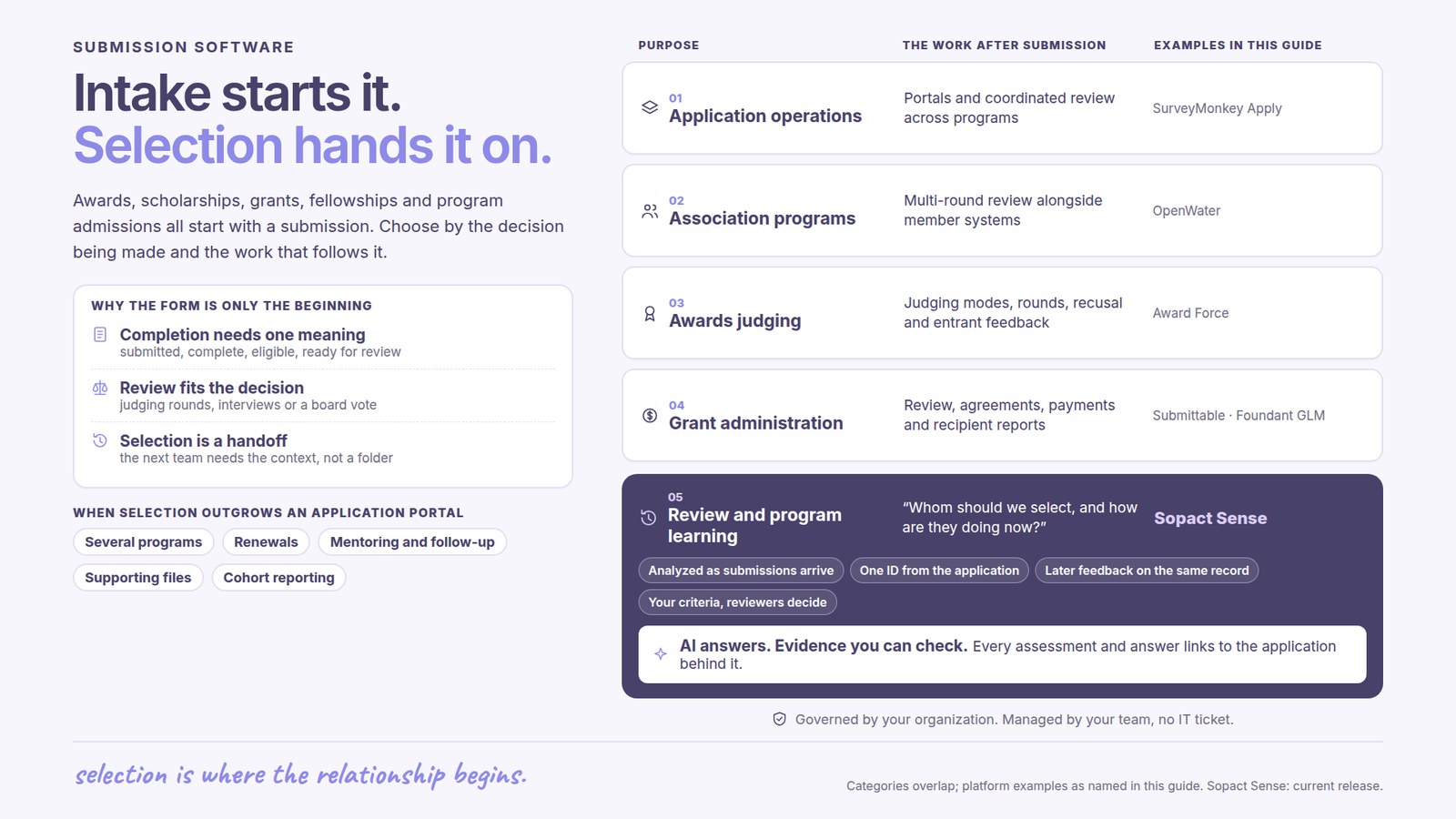
Sopact Sense — best for AI-supported review of complex essays and multi-field rubrics
Sopact Sense reads every submission against your rubric before a reviewer opens it. A scholarship application with three essays, two recommendation letters, a budget, and a transcript arrives for review already scored on each rubric dimension, with the specific sentences from the submission that support each score linked inline. The reviewer's job shifts: instead of reading from scratch and forming an opinion from memory, they're verifying a scored summary against the evidence, confirming what holds up, adjusting where their judgment differs, and flagging the borderline cases where committee discussion is actually warranted.
The same approach applies whether the submission is a 500-word case note or a 10-page essay bundle, a single-field rubric or a multi-field one. Complexity doesn't change the reviewer's workflow, only the AI's work. Every score links to passage-level evidence in the source documents, so when the committee, the board, or a rejected applicant asks why a decision went the way it did, the answer is a document — not a memory. One participant record persists across program cycles, so alumni follow-up, portfolio tracking, and year-over-year reporting work without manual matching from exports.
Sopact Sense connects to the finance and accounting system your organization already uses — QuickBooks, NetSuite, Sage Intacct — through API, webhook, and MCP. One system of record for finance, a best-in-class tool for application review.
Best for: Foundations, scholarship programs, research grants, awards, and nonprofits reviewing qualitatively complex applications where decision quality, consistency across reviewers, and audit defensibility matter as much as the decision itself.
Where it's not the fit: Simple yes/no intake forms or purely transactional submissions with no rubric scoring. A basic form tool is enough for those.
Submittable — best for high-volume, broad-feature submission management
Submittable is the brand most buyers recognize in this space. It handles arts awards, scholarships, CSR grants, and general application workflows for thousands of organizations. Strengths: form building, submission intake at scale, reviewer assignment, and team permissions. Automated Review — their AI review feature — is available as a premium add-on coordinated through their sales team.
Where Submittable shines: running many different cycle types on one platform, with a mature reviewer management layer. Where the ceiling shows: reviewers still read every application end-to-end and form their judgments from memory. The platform manages the workflow around review; it doesn't support the reviewer's decision with evidence-anchored scoring or enforce rubric consistency at the AI layer. For programs where decision quality and defensibility matter, that gap is where the risk lives.
Best for: Organizations running diverse cycle types who want a mature, broad-featured incumbent platform and have reviewer capacity for end-to-end reading.
Where it's not the fit: Programs where the bottleneck is reviewer time on qualitatively complex applications. Consider pairing Submittable with AI review tooling — or switching to a platform built around the review layer.
SurveyMonkey Apply — best for scholarship, fellowship, and grant programs with multi-stage review
SurveyMonkey Apply (formerly FluidReview) is a purpose-built application management platform, particularly strong in higher-education scholarship offices, fellowship administration, and grant programs that run multi-stage review — intake, first-round screening, finalist review, and decision. The platform is workflow-mature with configurable forms, reviewer assignment, scoring rubrics, and stage-based routing, and it plugs into the broader SurveyMonkey enterprise stack for governance and data controls.
Where SurveyMonkey Apply is strongest: formal scholarship and fellowship workflows where multi-round review is the norm and workflow configurability matters. Where the ceiling shows: like other workflow-mature incumbents in this cluster, the platform organizes routing and scoring aggregation; reviewers still read every application end-to-end and form judgments from memory rather than verifying against evidence. There is no native AI layer that pre-reads submissions against the rubric, so decision quality depends entirely on reviewer calibration and memory.
Best for: University scholarship offices, fellowship programs, and grant cycles with multi-stage review workflows where configurability and reviewer orchestration matter.
Where it's not the fit: Programs where decision quality depends on evidence-anchored scoring and reviewer consistency across qualitatively complex applications. The platform organizes the review; it doesn't support the reviewer's judgment with AI analysis against the rubric.
Submit.com — best for EU-based organizations and GDPR-heavy compliance
Submit.com is a strong alternative to Submittable with European data residency and a GDPR-native posture. The feature set covers submission management, reviewer workflows, and scoring; the differentiator is compliance footing rather than review capabilities.
Best for: EU-based foundations, research councils, arts funders, and organizations prioritizing data residency or regulatory fit.
Where it's not the fit: Programs where AI-powered qualitative review is the priority. Like most peers in this cluster, the platform manages the review workflow; the reading is still manual.
Reviewr — best for pure reviewer-focused workflows
Reviewr is focused narrowly on the judging and review stage. Reviewers log in to score assigned submissions against defined criteria. The interface is cleaner and lighter than full submission-management platforms, and it's often chosen when the application-collection side is already handled elsewhere.
Best for: Awards, contests, and scholarship programs with simple submissions and a priority on the reviewer experience.
Where it's not the fit: Complex rubrics, multi-document applications, or programs where the review load per application exceeds what's feasible for manual reading.
Judgify — best for awards and contests with judging panels
Judgify is designed around awards and contests — photography competitions, entrepreneurship challenges, industry awards. The platform centers on the judging flow, with configurable scoring criteria, judge dashboards, and announcement tooling.
Best for: Awards and contests with clear, tightly scoped scoring criteria and smaller submission sets.
Where it's not the fit: Research grants, complex scholarship programs, or multi-document submissions where the review is essay-heavy.
OpenWater — best for associations, conferences, and abstract management
OpenWater specializes in association and conference submissions — calls for papers, abstracts, proposals, panel selection. It's well established in the academic-society and scientific-conference space, with features tuned to multi-round peer review and program committee workflows.
Best for: Academic conferences, scientific associations, industry societies running calls for papers, and abstract management at scale.
Where it's not the fit: Grant or scholarship review with complex multi-document submissions where AI analysis would materially change reviewer workload.
Foundant — best for foundations running grant cycles
Foundant GLM is purpose-built for foundations — grant lifecycle management covering application intake, reviewer workflows, grantmaking decisions, and integrated payment processing. Widely used by community foundations and mid-sized private foundations, with a mature feature set for the specific workflow of foundation grant cycles.
Best for: Community foundations and mid-sized private foundations running annual or rolling grant cycles with in-house admin capacity.
Where it's not the fit: Programs where the challenge is AI-powered review of qualitatively complex content, or where reviewer time on reading is the dominant cost.
Fluxx — best for enterprise grantmaking with highly customized workflows
Fluxx is the enterprise platform large funders use — Ford Foundation, Hewlett, and similar — to manage complex multi-program grantmaking. Highly configurable, multi-stage review workflows, custom data models per program, deep governance and audit. The configurability is both the strength and the cost: Fluxx rewards organizations with dedicated grants administration staff and punishes smaller teams without that capacity.
Best for: Large foundations with dedicated grants admin teams and complex, customized grant processes across multiple programs.
Where it's not the fit: Small-to-mid programs needing usable-in-a-week tools. The configuration overhead is significant, and the review layer is workflow-focused rather than AI-assisted.
Good Grants — best for prizes, awards, and grant programs with judging panels
Good Grants (from Common Ground) is focused on grants and awards with a strong judging interface, positioned as easier to implement than Fluxx while serving adjacent use cases. Suits organizations that want configurability without Fluxx's setup overhead.
Best for: Grant programs and awards with judging panels seeking a configurable but faster-to-launch platform.
Where it's not the fit: Programs where AI-powered review of qualitative submissions would change the work. Like peers in this cluster, the review itself is manual.
How to pick the right tool
If your review has decision-quality risk — qualitatively complex submissions, high stakes, appeals to defend, Sopact Sense is the category. AI reads every application against your rubric and delivers evidence-anchored scores before reviewers open the file, so committee judgment lands on consistent, verifiable ground.
If you need the broadest feature set for managing diverse cycle types on one platform, Submittable is the incumbent. For scholarship and fellowship programs with multi-stage review, SurveyMonkey Apply (formerly FluidReview) is purpose-built for that vertical. With either, plan for reviewer calibration and training — the platform manages workflow but leaves scoring consistency to human effort unless you add AI review.
If you run a foundation with annual grant cycles and want integrated payments, Foundant is the default for community foundations; Fluxx for enterprise-scale grantmaking with dedicated admin capacity.
If your submissions are simple and the priority is the judging experience, Reviewr or Judgify.
If you run academic conferences or association abstract management, OpenWater.
If you're collecting documents for onboarding, KYC, or vendor workflows (not scored review), look at Clustdoc and peers — a different category serving a different job.
On finance integration: Sopact Sense connects through API, webhook, and MCP to the finance system your organization already runs — QuickBooks, NetSuite, Sage Intacct. For teams that want a single vendor for submission management, review, and payments, Submittable, Foundant, and Fluxx bundle payment processing. The trade-off is asking one vendor to be equally strong at submission workflow, AI-assisted review, and payment processing — which few platforms achieve. Sopact focuses on the review layer and connects to the finance system you already trust.
Frequently Asked Questions
What is submission software?
Submission software is any platform that collects applications, proposals, or entries from applicants and routes them through a review process. The term covers grant applications (Submittable, SurveyMonkey Apply, Foundant, Fluxx), awards and contests (Judgify, Good Grants, Reviewr), academic abstract management (OpenWater), scholarship programs, vendor onboarding (Clustdoc), and adjacent categories like pharmaceutical regulatory submissions (a separate cluster with tools like EXTEDO and Rimsys). For most commercial buyers — foundations, awards programs, scholarship committees — the practical shortlist is the grants/awards cluster. Sopact Sense is purpose-built for the review layer of that workflow, using AI to read submissions against rubrics before reviewers open them.
What is a submission management system?
A submission management system is software that handles the full lifecycle of an application or entry — from intake through review to decision and communication. It typically includes form building for applications, submission storage, reviewer assignment, scoring workflows, decision tracking, and applicant notifications. The feature gap between modern submission management systems is small on intake and workflow; the real differentiator is what happens during review — whether reviewers read everything manually or whether the platform reads against your rubric and delivers pre-scored submissions for verification.
What is the best submission software for grants?
For foundations running annual or rolling grant cycles with integrated payments, Foundant (community foundations) or Fluxx (enterprise scale) are the defaults. For programs where the bottleneck is reviewer time on qualitatively complex applications — essays, proposals, multi-document bundles — Sopact Sense is purpose-built for the review layer. For broad general-purpose grant submission management across many cycle types, Submittable remains the incumbent. The right answer depends on whether integrated payments, workflow breadth, or review speed and consistency is your primary concern.
What is the best submission software for awards and contests?
For awards and contests with clear scoring criteria and smaller submission sets, Judgify and Reviewr are purpose-built. Good Grants is a strong choice for prize programs with judging panels needing more configurability. For awards involving essay-heavy or multi-document applications — fellowship programs, entrepreneurship awards with business plans, research prizes — Sopact Sense provides AI-supported review that gives judges evidence-anchored scores against the rubric before they open the submission, making panel decisions more consistent and every winner selection defensible when another finalist asks why.
What is the best submission software for nonprofits?
Nonprofits run a wide range of submission workflows — scholarships, grants, fellowships, program applications, event proposals. For cycles centered on qualitative review of applications with essays or letters, Sopact Sense. For general submission management across diverse program types, Submittable. For community foundations running grant cycles with integrated payments, Foundant. For higher-education scholarship offices and fellowship programs with multi-stage review, SurveyMonkey Apply. The best choice depends on whether the program is review-intensive (Sopact), workflow-diverse (Submittable), payment-integrated (Foundant), or scholarship-vertical (SurveyMonkey Apply).
How does AI submission software work?
AI submission software reads each application against a rubric you define and produces a pre-scored summary before a reviewer opens it. Specifically: a reviewer sees the application's score on each rubric dimension, the evidence for that score (pulled from the submission itself), and the exact sentences the AI used. The reviewer's work shifts from reading and remembering to verifying against evidence — confirming what holds up, adjusting where human judgment sees something different, and flagging borderline cases for committee discussion. Consistency comes from applying the same rubric and prompts to every submission; defensibility comes from the passage-level evidence trail on every score. When evaluating AI submission software, check whether running the same rubric against the same submission twice returns the same result. If not, the AI is decorative.
What's the difference between submission software and review software?
Submission software typically means the full intake-through-decision platform — applicant-facing forms, file uploads, reviewer routing, scoring, and notifications. Review software narrows to the review stage — reviewers logging in, scoring assigned submissions, and aggregating scores. Most platforms in this category (Submittable, Submit.com, Foundant, Fluxx) combine both. Reviewr and parts of Judgify lean toward review-only. Sopact Sense uses AI to pre-score submissions against the rubric before reviewers see them, so the review step isn't just routed — it's anchored to evidence, and reviewers make verified decisions rather than impression-based ones.
How do you choose the right submission platform?
Three questions route the decision. First: what's the risk profile of your decisions — high-stakes scholarships and grants where applicants may appeal, or lower-stakes decisions where consistency matters less? High-stakes review should weight evidence-anchored scoring and audit defensibility heavily. Second: how complex are your submissions — simple forms, essay-heavy, or multi-document bundles with essays, letters, and supporting files? Complex submissions expose the gap between platforms that help reviewers make consistent judgments and those that just route files for reading. Third: who defends the scores when the board or an applicant asks why a decision was made the way it was? That question forces the evidence-trail dimension to the top of the list.
How much does submission software cost?
Sticker prices vary — some platforms publish pricing, some are sales-led on annual contracts. More importantly, the honest total-cost comparison includes reviewer effort and decision risk. For review-heavy programs with qualitatively complex applications, the gap between "reviewers read every word end-to-end and form opinions from memory" and "reviewers verify AI-pre-read scores against passage-level evidence" shows up in two places: reviewer capacity (one approach demands far more human hours per cycle than the other) and decision defensibility (one approach produces scores backed by documented evidence; the other produces scores backed by committee memory). For any program where application volume is meaningful or decision appeals happen, that delta typically matters more than the platform's sticker price.
Can submission software detect AI-generated applications?
Detection of AI-generated application content is genuinely hard — AI detectors have well-documented false positive and false negative rates, and the landscape changes as generation models evolve. Submittable's Automated Review add-on reportedly includes some detection signals; other platforms offer varying approaches. The more durable approach is structural: require specificity that AI-generated content struggles to produce authentically (named mentors, specific dates, references to program elements not on the public-facing page) and weight rubric dimensions toward traits AI output tends to flatten (distinctive voice, concrete specifics, personal narrative coherence). Sopact Sense's AI review flags uniformity and genericness across submissions as part of scoring; exact detection claims require careful testing against your specific applicant population.
How does Sopact Sense handle grant payments and financial disbursement?
Sopact Sense doesn't include a built-in payment module because the organizations we serve already run a finance and accounting system they trust — QuickBooks, NetSuite, Sage Intacct. Sopact integrates with those systems through REST API, webhook, and MCP, so approved grant records flow into the general ledger without duplicate data entry. One system of record for finance, a best-in-class tool for submission review. For organizations that want everything in one vendor, Submittable, Foundant, and Fluxx bundle a payment module; whether single-vendor convenience outweighs specialization depends on how much you trust any one platform to be equally strong at workflow, AI review, and payments.
How long does it take to set up submission software?
Setup time spans a wide range. Simpler, lighter platforms (Reviewr, Judgify, Good Grants) can be live in a week. General-purpose platforms (Submittable, Foundant) typically take two to six weeks for a first cycle, including form build, reviewer training, and workflow configuration. Enterprise platforms (Fluxx) often take three to six months with significant implementation consulting. Sopact Sense typically stands up in one to three weeks — the configuration work is defining the rubric once, not building multi-step workflow logic, which is one of the design choices behind the lower setup overhead.
Does submission software support multi-document applications — essays, letters, budgets?
Most platforms accept multi-document submissions as file uploads or structured fields (Submittable, Foundant, Fluxx, OpenWater handle this well). The differentiator is what happens during review. Most tools display the documents for reviewers to read and remember. Sopact Sense reads them — analyzing essays, recommendation letters, and budget justifications against the rubric dimensions you define, linking each score to the specific passages used, and delivering that evidence before a reviewer opens the application. Whether the submission is a 500-word case note or a 10-page essay bundle, the reviewer's work shifts from reading-and-remembering to verifying-against-evidence — so decisions are backed by what the application actually said, not what the reviewer recalls.
Product and company names referenced on this page are trademarks of their respective owners. Information is based on publicly available documentation as of April 2026 and may have changed since. Pricing, features, and vendor offerings listed are current as of that date and may vary. To suggest a correction, email unmesh@sopact.com.