


Related solution
Grantee & Portfolio Intelligence
Connect partner evidence with agreed measures and portfolio decisions.
Explore the solution →

USE CASE / SOFTWARE GUIDE
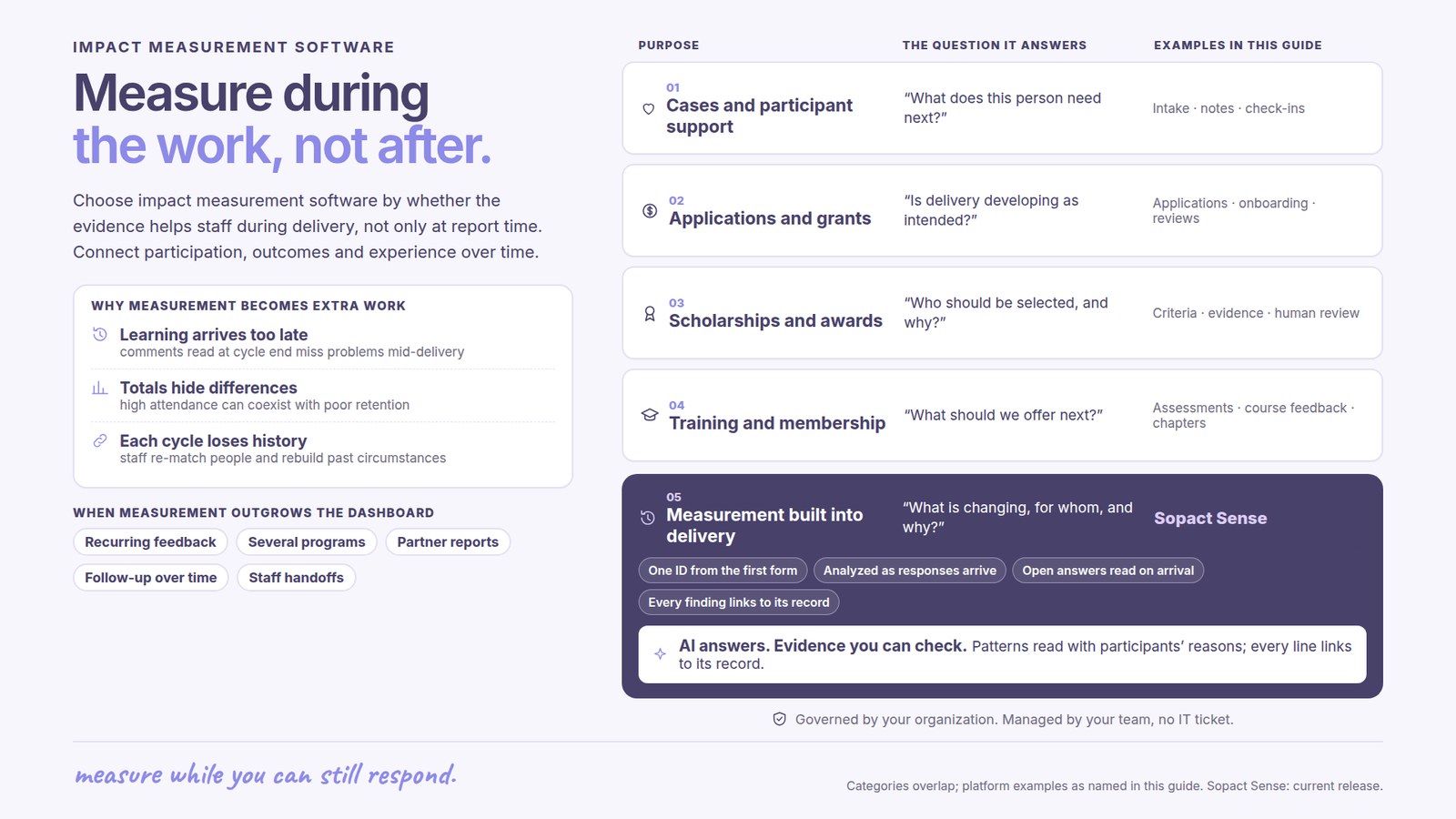
Impact measurement software helps organizations understand what changes for the people and communities they serve, using evidence collected across a program. Good software connects participation, outcomes and lived experience over time—and makes that evidence useful to the people delivering the work. Nonprofits, training providers, grantmakers and membership organizations need this understanding to improve services as well as explain results to funders.
The challenge is that measurement often operates separately from delivery. Applications describe the initial need, case notes record support, and surveys capture later feedback, but the team has to reconnect them for an evaluation. By then, a participation problem may have continued for months. Staff spend time reconstructing what happened instead of adjusting what happens next.
AI changes the role this evidence can play in an organization. In an AI-native workflow, incoming information is analyzed in context and remains available for questions throughout delivery. Sopact embeds this approach in case, application, grant, scholarship, training and membership work. Staff can support daily stakeholder needs, investigate problems and improve operations using the same evidence that later explains impact. Measurement becomes part of running the organization well.
Open Play noticed falling retention among girls.
Late sessions raised questions about safe travel home.
Investigate session timing and transport with the team.
Program teams already collect much of the information needed to understand their work. The problem is that an application, attendance register, mentor note and follow-up response rarely arrive together. Each tells part of the story, and the connections are left to an analyst or the person preparing the next report.
If comments are read only at the end of a cycle, a recurring scheduling or access problem can remain unresolved throughout delivery. Faster reporting helps, but earlier understanding is more valuable: staff can contact participants, change a session or support a partner while those actions still matter.
A high attendance total can coexist with poor retention among a particular group. An average assessment improvement can hide participants who are struggling. Numbers identify a pattern; participant feedback and staff observations help the team investigate what is happening.
When intake, support and follow-up are disconnected, staff repeatedly match people and reconstruct earlier circumstances. Keeping the same participant or partner connected over time makes progress easier to interpret and handoffs easier for colleagues.
The cost is both analytical and operational. Repeated preparation consumes staff time, while delayed understanding limits the team's ability to improve the service.
Marco Botha, CEO of Open Play Foundation, describes two reasons for collecting data: operational efficiency and understanding impact. In his conversation with Sopact, he explained that paper records from activities were collected and entered into Excel, leaving him roughly a month and a half behind the activity before the data was available.
The organization now uses Sopact across facility activity, participation, staff work, maintenance and water-resource monitoring. Marco describes a Monday data meeting to review the previous week and plan the next. Measurement has become part of how the team runs its work.
Marco was preparing a performance report with AI Assistance and asked it to identify inefficiencies the team might not be noticing. He described the system picking up a decline in girls' retention over roughly six weeks. The analysis then drew attention to late-afternoon sessions: could getting home after dark be a barrier?
The recommendations were to consider earlier sessions or transport. The important discovery was a connection worth investigating between participation, session timing and the experience of getting home. A total-attendance dashboard could show how busy a facility was without drawing the team's attention to that particular question.
Marco had not started by asking about girls' travel arrangements. Exploring the connected records opened a question the team could take to staff and participants while delivery was still underway.
He also described looking at attendance and retention across coaches and activities. That helped the team decide where to make greater use of an effective approach and what other coaches could learn from it. That changed the management question from how many children attended to what the more successful coaches or activities were doing differently—and whether colleagues could learn from it.
“I would say 80% of the time we spent on the system comes down to driving efficiencies.”
Marco Botha, CEO, Open Play Foundation
For Open Play, the system's everyday value extends well beyond an impact report: the evidence helps staff do their work better every week. Read the Open Play Foundation story.
Sopact treats measurement as part of the program relationship. Information collected to review an application, support a person or manage a grant can also help explain progress. The team builds on that evidence as work continues, instead of asking people to repeat their story for a separate measurement exercise.
Intake establishes the person's circumstances. Notes, assessments and check-ins show how needs and progress develop. Together, they help staff prepare for the next conversation and understand recurring barriers across the program. The same records support outcome reporting without separating it from care and support.
An application explains a proposed activity, an initial need and the expected change. Carrying that context into onboarding, mentoring and progress reviews helps staff understand whether delivery is developing as intended. At portfolio level, it also preserves why a program was supported and what subsequent evidence says about that decision.
For a selection-only program, the immediate value is clearer evidence for review, consistent criteria and less preparation for a human decision. Where the organization also follows recipients, that initial evidence can inform later progress reporting. A long-term journey is useful only when it serves the program's purpose.
Training teams can connect starting assessments, course feedback and later use of skills. Membership organizations can connect member needs, participation and recurring feedback across chapters. In both cases, learning informs what to offer next as well as what to report about the past.
The important change is the connection between collection and analysis. In Sopact's configured workflows, analysis is prepared as responses and documents arrive and is available through AI Assistance. Staff can ask a current question using the program's accumulated evidence, rather than assemble and analyze another batch of files first.
A participant needs timely support, a frontline colleague needs context for a conversation, and a program leader needs to know where delivery is slipping. These questions arise throughout the week. Current analysis gives the organization a way to respond without waiting for the next dashboard-building or reporting project.
Participation, completion, assessment and follow-up data help the team see differences between groups or periods. Shared definitions keep the comparison meaningful: visits and unique participants are different measures, and a result among respondents is not automatically a result for everyone enrolled.
Open-ended responses, interviews, notes and reports contain reasons that a score cannot express. Bringing that material into the analysis lets staff investigate a numerical pattern alongside the experience behind it. Source-linked answers make it easier to examine an interpretation before acting.
Connected observations help staff follow the same people or programs through successive stages. Earlier needs remain available when interpreting a later result. Missing follow-up remains visible, rather than disappearing from a positive headline.
This is more useful than shortening one report. The incoming analysis remains available for new questions, continuing support and the next reporting cycle. People decide what the findings mean and which response is appropriate.
A program cannot achieve its intended results reliably if people cannot attend, facilities are unavailable or staff cannot see where help is needed. These are operational questions, but they influence whether the program reaches people and delivers the experience it promises.
Open Play's water monitoring makes that connection concrete. A staff member submits readings through a Sopact form each Wednesday. Marco can examine changes in water use and compare them with earlier patterns. Maintenance submissions can include a photograph, helping him understand a problem and arrange the appropriate response. The published customer story describes a water leak surfacing in the data while the team could respond. A system introduced to understand program impact also helped protect a resource on which local activities depended.
For other programs, the useful question may be which participants need follow-up, where mentoring demand is increasing or why a partner's delivery has slowed. Connecting the relevant observations helps a small team focus its attention. Over time, it also provides a record of what changed and how the organization responded.
“Drive efficiencies 'cause efficiencies drive impact over time.”
Marco Botha, Open Play Foundation
Operational improvement and social outcomes should retain their separate meanings. A quicker follow-up is an operational gain; a later change in participants' circumstances is an outcome to measure. Understanding both helps the organization learn whether better delivery is contributing to the change it seeks.
A practical measurement framework gives the work direction. Marco described translating Open Play's objectives into useful data points and behaviors, rather than leaving the framework as a diagram. The same principle applies to a program or portfolio: collect evidence that helps answer a question the team actually needs to resolve.
A data dictionary makes the definitions clear. It establishes what counts as participation, which outcome is being observed, the relevant period and the group the result describes. Local program detail can remain alongside the measures shared across a portfolio.
This context matters when AI reads mixed sources. A mentor's observation, a participant's self-report and an assessment result offer different evidence. Keeping their origin and meaning visible helps staff interpret them together without treating them as interchangeable facts.
Evidence of change can guide operational action without proving causation. A claim that the program caused a longer-term outcome requires an appropriate evaluation design. Sopact makes the evidence available for that judgment; it does not remove the need to make it carefully.
As programs grow, the organization needs more than a set of separate reports. It needs to retain what each team learned, the evidence behind it and the circumstances that explain differences. That knowledge should remain useful when a colleague leaves or a new partner joins.
Sopact connects forms, files and feedback around recurring program and portfolio questions. Shared measures can support comparison where it is appropriate, while narrative evidence preserves local conditions. A grant review can draw on earlier commitments; a training review can use previous participant feedback; a portfolio conversation can investigate a pattern across several programs.
Impact reporting becomes one use of this continuing knowledge. Staff can explain results to a funder while using the same evidence to improve delivery and inform the next cycle.
Sopact's typical setup estimate is two days to two weeks for an agreed workflow. Start with the program question, relevant sources and people who will use the findings. Historical records and integrations affect the scope.
Once the workflow is configured, analysis is available as data arrives. The useful measure is how quickly the team can understand a developing issue and decide what to do, alongside how much recurring preparation it avoids. A final human decision or an outcome observed months later naturally has a different timescale.
Your team owns the routine work with personalization and continuing Sopact support. That gives the organization room to refine its questions as it learns. A demonstration should follow your actual evidence from collection into a useful program decision and a report you can explain.
Impact measurement software connects evidence about participation, outcomes and experience so organizations can understand change over time. Good software also makes that evidence useful for improving program delivery.
Yes. Applications, intake, case notes, assessments and follow-up can contribute evidence during delivery. Connecting them reduces separate collection and makes findings useful to staff before a reporting deadline.
Configured analysis is prepared as responses and documents arrive. AI Assistance lets staff explore quantitative results, qualitative evidence and connected history together, with sources available for review.
Teams can spend less time assembling evidence and use it to investigate attendance, follow-up, partner support and other delivery needs. Open Play describes using Sopact for weekly decisions across participation, facilities and resources.
No. AI can help organize and interpret the available evidence. Causal claims still require an appropriate evaluation design; operational findings and observed changes remain useful within their stated limits.
Continue with a purpose
Related solution
Connect partner evidence with agreed measures and portfolio decisions.
Explore the solution →Continue learning
Connect useful collection with analysis, learning and reporting.
Start learning →
Customer story
See how operational evidence supports daily decisions and a funder report.
Read the story →See how your applications, feedback and follow-up can support current decisions and a clearer account of results.
See it with your workflow →