


What is impact assessment?
Impact assessment is a structured judgment about the consequences of an action: made before a decision, to set out what change to expect, for whom and at what risk, and repeated afterwards, to test reported results against those expectations. It supports a decision; it is not the report written at the end.
The International Association for Impact Assessment describes it as a decision-support process concerned with future consequences. Formal environmental or regulatory assessments follow their own procedures. This guide covers the evidence side that every assessment shares, using a funded program as the example.
THE SHORT VERSION
- Before the work starts, write down the changes you expect, who they affect, and exactly how each one will be counted.
- After each reporting period, set the results beside those expectations and turn every gap into one clear question.
- Keep the claim honest: a result that matches an expectation shows the change was observed, not that the program caused it.
What are the types of impact assessment?
The common types are social, environmental, organizational and sustainability assessments, sorted by what could be affected, and each can be done before a decision or after the action. Most real assessments touch more than one area.
Scroll horizontally to see all columns →
| Type | Typical question | Evidence that helps |
|---|---|---|
| Social | How could people and communities be affected, and differently for which groups? | Stakeholder accounts, service access, who gains and who bears costs |
| Environmental | What could change in ecosystems, resources or the physical site? | Baseline studies, measurements, specialist modeling |
| Organizational | How could a change affect workload, capability or service quality? | Operational records, staff and user feedback |
| Sustainability | Will the benefits last once funding ends? | Longer-term trends, ownership, resources, risks |
Economic, health, human-rights and technology assessments need their own expertise. One positive total can sit beside a serious harm to a particular group, so look at each group, not only the average. For people and communities in depth, see social impact assessment; for internal change, organizational assessment.
How is impact assessment different from impact measurement and evaluation?
Assessment judges likely and actual consequences to inform a decision; measurement tracks defined metrics over time; evaluation judges results against set questions, sometimes with a design that estimates cause. The three overlap, and the question you ask decides how strong a conclusion can be.
A forecast, an observed trend and an attributed effect are three different claims. An assessment that keeps them apart in its wording is more useful than one with a longer list of indicators. For observed results over time, see outcome evaluation; for questions of cause, impact evaluation.
What are the steps in an impact assessment process?
Seven steps, split across two moments: four before the work starts, when you set expectations, and three after each period, when you test results against them. The table follows a fictional regional workforce fund that funds four job-training partners, the example used through the rest of this page.
Scroll horizontally to see all columns →
| Step | When | Workforce fund (fictional) |
|---|---|---|
| 1. Name the decision and alternatives | Before | Fund four partners, or fewer at larger grants |
| 2. Identify who is affected | Before | Trainees by gender, age and disability; employers |
| 3. Describe the starting point | Before | What trainees earn and do now; what would happen anyway |
| 4. Agree expected changes and how to count them | Before | Five metrics in a signed reporting agreement |
| 5. Compare results with the agreement | After each period | Each partner report checked line by line |
| 6. Ask about every gap | After each period | One question per difference, sent while memory is fresh |
| 7. Decide and update | After each period | Hold, add up, or change the next agreement |
Step 3 needs a reference point, not a snapshot. Demand for workers, local wages and other services can change even if the program never runs, and the assessment should say what it assumes about them. Agree too how you will judge significance: scale, duration, reversibility, likelihood and who carries the effect.
The video below looks at why most baseline data cannot be used later: the survey was exported to a spreadsheet and nobody can tell who was who at follow-up. Watch for what has to be in place before the first answer is collected.
How do you assess expected impact before a program starts?
Hold one conversation about goals and expected change, record it with consent, and turn it into a short written agreement that states each expected change as a metric with a definition and a due date. For a grant or investment, that conversation is the onboarding call.
In the fictional fund’s call, one partner said it wanted graduates in jobs that pay a living wage, and still there a year later. That sentence became a chain of expected changes, from training and mentoring through certification, placement within 90 days and retention at 12 months to living-wage jobs, and five metrics both sides signed.
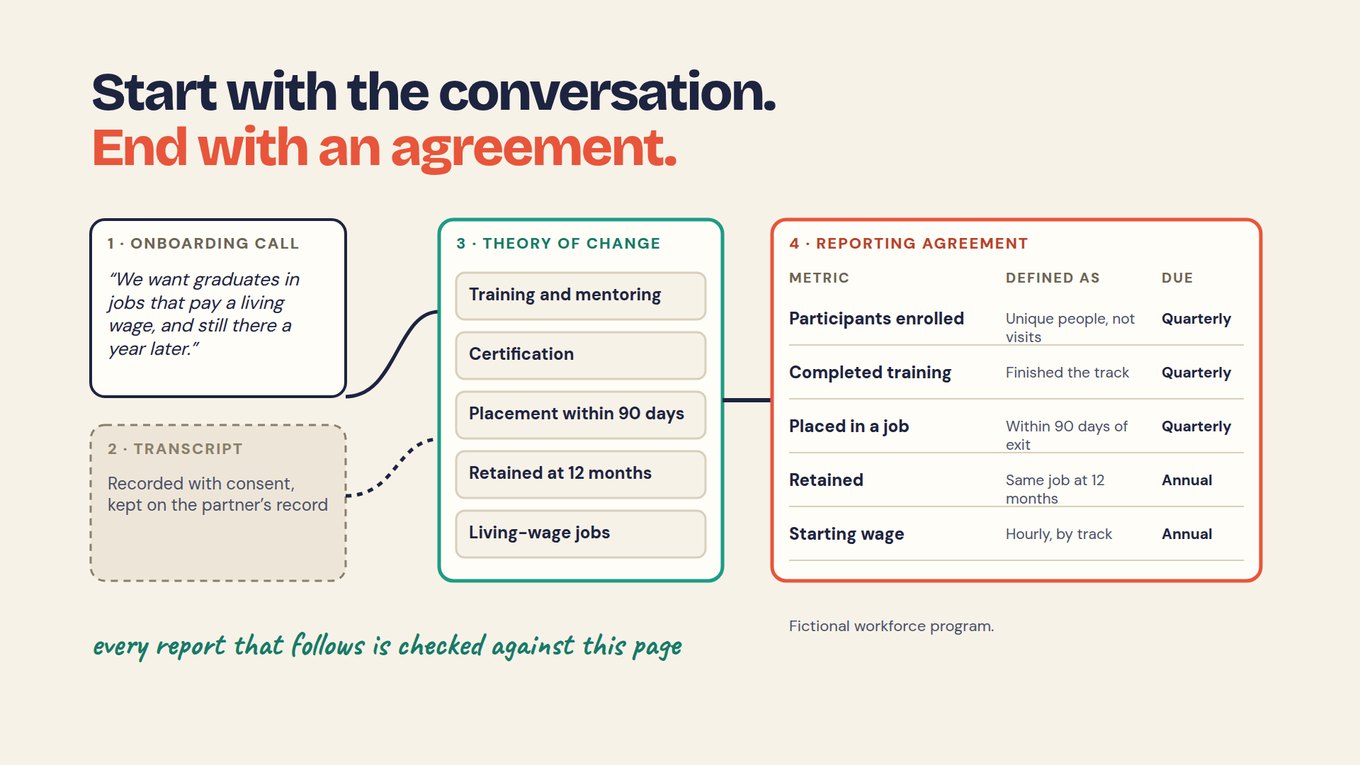
Ask the question that could change a number: when someone says “placed”, ask how they would count one person. AHA Ventures, the investment arm of the American Heart Association, works this way: its head of impact drafts each portfolio company’s logic model and data dictionary during the onboarding call, with Sopact Sense. The chapter Turn the onboarding call into a reporting agreement covers the call, the transcript and sign-off.
Expected changes must be outcomes, not outputs. The video below sets out rules for telling them apart; watch for the test of whether a metric describes something your team did or something that changed for a person, because only the second belongs in an assessment of impact.
PROMPT · PASTE INTO CLAUDE, CHATGPT OR YOUR AI TOOL
You are helping us assess the expected impact of a proposed program before we decide to fund or run it.

Inputs:
1. The proposal or call transcript: [PASTE]
2. Any baseline information we hold about the people or place affected: [PASTE, OR WRITE "NONE"]

Tasks:
1. List the changes the proposal expects, in its own words, and sort them into outputs and outcomes.
2. For each outcome, draft a metric with a plain definition, a time window and a due date.
3. List who could be affected, including anyone who might bear costs or harm.
4. Write the assumption behind each step, and what could happen without the program.
5. List the questions we must settle before sign-off.

Rules: use only what the inputs say. Do not invent numbers, targets or baselines. Where something is missing, write "not in our data".
How do you assess results after the program has run?
Set each reported result beside the agreed expectation and give it one status: matches, different, missing or not split. Each gap becomes one question, sent while the partner still remembers how the number was made.
Partner C’s first report to the fund shows all four statuses. Enrollment matched: 80 unique people. Placement was counted within six months, not 90 days. Retention at 12 months was absent. Starting wage arrived as one average instead of split by track.
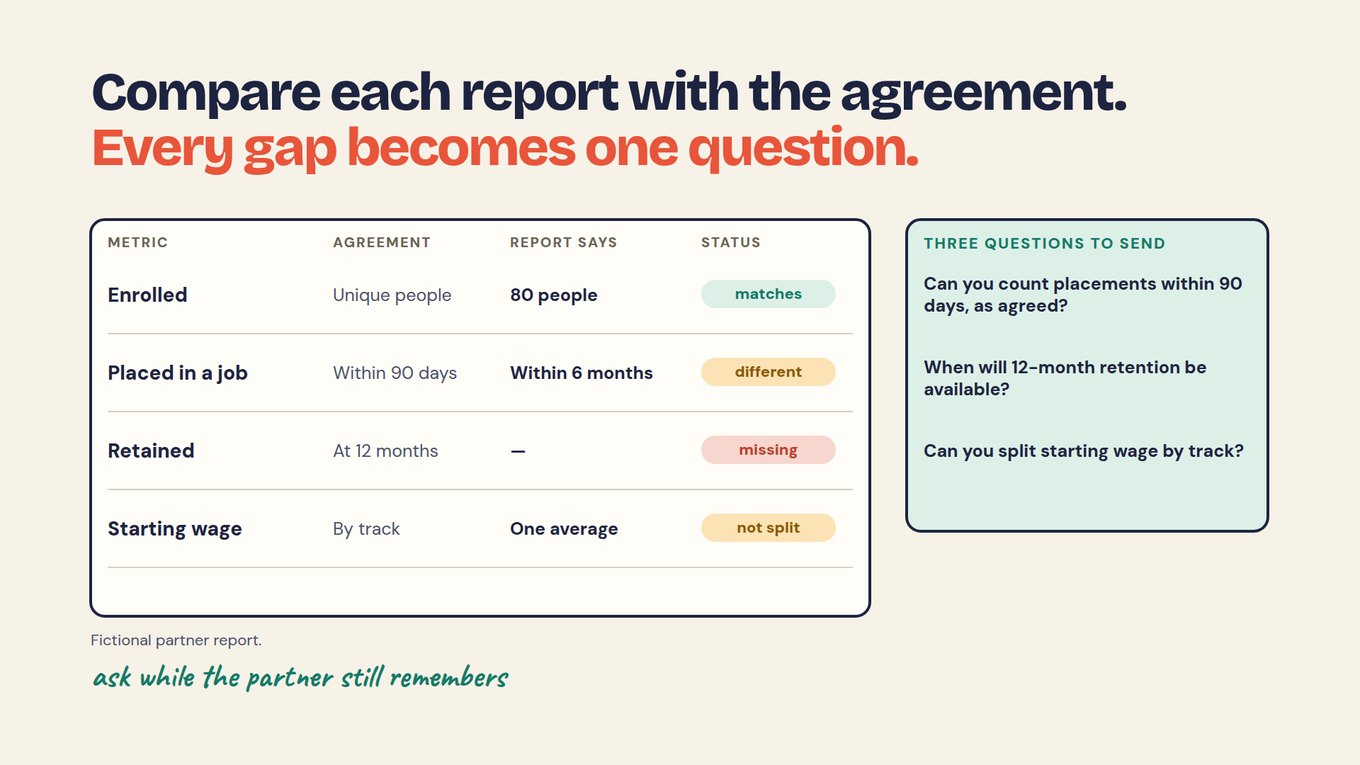
The fund asked: “Can you count placements within 90 days, as agreed?” “When will 12-month retention be available?” “Can you split starting wage by track?” Meanwhile it added only the results that share a definition: Partners A, B and D placed 42, 31 and 27 people within 90 days, 100 in all, with C’s 55 held until it confirms the 90-day count.
A “different” status is not an accusation; C’s six-month figure may be exactly what another funder asked for. The chapter Check each partner report against the agreement covers the follow-up. In Sopact Sense, the AI Assistant can answer the comparison from the records you allow it to use, and each line links to the record behind it.
Can an impact assessment prove that a program caused the change?
No, not on its own: an assessment shows whether expected changes happened, and a claim that the program caused them needs a comparison with what would have happened otherwise. Treat attribution as a separate question with its own design.
A placement rate that meets the agreement could reflect a strong local job market, or trainees who were already close to work. Comparing with earlier cohorts or with local figures on the same definition gives context, not proof; only a planned comparison group or a similar design can support a claim about cause. The guide on attribution vs contribution explains the difference between the two claims.
Outputs are not outcomes, self-reported jobs and wages can be wrong, and people who stop answering follow-ups may differ from those who stay. AI can draft the expected changes and flag gaps, but people make the judgment, after checking each line against the record.
What should an impact assessment report contain?
The decision and alternatives, who is affected, the expected changes with their definitions, the results beside them, every gap with its question, and the limits of the conclusion. Keep forecasts, observed results and assumptions in separate places so a reader cannot mistake one for another.
Report harms and misses next to gains, and name the groups the evidence did not reach. Tailor the wording to each reader without changing the numbers underneath, and date the agreement each result was judged against, so a later reader knows which rule applied.
Start with one decision and one agreement
Take one upcoming grant, investment or program change and run both moments of the assessment on it once.
- Write the decision and at least two alternatives, including doing nothing.
- List who could be affected, and how you will see results for each group.
- From the planning conversation, write three to five expected changes as metrics, each with a definition, a window and a due date.
- Get sign-off from someone on each side, and date it.
- When the first results arrive, give each one a status: matches, different, missing or not split.
- Send one question per gap, and record the answer before you add anything up.
After the first cycle you hold a signed yardstick, one checked set of results and a short list of answered questions, which is the evidence the next decision needs.
Frequently asked questions
Is impact assessment done before or after a project?
Both. The assessment before a decision sets out expected changes, who they affect and the risks, and compares alternatives. The assessment after each period tests reported results against those expectations and checks what happened to the planned responses. Writing the expectations down, with definitions, is what makes the second assessment possible; without them there is nothing fair to compare results against.
What are the main types of impact assessment?
Social, environmental, organizational and sustainability assessments are the most common, with economic, health, human-rights and technology assessments needing specialist methods. The types overlap, and one project can involve several. Choose the scope around the decision you face, and check each affected group separately, because a good average can hide a serious harm to one group.
How is impact assessment different from impact evaluation?
Assessment asks what consequences are likely and whether results match expectations, to inform a decision. Evaluation judges results against set questions and may use a design, such as a comparison group, to estimate what the program caused. The methods overlap; what matters is stating the question and how strong a conclusion the design supports.
Can AI conduct an impact assessment?
AI can help with parts of it: drafting expected changes from a call transcript, matching a report to an agreement, and grouping open answers into themes. It cannot judge significance, weigh alternatives or take responsibility for the decision. Tell it to use only your documents, to write “not in our data” for anything missing, and check its output against the records.
When should an impact assessment be updated?
When new evidence arrives, when the proposal or agreement changes, or at a monitoring point you agreed in advance. Record which agreement and which period each finding was judged against. If a definition changes, keep a dated note of what changed and who approved it, so earlier results can still be read by the rule that applied then.
